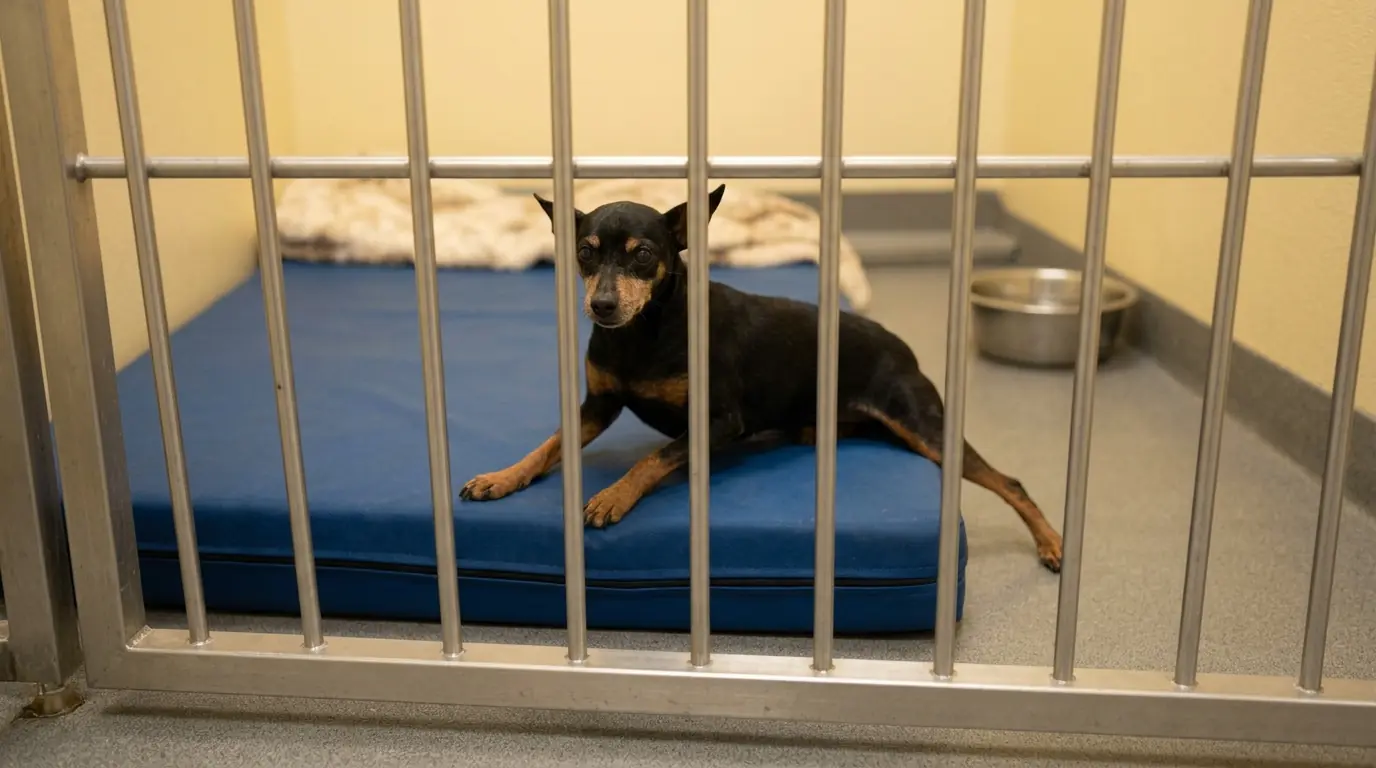
Getting onto the bed is not Minnie's problem.
The nine-year-old Miniature Pinscher can walk across her recovery kennel slowly, position herself beside the low mattress, and lower her small body onto it.
She knows exactly how to rest.
The problem begins later.
Minnie wakes.
She sees something beyond the kennel door.
Her head comes up.
Her front paws plant firmly into the mattress.
Then she tries to stand.
Her shoulders rise.
Her chest comes off the bed.
But behind her, almost nothing follows.
Minnie's thin back legs scramble for traction.
One slides sideways.
The other folds beneath her.
She pulls harder with her front legs until half her body reaches the edge of the mattress.
Then her hindquarters slip completely off.
Minnie stops.
Her front half remains on the bed.
Her back half rests on the floor.
And after several unsuccessful attempts, she simply lies there looking toward the door.
She still has feeling in those legs.
She can still move them.
But after an old spinal injury and significant muscle loss, knowing she wants to stand and making her entire body accomplish it have become two very different things.
Minnie's Injury Is Not New
Minnie did not arrive with a fresh spinal injury.
Her condition appears to be the result of an older problem.
Exactly what happened in the past is unclear.
What matters now is what the injury left behind.
Her hind legs are noticeably thinner than they should be.
The muscles have wasted.
Her coordination is poor.
And although she retains sensation, her rear limbs do not consistently cooperate with the rest of her body.
That distinction matters.
Minnie is not simply a dog who “can't feel her legs.”
Her situation is more complicated.
Sensation Does Not Guarantee Normal Movement
The nervous system has several jobs.
A dog may retain some sensation in a limb while still having significant problems with strength, coordination, positioning, or motor control.
Minnie can respond to her hind legs.
She sometimes moves them intentionally.
But when several movements have to happen in the correct sequence—especially when she is trying to rise—the system begins to break down.
Her front half gets ahead.
Her back half cannot keep up.
Lying Down Requires Less From Her
Minnie has learned a workable way to lower herself.
She approaches the bed.
Her front legs bend.
Her body comes down.
The hindquarters follow, sometimes somewhat awkwardly, but gravity helps.
Soon she is resting.
Getting back up reverses the challenge.
Now gravity is working against her.
Her hindquarters need to lift.
Her back legs need to move underneath her.
Her paws need to find stable positions.
Her muscles need to generate enough force.
And her nervous system has to coordinate all of it quickly enough to keep her balanced.
That is where Minnie struggles.
Her Front Legs Have Become Her Engine
When Minnie wants to stand, she relies heavily on the strongest part of her body.
Her front end.
Both paws spread against the mattress.
Her shoulders tense.
Her elbows straighten.
She pulls.
Sometimes she can lift nearly her entire chest.
But instead of the hindquarters rising with her, they begin sliding backward.
The harder Minnie pulls forward, the farther her rear legs can drift behind her.
Eventually, she has stretched herself into a position from which standing becomes even more difficult.
The Bed Edge Makes the Problem More Visible
Minnie's mattress is deliberately low.
A tall bed would create an obvious obstacle.
But even a small height difference matters when her rear limbs are poorly controlled.
Her front paws remain on the mattress.
Her hindquarters reach the edge.