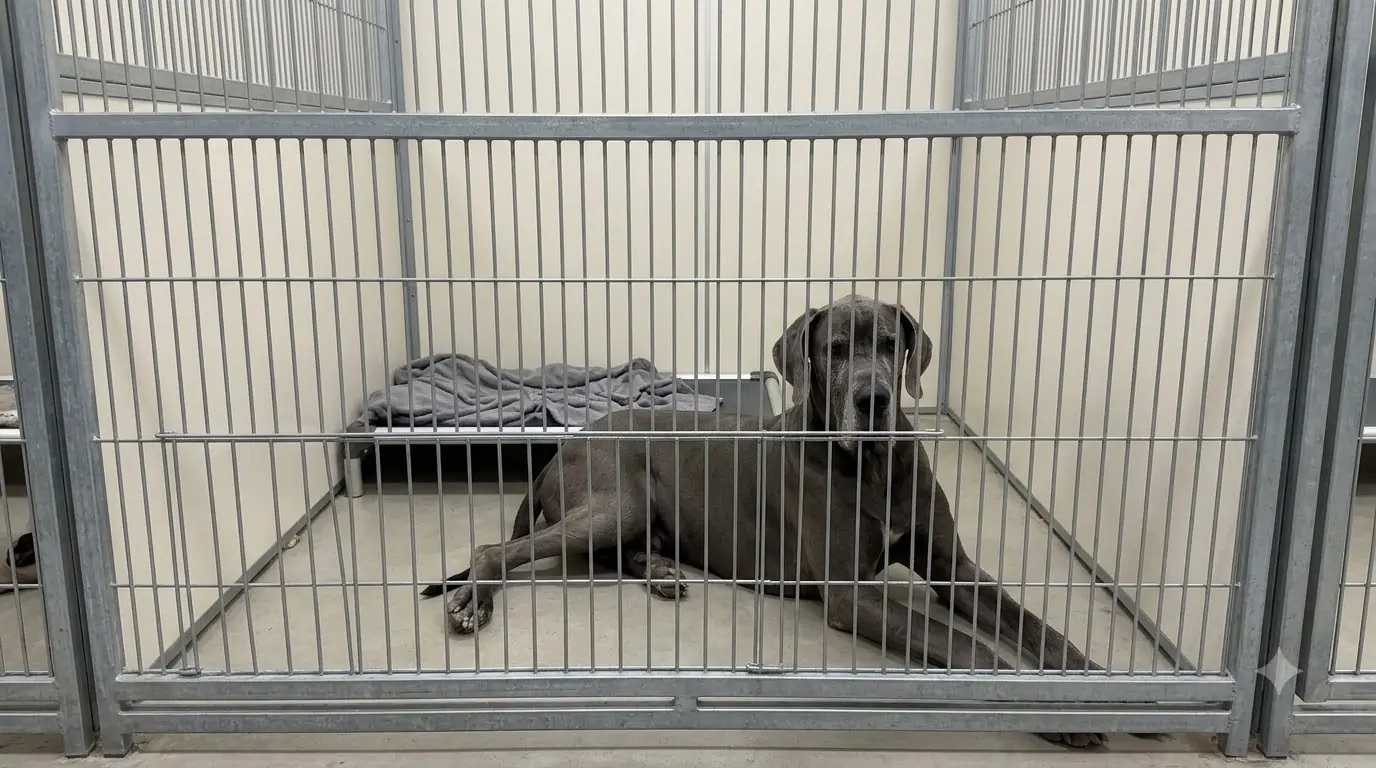
Moose is 9 years old, a senior Great Dane with severe arthritis living in an overcrowded shelter.
Because space is limited, Moose is being housed in a standard-size kennel.
For an enormous dog whose joints have become stiff and painful, simply turning his body around inside that space is difficult.
That creates a heartbreaking scene whenever someone stops outside his kennel.
Moose cannot quickly spin around and walk to the gate.
First, he has to slowly back away from his cot.
Then he carefully turns his entire body inside the narrow kennel.
Only after that can he begin walking toward the bars.
Too often, by the time Moose gets there, the person who stopped to see him is already gone.
Moose Has to Back Up Before He Can Even Turn Around
For a smaller or younger dog, responding to a visitor might take seconds.
Moose's body does not work that way anymore.
He is a Great Dane—a naturally giant dog—and severe arthritis has made his movements stiff and slow.
When Moose is positioned near his cot and someone appears behind him at the kennel door, he cannot simply pivot.
There is not enough room for an easy turn.
Moose begins by backing up.
One step.
Then another.
He carefully creates enough space between his enormous body, the cot, and the kennel walls.
Only then can he start rotating himself toward the front.
His whole body has to follow.
By the time Moose finally faces the gate, several precious seconds have already passed.
For many visitors, that is too long.
People Leave Before Moose Gets There
Shelter visitors often make decisions quickly.
Someone stops at Moose's kennel.
They look inside.
Moose may still be facing away from them.
He does not immediately rush toward the gate.
They wait briefly.
Then they move on.
But Moose has already started trying.
His stiff legs are moving backward.
His body is slowly turning.
He finally gets himself facing the correct direction.
Then Moose begins making his way toward the bars.
When he arrives, the hallway may already be empty.
There is no responsible way to say Moose feels rejected or understands that someone has walked away.
What can be observed is enough.
The visitor came.
Moose tried to reach them.
His body needed more time than they gave him.
His Size Makes Every Movement More Complicated
Moose's size is impossible to ignore.
Great Danes are giant dogs, and Moose is trying to maneuver that large frame inside a kennel designed for ordinary shelter use during a period of overcrowding.
His severe arthritis makes the problem harder.
He cannot bend, pivot, or reposition himself with the ease of a healthy younger dog.
So turning around becomes a sequence rather than a single movement.
Back away from the cot.
Find enough space.
Shift his front end.
Bring the hindquarters around.
Straighten himself.
Then start toward the door.
None of those movements looks dramatic by itself.
Together, they can consume the entire amount of time a visitor spends looking into his kennel.
By the time Moose is finally ready to greet them, they may be looking at another dog.
Families See a Very Large Senior Dog With Significant Needs
Moose's size and stiff gait have also made potential families hesitant about whether they could realistically care for him.
That concern should not simply be dismissed.
A giant senior dog with severe arthritis can require practical accommodations.
Helping Moose into a vehicle, assisting him on slippery flooring, managing stairs, repositioning him if his mobility declines, and transporting him for veterinary appointments can all be more physically demanding than caring for a smaller dog.
His arthritis may also require ongoing veterinary management.
No information was provided about Moose's medications, diagnostic imaging, pain-management plan, weight, or prognosis.
It is also unknown whether he currently uses mobility aids.
Those details should be obtained directly from the shelter.
But Moose's size should not be confused with unwillingness to interact.
When visitors leave before he turns around, they may never see that he was trying to reach them.
Severe Arthritis Has Changed the Way Moose Moves
Moose has severe arthritis.
No additional orthopedic diagnosis was provided, so the location and full extent of his joint disease should not be assumed.
What can be seen is the effect on his mobility.
His gait is stiff.
Turning takes time.
Navigating a confined space requires deliberate movement.
Potential adopters, fosters, or rescues should ask how independently Moose can stand, walk, lie down, and rise again.
They should also ask how he handles stairs, slick surfaces, getting into vehicles, and longer walks.
Information about pain medication, anti-inflammatory treatment, weight management, supportive bedding, and any rehabilitation recommendations would also be important.
Moose is still mobile enough to make his way toward visitors.
He simply cannot do it quickly.
His History Before the Shelter Is Unknown
No information was provided explaining how Moose entered the shelter.
It is unknown whether he arrived as a stray, was surrendered by an owner, transferred from another facility, or entered under other circumstances.
His history before intake is unknown.
There is also no information about how long Moose has been living with severe arthritis.
Nothing provided establishes neglect, abuse, abandonment, or another specific cause.
Those details should not be invented.
The challenge Moose faces today is visible without adding anything to his past.
He is a giant senior dog trying to maneuver an arthritic body inside a standard kennel while potential families make decisions from the hallway.
The Empty Hallway Is What Moose Often Finds
The saddest part comes at the end of the process.
Moose finally completes his turn.
His large body is now facing the kennel gate.
He begins walking forward with that stiff senior gait.
A few more slow steps bring him to the bars.
But the person who caused Moose to get up and turn around is no longer there.
The hallway in front of him is empty.
Moose has completed the entire difficult maneuver for a visitor who never saw him finish it.
Later, another person may stop.
If Moose has turned away again or returned toward his cot, the process begins from the beginning.
He needs to back up.
He needs room to turn.
He needs time.
Moose Needs More Than a Few Seconds at the Kennel Door
For anyone meeting Moose, patience matters.
The fact that he does not immediately appear at the gate should not automatically be interpreted as disinterest.
His body has physical limitations that affect the speed of his response.
Waiting a little longer may completely change what someone sees.
Shelter staff can also explain Moose's mobility and help potential adopters understand what caring for a giant arthritic dog would realistically involve.
No information was provided about Moose's behavior around dogs, cats, children, or other household situations.
Those details must be confirmed separately.
His size, age, and arthritis cannot answer behavioral questions.
Moose's Exact Risk Status Has Not Been Provided
The shelter is overcrowded, and Moose has been difficult to place because potential families are concerned about his enormous size and mobility needs.
However, no explicit euthanasia-list status or deadline was provided.
It would therefore be inaccurate to claim Moose has only hours or days remaining.
No shelter name, location, or Animal ID was supplied either.
Anyone interested in Moose should contact the shelter directly to confirm his current status, placement options, and whether any deadline applies.
Overcrowding makes timely confirmation especially important, but urgency should not be created by inventing a deadline that was never provided.
Moose Is Still Trying to Make It to the Gate
The scene is easy to misunderstand from the hallway.
Someone stops.
Moose is beside his cot with his enormous body facing the wrong direction.
He does not immediately turn around.
The visitor waits.
Then they walk away.
Inside the kennel, Moose begins backing up.
His stiff legs take one careful step after another.
Once there is finally enough space, he starts turning.
His shoulders move first.
Then the rest of his enormous body slowly follows.
Moose straightens himself and begins walking toward the kennel gate.
Eventually, he reaches the bars.
But there is nobody standing there anymore.
The person may have thought Moose never bothered to come.
They simply did not see how much work it took him to turn around.
DOG INFORMATION
Name: Moose
Breed: Great Dane
Age: 9 years old
Current condition: Severe arthritis with a stiff, slow gait and difficulty maneuvering in confined spaces
Shelter situation: Overcrowded shelter; currently housed in a standard-size kennel
Placement challenge: Potential families have expressed concern about managing his giant size and mobility needs
Deadline: No euthanasia deadline provided
Current status: Senior shelter dog facing placement challenges; exact availability and risk status should be confirmed directly with the shelter
HOW TO HELP
Anyone interested in Moose should contact the shelter directly to confirm his current availability, medical condition, placement options, and whether any deadline applies.
Potential adopters, fosters, or rescues should request Moose's veterinary records and ask about his arthritis treatment, pain management, mobility, ability to navigate stairs and vehicles, and whether he needs physical assistance or mobility equipment.
Anyone meeting Moose should also give him time. If he does not immediately turn around when you stop at his kennel, he may already be trying.
Sharing Moose's case may help people see what a quick walk past his kennel can miss: the giant old dog facing away is slowly backing up, carefully turning his arthritic body around, and trying to reach the gate before the hallway becomes empty again.
Please contact the shelter directly for the most current information about Moose's availability, medical needs, placement requirements, and risk status.