Annie is three years old, small enough to disappear almost completely behind Moose when something scares her.
And that is exactly what she does.
Moose is an 8-year-old Labrador mix with a much larger frame, a steadier presence, and a way of standing between Annie and whatever has just made her unsure.
A kennel door closes too loudly.
A cart rattles down the hallway.
Another dog barks unexpectedly.
An unfamiliar voice appears outside their space.
Annie moves behind Moose.
Sometimes only her face disappears.
Sometimes nearly all of her does.
Moose does not seem bothered by it.
He stands.
Annie waits.
Then the sound passes.
That simple pattern became one of the first things shelter staff noticed after the pair came into care.
They had been found together near an abandoned rural property.
What happened before that is not fully known, and staff do not try to fill the gaps with assumptions.
There is no need.
The most important part of Annie and Moose's story is happening in front of them now.
Moose is the dog Annie uses to understand whether the world is safe enough to step into.
And one night, for the first time since arriving, he was gone.
They Were Found Together
Annie and Moose were discovered near an abandoned rural property.
Beyond that, much of their earlier history remains unclear.
Nobody knows with certainty how long they had been together.
Nobody knows whether they had belonged to the same household.
Nobody knows whether they were related in any way.
What staff do know is that they arrived functioning like two dogs who were already deeply familiar with one another.
Annie did not treat Moose like a stranger.
She oriented herself around him almost immediately.
He moved.
She followed.
He stood at the front of the kennel.
She stayed behind.
He relaxed.
She relaxed more quickly too.
That kind of behavior became especially important because Annie was noticeably frightened by the unfamiliar environment.
The Shelter Was Harder for Annie
Moose adjusted faster.
He was cautious at first, like many dogs entering a new shelter, but over time he began approaching the kennel gate.
He became more willing to greet people.
He watched staff.
He accepted treats.
He began understanding the daily routine.
Annie did not progress at the same speed.
Weeks passed.
She still rarely came forward first.
When someone unfamiliar approached, she often retreated behind Moose.
If there was a sudden sound, she moved closer to him.
If Moose stepped toward the gate, Annie might remain a few feet back and watch what happened.
That difference between them mattered.
Moose was becoming more confident.
Annie was still using his confidence as information.
Moose Became Her Hiding Place
There is a physical simplicity to the way Annie responds to him.
When she is uncertain, she does not merely stand somewhere near Moose.
She gets behind him.
His body becomes a barrier between her and the unfamiliar thing.
It can happen in seconds.
A sound.
A person.
A change in the hallway.
Annie disappears behind his shoulder.
Moose stays where he is.
Staff have never needed to teach him to stand still for her.
He simply does.
The behavior is one of the clearest examples of how their personalities differ.
Moose is not fearless.
He is simply more comfortable moving toward people and new activity.
Annie needs more time.
Moose gives her that time without forcing her forward.
Progress for Annie Comes in Small Steps
Annie's confidence has improved, but not dramatically.
That is normal.
Some dogs adjust quickly.
Others require much more repetition.
For Annie, progress often means one extra step.
Standing slightly farther from Moose.
Taking a treat while someone is nearby.
Watching instead of immediately retreating.
Moving toward the gate after Moose has already greeted someone.
Those are small wins.
The shelter does not expect Moose to solve everything for her.
Staff continue working to build Annie's independent confidence.
But his presence clearly helps.
She looks at him.
She watches what he does.
Then she decides whether to move.
Moose Has His Own Personality Too
It would be easy to talk about Moose only as Annie's source of comfort.
That would be unfair.
He is an individual dog.
At eight years old, he has his own preferences, habits, and needs.
He enjoys greeting people more than Annie does.
He is more willing to stand at the gate.
He may investigate activity Annie would rather avoid.
He does not spend every moment checking on her.
That is part of what makes their relationship believable.
He is not constantly managing Annie.
He simply remains available.
And Annie uses that availability.
Their Kennel Developed a Familiar Rhythm
Over time, daily shelter life became more predictable.
Morning.
Food arrives.
Moose notices first.
Annie watches him.
Cleaning begins.
The pair moves around the kennel.
Staff return blankets.
Toys are placed back.
Later, people walk past.
Moose approaches the gate.
Annie stays farther back.
Eventually, she may come forward too.
At night, both dogs settle.
Sometimes close.
Sometimes with a little space between them.
The important part is that Moose is there.
For Annie, that seems to make the kennel easier to understand.
Then Moose Got Sick
One day, Moose became unwell and needed closer medical observation.
For the first time since entering the shelter, he had to be moved away from Annie overnight.
The decision was necessary for his care.
It was not meant as a behavioral test.
But it created one anyway.
Moose left.
Annie remained.
The kennel suddenly felt much larger.
Annie Had the Kennel to Herself
At first glance, she had more space.
Both resting areas were available.
Both blankets were there.
The kennel gate was unobstructed.
She could sleep anywhere.
Instead, Annie began moving things.
She took one blanket.
Then the other.
She gathered both into the same corner.
Then she went for one more thing.
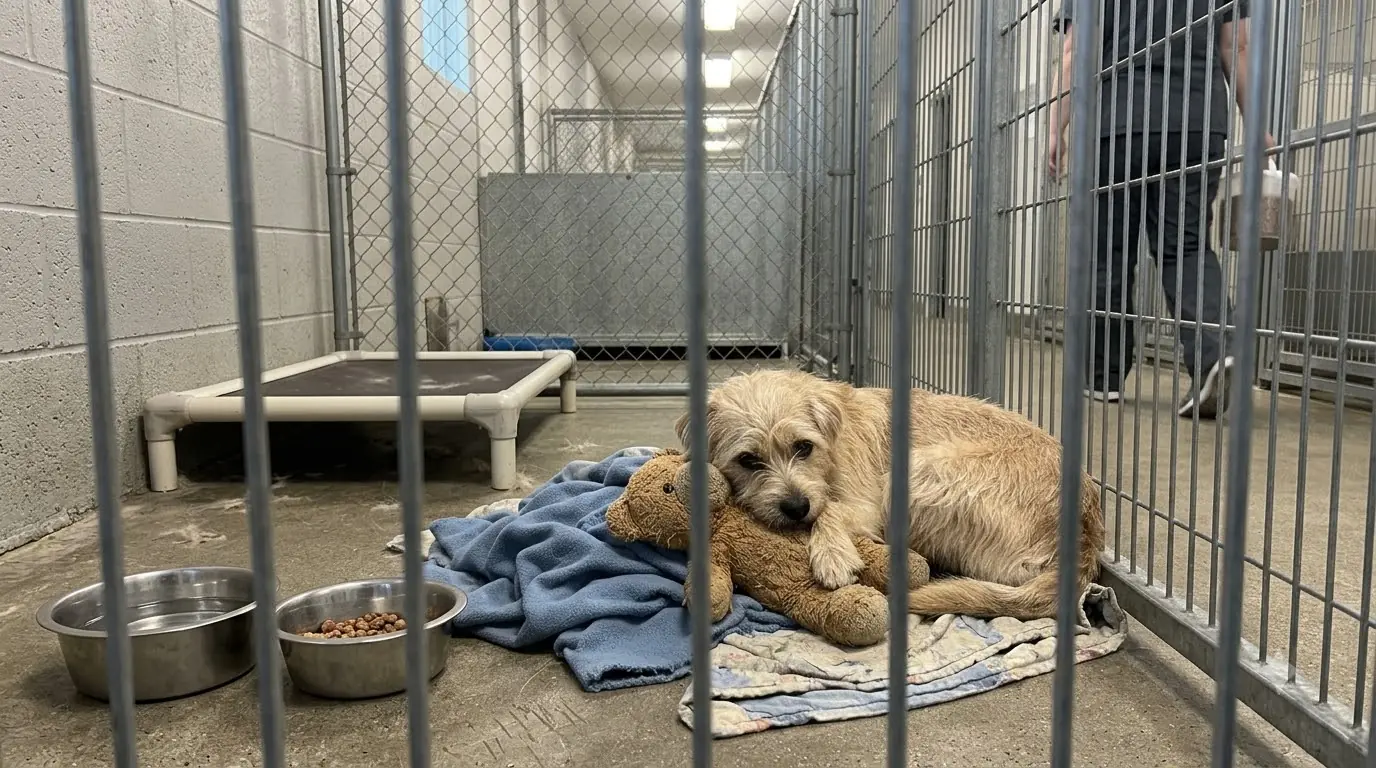
Moose's worn stuffed bear.
The toy had been part of their shared space for some time.
It carried familiar scent.
Annie dragged it onto the blanket pile.
Then she curled around it.
She Slept With Her Chin on the Bear
Annie did not simply place the stuffed bear nearby.
She positioned herself around it.
Then she rested her chin on top.
The kennel was quiet.
Moose was still in the medical area.
Annie stayed in the corner she had created.
Again, staff avoid pretending to know exactly what a dog is thinking.
Nobody can say Annie understood the toy as a symbolic replacement for Moose.
What they can say is exactly what happened.
Moose left.
Annie gathered both blankets.
She moved his stuffed bear onto them.
She curled around the toy.
She slept with her chin resting on it.
That behavior was enough.
Morning Did Not Change Anything
The next morning, Moose had not yet returned.
Staff came in.
The shelter woke.
Breakfast arrived.
Annie was still in the same corner.
The blankets were still piled together.
The stuffed bear was still with her.
One of Annie's paws remained wrapped around it.
Food was available.
She did not immediately move toward it.
She kept the toy close.
That image became one of the clearest examples staff had seen of how much Annie's routine had come to include Moose.
She Was Not Panicking
This distinction matters.
Annie was not in a dangerous state.
She was not described as medically unstable.
She was not violently trying to escape.
She was not harming herself.
Her response was quiet withdrawal.
She made herself small.
She surrounded herself with familiar scent.
She stayed in one place.
That kind of behavior can be emotionally powerful precisely because it is restrained.
There is no need to exaggerate it.
What Moose's Absence Changed
When Moose is in the kennel, Annie often uses him as her first point of reference.
Without him, she had to navigate the space differently.
She did not have his body to hide behind.
She did not have his reactions to watch.
She did not have his scent moving around the kennel.
So she created something familiar out of what remained.
The blankets.
The stuffed bear.
The corner.
That became her temporary version of security.
Why This Matters for Adoption Planning
Annie's behavior does not automatically mean she could never live apart from Moose.
Shelters have to be careful about conclusions like that.
But it does mean separation should be considered seriously.
There is already a repeated pattern.
Annie hides behind Moose.
She uses his behavior to judge unfamiliar situations.
She comes forward more easily when he does.
When he was removed overnight, she gathered familiar objects and stayed with them.
Those facts matter.
They suggest that placing the dogs together could make Annie's transition into a new home significantly easier.
Finding a Home for Moose Might Be Easier
Moose is older, but he is also more confident with people.
That makes him easier to meet.
A visitor can approach the kennel and see him clearly.
He may come forward.
He may engage.
He may make a quick positive impression.
Annie does not always do that.
She often remains behind him.
That means a person could easily connect with Moose before understanding Annie at all.
And that creates the central adoption problem.
Someone may want Moose.
But can they take Annie too?
Annie Alone Would Require More Patience
If someone met Annie by herself, they might initially see only a frightened Terrier mix who does not approach.
That would be incomplete.
Annie is capable of progress.
She is simply slower.
Moose changes what people get to see.
With him present, Annie may watch from behind him and then take a step forward.
That first step is important.
Without Moose, she may need much more time before reaching the same point.
A home prepared to adopt both dogs would need to understand that.
Two Dogs Mean Two Sets of Responsibilities
The emotional reason for keeping them together is clear.
The practical side is harder.
Two dogs require more money.
More food.
More veterinary care.
More space.
More time.
More management.
Housing restrictions matter.
Resident pets matter.
Lifestyle matters.
Someone may have enough capacity for Moose but not Annie.
Or enough capacity for Annie but not two dogs.
That is not cruelty.
It is a real limitation.
The Right Home Needs to Understand Fear Without Reinforcing It
Annie's caution should be respected.
It should not be treated as permanent helplessness.
A future adopter needs to give her time.
Avoid forcing greetings.
Use predictable routines.
Allow Moose to provide familiarity.
But also help Annie build her own confidence.
That means rewarding independent exploration.
Giving her safe choices.
Letting her interact with people without always hiding behind Moose.
The goal should not be to make her dependent forever.
It should be to let Moose help her transition while she learns that the new home itself is safe.
Moose Needs Individual Attention Too
Moose should not be treated like a full-time emotional support system.
He is eight.
He has his own age-related needs.
He deserves individual walks.
His own veterinary care.
His own relationship with adopters.
His own quiet time.
A successful home would make space for both dogs as individuals.
Moose can still be Annie's familiar reference point.
But he should not become responsible for every moment of her confidence.
Shelter Staff Keep Working With Annie Separately
While Moose is present, staff continue encouraging Annie to engage on her own.
They may sit quietly.
Offer treats.
Avoid direct pressure.
Let her choose distance.
The goal is gradual progress.
Some days Annie advances quickly.
Other days she does not.
That is okay.
Confidence is not linear.
The important thing is that her relationship with Moose becomes a bridge rather than a permanent hiding place.
Moose's Medical Stay Revealed Something Valuable
Before that overnight separation, staff already knew Annie used Moose for confidence.
What they had not seen as clearly was how she behaved when he was gone for an extended period.
The blankets answered that.
So did the stuffed bear.
Annie's behavior became more withdrawn.
She chose familiar scent.
She stayed in one location.
She did not approach the gate.
That information now matters when evaluating future placements.
The Stuffed Bear Became Part of Their Story
The toy itself is ordinary.
Worn fabric.
Familiar smell.
Nothing special to anyone else.
For Annie, it became the object she chose when Moose was absent.
That is why staff remember it.
Not because it proves some complex human emotion.
Because it was the thing she kept closest when the dog she usually hid behind was gone.
Their Meet-and-Greets Need to Be Quiet
Annie and Moose are unlikely to show their best selves in a rushed introduction.
Moose may be fine.
Annie may not.
A potential adopter needs to sit.
Wait.
Let Moose approach.
Let Annie watch.
That process can take time.
The best person for them will not interpret Annie's hesitation as rejection.
They will understand that she is collecting information.
Moose is usually part of that process.
Someone May Initially Come for Moose
This is likely one of the hardest scenarios.
A person sees Moose.
Likes him.
Connects with him.
Then learns that Annie is strongly attached to him.
Now the decision becomes bigger.
Maybe they have room for one dog.
Maybe their lease allows one.
Maybe they already have another pet.
Maybe two dogs exceed their budget.
The shelter cannot pressure them.
That would not help Annie or Moose.
Instead, staff explain what they have seen.
Then let the person decide honestly.
Someone Else May Be Drawn to Annie
The opposite is possible too.
A patient adopter may immediately understand Annie.
They may have experience with fearful dogs.
But Moose comes with her.
At eight, he has his own needs.
The household still has to work for both.
Again, the overlap matters.
Their Ages Create Different Timelines
Annie is three.
Moose is eight.
That five-year age difference is significant.
Annie may remain active for many years.
Moose may slow sooner.
A home needs to be prepared for that.
Shared walks may eventually become different walks.
Moose may need more rest.
Annie may need more activity.
Keeping them together does not mean keeping their days identical.
It means allowing the relationship to remain while adapting around each dog's changing needs.
Their Ideal Home Does Not Have to Be Perfect
It needs to be predictable.
Patient.
Stable.
Able to accommodate two dogs.
A very chaotic household may be harder for Annie.
A quieter routine may help her.
Moose's confidence can support her, but the environment matters too.
Secure outdoor space, thoughtful introductions, consistent feeding and sleeping areas, and patient human interaction could all help.
Resident Pets Would Need Careful Introductions
Because Annie is fearful, adding too much social pressure could overwhelm her.
If there are existing dogs, compatibility needs to be evaluated carefully.
Moose's behavior with resident animals matters too.
A bonded pair still has individual social preferences.
No assumption should be made simply because they get along with each other.
Their Current Status
Moose remains under appropriate veterinary observation as needed, and the shelter continues monitoring his health.
Annie and Moose are being kept together whenever medically and practically possible.
Their adoption plan continues to focus on finding one home for both.
Annie is still cautious.
Moose is still the more outgoing dog.
He still approaches first.
She still watches.
And when unfamiliar sounds come from the hallway, Annie still often shifts behind him.
Annie Is Making Progress
Weeks of shelter care have not transformed Annie into a completely different dog.
That would be unrealistic.
But there are improvements.
She watches staff more calmly.
She can remain visible longer.
She sometimes steps out sooner after Moose approaches someone.
Small progress is still progress.
A future adopter would need to continue that work.
Moose Is Not Always in Front
There are also moments when Annie surprises staff.
A familiar person appears.
Annie stays where she is instead of hiding.
A treat is offered.
She reaches forward.
Moose may still be nearby, but she does the final step herself.
Those moments matter because they show what the relationship can become.
Moose can help Annie feel safe without being the only way she feels safe.
That Is the Goal
The shelter does not want Annie permanently afraid without Moose.
It wants her to grow.
But it also does not want to remove the relationship that is clearly helping her grow.
Those goals can exist together.
Keep the pair together.
Build independence.
Respect the bond.
Support individuality.
That is what a thoughtful adoption could do.
The Right Adopter Will Notice More Than the Fear
They will notice Moose standing calmly at the gate.
They will notice Annie behind him.
They will wait.
Then maybe Annie's nose appears.
Then one eye.
Then one step.
That is the moment that matters.
Not because Moose did everything for her.
Because his presence gave Annie enough confidence to try.
One Night Made the Challenge Clear
Before Moose got sick, the shelter already knew these dogs were close.
After one night apart, the picture became more specific.
Annie did not simply sleep alone.
She rebuilt their shared space into one corner.
Two blankets.
One worn bear.
Her body curled around it.
Her chin resting on top.
Morning came.
Moose had not returned.
Annie was still there.
Breakfast arrived.
One paw remained wrapped around the toy.
That was the detail staff could not ignore.
When Moose Returned, Routine Could Begin Again
Once medically appropriate, Moose's return allowed Annie to settle back into the pattern she already knew.
He was present again.
His smell moved through the kennel.
His body occupied space.
His reactions became available for Annie to read.
The bear returned to being a toy rather than the closest thing she had to him.
And shelter life became easier to interpret again.
The Home They Need
Annie and Moose need a home prepared for two different dogs.
Moose is older and more socially confident.
Annie is younger and more fearful.
He may adapt first.
She may require weeks or months.
The adopter needs enough patience for that.
Enough money for two.
Enough space for two.
Enough flexibility for their age difference.
Enough understanding to let Annie hide when she needs to without allowing hiding to become her entire life.
Moose needs age-appropriate care.
Annie needs gradual confidence building.
Both need individual relationships with the people who adopt them.
The Bear Is Still There
The worn stuffed bear still belongs in their kennel.
Most days, it does not carry any special significance.
It lies on a blanket.
Gets moved.
Gets nudged.
Sometimes Moose ignores it.
Sometimes Annie does too.
That normality is important.
Their story is not one dramatic night.
It is every ordinary day around it.
Moose goes to the gate.
Annie stays behind him.
Moose relaxes.
Annie takes one step forward.
They settle.
They sleep.
The shelter gets quiet.
And somewhere outside that kennel, staff continue looking for the home that understands what Annie has already made very clear.
She may eventually learn to stand on her own.
But right now, when the world becomes unfamiliar, Moose is still the place she knows how to find.