The Belle Gunness Farm Murders
The Fire That Exposed One of America’s Darkest Murder Mysteries
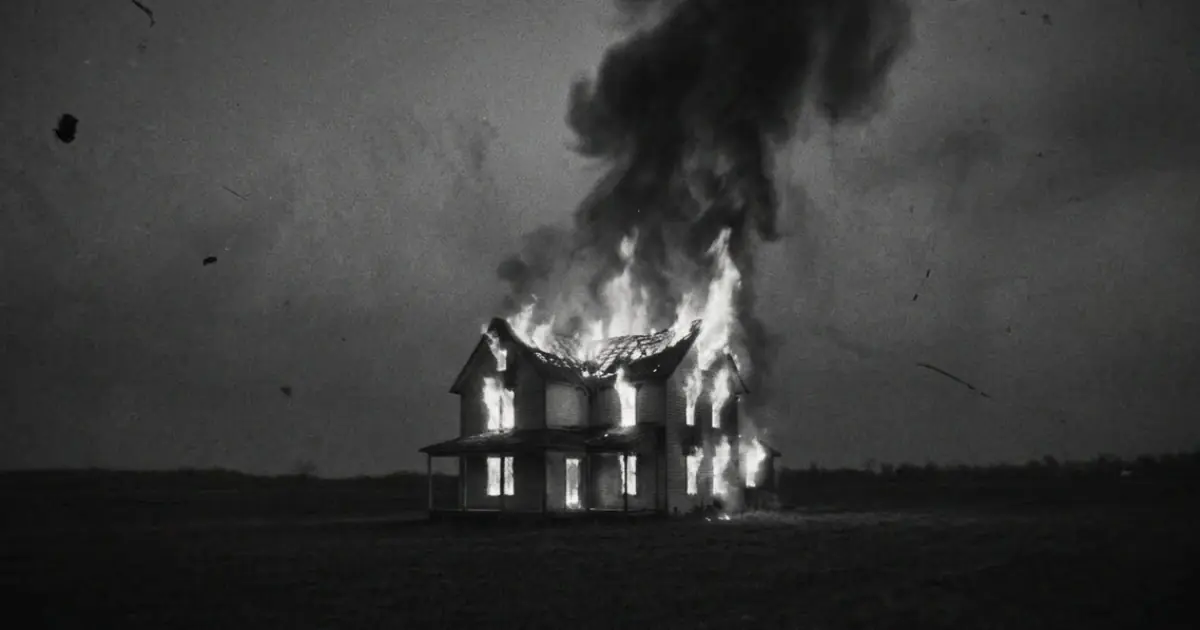
Indiana, 1908.
Just before dawn on April 28, smoke began pushing through the upper floor of a farmhouse outside La Porte.
The hired man, Joseph Maxson, woke to the smell.
At first, according to later accounts, he may have thought someone had started breakfast early.
Then he opened his door.
Fire.
Not a small kitchen blaze.
The house was already being consumed.
Maxson shouted for the woman who owned the farm.
Belle Gunness.
Then for the children.
No answer.
He tried to reach the other side of the house, but the flames were moving too quickly.
Eventually he escaped through an upstairs window and ran for help.
By the time men returned to the property, there was almost nothing to save.
The farmhouse had collapsed into its cellar.
Walls were blackened.
Timbers smoldered.
The interior had become a heap of brick, ash and burned furniture.
And buried beneath the ruins were four bodies.
Three belonged to children.
The fourth appeared to be an adult woman.
At first, everyone assumed the explanation was obvious.
Belle Gunness and her children had died in a terrible house fire.
But there was one problem.
The woman had no head.
And when people who knew Belle looked at the remains, another problem appeared.
The body seemed too small.
Belle Gunness had been a large, physically powerful woman. Contemporary descriptions put her around 5 feet 8 inches tall and, according to some accounts, well over 200 pounds. The adult body recovered from the basement appeared substantially smaller. One physician who examined it reportedly believed it could not be Belle at all. (Wikipedia)
The head was nowhere to be found.
Men searched through the debris.
They sifted ashes.
They dug around the cellar.
Still no head.
Then investigators learned something that made the fire even more suspicious.
The day before the farmhouse burned, Belle Gunness had gone to her attorney.
She had made out her will.
She also told him that she feared a former farmhand named Ray Lamphere might kill her and burn her house.
The very next morning, the house was gone. (La Porte County History)
For law enforcement, the story initially seemed to point in one direction.
Belle Gunness was the victim.
Ray Lamphere was the suspect.
Then a man arrived in La Porte looking for his missing brother.
And everything changed.
Because instead of finding one murderer in the ruins of the farmhouse, investigators were about to discover that the entire farm may have been a graveyard.
Before the Fire
Belle Gunness had not always been Belle Gunness.
She was born in Norway in 1859 and immigrated to the United States in 1881, eventually settling in the Chicago area. Later she moved to Indiana, where she became the owner of a farm outside La Porte. Local historical sources describe her as a Norwegian immigrant who eventually used matrimonial advertisements to attract men from across the Midwest, often encouraging them to sell property, bring cash and keep their plans private. (Wikipedia)
Long before the bodies were discovered, death seemed to follow Belle.
Her first husband, Mads Sørensen, died in Chicago in 1900.
His death was officially attributed to illness or heart-related causes, but even at the time there were suspicions surrounding the circumstances. Belle collected life-insurance proceeds afterward.
No murder charge followed.
Nothing was proved.
But the death later looked much more sinister once the La Porte farm was excavated. (Biography)
Belle later married Peter Gunness.
That marriage also ended in death.
According to the explanation Belle gave, Peter was killed when a heavy household object fell and struck his head.
A coroner's inquiry was held because the circumstances seemed unusual, but again no murder case was brought against her.
Belle collected insurance money.
Once again, death had left her financially better off. (Wikipedia)
None of this proved Belle was a murderer.
At the time, each event could be examined separately.
A husband dies.
An accident occurs.
Insurance pays.
People grieve.
Life continues.
But investigators in 1908 were no longer looking at those events separately.
They were looking backward from a farm filled with human remains.
And suddenly old accidents began to look very different.
A Widow With a Farm
By the middle of the decade, Belle was a widow living on rural property outside La Porte.
She had land.
A farmhouse.
Livestock.
Children.
She also had something that could be very attractive to unmarried men in the early twentieth century.
Property.
Security.
The appearance of prosperity.
Belle began placing advertisements seeking male companionship.
The ads appeared in Norwegian-language and other Midwestern publications.
The basic message was inviting.
A widow with a valuable farm wanted a reliable man as a partner.
A little money would be required.
But the right man could apparently step into an established life.
For lonely bachelors and immigrant farmers scattered across the Midwest, the opportunity could sound extraordinary.
A woman with property.
A possible marriage.
A farm.
A future.
Letters began arriving.
Belle answered them.
Her correspondence could be warm and persuasive.
According to the La Porte County Historical Society, men who responded were sometimes encouraged to liquidate their belongings, bring cash and avoid telling others too much about their plans. (La Porte County History)
That last element would later appear almost perfectly designed for murder.
If a man told few people where he was going, disappeared after arriving, and had converted much of his wealth into portable cash, then tracing him became much harder.
Especially in 1905.
There were no cell phones.
No electronic bank alerts.
No social media.
No national missing-person database accessible instantly to small-town police.
A man could board a train, arrive in Indiana and simply disappear.
Belle only needed an explanation.
He changed his mind.
He returned home.
He went west.
He left with horse traders.
He moved on.
And because many of these men lived far from La Porte, relatives might spend weeks or months wondering whether something had happened before anyone connected one disappearance to another.
The Men Who Came to the Farm
One suitor came from Wisconsin.
Another from Minnesota.
Another from South Dakota.
Others arrived from different parts of the Midwest.
Some withdrew substantial sums of money before traveling.
Then they disappeared.
Henry Gurholt, for example, reportedly visited Belle's farm after responding to one of her advertisements. After he vanished, Belle told his family that he had left with horse traders.
But some of his belongings remained behind.
John Moe of Minnesota also traveled to La Porte after corresponding with Belle. According to later accounts, he withdrew significant cash. He disappeared as well. His property was later linked to the Gunness circle. (Wikipedia)
There were other names.
Ole Budsberg.
Olaf Lindbloom.
Olaf Svenherud.
Men whose stories became attached to the Gunness investigation after the farm was opened up.
The problem is that the exact number of Belle Gunness's victims has never been established with certainty.
Some contemporary and later sources suggested more than a dozen.
Others speculated that she may have killed twenty, thirty or even forty people.
Those higher numbers remain estimates rather than firmly documented victim counts.
What investigators physically found on the farm was horrific enough without exaggeration.
Multiple sets of human remains.
Several dismembered.
Many badly decomposed.
Some never conclusively identified. (Wikipedia)
And one disappearance would finally expose the pattern.
Andrew Helgelien.
Andrew Helgelien
Andrew Helgelien lived in South Dakota.
Like other men before him, he corresponded with Belle.
Their relationship developed through letters.
Belle invited him to La Porte.
The letters reportedly became increasingly intimate.
She wanted him to come.