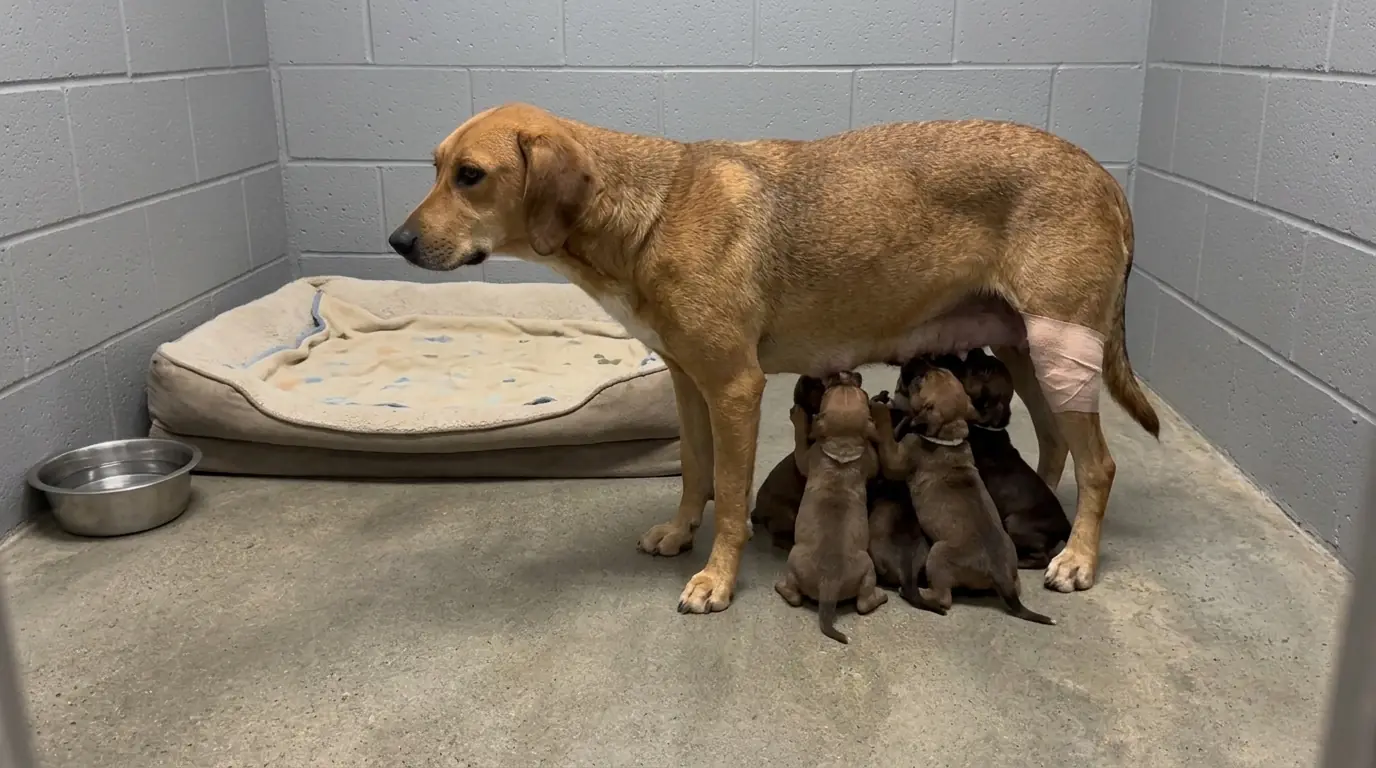
Daisy Stayed Close Even When She Couldn’t Get Onto the Bed
Daisy had already been through more physically than most new mothers should have to manage.
She was a hound mix nursing a young litter when she required surgery on one of her hind legs. By the time she came back into the maternity kennel, the procedure was behind her, but the difficult part was not.
She still had puppies depending on her.
Her surgical leg needed protection.
Her movement had to be limited.
And the puppies were still young enough that they regularly gathered together on the low padded bed provided for them.
That was when Daisy’s problem became most obvious.
Whenever the puppies crawled onto the mattress and settled into a warm pile, Daisy would stand beside the edge and look down toward them.
The bed was intentionally low.
For a healthy dog, it would have required only a small step.
For Daisy, that step was suddenly too much.
She would shift her weight onto her stronger hind leg.
Then she would lift the recovering leg slightly, as though preparing to step forward.
She might try once.
Then again.
Her body would tense before the movement was completed.
Eventually, instead of forcing herself onto the mattress, Daisy would lower herself carefully onto the kennel floor right beside it.
The puppies did the rest.
One by one, they would wake, turn toward her warmth and scent, and crawl off the edge of the low bed until they reached her abdomen.
Soon several were pressed against her, nursing while Daisy remained stretched out on the floor.
She could not comfortably climb into their bed.
So the litter came to her.
Her Recovery Had to Protect Two Different Needs at the Same Time
Caring for a nursing mother after orthopedic surgery requires a different balance than caring for a dog recovering alone.
Daisy needed rest.
She needed controlled movement.
She needed to avoid sudden twisting, jumping, slipping, and repeated strain through the healing hind leg.
But she also needed safe access to her puppies.
At the same time, the puppies were not simply props in her recovery.
Each one had needs of its own.
They needed warmth.
They needed appropriate nutrition.
They needed to be weighed and monitored.
They needed to be watched for normal hydration, activity, stool, and development.
And because Daisy was recovering from surgery, we could not assume she should be responsible for every part of their care without additional support.
The goal was not to romanticize her effort.
A mother continuing to nurse while injured can be emotionally powerful to witness, but physically, it can also be exhausting.
Our job was to reduce that burden.
The Surgery Explained Why a Small Step Had Become a Major Obstacle
Daisy’s hind-limb problem had already been evaluated before surgery, and the procedure had been performed because the injury required stabilization that rest alone could not provide.
Afterward, the priorities were straightforward but demanding.
Pain control had to be adequate.
The incision needed to remain clean and protected.
Activity had to be restricted.
Her gait had to be monitored.
Any increase in swelling, heat, discharge, sudden pain, or loss of function needed prompt veterinary attention.
And because she was nursing, medication choices had to be made with both Daisy and the puppies in mind.
She could not simply be given whatever would normally be prescribed to an adult orthopedic patient without considering potential exposure through milk.
Her veterinary team built a plan around that reality.
Daisy was able to bear some weight, but she was not expected to move normally.
Her recovering leg remained guarded.
She placed it carefully.
When she stood, she often shifted more of her weight onto the opposite side.
The difference was particularly noticeable when she approached the puppies’ bed.
Walking forward on a flat nonslip surface was one task.
Stepping upward onto a raised surface required her to redistribute weight and flex the recovering limb in a way she was not yet comfortable doing.
That was why a bed only a few inches high still stopped her.
The Maternity Kennel Had to Be Redesigned Around Her Leg
The original setup had already been simple.
The puppies had a low padded area.
Daisy had enough room to lie beside them.
Food and water were nearby.
The floor could be sanitized.
But after surgery, even small details mattered.
Nonslip material was placed along Daisy’s main walking route.
The bed could not slide when she touched it.
Edges that might catch her recovering foot were avoided.
Her water had to be reachable without requiring her to weave around the puppies.
The bedding needed enough cushioning for the litter without becoming so deep that Daisy’s foot sank into it during a transfer.
Most importantly, we stopped expecting Daisy to use the bed in the same way she had before surgery.
The puppies could continue using it.
Daisy did not have to climb onto it.
If she was more comfortable resting beside them on a protected padded section of floor, the environment needed to support that choice.
The emotional image was unusual: a mother dog lying on the floor while her puppies slept a few inches above her.
But from Daisy’s perspective, the safest option was the one that placed the least unnecessary strain on her healing leg.
The Puppies Learned Her New Position Quickly
Young puppies are driven by simple needs.
Warmth.
Milk.
Contact.
Sleep.
They did not need Daisy to be centered perfectly on a mattress.
When she lay beside the bed, they began adjusting.
One puppy might wake first, crawl toward the edge, and tumble gently onto the low padded transition below.
Another would follow.
Soon a small cluster would gather against Daisy’s underside.
Their movement was slow and clumsy, appropriate for their age.
Some reached a teat immediately.
Others crawled over a sibling before finding a position.
Daisy remained still while they organized themselves.
She would occasionally adjust a front leg or shift her chest, but she avoided making the kind of abrupt hindquarter movement that could put pressure through the recovering limb.
This became their routine.
The puppies gathered on the bed.
Daisy stood at the edge.
She considered the step.
Then she lay beside them.
The litter crawled to her.
It happened often enough that everyone caring for them began to recognize the sequence.
Nursing Was Monitored Rather Than Simply Assumed to Be Enough
Because Daisy was injured and recovering from surgery, nursing required close observation.
Pain can affect appetite.
Stress can affect milk production.
Reduced mobility can change how often a mother chooses to reposition herself with the litter.
Medication and recovery can also alter routine.
So each puppy was monitored individually.
Body weights were tracked.
Nursing behavior was observed.
Puppies that consistently struggled to access a teat, tired too quickly, or failed to gain appropriately would require intervention.
Supplemental feeding could be used when justified, but it had to be done carefully and according to age and need.
The goal was not to replace Daisy unnecessarily.
It was to make sure the puppies did not become nutritionally dependent on a mother whose own body was already under unusual demands.
Daisy herself was also receiving nutrition appropriate for lactation and recovery.
Producing milk requires substantial energy.
Healing tissue requires resources too.
She needed enough calories, protein, hydration, and overall nutritional support to maintain her own condition while still nursing.
Her appetite was watched closely.
So was her stool.
Orthopedic recovery does not happen in isolation from everything else happening in the body.
Her Leg Made Every Maternal Movement More Complicated
A mother dog caring for puppies does far more than lie still while they nurse.
She gets up and down repeatedly.
She turns around them.
She steps over them.
She changes position.
She moves away to eat, drink, and eliminate.
Then she returns.
For Daisy, every one of those ordinary movements had become more difficult.
Turning inside the maternity area required care because the puppies did not always move out of her path.
Stepping backward was awkward.
Lowering herself to the floor had to be controlled.
Standing again required her to push up while protecting the recovering hind leg.
We could not allow the puppies to constantly swarm around her feet while she was trying to rise.
At certain moments, the litter needed to be gently contained on one side of the space so Daisy could change position safely.
This was not separation for the sake of convenience.
It was injury prevention.
One accidental stumble over a puppy could hurt both Daisy and the litter.
She Still Tried the Bed
What made the behavior especially difficult to watch was that Daisy did not simply stop approaching the mattress.
She kept trying.
She would stand at the edge when the puppies were already settled there.
Her front feet would be close enough to step up easily.
Then she would shift her hindquarters.
Her stronger back leg moved underneath her body.
The recovering leg lifted.
For a second, it looked as though she might climb in.
Then she put the foot back down.
Sometimes she repeated the motion twice.
Occasionally three times.
There was no dramatic cry.
No sudden collapse.
Just hesitation.
Daisy’s body was telling her that the movement was not comfortable or secure.
Eventually, she would stop trying.
She would turn slightly, lower her front end, ease her hindquarters down, and lie beside the mattress instead.
Then she waited.
Soon enough, the puppies started moving toward her.
Pain Control Did Not Mean She Should Ignore Her Limits
Daisy’s comfort improved with appropriate postoperative management, but successful pain control does not mean an animal should suddenly be expected to behave as though surgery never happened.
Pain has a protective role.
Some caution after orthopedic surgery is appropriate.
The goal was to prevent unnecessary suffering while still protecting the repair.
If Daisy felt comfortable enough to walk calmly, that was useful.
If medication made her comfortable enough to attempt jumping or climbing before her leg was ready, that would not have been a success.
So her activity remained controlled even as she began moving more freely.
She was not allowed to test the leg by climbing onto furniture or making sudden turns.
Her world stayed intentionally small.
The maternity kennel was not restrictive because she had done something wrong.
It was restrictive because healing tissue needs time.
The Incision Became Less of a Concern Before Her Strength Did
As the days passed, Daisy’s surgical site began progressing normally.
The incision remained monitored for redness, swelling, discharge, heat, or signs that she was bothering it.
Her veterinary follow-up confirmed that healing was proceeding as expected.
But visible incision healing did not mean her leg was functionally restored.
Muscle strength had already been reduced.
Her gait had changed to compensate.
She had spent days redistributing weight away from the recovering side.
Those patterns do not disappear as soon as skin closes.
So rehabilitation began gradually.
Controlled weight bearing was encouraged as appropriate.
Standing exercises were brief.
Movement took place on surfaces with reliable traction.
If she became tired or increasingly reluctant to load the leg, the session ended.
Nobody tried to force a faster recovery because puppies were waiting nearby.
The Puppies Were Changing Too
While Daisy recovered, the litter continued developing.
Their crawling became more coordinated.
They began pushing higher on their legs.
They spent more time awake.
They started interacting with one another instead of functioning almost entirely as a pile of nursing newborns.
That development mattered for Daisy.
The stronger the puppies became, the easier it was for them to move toward her when she settled beside the bed.
But it also meant they became more capable of getting under her feet.
Their maternity area had to evolve.
As the puppies grew, individual personalities also began to appear.
One might consistently reach Daisy first.
Another might stop to investigate the edge of the bedding.
One might settle near her chest rather than immediately nursing.
Monitoring the litter as individuals helped ensure that a more assertive puppy did not always displace a smaller one.
Daisy was still central to their care, but the puppies were becoming their own animals.
For the First Time, Daisy Began Resting Away From Them
As the puppies grew and supplemental support was adjusted when needed, Daisy gradually began spending short periods resting without the litter pressed against her.
That was important.
A recovering mother should not have to remain physically available every minute.
At first, Daisy stayed close even when she was not nursing.
She might lie on the floor beside the mattress while the puppies slept above her.
Later, she occasionally chose a resting spot a little farther away.
She could see and hear them.
She could return when they became active.
But she no longer remained within immediate contact constantly.
This was not a loss of maternal behavior.
It was part of a healthier transition.
Her body needed uninterrupted rest.
Her surgical leg benefited from controlled periods of inactivity.
And the puppies needed to begin developing brief periods of independence.
Weaning Had to Happen Gradually
Because Daisy was recovering from surgery, there might have been a temptation to separate her early and reduce the physical demands of nursing as quickly as possible.
That would not have been appropriate without considering the age and development of the puppies.
Weaning needed to be gradual.
As the litter became developmentally ready, age-appropriate food was introduced.
Nursing sessions slowly became less central to their nutrition.
Daisy was allowed increasing amounts of time away from them.
Her mammary glands were monitored during this transition.
Abruptly stopping nursing can create discomfort and increase the risk of problems such as engorgement or inflammation.
So the process was paced.
The puppies learned to eat more independently.
Daisy gained longer rest periods.
Her caloric needs began changing as milk production declined.
The maternity setup slowly shifted from a nursing environment toward a space for increasingly mobile young dogs.
Rehabilitation Became Easier Once Daisy Was Not Constantly Needed
As the puppies relied less heavily on nursing, Daisy’s orthopedic recovery could become a larger part of her daily routine.
Her walks remained short.
Her movement was controlled.
She was encouraged to use the recovering leg appropriately without overloading it.
Some days were better than others.
There were mornings when she placed the foot confidently.
There were afternoons when fatigue made her more cautious.
That variation was expected.
Muscle rebuilding takes time.
Even when an orthopedic repair is healing properly, the dog still has to relearn normal movement and rebuild strength around the joint.
Daisy’s caregivers watched the quality of each step rather than simply counting how far she could walk.
Was she placing the foot fully?
Was she shortening the stride?
Was she swinging the leg outward to avoid bending it normally?
Was she loading it more evenly when standing?
Those small changes mattered.
The Bed Stayed in Place
We considered changing the maternity bed entirely.
But as the puppies grew, the low mattress remained useful for them.
Instead, the surrounding area was adapted so Daisy had options.
A broad padded section beside the bed gave her a comfortable place to lie without stepping up.
The transition zone between floor and mattress was kept clear.
Nothing could slide.
Daisy could choose whether to remain beside the bed or attempt to climb onto it.
For a while, she always chose the floor.
Then one afternoon, that changed.
The First Successful Step Was Almost Easy to Miss
The puppies had already finished nursing and were resting together on the mattress.
Daisy approached.
She stood beside the edge.
The familiar pause followed.
She shifted her weight.
Her front feet stepped onto the bedding.
Then her stronger hind leg followed.
For several seconds, the recovering leg remained on the floor.
Daisy stood with her body stretched between two levels.
She could have backed away.
Instead, she adjusted.
The recovering leg lifted.
This time, she placed it onto the mattress.
There was no jump.
No sudden burst of strength.
She simply stepped up.
Then she stood there.
That was all.
We did not encourage her to repeat it.
One successful transfer was enough.
She was allowed to turn carefully and settle as she chose.
The Next Day, She Went Back to Lying on the Floor
That first successful climb did not become her new normal immediately.
The next morning, Daisy approached the mattress and hesitated again.
She lifted the recovering leg.
Then she put it down.
After a second attempt, she lay beside the bed.
The puppies crawled out to her.
That was not regression.
A recovering limb can fatigue.
Confidence can vary.
Muscles can be sore after doing something new.
The correct response was not to force her to repeat yesterday’s success.
The correct response was to continue the plan.
Gradual rehabilitation.
Safe surfaces.
Controlled activity.
Adequate rest.
Veterinary reassessment when needed.
Her Relationship With the Litter Began to Change
By the time Daisy was using the recovering leg more consistently, her puppies no longer needed the same kind of constant physical access to her.
They ate more independently.
They explored.
They played.
They slept apart from her more often.
Some still tried to nurse when given the opportunity, but Daisy increasingly chose when to allow it.
That shift was normal.
It also changed the emotional image that had defined the early part of her recovery.
At first, the puppies would gather on the bed and Daisy could not reach them.
Then they would crawl down to her.
Weeks later, the same puppies were capable of climbing off and on the mattress without difficulty.
Daisy was the one becoming more mobile too.
The difference was that her progress had to happen slowly.
Daisy Needed an Identity Beyond Motherhood
As weaning progressed, Daisy began spending more time away from the maternity kennel.
That gave us a clearer picture of who she was when she was not surrounded by puppies.
She was observant.
She enjoyed slow sniffing walks.
She preferred exploring at her own pace rather than being hurried.
She was interested in people but did not immediately demand constant contact.
In quieter settings, she often settled nearby after a short period of investigation.
Those details mattered for her future.
Her puppies would eventually move into their own next stages.
Daisy needed one too.
Her medical recovery, temperament, and long-term orthopedic needs had to be evaluated independently from her role as their mother.
Her Future Home Will Need to Respect the Leg She Still Has to Protect
Daisy’s surgery may allow her to regain good function, but orthopedic recovery does not mean the history disappears.
Her future caregivers will need to understand what she has been through physically.
She may require continued controlled exercise.
Maintaining a healthy body weight will matter.
High-impact activity may need to remain limited depending on veterinary guidance and the specifics of her repair.
Slippery floors should be managed.
Sudden intense exercise after long periods of rest should be avoided.
Follow-up examinations may continue as her recovery progresses.
If she begins limping more, stops bearing weight, develops swelling, or suddenly becomes reluctant to move, those changes deserve attention.
A successful recovery is not measured by how quickly a dog returns to doing everything she once did.
It is measured by whether she can move comfortably and safely over time.
The Puppies Eventually Stopped Waiting for Her
As the litter became more independent, the scene in the maternity kennel changed completely.
The puppies no longer spent most of the day gathered in one sleeping pile.
They moved around.
They played.
They investigated bedding.
They ate from their own dishes.
When Daisy entered, they still noticed her immediately, but they did not always crawl straight to her abdomen.
Some approached her face.
Some followed behind her.
Others continued whatever they had been doing.
Daisy was still their mother.
But the physical dependence that had once forced them to crawl down from the bed every time she could not reach them was fading.
That was good for all of them.
One Evening, Daisy Climbed Onto the Bed and Nobody Needed Her There
The moment that best captured Daisy’s recovery came later than we expected.
It was not during a nursing session.
It was not when the puppies were crying for her.
They were already settled.
Some were asleep.
Others were barely awake, pressed together on the mattress.
Daisy walked over.
She stopped at the edge.
For a moment, the scene looked exactly like it had after her surgery.
She stood beside the same low bed.
Her front feet were close to the edge.
Her recovering hind leg was slightly behind the other.
Then she stepped forward.
One front foot.
The other.
Her stronger hind leg.
Finally, the recovering leg.
She climbed onto the mattress.
Slowly.
Carefully.
Without needing to be lifted.
Daisy turned once and lowered herself beside the puppies.
A few of them shifted toward her.
Most stayed asleep.
There was no urgency anymore.
No litter of hungry babies waiting for a mother who could not physically reach them.
No need for Daisy to lie on the floor while they crawled out to her.
She was simply able to choose the bed.
Her leg was not magically restored, and her rehabilitation was not finished.
She still had strength to rebuild.
She still needed controlled exercise and follow-up.
But the small step that had stopped her over and over after surgery was finally becoming something her body could manage again.
And by then, the puppies she had once been unable to climb in beside were already learning that they no longer needed her to be there every minute.