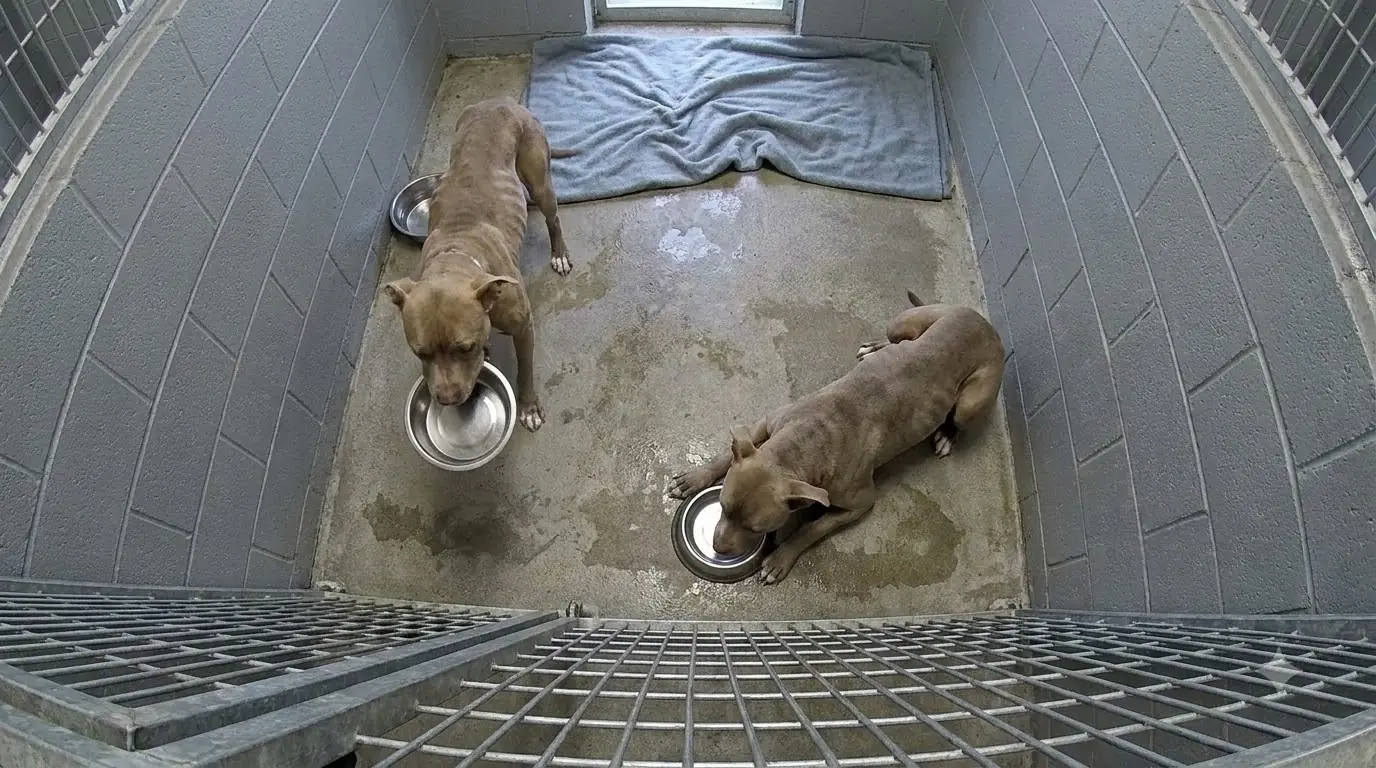
Nala's meals are deliberately small.
The 8-year-old American Pit Bull Terrier arrived at the rescue severely malnourished, anemic, and so weak that only a few steps can make her legs begin to tremble.
Staff bring her food directly to her.
She eats while someone keeps an eye on her, and when the last bite is gone, there is usually nothing more Nala needs to do.
She could simply lie down.
Instead, she picks up the empty stainless-steel bowl.
Then she turns toward the kennel door.
Nala takes a few careful steps with the bowl between her jaws.
Her legs begin shaking.
She slows.
Sometimes she gets only halfway across the kennel before her body can no longer continue.
Nala lowers herself onto the floor.
But she doesn't leave the bowl behind.
She places it between her front paws and rests there, breathing harder from an effort that should have been insignificant for a healthy dog.
After watching the same routine happen again, staff realized this wasn't a one-time behavior.
And they also knew they couldn't keep letting Nala exhaust herself after every meal.
Nala Had Arrived With Very Little Strength Left
Her thin body made the severity of her condition immediately visible.
She had lost far more weight than would be expected from simply missing a meal or two.
Her frame was poorly padded, and muscle loss had left her without the strength normally expected from an adult Pit Bull.
Then veterinary assessment added another concern.
Nala was anemic.
Anemia means there are not enough healthy red blood cells—or enough functional hemoglobin—to carry oxygen through the body normally. Depending on severity and cause, affected dogs may become profoundly tired and weak.
For Nala, that weakness was obvious every time she moved.
She could still stand.
She could still walk.
But neither ability lasted very long.
A few steps could leave her legs trembling beneath her.
That meant the rescue had to think carefully about something that seemed obvious at first.
Feeding her.
They Couldn't Simply Fill the Bowl
When people see an extremely thin dog, the instinct is often to give as much food as possible.
Nala's recovery needed more control than that.
A severely malnourished dog requires a veterinary-guided nutritional plan that accounts for her condition and how her body responds as food is reintroduced.
So instead of one enormous meal, Nala received carefully managed portions appropriate to her recovery plan.
Staff watched her closely.
Would she eat willingly?
Could she tolerate the food?
How was her energy afterward?
Was her body beginning to respond to consistent nutrition?
The first encouraging answer came quickly.
Nala wanted to eat.
But what she did when the meal ended created another question.
She Carried the Bowl to the Same Place
The first time Nala picked up her empty bowl, nobody thought much of it.
Some dogs carry bowls.
Some lick them long after the food is gone.
Some pick them up simply because they have learned that bowls predict meals.
But Nala did something more specific.
She headed toward the front of the kennel.
The next meal ended.
Nala picked up the bowl again.
Same direction.
Another meal.
Same routine.
Staff began paying attention.
She wasn't energetic enough to wander around carrying objects for entertainment. Toys rarely motivated her to spend that much physical effort.
Yet after eating, Nala repeatedly used some of her limited strength to move the empty bowl toward the door.
Nobody could know exactly why.
Staff did not claim Nala was asking for more food or trying to show the bowl to someone.
But they could see that the empty bowl remained important to her after the meal was gone.
Then they noticed how much the routine was costing her.
Halfway to the Door, Her Legs Would Give Out
Nala often began the trip standing.
The stainless-steel bowl hung from her mouth while she moved forward carefully.
Then her gait changed.
Her steps became shorter.
The muscles in her legs began to tremble.
Sometimes she stopped before reaching the front.
She lowered her chest first.
Then her hindquarters.
The bowl came down with her.
Even after lying on the floor, Nala frequently kept it close, positioned between her front paws.
For several moments she simply rested.
That was the part staff couldn't ignore.
Whatever motivated Nala to carry the bowl, a short walk across the kennel was using energy her body desperately needed elsewhere.
The behavior was emotionally striking.
Medically, it showed just how depleted she remained.
Her Anemia Made the Weakness More Concerning
Nala's caregivers could not look at her shaking legs and assume she simply needed exercise.
Her body was dealing with severe nutritional depletion and anemia.
The underlying reason for anemia also matters, and veterinary care has to address the individual dog's medical picture rather than treating weakness as a diagnosis by itself.
For Nala, the immediate priorities were stabilization, appropriate nutrition, rest, and monitoring.
Staff watched for changes in her energy and ability to tolerate activity.
They also paid attention to whether she could rest comfortably after meals.
The goal was not to turn the walk with the bowl into a rehabilitation exercise.
Nala was already telling them that it was too much.
So they changed the routine.
Staff Started Bringing Everything Closer
Nala did not need to cross the kennel to get attention.
She did not need to walk farther than necessary for water.
And she certainly did not need to carry an empty bowl several feet simply because she kept trying to do it.
Staff could sit closer after meals.
Her resting area could remain near the places where routine care happened.
If Nala picked up the bowl and started moving, caregivers could make sure she wasn't pushing herself until her legs failed beneath her.
They did not punish the behavior.
They did not repeatedly take the bowl away the instant she touched it.
Instead, they worked around the physical limitation underneath it.
Nala could keep the familiar routine without being required to finish the entire journey.
Then, as her nutritional care continued, staff began seeing something they had been waiting for.
Her Legs Took Longer to Start Shaking
The difference did not appear overnight.
At first, Nala still tired after only a few steps.
But eventually there were meals after which she stood a little more steadily.
She picked up the bowl.
Walked.
One step.
Two.
Three.
The trembling still came.
Just not quite as quickly.
That was progress.
Nala was still far too thin.
Her anemia and overall medical condition still required attention.
Nobody interpreted a slightly longer walk as proof that she had recovered.
But her body seemed to have a little more reserve than it had on arrival.
The rescue continued with the same cautious approach.
Food.
Rest.
Monitoring.
And no unnecessary demands.
One Day, She Reached the Door
Nala finished her portion and inspected the empty bowl.
Then she picked it up.
A caregiver stayed nearby.
Nala walked toward the front.
Her pace was slow.
The bowl bumped lightly against her chest.
Staff expected her to lower herself halfway across the kennel as usual.
She didn't.
Her legs began to tremble near the end, but Nala kept moving until she reached the door.
Then she placed the bowl down.
And immediately lay beside it.
She was tired.
That had not changed.
But this time, the distance that had repeatedly stopped her was something she had managed to complete.
Staff let her rest.
Nobody asked her to walk back.
The Bowl Still Didn't Explain Itself
Even after seeing the routine many times, the rescue could not know precisely what Nala intended.
Maybe the bowl had become strongly associated with food.
Maybe carrying it had been reinforced somewhere in her previous life.
Maybe she simply liked holding it after eating.
There was no need to invent a more dramatic explanation.
What mattered was observable.
Nala consistently valued that particular object enough to carry it even when walking was physically difficult.
And as her strength began to change, the bowl became an unexpectedly clear way for staff to notice those changes.
At first, she could carry it only a few steps.
Then a little farther.
Eventually, on a stronger day, she reached the kennel door.
That did not make the bowl a medical test.
But it made the difference in Nala's endurance hard to miss.
Recovery Still Has to Move Slowly
Nala is not suddenly a healthy dog because she can sometimes cross her kennel.
Severe malnutrition takes time to correct.
Muscle has to be rebuilt gradually.
Her anemia requires appropriate veterinary attention and monitoring.
Her body condition cannot safely transform overnight.
There may be stronger days and weaker ones.
Staff continue watching the things that matter more than whether she completes her unusual post-meal routine.
Her appetite.
Her weight and body condition over time.
Her energy.
Her ability to stand and move comfortably.
Her response to treatment.
Her overall quality of life.
The goal is a body that can handle ordinary life again.
Not simply a dog that can carry a bowl farther.
Nala Still Picks It Up After Eating
That part hasn't changed.
The final bite disappears.
Nala checks the bowl.
Then her jaws close gently around its rim.
She turns toward the kennel door.
Some days she makes it farther than others.
There are still times when the trembling starts and Nala has to lower herself onto the floor before reaching her destination.
When that happens, the stainless-steel bowl usually ends up exactly where it did during her first days in rescue.
Between her front paws.
Nala rests.
Staff let her catch her breath.
Nobody makes her finish the trip.
The Distance Is Slowly Becoming Less Important
When Nala first arrived, a few steps could expose just how little strength her body had left.
The bowl made that weakness visible every day.
She would eat a carefully measured meal, pick up the empty dish, start toward the door—and run out of strength before she got there.
Now there are days when she can go farther.
Sometimes she reaches the front.
Sometimes she still doesn't.
Her recovery is not complete, and the medical problems that brought her into care cannot be reduced to one hopeful behavior.
But there is a meaningful difference.
Nala still carries the same empty bowl.
Her legs just don't always give out as quickly as they used to.