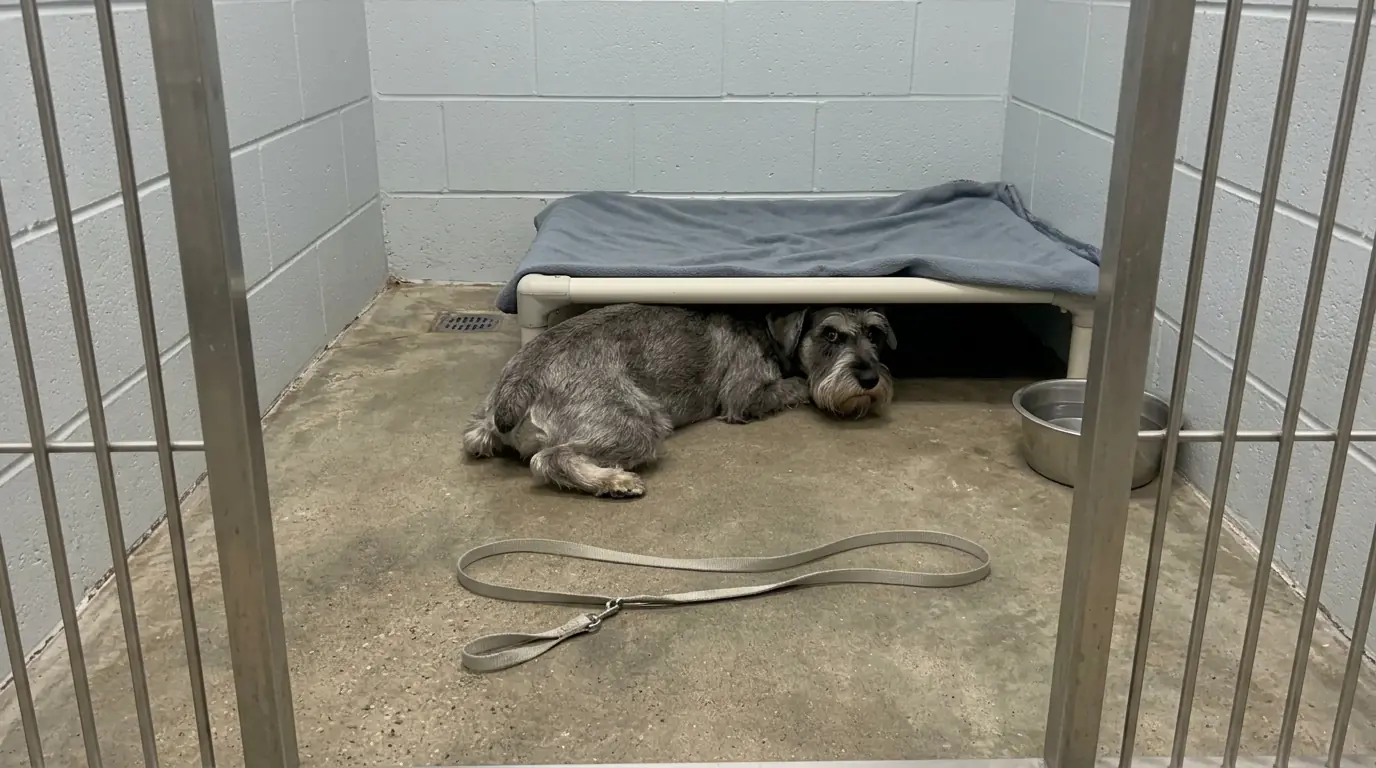
Nico can tolerate a leash while it is still.
It can hang outside his kennel.
It can rest on a hook.
Sometimes he will even look at one without moving from his bed.
Then it falls.
The metal clip strikes the concrete.
The leash slithers several inches across the floor.
Nico changes instantly.
The six-year-old Miniature Schnauzer jumps backward.
Then he runs.
Around the cot.
Past the water bowl.
Toward the kennel gate.
Back again.
His paws scramble for traction on the sealed concrete as he tries to turn faster than his body can manage.
One hind foot slides sideways.
Nico nearly falls.
He catches himself and keeps going.
Then he sees the narrow opening beneath his raised cot.
He drops his head.
Pushes his nose underneath.
Then his neck.
Then both shoulders.
The space is too small.
Most of Nico's body remains exposed behind him.
But he keeps pressing forward as though those few inches beneath the bed are the only place in the kennel where the leash cannot reach him.
Nico Was Found With Something Dragging Behind Him
When Nico was found wandering, an old length of material was still attached near his neck and trailing behind him.
How long he had been moving that way is unknown.
No one knows exactly what happened before he was found.
There is no reliable way to reconstruct every experience Nico may have had with a leash, rope, tether, or collar.
That uncertainty matters.
His current behavior should not be turned into a dramatic backstory that cannot be verified.
What can be observed is happening inside the shelter now.
A leash moving across the floor produces an extreme response.
It Is Not Just the Sight of the Leash
The sound appears especially important.
Metal clip against concrete.
A dragging line behind it.
That brief combination is often enough.
Nico's body stiffens.
Then he bolts.
A leash sitting motionless may receive a very different response.
That distinction gives staff something useful to observe.
The object itself may not be the entire trigger.
Movement and sound may be critical parts of it.
His Reaction Happens Almost Too Quickly to Interrupt
Nico does not slowly become uncomfortable.
There is little hesitation.
The leash falls.
Nico runs.
Once he starts, his movement becomes frantic enough that the kennel itself creates new risks.
He turns sharply.