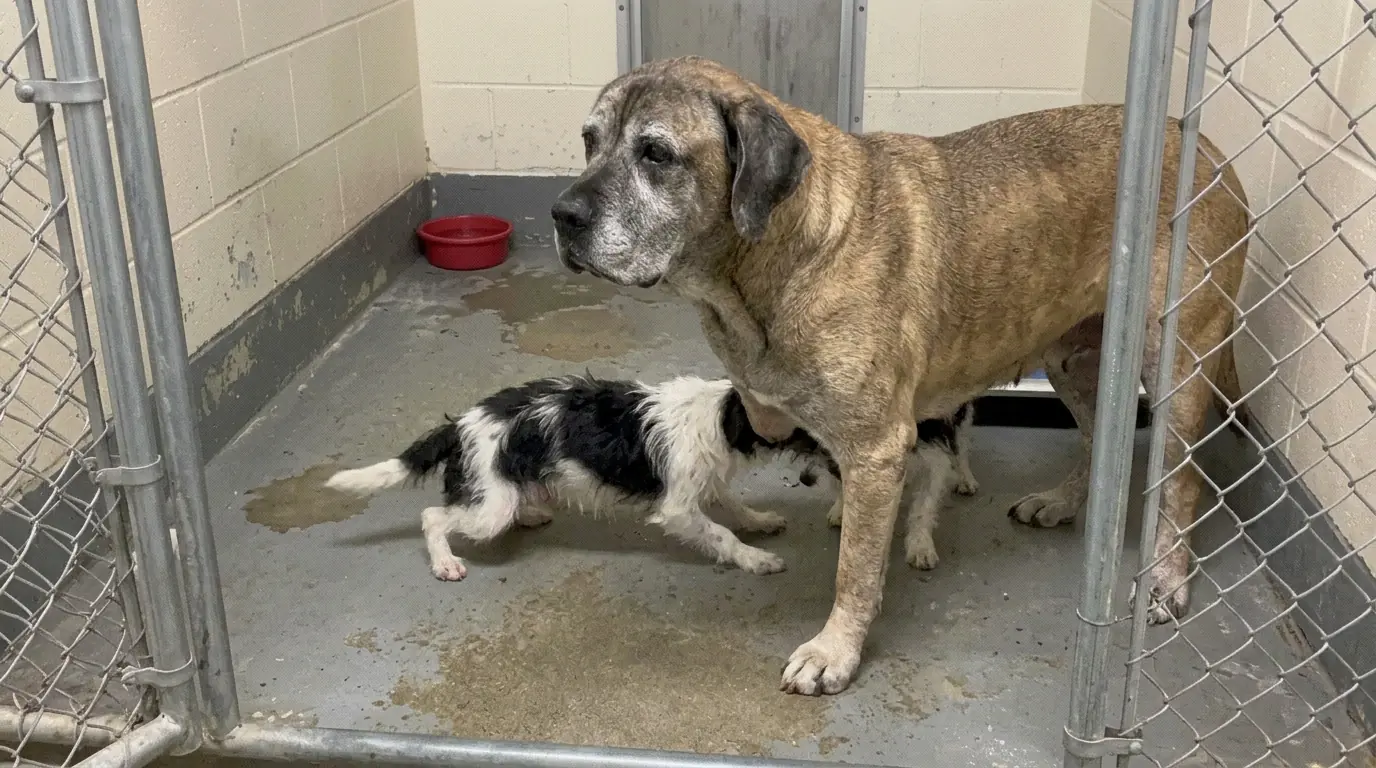
Penny Disappeared Under Duke the First Time the Kennel Row Erupted
Penny and Duke arrived at the shelter together.
Penny was a young Terrier mix, small, quick, and unusually sensitive to sudden sound.
Duke was the opposite in almost every visible way.
He was an older Mastiff mix, broad through the chest, slow in his movements, and missing one front leg.
They had clearly spent enough time together to be familiar with one another, but we did not immediately label them a bonded pair.
That kind of conclusion needed to come from repeated behavior.
It did not take long for Penny to give us something to watch.
The kennel row was relatively quiet when the two dogs first settled in.
Then several dogs farther down began barking.
One bark triggered another.
Metal doors rattled.
A dog jumped against a gate.
The sound built quickly.
Penny’s body changed almost immediately.
Her ears flattened.
Her head lowered.
She crouched closer to the floor.
Then, instead of running toward the back of the kennel, she moved directly toward Duke.
She ducked beneath his chest.
Duke did not step away.
He stayed where he was.
With only three legs to balance on, that was not a casual position for him to hold.
He widened his stance slightly and remained standing while Penny pressed herself completely underneath his body.
Her back nearly touched his underside.
Her front legs folded beneath her.
Her head disappeared behind one of his remaining forelimbs.
Duke stood over her.
The barking continued.
Neither dog moved.
When the hallway finally settled, Penny slowly crawled back out.
That was the first time we saw it.
It was not the last.
The Behavior Happened Too Consistently to Ignore
Shelters are noisy places.
Even well-managed facilities have moments when sound rises suddenly.
A dog being moved can start barking.
A cart can rattle.
A kennel latch can slam.
One anxious dog can set off an entire row.
For Penny, those bursts of noise seemed especially difficult.
She did not merely look toward the sound.
She compressed her body.
She lowered herself.
Then she sought Duke.
Almost every time the kennel row became loud enough, the same sequence appeared.
Penny moved beneath his chest.
Duke remained standing.
She stayed there until the environment became quieter.
Only then did she come out.
We were careful not to assign thoughts to either dog.
We could not say Penny believed Duke would protect her.
We could not say Duke understood that she needed shelter.
What we could say was that Penny repeatedly chose the same location when frightened by noise, and Duke repeatedly tolerated her being there without moving away.
That pattern mattered.
Duke’s Missing Leg Made the Position More Significant
Duke was missing one front leg.
His amputation was not new.
The surgical site was fully healed, and he had clearly adapted to three-legged movement before arriving at the shelter.
Still, being a large senior dog with one front limb missing came with practical challenges.
A dog’s front legs bear a large proportion of body weight.
For Duke, the remaining front leg had to do more work.
His shoulders, spine, and hindquarters all participated differently in balance and movement.
Standing still could actually be more tiring than walking.
When he walked, momentum helped him move through the tripod gait he had learned.
When he stood, he had to distribute his weight carefully across three points of support.
That made what happened with Penny particularly important from a welfare perspective.
We did not want her fear response to place unnecessary strain on Duke.
If she repeatedly pressed into him and destabilized him, we would need to intervene.
But that was not what we observed.
Penny tucked herself underneath without pushing hard against his legs.
Duke usually adjusted his stance once and remained stable.
He did not stumble.
He did not try to shake her off.
He did not show escalating tension.
Still, his comfort had to remain part of every decision.
Penny’s Sensitivity Was More Than Ordinary Startle
Many dogs react when a kennel suddenly becomes loud.
Penny’s reaction was more intense.
A metal bowl dropping could cause her to crouch.
A sharp bark directly beside her could send her looking for cover.
If multiple dogs began vocalizing at once, she often stopped whatever she was doing.
During meals, she sometimes lifted her head and abandoned the bowl temporarily.
During rest, she could wake abruptly and stand with her body low.
Her response was especially strong when sounds were sudden and close.
That did not tell us why.
We did not know whether Penny had always been noise-sensitive.
We did not know what environments she had lived in before entering the shelter.
We did not invent a history of punishment, trauma, or mistreatment to explain it.
Noise sensitivity can develop for many reasons, including temperament, limited exposure, previous frightening experiences, or changes in an animal’s environment.
The cause was unknown.
The behavior in front of us was not.
Penny was struggling.
Her First Behavioral Plan Was Built Around Reducing Overload
The solution was not to expose Penny to more noise until she “got used to it.”
Flooding a frightened dog with an overwhelming stimulus can make fear worse.
Instead, her environment was modified.
Visual barriers helped reduce stimulation from passing dogs.
Her resting area was positioned away from the busiest part of the kennel where possible.
Predictable handling routines were established.
Caregivers approached in a consistent way rather than surprising her.
Sound-dampening measures in the kennel area helped when available.
Most importantly, Penny was given opportunities to retreat.
Fearful dogs need choice.
A dog that cannot escape a frightening stimulus often becomes more distressed.
Penny already had one self-selected retreat: Duke.
We did not remove that option abruptly.
At the same time, we wanted to teach her that safety could exist in other forms too.
Duke Had His Own Medical Needs
Because Penny’s behavior was so visually striking, it would have been easy for Duke to become only a shelter for her.
He was not.
Duke was a senior tripod dog with his own physical needs.
His remaining front limb needed close attention.
So did his shoulders, spine, hips, and joints.
Large three-legged dogs can develop compensatory strain over time.
His veterinary team evaluated his gait, muscle condition, body weight, and comfort.
The remaining front leg was checked for overuse.
His paw pads and nails were monitored.
Arthritic changes were considered in the context of his age and body size.
There was no reason to assume that because Duke moved competently, mobility was effortless.
His daily routine had to protect him too.
That meant controlled exercise, good traction, appropriate body condition, and rest.
Penny could rely on him emotionally without being allowed to physically exhaust him.
Their First Few Nights Revealed Different Sleep Patterns
Duke settled relatively quickly.
Once he found a comfortable position, he tended to stay there.
Lying down as a large three-legged dog required planning.
He would shift his weight backward, lower his hindquarters, and then carefully bring his chest down while protecting the remaining front leg.
Once he was settled, he did not get up unnecessarily.
Penny had a harder time.
She slept lightly.
Hallway sounds woke her.
If Duke was lying down and barking suddenly increased, Penny sometimes squeezed herself against his side rather than crawling beneath him.
If he was standing, she used the space under his chest.
This difference gave us another useful clue.
The behavior was not simply about a specific body position.
Penny was seeking proximity to Duke during periods of auditory stress.
We Began Offering Penny Another Place to Hide
The goal was not to break the relationship.
It was to give Penny additional coping options.
A covered resting area was introduced.
It was low enough for her to enter easily and placed where she could still see Duke.
Soft bedding helped.
Nothing was forced.
Penny was allowed to inspect it in her own time.
Treats could be tossed near the entrance.
Then slightly inside.
The hiding space was never used to trap her.
At first, Penny ignored it whenever the kennel became loud.
She still went straight to Duke.
That was fine.
Behavioral recovery is not measured by whether a dog abandons the strategy that currently works.
It is measured by whether safer choices gradually become available.
Duke’s Response to Her Was Remarkably Consistent
Each time Penny crawled underneath him, we watched Duke closely.
His body language mattered.
If he had become stiff, turned his head sharply toward her, lifted a lip, moved away repeatedly, or shown other signs of discomfort, we would have needed to protect his space.
Instead, he remained remarkably neutral.
Sometimes he looked down.
Sometimes he did not.
He usually shifted his remaining front paw slightly outward and kept his three-legged stance.
Penny fit underneath him almost completely.
For a small Terrier mix beneath a Mastiff-sized dog, there was enough room that she did not have to press tightly against his abdomen.
That helped.
When the noise faded, Penny usually came out without Duke having to move.
Then he would reposition or lie down.
The interaction appeared functional for both dogs.
We Still Did Not Call Them Bonded Yet
Repeated comfort-seeking was important.
It was not the only thing we wanted to know.
Could Penny eat if Duke was temporarily away?
Could Duke rest without Penny constantly touching him?
Could Penny interact with caregivers independently?
Could Duke take a short walk without Penny becoming unable to settle?
Those questions mattered.
A healthy social relationship is different from complete dependence.
Brief separation gave us more information.
When Duke left for a veterinary check, Penny became more alert.
She watched the kennel door.
Sudden noises were harder for her.
But she could still take food from a familiar caregiver.
She could enter her covered resting space.
She did not become completely unable to function.
Duke, meanwhile, could move through the clinic without Penny present.
He remained interested in food and people.
That was encouraging from a management standpoint.
They were attached.
They were not incapable of existing separately.
Penny’s Fear Was Strongest During Unpredictable Noise
Not all sounds affected her equally.
Steady background noise was easier.
A ventilation system running continuously did not produce the same reaction as a sudden crash.
Soft conversation was manageable.
One sharp bark directly outside the kennel was not.
That distinction shaped her behavioral work.
The objective was not total silence.
No permanent home can guarantee that.
Instead, Penny needed controlled opportunities to learn that unexpected sounds did not always require an immediate escape response.
This had to happen below the point where she became overwhelmed.
A distant sound at low intensity could be paired with food.
A familiar caregiver could remain nearby.
If Penny stayed loose enough to eat and explore, the session could continue.
If she crouched, froze, or stopped taking food, the stimulus was too much.
The answer was distance and reduction, not pressure.
Her Progress Appeared in Seconds at First
The first improvement was easy to miss.
A dog barked in another room.
Penny’s ears moved.
Her head lifted.
But she did not run under Duke.
A few seconds later, she resumed sniffing the floor.
That was it.
On another day, a kennel door clanged.
Penny crouched and moved toward Duke.
But before reaching him, she stopped beside the covered bed.
She stood there.
Then she stepped inside.
She remained only briefly.
When the hallway quieted, she came out.
That was the first time she chose another shelter during a noise event.
It did not replace Duke.
The next loud period sent her straight underneath him again.
Recovery was not linear.
Duke’s Mobility Required More Attention as He Settled In
Shelter stress can sometimes mask physical discomfort.
As Duke became calmer, we were able to observe his movement more accurately.
He handled his missing front leg well, but longer periods of standing caused fatigue.
His remaining forelimb carried significant load.
After resting, he could be stiff.
His pace was deliberate.
Slippery flooring increased the effort required for turns.
His environment was therefore modified with nonslip surfaces.
His exercise remained short and controlled.
A large tripod dog can still enjoy walks, sniffing, and normal interaction, but activity needs to be appropriate for the joints doing extra work.
His body weight also mattered.
Even a small amount of unnecessary weight would increase strain on the remaining limbs.
Duke was not treated as fragile.
He was treated as a senior dog whose mechanics deserved respect.
Penny Began Watching Duke Before Hiding
Over time, the sequence of her fear response changed subtly.
At first, loud noise triggered immediate movement.
Sound.
Crouch.
Run under Duke.
Later, Penny sometimes looked toward him first.
If Duke remained relaxed, she hesitated.
That did not mean she was consciously evaluating him in a human sense.
But social referencing is a real part of canine behavior.
Dogs can use the behavior of familiar animals as information about the environment.
Penny’s response appeared less automatic when Duke did not react.
Sometimes she still crawled under him.
Other times she stayed where she was.
Those moments showed that her threshold was changing.
Foster Placement Had to Accommodate Both Dogs
Once both dogs were medically stable and their behavior was better understood, foster care offered a quieter setting.
The home was chosen carefully.
A chaotic environment with constant door slamming, children running through rooms, and repeated high-intensity noise would have been difficult for Penny.
Duke needed physical accessibility.
Stairs were minimized.
Rugs covered slick flooring.
His resting area was large and supportive.
Penny had multiple covered spaces.
One was near Duke’s bed.
Another was farther away.
This gave her choices.
Their routines were kept predictable.
Meals happened separately enough that each dog’s intake could be monitored.
Walks were adapted to their different needs.
The First Loud Sound in Foster Brought the Old Behavior Back Immediately
A delivery truck dropped something outside during their first week.
The sound was sudden.
Penny jumped.
She ran across the room.
Duke was standing near the kitchen.
Penny ducked beneath his chest.
Duke widened his stance.
There it was again.
Same behavior.
Different environment.
That told us the kennel itself had not created the pattern.
Penny’s reliance on Duke during sudden noise had traveled with them.
The good news was that foster care gave us more control over what happened next.
No row of barking dogs followed the first sound.
The house became quiet again quickly.
Penny came out within moments.
She Started Using the Covered Bed More Often
The covered bed in foster care became increasingly valuable.
Penny entered it voluntarily during calm periods.
That mattered because a hiding place works better during fear if the animal already considers it familiar.
She slept there.
She carried small treats inside.
Sometimes she watched Duke from the opening.
Then came a day when a pan slipped in the kitchen.
Penny startled.
She turned toward Duke.
He was lying down.
Instead of climbing over him or pressing against his body, she ran into the covered bed.
She stayed there until the room was calm.
That was an important shift.
Duke remained available.
But he no longer had to be her only form of shelter.
Their Relationship Became Easier to Define
By this point, enough behavior had repeated across multiple settings to describe Penny and Duke as a closely attached pair.
Penny sought Duke during stress.
They chose to rest near each other.
Duke tolerated proximity without apparent conflict.
When separated briefly, both remained functional but attentive to the other’s return.
Neither dog guarded resources from the other.
They could relax together without needing constant interaction.
The relationship appeared to improve their comfort.
That did not mean every future decision had to keep them physically together every minute.
It meant their attachment was real enough to consider in placement planning.
Penny Needed Independence for Her Own Sake
It would have been unfair to make Duke permanently responsible for regulating Penny’s fear.
He was aging.
His mobility could change.
His remaining front leg might become more uncomfortable over time.
There could eventually be moments when standing over Penny was simply not physically appropriate for him.
So Penny’s behavioral work continued.
She learned predictable cues before household noises when possible.
She was given access to safe retreat areas.
Positive associations were built around low-level sounds.
Caregivers avoided dragging her out when she hid.
Her confidence was encouraged through sniffing, food puzzles, quiet exploration, and choice-based interactions.
The goal was resilience, not fearlessness.
Penny did not need to become a dog who ignored every loud sound.
She needed enough coping skills that one startling noise did not always send her immediately beneath Duke.
Duke Began Lying Down Sooner
As he settled into foster care, Duke stopped spending as much time standing alert.
That created an unexpected change in Penny’s routine.
If a loud sound occurred while he was already lying down, there was no space beneath his chest.
At first, Penny tried to squeeze beside him.
Sometimes she pressed into the space between his shoulder and the wall.
But as her covered bed became more familiar, she increasingly chose it instead.
This reduced the physical demand on Duke.
It also gave Penny a strategy she could use whether he was standing or not.
A Thunderstorm Tested Everything
One evening, a storm moved through the area.
Thunder was harder for Penny than most household sounds.
The first distant rumble made her alert.
The next was louder.
She went directly to Duke.
He was standing.
She crawled underneath him.
Duke stayed in place.
For several minutes, the old image returned completely.
Small Terrier hidden beneath large tripod Mastiff.
Then Duke became tired.
He shifted.
Penny felt the movement and came out.
Instead of trying to keep him standing, her foster caregiver guided the environment rather than the dog.
The covered bed was open nearby.
The room remained dim and quiet.
Penny entered it.
Duke lay down beside the entrance.
They spent the rest of the storm that way.
Penny inside.
Duke outside.
Both able to rest.
That was a much more sustainable version of the same relationship.
Duke’s Age Could Not Be Ignored
As weeks turned into months, Duke continued doing well, but his age remained part of the picture.
His three-legged gait was stable.
He enjoyed short walks.
He had good days when he moved with surprising efficiency.
He also had slower mornings.
The remaining front limb sometimes appeared more fatigued after increased activity.
His veterinary team monitored him for progressive arthritis and compensatory strain.
Pain management could be adjusted as needed.
His exercise plan remained conservative.
The future home would need to understand that a senior Mastiff mix with one front leg missing might eventually require more assistance.
Penny’s dependence on him therefore had to continue decreasing even if the pair stayed together.
Penny’s Startle Response Became Shorter
She remained noise-sensitive.
That did not disappear.
A dropped object could still make her jump.
A nearby dog barking suddenly could still cause her to crouch.
But the duration of the reaction changed.
She recovered faster.
She resumed eating sooner.
She did not always need physical proximity to Duke.
Sometimes she looked for him and remained where she was.
Sometimes she entered her covered space.
Sometimes she startled, shook herself off, and continued walking.
Those small responses were the real markers of progress.
Not the complete absence of fear.
She Also Learned to Move Away From Duke Voluntarily
Early in foster care, Penny often chose the bed closest to him.
Later, she began sleeping elsewhere.
A sunny patch across the room became a favorite.
She spent time exploring the yard without checking his location every few seconds.
During quiet evenings, she sometimes rested in another room while Duke remained near the couch.
This independence did not weaken their relationship.
It made it healthier.
Penny could choose Duke when she wanted proximity rather than needing him for every uncomfortable moment.
Placement Planning Needed to Be Honest About Both Dogs
Keeping Penny and Duke together was strongly preferred because their repeated behavior showed a meaningful attachment.
But any home considering them needed to understand what that actually involved.
Duke required senior tripod care.
Traction mattered.
Weight management mattered.
Joint comfort mattered.
Long flights of stairs would be difficult.
Penny needed a quieter environment and caregivers who understood noise sensitivity.
Punishing her for hiding would be inappropriate.
Forcing her into loud situations in the name of socialization would likely make things worse.
A home would need safe retreat spaces and patience.
The pair did not need pity.
They needed practical accommodations.
Penny Eventually Stopped Fitting Under Him So Often
The behavior never disappeared completely.
During unusually intense noise, Penny could still run toward Duke.
If he was standing and comfortable, she sometimes ducked beneath his chest exactly as she had in the shelter.
Duke still usually remained where he was.
But those moments became less frequent.
More often, Penny stopped beside him.
Or she pressed briefly against his shoulder.
Or she chose the covered bed.
The relationship was still there.
The emergency quality had softened.
One Loud Afternoon Showed How Much Had Changed
Construction noise started outside the foster home one afternoon.
A sharp metallic bang came from the street.
Penny startled awake.
Months earlier, she would have been underneath Duke within seconds.
This time, she stood.
Her ears went back.
She looked toward the window.
Then she looked at Duke.
He was sleeping on his side.
Penny did not wake him.
She crossed the room and entered her covered bed.
A few minutes later, another bang sounded.
She stayed inside.
Duke continued sleeping.
Eventually, Penny came back out and lay several feet away from him.
Nothing dramatic happened.
That was the point.
Duke No Longer Has to Stand Every Time Penny Is Afraid
When Penny first entered the shelter, the loudest moments in the kennel row seemed to erase every other option she had.
She flattened herself.
She ran toward Duke.
She crawled under his chest.
And Duke, balancing a large senior body on three legs, stood over her until the hallway became quiet again.
It was the behavior that first made everyone pay attention to their relationship.
It also showed us what Penny lacked.
She had one place where she knew how to hide.
Over time, we did not take that place away from her.
We gave her more.
A covered bed.
A quiet corner.
A predictable routine.
Distance from overwhelming sound.
The ability to recover without being forced.
And gradually, Penny learned that safety did not exist only underneath Duke.
She is still sensitive to noise.
Duke is still missing a front leg.
Neither dog has become something they are not.
On a particularly loud day, Penny may still hurry toward him.
Sometimes she still fits herself beneath his chest, and Duke still stands quietly while she waits for the noise to pass.
But now there are other days when the same sound comes.
Penny startles.
She looks across the room.
Duke stays asleep.
And instead of making an elderly three-legged dog get up so she can hide beneath him, Penny turns toward her own covered bed and settles there until the house is quiet again.