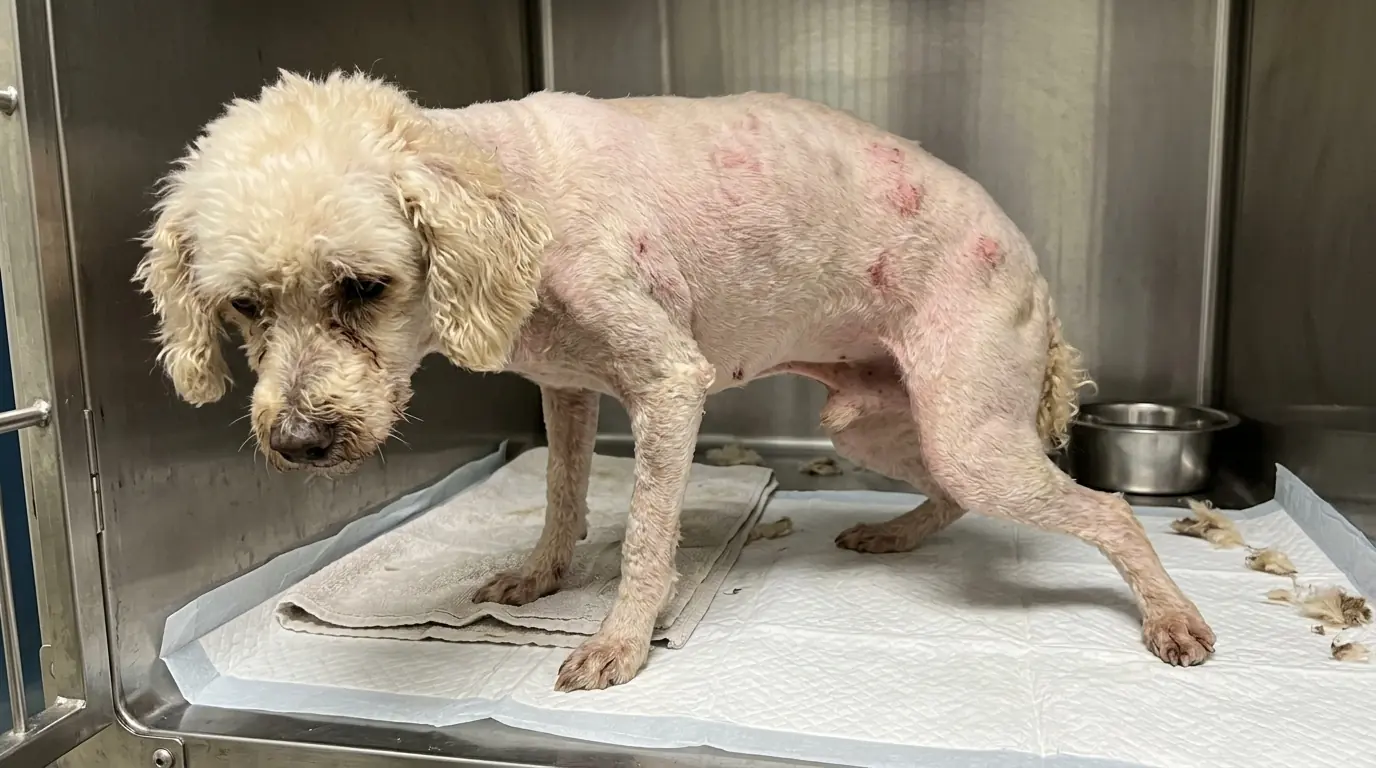
For a long time, it was difficult to tell where Noodle's coat ended and his body began.
The ten-year-old Miniature Poodle arrived at the shelter with thick mats packed around his hips and legs. Sections of fur had hardened together so tightly that normal movement was difficult.
Underneath was an even bigger concern.
Once much of the coat was carefully removed, irritated and ulcerated areas of skin became visible.
And without the mass of tangled fur hiding his frame, everyone could see just how thin Noodle was.
Now he lies curled on a towel in medical intake.
Every so often, he decides to stand.
His front legs straighten first.
His chest rises.
Then his hind legs try to follow.
For a moment, Noodle is upright.
Then they begin trembling.
One rear paw slides outward.
The other follows.
His hips slowly sink between them until his belly reaches the padded surface again.
Noodle rests.
A few minutes later, he tries once more.
The Mats Had Become More Than a Grooming Problem
Matting can begin as tangled hair.
Severe matting is different.
When large sections of coat become tightly compacted, they can pull continuously against the skin and restrict normal movement.
For Noodle, some of the worst matting surrounded his hips and legs—the very areas that need freedom of motion for walking, sitting, standing, and changing position.
His coat was no longer simply covering his body.
It was interfering with it.
Removing It Revealed What Had Been Hidden
The first goal was not to make Noodle look like a freshly groomed Poodle.
It was to safely access his body.
As the compacted coat came away, the condition underneath became clearer.
His body was thin.
His skin was inflamed in multiple places.
Some areas were ulcerated.
His legs had very little visible muscle.
The transformation after clipping was dramatic, but not because Noodle suddenly looked better.
It showed how much still needed treatment.
Severe Matting Can Hide Skin Damage
Dense mats can trap moisture and debris close to the skin.
They can create friction and tension.
They can conceal wounds, inflammation, parasites, or infection until the hair is removed.
In severe cases, even clipping must be performed carefully because skin can be pulled tightly into the matted coat.
Noodle's skin needed medical attention after the mats were gone.
The haircut was only access to the problem.
It was not the solution.
Then Noodle Tried to Stand
With the restrictive fur removed, it might have seemed logical that moving would immediately become easier.
Noodle certainly tried.
He planted his front paws.
Pushed.
Raised his chest.
His rear legs straightened.
Then they began shaking.
Within seconds, both hind paws drifted outward.
Noodle could not pull them back underneath himself quickly enough.
His abdomen slowly descended until he was lying down again.
The Mats Were Only One Part of His Difficulty
Restrictive coat can interfere with movement.
But removing it cannot instantly restore muscle that has been lost.
Noodle is a senior dog.
He is underweight.
His skin is painful.
His hindquarters appear weak.
There may be several reasons his rear legs cannot support him normally.
That is why the shelter cannot simply assume he needs food and a haircut.