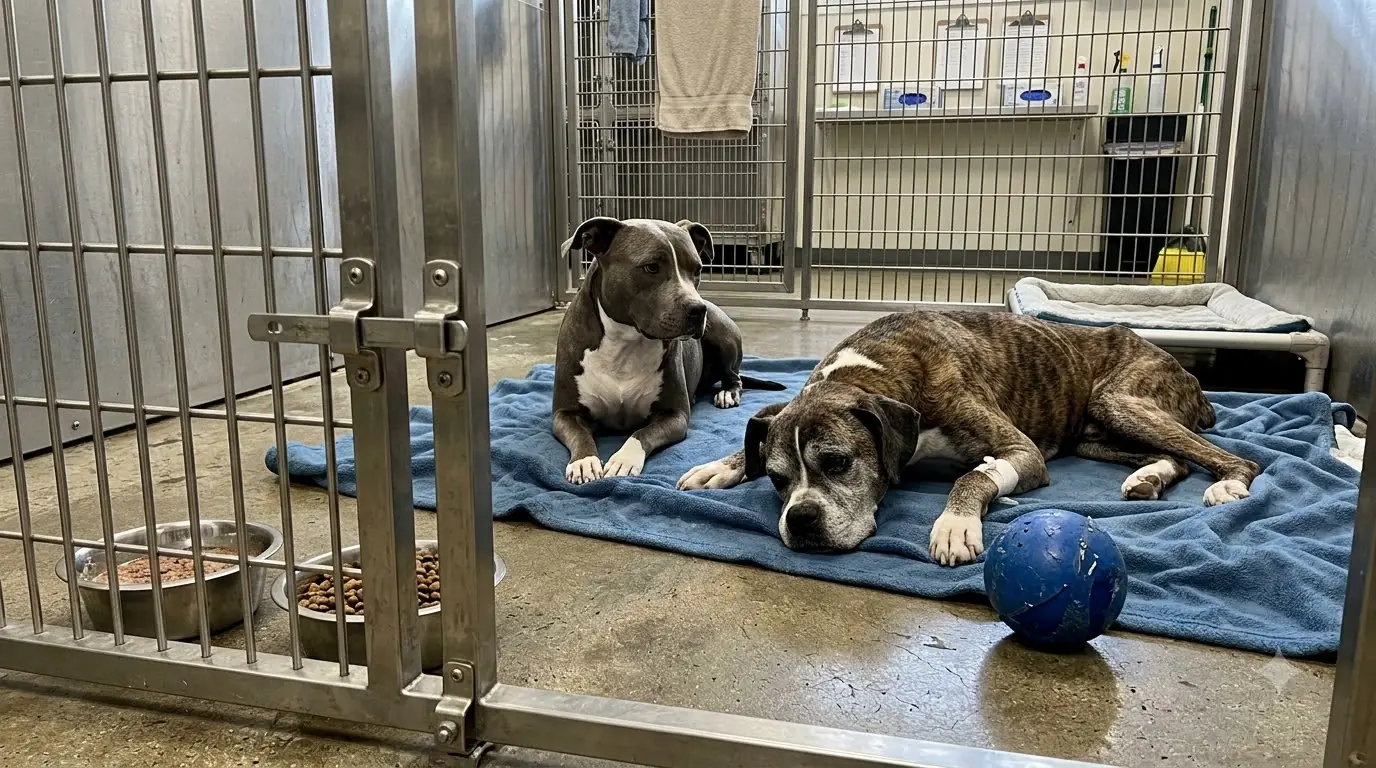
Breakfast usually arrives with two bowls.
One for Ruby.
One for Otis.
Ruby is a 5-year-old Pit Bull mix with more strength, more energy, and every physical ability to finish her own meal without waiting for anyone.
Otis is a 9-year-old Boxer mix who is still recovering in a medical kennel. He is painfully thin and does not yet have the stamina to remain standing for long.
That difference between them is impossible to miss.
Ruby could eat quickly.
Otis cannot.
So most mornings, something unusual happens.
Ruby takes a few bites from her bowl.
Then she stops.
She looks toward Otis.
And while he slowly works through his meal, Ruby leaves the rest of hers and sits beside him.
She does not steal his food.
She does not push toward his bowl.
She simply waits nearby.
Only after Otis has made progress does Ruby often return to her own breakfast.
Shelter staff began noticing the pattern because it kept repeating.
At night, another pattern appears.
There are comfortable places for both dogs.
Ruby still squeezes herself along the edge of Otis's blanket.
She makes her body smaller than she needs to.
Otis gets the softer middle.
Ruby takes whatever space remains.
Then, one morning, breakfast arrived and Otis did not get up at all.
Ruby did not eat.
Instead, she walked away from her bowl, found her favorite rubber ball, carried it over to Otis, and dropped it beside his paw.
Then she lay down facing him.
Hours later, the food was still there.
So was the ball.
So was Ruby.
Ruby and Otis Are Recovering Together
Ruby and Otis share a medical recovery kennel because Otis currently needs a quieter routine and closer observation than a healthy adult dog might.
He is severely underweight.
His energy is limited.
Standing for long periods takes effort.
Movement comes in shorter stretches.
Rest takes up much of his day.
Ruby's condition is different.
She is younger.
She is stronger.
She can stand, move, investigate, eat, and shift around the kennel without the same difficulty.
That makes her behavior around Otis easier to notice.
She is not staying beside him because she physically has to.
She has options.
She repeatedly chooses him.
Staff are careful not to assign human motives to that choice.
Nobody can say Ruby understands Otis's medical condition in the same way a person would.
She cannot read a chart.
She does not know his weight.
She does not know why the shelter monitors his meals.
But she clearly responds to his slower pace.
When Otis takes longer, Ruby slows down.
When Otis rests, Ruby settles near him.
When Otis cannot get up, Ruby often remains where he is.
That is what staff can observe.
And that is enough.
Their Relationship Is Most Visible at Feeding Time
Meal times are one of the easiest places to see the difference between Ruby and Otis.
Ruby can eat normally.
Otis needs time.
He may stand for a short period and then shift his weight.
He may eat more slowly.
He may pause.
Some meals require more patience than others.
The shelter monitors his intake carefully because nutrition is an important part of his recovery.
Ruby receives her own food.
She is not asked to wait.
Yet she often does.
She begins eating.
Then she notices Otis.
Sometimes only a few bites are gone from Ruby's bowl when she steps away.
She walks toward him.
Then she sits.
Otis keeps working on his meal.
Ruby remains beside him.
It would be easy to call the behavior “supportive,” but even that word can imply more intention than staff can prove.
So they describe what happens instead.
Ruby eats.
Otis eats slowly.
Ruby stops.
Ruby sits near Otis.
When he is finished or settles, she eventually returns to her own food.
That sequence has become part of their daily routine.
Ruby Does Not Treat Otis Like Competition
In a shelter setting, food can reveal a lot about how two dogs manage shared space.
Ruby does not appear interested in taking Otis's meal.
That matters.
She has her own bowl.
Otis has his.
Staff supervise appropriately.
Ruby's attention shifts from her food to Otis, but not in a way that pressures him.
She does not crowd his face.
She does not hover over the bowl.
She positions herself nearby.
For a dog who is weak and recovering, that calm proximity may be easier to tolerate than a more energetic companion.
Otis does not have to match Ruby's pace.
Ruby appears willing to reduce hers.
Otis Spends Much of His Day Resting
Otis's body is still rebuilding strength.
He is painfully thin, and recovery from significant weight loss is not something the shelter rushes.
His care team focuses on careful feeding, monitoring, rest, and whatever veterinary treatment is appropriate to his condition.
The relationship story does not replace the medical one.
But it sits beside it.
Otis spends long periods lying down.
Ruby has plenty of time to become bored with that.
Instead, she often settles nearby.
At night, this becomes especially obvious.
Ruby has enough room to rest separately.
She usually chooses the edge of Otis's blanket.
Because Ruby is the younger, physically stronger dog, she could take the center.
She does not.
She curls along one side.
Sometimes only part of her body fits comfortably.
Otis remains in the wider, softer area.
Ruby stays on the edge.
The Empty Space Is What Makes It Meaningful
If the kennel contained only one bed or one blanket, their closeness would be less informative.
But Ruby has alternatives.
That changes the meaning of the scene.
She can move away.
She can stretch out.
She can choose a separate soft spot.
At night, she frequently does not.
Instead, she makes herself smaller beside Otis.
This is one of the most reliable patterns staff have documented.
Otis settles.
Ruby follows.
The blanket becomes crowded.
The rest of the kennel does not.
Ruby Still Has Her Own Personality
It is important not to reduce Ruby to “the dog who stays beside Otis.”
She is five years old.
She has energy.
She has interests.
She enjoys attention.
And she has a favorite rubber ball.
That ball matters because it is one of the few items in the kennel that is clearly associated with Ruby rather than Otis.
She carries it.
She engages with it.
She keeps track of it.
It is hers in the practical sense that she is the one most interested in it.
That is why staff paid attention when breakfast arrived one morning and Ruby carried the ball somewhere else.
The Morning Otis Stayed Down
That morning began like any other.
Breakfast arrived.
Two bowls were placed in their usual positions.
Ruby noticed.
Normally, she would start eating.
Otis would slowly work on his own.
Ruby might stop after several bites and sit beside him.
But this time, Otis did not get up.
He remained down.
Staff were already aware of his condition and continued monitoring him appropriately.
There was no need to invent a crisis.
Otis was weak.
Some mornings were harder than others.
Ruby's response was immediate in its own quiet way.
She did not start eating.
She looked toward Otis.
Then she left her bowl untouched.
Ruby Went for the Ball
Instead of moving toward breakfast, Ruby walked to where her rubber ball was.
She picked it up.
She carried it across the kennel.
Otis remained lying down.
Ruby approached him.
Then she dropped the ball beside his paw.
Not several feet away.
Not near her own bed.
Right beside him.
After that, Ruby lowered herself to the floor.
She faced Otis.
And stayed there.
There was no dramatic movement.
No barking.
No frantic pacing.
No desperate scratching at the kennel gate.
Just a dog lying down across from another dog.
Between them sat a small rubber ball.
The Ball Stayed There for Hours
Time passed.
Breakfast was still available.
Ruby could smell it.
She did not return to her bowl.
Otis remained resting.
Ruby remained facing him.
The ball stayed between them.
Staff continued their work.
Other dogs ate.
Kennels were cleaned.
People moved through the area.
Ruby had reasons to get up.
She did not.
Hours later, the food was still untouched.
The ball had not moved.
Ruby was still beside Otis.
It was one of those shelter moments that looked almost too simple to explain why it mattered.
But its power came from the pattern behind it.
Ruby usually pauses her meal to sit beside Otis while he eats.
That morning, Otis did not eat.
Ruby did not either.
Ruby usually keeps her ball for herself.
That morning, she carried it to him.
Ruby usually sleeps beside him.
That morning, she stayed beside him while the day continued around them.
Staff Do Not Pretend to Know What Ruby Meant
This is where responsible storytelling matters.
It is tempting to say Ruby was trying to cheer Otis up.
We cannot know that.
It is tempting to say she gave him her favorite thing because she understood he was sick.
We cannot prove that either.
What we can say is precise.
Ruby did not touch her breakfast.
She retrieved her rubber ball.
She carried it to Otis.
She dropped it beside his paw.
She lay down facing him.
She remained there for hours.
Those facts are enough.
The emotional weight comes from what Ruby did, not from pretending to know exactly why.
Otis Does Not Need Ruby to Be His Nurse
Ruby's closeness does not replace medical care.
Otis needs veterinary oversight.
He needs nutritional management.
He needs monitoring.
He needs time.
His weakness is a medical issue, not something a companion dog can treat.
Ruby is not responsible for his recovery.
That distinction protects both dogs.
Staff do not expect her to stay with him every second.
They do not use her as a substitute for human care.
She is allowed to move.
Play.
Rest separately.
Interact with people.
Her role is not medical.
Her role is simply the one she keeps choosing for herself.
Stay near Otis.
Otis Gives Ruby Something Too
Because Otis is weaker, it can appear that the relationship runs in only one direction.
Ruby waits.
Ruby lies beside him.
Ruby brings the ball.
But Otis matters to Ruby too.
She organizes parts of her day around him.
She seems more likely to settle when he settles.
At night, his blanket becomes the place she chooses to sleep.
At meals, his pace becomes the pace she pays attention to.
That does not happen because Otis is physically stronger.
It happens because he is familiar to her.
He is part of her routine.
The shelter cannot know everything about the history they shared before this recovery kennel.
What staff do know is that Ruby repeatedly treats proximity to Otis as valuable.
That means his presence gives her something, even if it is difficult to name precisely.
Their Bond Is Built in Small Choices
Some bonded pairs reveal themselves through obvious separation distress.
Ruby and Otis are quieter.
Their strongest moments happen around ordinary decisions.
Where to sleep.
When to eat.
When to stop eating.
Whether to play.
Where to place a toy.
Whether to leave the blanket.
Whether to stay on the floor.