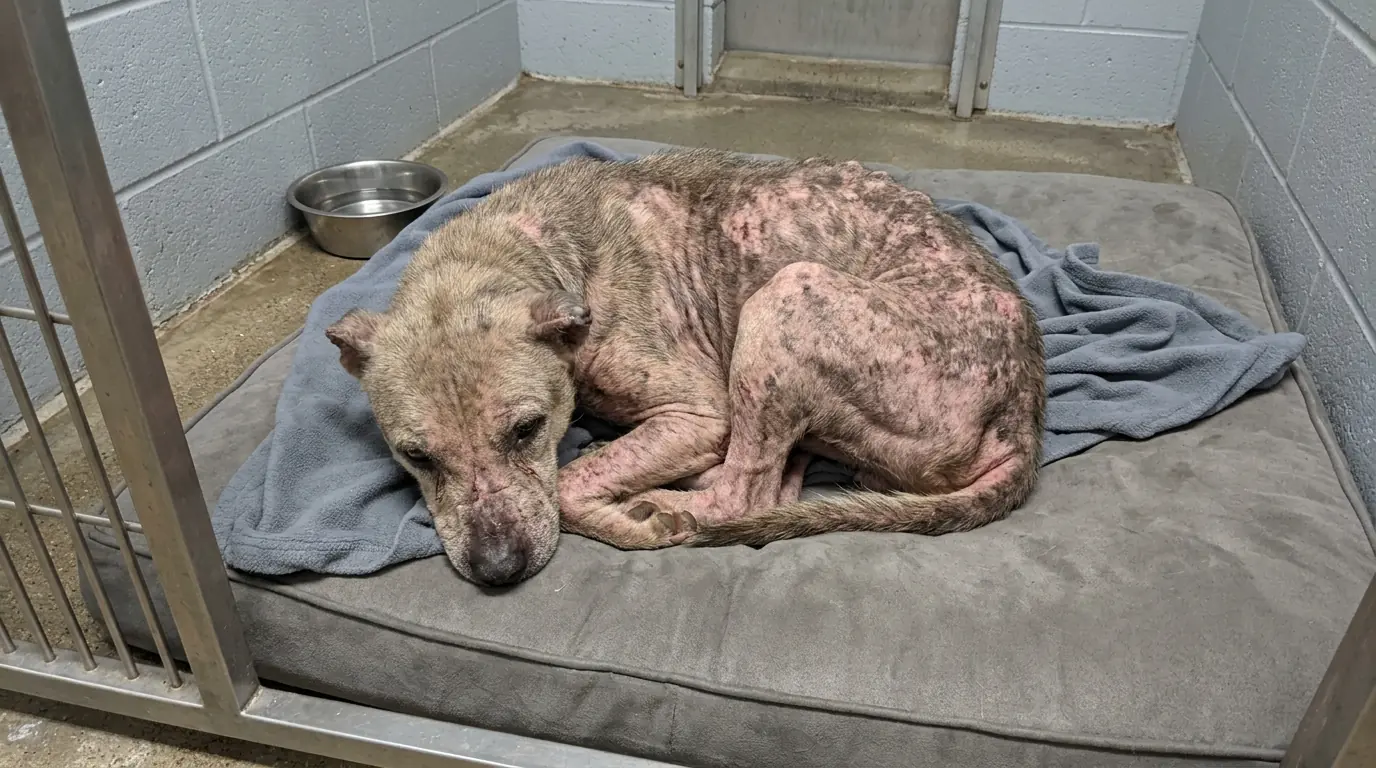
Otis almost disappears into the middle of his bed.
The 10-year-old mixed-breed dog has been given enough soft bedding to stretch out comfortably, but that is rarely how shelter staff find him.
Instead, Otis tries to curl himself into a tight circle.
His legs tuck underneath him.
His head lowers toward his body.
And for a few quiet moments, he looks like any senior dog trying to settle down for a nap.
Then the details become impossible to miss.
Most of the fur that should cover his body is gone.
Large areas of exposed skin look uneven and discolored from a serious skin condition.
Scars cross parts of his face and body.
The tip of one ear is missing from an old injury, leaving the ear permanently different from the other.
And beneath all of it is a body that looks far too thin for the oversized bed surrounding him.
The Missing Ear Is the First Thing Some People Notice
It is an obvious question.
What happened to Otis?
The old injury to his ear had already healed by the time he reached the shelter.
The missing portion was not going to grow back.
His scars offered other visible evidence that his body had been through injuries before.
But without a reliable history, those marks could not tell staff exactly how they happened.
A scar shows that tissue was once injured.
It does not explain the circumstances.
So the shelter could acknowledge what was visible without inventing the missing parts of Otis's past.
His Skin Was a More Immediate Problem
The damaged ear looked dramatic.
The extensive hair loss represented an active medical concern.
Otis had lost fur across much of his body.
His exposed skin looked patchy and unhealthy.
For a senior dog already in poor body condition, severe skin disease added another layer of physical stress.
Staff needed to know what was affecting the skin and what could be done to make him more comfortable.
Hair Loss Is a Symptom, Not a Diagnosis
A dog can lose large amounts of fur for many reasons.
Parasites can be involved.
Infection can be involved.
Allergic or inflammatory skin disease can contribute.
Underlying medical conditions can affect the skin and coat.
More than one problem can also exist at the same time.
Otis's appearance alone could not identify the cause.
That required veterinary evaluation.
Until more was known, the safest description was also the simplest: Otis had a serious skin condition that had left much of his body without its normal coat.
Being Nearly Hairless Changed Everyday Comfort
Fur does more than change the way a dog looks.
It provides a layer between the skin and the surrounding environment.
Without much of that protection, Otis's exposed skin came directly into contact with his bedding whenever he lay down.
That made the surface beneath him important.
Rough material could create unnecessary friction.
Dirty or damp bedding could be especially problematic for already compromised skin.
Even temperature could feel different for a thin senior dog with little coat.
So the Oversized Bed Served a Purpose
Visually, the bed made Otis look even smaller.
His curled body occupied only a portion of it.
There was empty bedding around him in every direction.
But that extra space meant Otis could reposition himself without immediately ending up on a hard kennel floor.