Walter Usually Tried to Make Himself Smaller When People Walked Past
Walter was a senior Pit Bull mix with a broad head, a graying muzzle, and the kind of heavy, deliberate movement that made his age obvious before anyone read his intake card.
He was also partially deaf.
That combination shaped almost everything about how he experienced the shelter.
Walter could still hear some sounds, especially lower or louder ones, but his response was inconsistent. A person could call his name from one direction and get no reaction, then close a kennel latch nearby and see his head lift immediately.
Movement affected him much more reliably than voices did.
Fast movement was especially difficult.
When visitors passed his kennel at an ordinary walking pace, Walter usually backed away.
He did not bark at them.
He did not rush the gate.
He moved in the opposite direction.
By the time someone stopped to look at him, Walter was often pressed near the far end of the kennel with his body angled toward the wall.
If an arm lifted suddenly, he became even smaller.
If someone leaned directly toward the bars, his muscles tightened.
Most people saw him for only a few seconds before moving on.
That meant they usually saw the same thing: an older gray-faced dog lying as far away from them as possible.
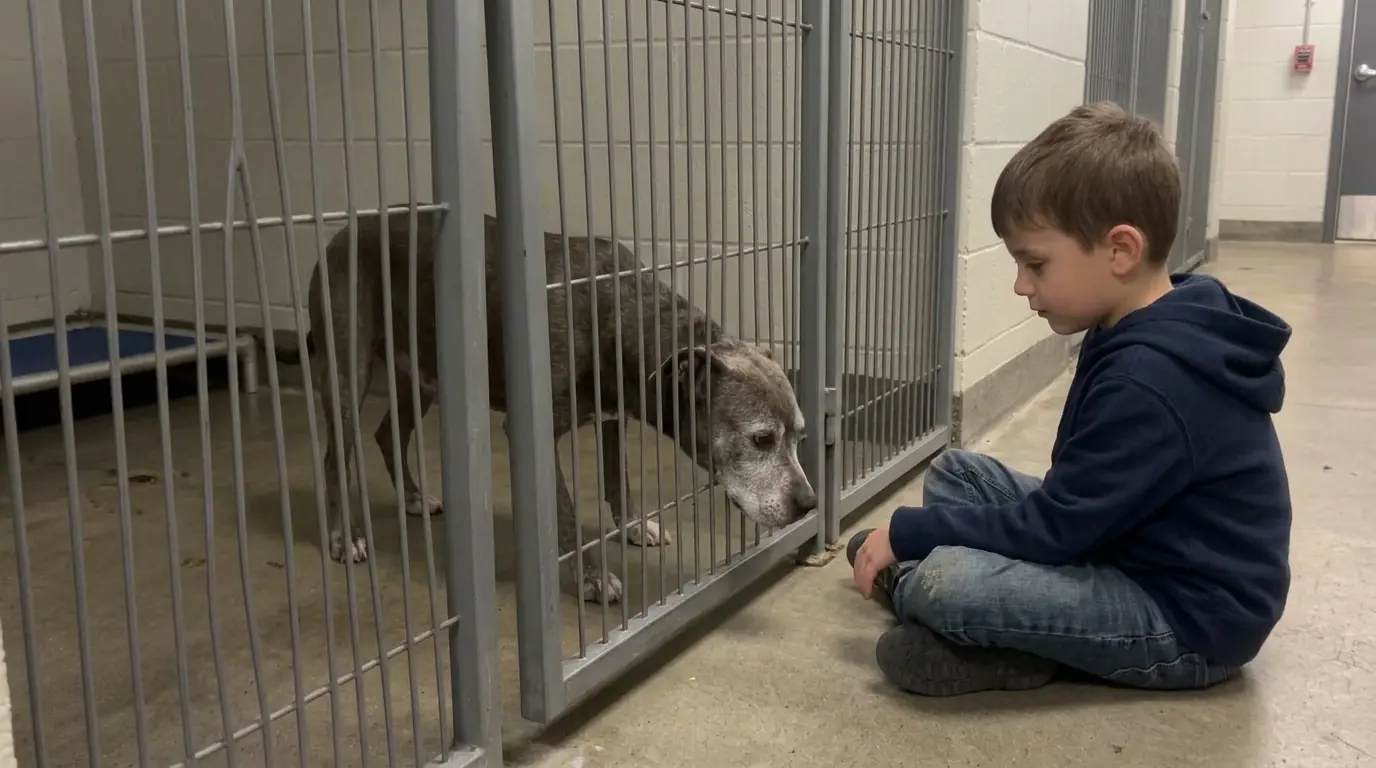
Then one afternoon, a little boy stopped in front of Walter’s kennel.
Walter retreated as usual.
But the boy did something most visitors did not.
He sat down.
Nothing Happened at First
The boy did not reach through the bars.
He did not tap the kennel door.
He did not call Walter repeatedly.
He simply sat on the floor outside the gate with one hand resting near his knee.
Walter stayed at the back.
His head was up.
His eyes remained fixed on the visitor.
Several seconds passed.
Then more.
The boy remained still.
That absence of movement seemed to change the situation.
Walter shifted his front feet.
He stood.
Slowly.
His hindquarters came up last, and he paused for a moment before taking the first step forward.
Then another.
He stopped midway through the kennel.
The boy did not move.
Walter lowered his head slightly.
He continued.
By the time he reached the gate, his body was still cautious, but he had chosen to cross the entire kennel on his own.
The boy’s hand remained on the floor on the opposite side of the bars.
Walter sniffed.
Then he pressed his nose into one of the narrow spaces in the metal door.
His nose stopped directly in front of the small hand waiting on the other side.
For several seconds, nobody moved.
That was the first time staff had seen Walter voluntarily approach an unfamiliar visitor all the way to the front of his kennel.
We Did Not Turn the Moment Into More Than It Was
It was tempting to describe the interaction in human terms.
We could have said Walter somehow knew the child was safe.
We could have said he trusted children more than adults.
We could have claimed that the boy understood exactly what Walter needed.
None of those conclusions would have been responsible from one encounter.
What we actually knew was simpler.
Walter was sensitive to rapid movement.
A visitor became very still.
Walter approached.
That behavior fit what staff had already begun observing during his daily care.
Slow was easier for him.
Predictable was easier.
Letting Walter make the first move was much easier than approaching him directly.
The little boy had accidentally followed almost every principle that had been helping Walter.
And Walter responded.
Partial Deafness Made Human Movement More Important
Hearing loss changes how dogs gather information.
A dog who hears normally may notice a person approaching before seeing them.
Footsteps.
Voices.
Clothing shifting.
A door opening.
Those sounds provide context.
Walter did not always receive that warning.
Sometimes he appeared unaware that someone was near his kennel until the person entered his field of vision.
If that happened suddenly, his response could be immediate.
Startle.
Tension.
Retreat.
That did not make him aggressive.
It meant he needed people to consider how they entered his awareness.
Staff quickly stopped relying on voice alone.
Calling Walter before approaching was not enough because there was no guarantee he heard it.
Instead, caregivers made sure he could see them.
They avoided reaching over him when he was sleeping.
They used gentle visual signals.
When appropriate, a small vibration through the floor from a deliberate step could help alert him before closer handling, but it was never used to frighten him.
The goal was always the same.
Do not surprise Walter if the surprise can be prevented.
His Veterinary Exam Confirmed That His Hearing Was Limited
Walter’s senior intake examination included more than a quick check of his ears.
His ear canals were examined for inflammation, debris, infection, masses, or other problems that might contribute to hearing difficulty.
His response to sound was also observed carefully.
Behavioral hearing assessment in a shelter setting has limitations.
A frightened or distracted dog may not respond even when sound is audible.
But Walter’s pattern remained consistent enough to support partial hearing loss.
He responded to some louder sounds.
He missed softer cues.
He often depended more heavily on visual information.
There was no obvious reversible ear problem that fully explained the deficit.
Given his age, degenerative hearing loss was considered a likely contributor.
That meant the goal was adaptation, not promising that his hearing would return.
Walter’s Senior Body Needed Attention Too
His behavior was the most noticeable issue in the kennel, but Walter was still an older dog and needed a complete medical workup.
His joints were evaluated.
His teeth were examined.
His weight and muscle condition were documented.
Baseline senior bloodwork was appropriate to screen for changes that could influence medication, energy, appetite, or future care.
Walter had age-related stiffness, especially after longer rest periods, but no acute orthopedic injury explained his reluctance to approach people.
That distinction mattered.
He was physically slower.
He was behaviorally cautious.
Both needed to be considered separately.
A senior dog who takes time to stand should not automatically be labeled fearful.
A fearful dog who stays in the back of a kennel should not automatically be assumed painful.
Walter was both somewhat stiff and highly sensitive to certain social approaches.
The care plan had to respect the difference.
The Back of the Kennel Had Become His Default Safe Place
During the first days, Walter spent much of his time at the far end of the kennel.
His bed was there.
He often positioned his body so he could see the entrance without being close to it.
If someone entered too quickly, he backed toward the wall.
That pattern told staff not to make the front of the kennel the only place where good things happened.
Meals could be placed without forcing him forward.
Treats could be tossed at a comfortable distance.
Caregivers sometimes sat sideways near the entrance and did nothing.
Walter was allowed to watch.
The first signs of progress were small.
He started eating while a familiar person remained nearby.
Then he stayed lying down instead of standing whenever the kennel opened.
Later, he began approaching familiar staff for treats.
None of that happened instantly.
The Little Boy Changed How We Thought About Visitor Introductions
The boy’s interaction did not become a shelter attraction.
Walter was not turned into a dog that children were encouraged to approach.
That would have been inappropriate.
A senior partially deaf dog who startles at sudden motion requires careful supervision around anyone, especially children who may move unpredictably.
But the encounter did give us useful information.
Walter had approached someone unfamiliar when that person reduced movement dramatically.
So staff began refining introductions around that observation.
Visitors who were genuinely interested in Walter were asked not to stand directly over the gate.
They could turn slightly sideways.
They could sit if appropriate.
Hands stayed low and still.
No reaching through the bars.
No tapping.
No repeated waving.
Then Walter decided what happened next.
Sometimes he remained in the back.
That was respected.
Sometimes he came halfway forward.
Sometimes he reached the door.
Choice became central to every interaction.
Not Every Quiet Visitor Got the Same Response
This was important.
Walter did not suddenly begin approaching everyone who sat down.
On some days, even a calm visitor was too much.
He stayed on his bed.
He watched.
He declined the interaction.
On other days, he came closer.
His comfort depended on many variables.
How busy the hallway had been.
Whether he had just woken up.
How quickly the person had approached before sitting.
Whether another dog was barking.
Whether Walter was physically stiff that day.
Behavior is rarely controlled by one factor.
The little boy had shown us a possible pathway, not a guaranteed formula.
Walter Learned Visual Cues Faster Than We Expected
Because spoken cues were unreliable, reward-based training focused on clear hand signals.
A visual marker for attention.
A simple hand cue for coming closer.
A signal before leash attachment.
The cues were exaggerated enough to be visible but not so large that they looked threatening.
Walter responded well once he understood the pattern.
Food helped.
So did consistency.
The same cue needed to mean the same thing every time.
This was especially useful during routine handling.
Instead of suddenly clipping a leash onto Walter’s collar, a caregiver could show him the leash, wait for attention, offer the familiar hand signal, and proceed only when his body remained relaxed.
Predictability reduced startle.
Touch Had to Begin Where Walter Could See It
Walter was not comfortable with hands appearing unexpectedly near his head.
That made sense for a dog who could not always hear someone shifting position beside him.
Caregivers approached from within his visual field.
They offered a hand low enough for him to investigate without requiring contact.
If Walter leaned forward, brief touch began along the shoulder or chest rather than directly over the top of his head.
He could move away.
When he did, the interaction stopped.
That control mattered.
Over time, Walter began staying closer.
Then he started leaning slightly into familiar hands.
It was a quiet form of progress.
Children Were Never Assumed to Be Automatically Safe for Him
The little boy’s success could easily have created the wrong lesson.
Walter did not become a “kid dog” because of one gentle encounter.
In fact, his sensitivity to rapid movement meant an active child could be especially difficult for him.
Running.
Jumping.
Sudden hugging.
Hands appearing from behind.
Those were exactly the kinds of movements that could startle Walter.
Any future home with children would require careful assessment, supervision, and realistic expectations.
The emotional value of the original interaction came from how still the child was.
Not simply from his age.
That distinction protected both Walter and future visitors.
His Kennel Behavior Slowly Became Less Defensive
Weeks of predictable handling began changing Walter’s relationship with the kennel front.
At first, people walking past caused him to retreat automatically.
Later, he sometimes stayed where he was.
That was a significant change.
A volunteer could pass without Walter pressing himself into the back corner.
Then came another milestone.
Walter began lifting his head when familiar caregivers approached instead of immediately moving away.
Sometimes he stood.
Sometimes he walked toward the gate before they entered.
The behavior was still dependent on pace.
A hurried person could send him backward again.
Slow movement remained essential.
One Fast Afternoon Brought the Old Response Back
Shelter progress is rarely linear.
During one busy afternoon, several visitors entered the kennel area at once.
A door closed hard.
One dog began barking.
Another joined.
People shifted quickly through the hallway.
Walter retreated.
By the time staff checked on him, he was again pressed against the back wall.
His muscles were tight.
He would not approach for food.
Nothing about that afternoon erased the previous weeks.
His threshold had simply been exceeded.
The area was quieted as much as possible.
Walter was given space.
Nobody insisted on interaction.
Later, when the hallway settled, he accepted food again.
The episode was a reminder that confidence is context-dependent.
Foster Care Gave Walter a Better Environment for Learning
A quiet foster placement became available once Walter’s medical needs were stable.
The home was selected with his hearing and startle sensitivity in mind.
The household routine was calm.
There was enough space for Walter to retreat without becoming isolated.
His bed was positioned where he could see people approaching.
Nobody walked directly up behind him while he slept.
A hand signal was used before touching him when possible.
The first few days were uneventful.
That was ideal.
Walter explored one room.
Then another.
He found the water bowl.
He found the back door.
He found a bed against the wall.
And he watched.
The Doorway Became His New Version of the Kennel Gate
In foster care, Walter’s caution appeared most strongly around doorways.
If someone entered a room quickly, he moved away.
If a person paused at the threshold, turned slightly sideways, and waited, Walter often stayed.
Eventually, he approached.
The same lesson from the shelter still applied.
Reduce movement.
Allow distance.
Let Walter decide.
His foster caregiver learned not to call him repeatedly.
Visual invitations worked better.
A small hand signal.
Then wait.
Walter’s response became more confident because he could predict what people would do.
He Started Choosing to Sit Near People
Walter did not become a lap dog.
He was too large for that to be practical anyway.
But he began making voluntary social choices.
At first, he rested across the room.
Then halfway across.
Later, he selected a bed near the couch.
Sometimes he approached a seated person, sniffed a hand, and stayed close enough for gentle chest scratches.
If the person stood suddenly, Walter still startled.
That did not disappear.
The difference was recovery time.
He no longer always fled to the farthest corner.
He could startle, take several steps back, watch, and then return.
His Hearing Loss Became Easier to Manage Once Everyone Used the Same System
Consistency made Walter’s life simpler.
People entering the home tried to come into his visual field before touching him.
He was not awakened by grabbing.
Lights could be switched on before approaching him in a dark room.
Visual cues were used for common routines.
A gentle floor vibration could alert him if he was facing away and needed to know someone was nearby.
The goal was never to eliminate all surprises.
No home can do that.
It was to make surprises less frequent.
Walter responded by spending less time monitoring every movement around him.
The First Visitor in Foster Care Was a Test
When an unfamiliar adult visited, Walter returned to some of his old behavior.
He moved away.
His body lowered.
The visitor followed the instructions already proven useful.
No approach.
No staring.
No reaching.
The person sat sideways in a chair and ignored Walter.
For nearly ten minutes, Walter remained across the room.
Then he stood.
He walked closer.
Stopped.
Sniffed the air.
Eventually, he approached within a few feet.
That was enough.
Nobody tried to force the interaction further.
Walter left on his own and returned later.
The process was slow.
But it worked because success was defined as voluntary participation, not physical contact.
We Kept Thinking About the Little Boy
That original moment remained useful because it represented something Walter had struggled to find in the shelter.
Stillness.
Visitors naturally wanted to interact.
They leaned forward.
They raised their hands.
They called his name.
All of those behaviors were socially normal for humans.
For Walter, they could become confusing or startling.
The boy had unintentionally removed almost all of them.
He had simply sat.
Walter was allowed to gather information at his own speed.
That lesson became part of his future-home profile.
Walter Was Not Looking for Someone to “Fix” His Deafness
His hearing loss was not the tragedy of the story.
The difficulty came from living in environments designed around hearing dogs.
A person calling before touching.
A verbal cue from behind.
Footsteps announcing an approach.
Walter could miss those things.
Once people adapted, his disability became much easier to manage.
He did not need pity.
He needed communication he could perceive.
His Senior Stiffness Also Improved With Routine
Walter’s age-related joint stiffness remained manageable with an appropriate veterinary plan.
His body condition was kept lean.
Walks were moderate rather than strenuous.
Nonslip surfaces helped.
He was given time to rise instead of being hurried.
This mattered behaviorally too.
A dog who needs several seconds to stand should not have a person suddenly reaching toward him during the transition.
Physical and behavioral comfort overlapped.
The slower everyone became, the better Walter functioned.
He Eventually Began Approaching Before People Sat Down
This was one of the most meaningful changes.
For months, sitting had been the easiest way for an unfamiliar person to reduce pressure.
Then Walter began needing less.
A familiar visitor could enter slowly and remain standing sideways.
Walter might approach.
A new person could pause several feet away.
Walter might take the first step before they found a chair.
The original accommodation was still useful.
It was no longer always necessary.
That is what good behavioral rehabilitation often looks like.
Not forcing the dog to abandon caution.
Expanding the situations in which the dog can remain comfortable.
He Still Startles
Walter remains partially deaf.
That is not expected to disappear.
If someone moves suddenly into his peripheral vision, he may still flinch.
If touched while deeply asleep without warning, he may wake sharply.
If several unfamiliar people move quickly around him, he may seek distance.
Those are important long-term considerations.
Any permanent home will need to continue thoughtful handling.
Visitors should be instructed.
Children, if present, would require supervision and clear boundaries.
Walter should always have a place where he can retreat without being followed.
His Future Home Needs Patience More Than Experience
Walter does not require someone who can perform complicated behavioral techniques.
He needs people willing to slow down.
People who understand that calling louder does not solve partial deafness.
People who can wait rather than reaching.
People who will teach visitors to let him approach.
People who will not punish a startle response.
His care is less about doing more.
It is often about doing less.
Less movement.
Less pressure.
Less insistence.
More predictability.
The Small Hand at the Kennel Door Became a Turning Point
Walter’s first weeks could easily have defined him as a dog who did not want people.
That would have been inaccurate.
He did want distance from movement he could not easily predict.
That was different.
The little boy revealed the difference before anyone had fully put it into words.
He sat down.
Walter watched.
No one pushed him.
Eventually, the old Pit Bull mix stood.
He walked the length of the kennel.
He pressed his nose through the bars.
The child’s hand stayed still.
That moment became a blueprint for nearly everything that followed.
Walter No Longer Lives at the Back of the Room
These days, Walter still likes to know where people are.
He still watches movement carefully.
He still does best when newcomers give him time.
But he no longer automatically puts the greatest possible distance between himself and every person who enters.
Sometimes he stays on his bed.
Sometimes he gets up.
Sometimes he approaches.
And sometimes, when someone sits quietly nearby, Walter crosses the room with the same slow steps he once took across that shelter kennel.
He still pauses before the final distance.
He still sniffs.
Then he often moves closer.
The hearing loss remains.
The sensitivity to sudden motion remains.
The gray in his muzzle has not disappeared.
Walter has not been transformed into a dog who welcomes every stranger immediately.
He has simply learned that people can move slowly enough for him to understand them.
And the behavior that first showed us what he needed remains the clearest reminder.
A crowded shelter hallway had taught Walter to stay at the back.
One little boy sat down and became still.
For the first time, Walter decided to come forward on his own.