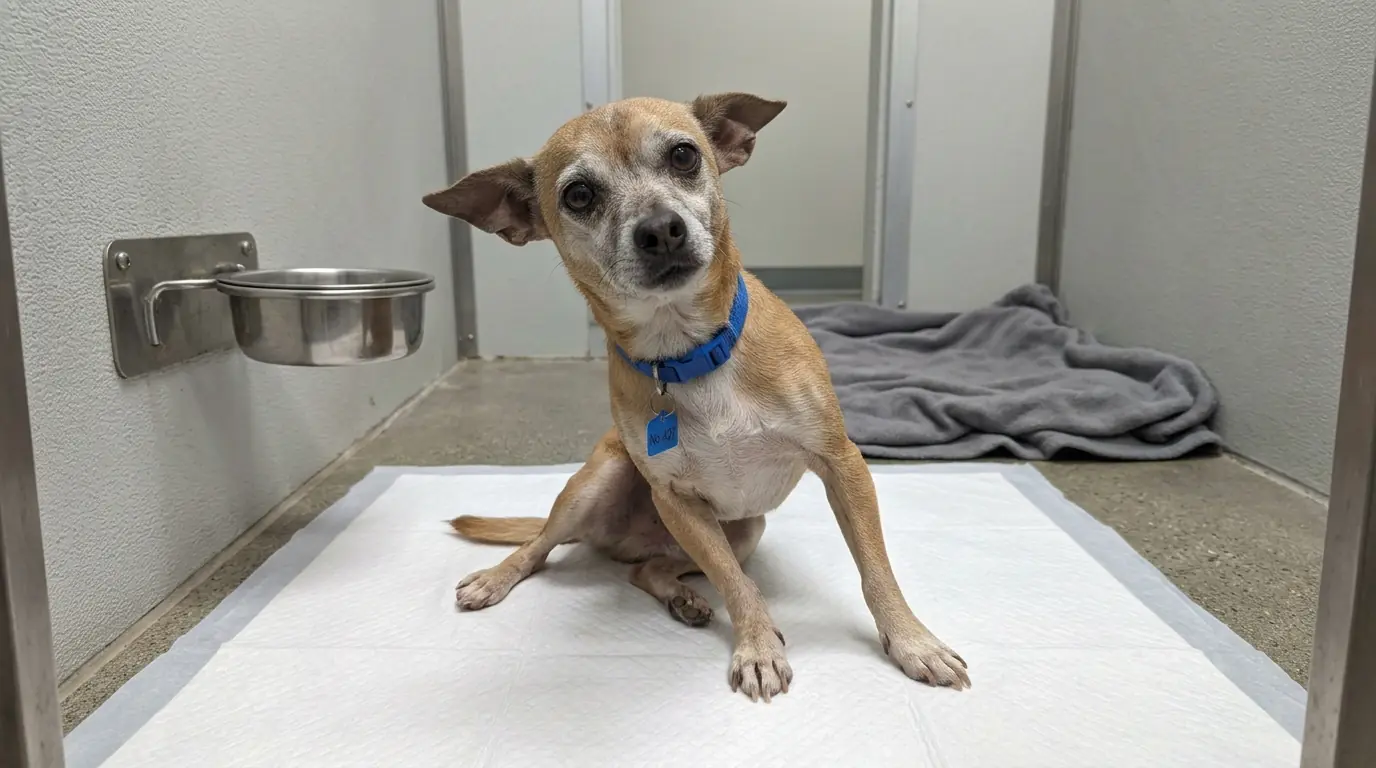
Peanut can get himself upright.
That is what makes the next few seconds so difficult to watch.
The seven-year-old Chihuahua mix plants his tiny front paws on the pee pad inside his medical kennel.
He pushes.
His chest rises.
His head comes up.
Then Peanut carefully pulls himself into a sitting position.
For a moment, everything looks almost normal.
He is upright.
His paws are underneath him.
His eyes look toward the kennel door.
Then his body begins to drift.
Slowly at first.
His head tilts.
One shoulder drops.
His weight shifts toward the weaker side.
Peanut tries to correct himself.
But the lean continues.
A few seconds later, he topples sideways onto the pad.
He lies there briefly.
Then his front paws begin moving again.
Peanut pushes himself back up.
Sits.
Tries to hold the position.
And starts the entire sequence over.
Peanut Arrived After a Head Injury
The injury left him with obvious problems involving balance and weakness.
One side of his body does not function as strongly or consistently as the other.
Exactly what his long-term recovery will look like is not yet clear.
Head injuries can vary enormously.
What matters immediately is that Peanut's difficulty sitting is not simply clumsiness.
His body is struggling to keep itself centered.
Sitting Still Is Actually a Complicated Task
A healthy dog makes it look effortless.
But remaining upright requires constant adjustments.
The brain has to understand where the body is positioned.
The eyes provide information about the environment.
The vestibular system contributes to balance and orientation.
Muscles on both sides of the body continuously make tiny corrections.
Peanut has to coordinate all of those systems just to remain sitting.
Right now, something in that process is not working normally.
His Weak Side Always Seems to Lose the Argument
Peanut begins centered.
Then the same shoulder starts dropping.
One front leg bends sooner than the other.
His body follows.
Sometimes he catches himself for a second.
His stronger leg pushes against the pad.
His chest moves toward the center again.
But the correction does not last.
The weaker side gives way.
Peanut falls.
He Doesn't Stay Down
Within moments, his paws begin searching for traction.
Peanut rolls partly onto his chest.
His stronger front leg braces against the pad.
Then he pushes.
The weaker side follows more slowly.
His body rises.
Peanut sits again.
Five seconds.
Maybe ten.
Then the lean begins.
Repeating the Movement Shows Motivation—But It Can Also Exhaust Him
It is tempting to see every attempt as good exercise.