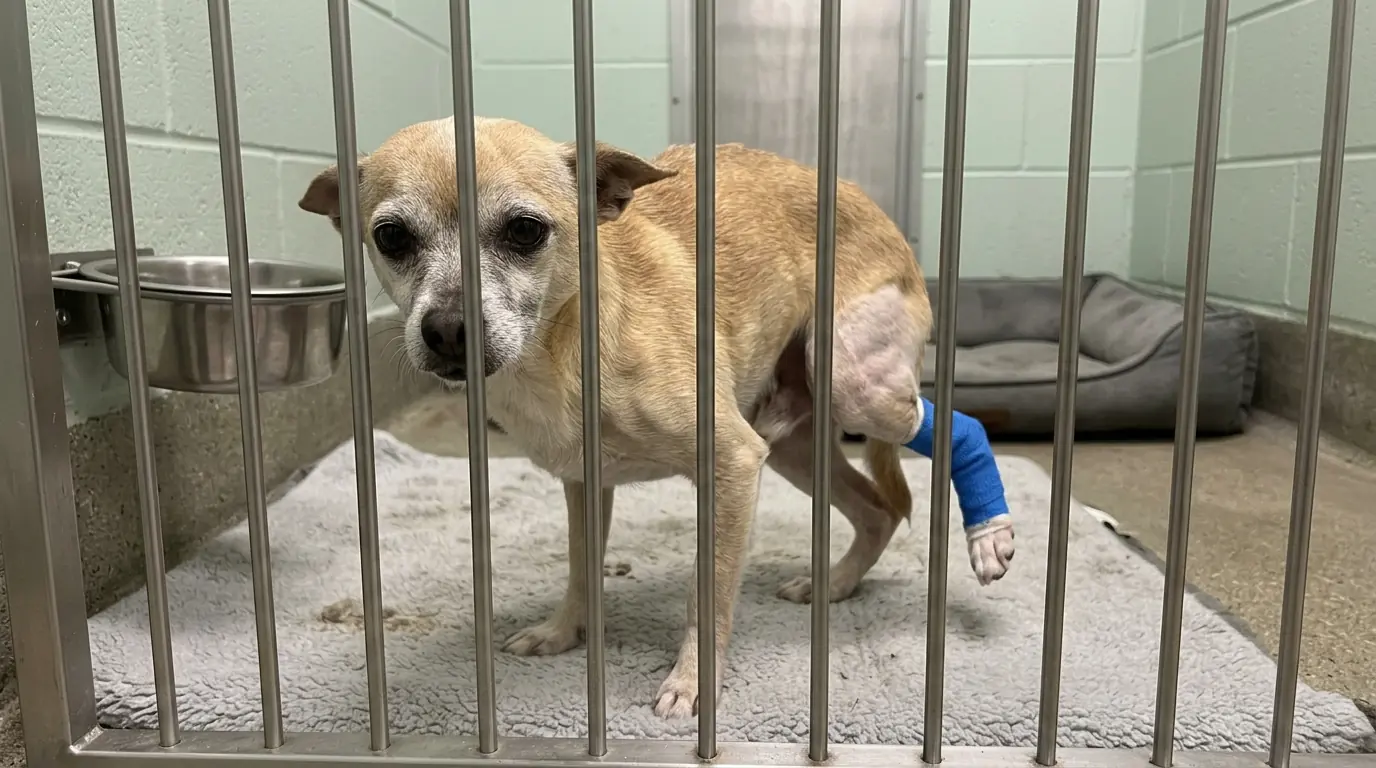
Peanut is trying to stay on his feet.
All three of them.
The nine-year-old Chihuahua mix stands inside his medical kennel with one rear leg held completely off the floor. The injured limb has been shaved for treatment and carefully bandaged after Peanut was found hurt beside a road.
The rest of him looks depleted.
His ribs and hips are easy to see beneath his thin coat. His remaining legs tremble under his weight, and he can only stay upright for short periods before exhaustion begins pulling him down.
Still, whenever footsteps stop outside his kennel, Peanut tries.
His head rises.
His front paws brace.
He pushes himself onto three legs and looks toward the door.
Within seconds, the shaking begins.
His body sinks lower.
His front elbows bend.
His good back leg starts to buckle.
But even as the rest of Peanut collapses toward the bedding, one part of him never changes.
The injured leg remains lifted.
He would rather let his entire body reach the floor first than allow that paw to touch it even once.
Peanut Was Found Injured Beside a Road
That location immediately raises concern for trauma.
But it does not establish exactly what happened.
A vehicle injury is one possibility.
A fall, an encounter with another animal, or another form of trauma could produce serious limb damage too.
Without witnesses or definitive evidence, Peanut’s history cannot be reconstructed from where he was found.
What the shelter does know is what arrived with him.
A severely injured hind leg.
A body much thinner than it should be.
And a dog unwilling to place even the slightest amount of weight through that limb.
The Injured Leg Needed More Than a Bandage
A bandage can protect damaged tissue.
It does not explain the injury underneath.
Depending on Peanut’s examination, veterinary assessment may need to consider wounds, fractures, joint damage, tendon or ligament injury, nerve involvement, infection, and other consequences of trauma.
The circulation and sensation in the paw matter.
So does the position of the limb.
And because Peanut was found after an unknown event, the rest of his body needs attention too.
The most obvious injury should never automatically become the only one examined.
Peanut’s Refusal to Touch Down Is Important
Dogs often reduce weight on a painful leg.
Some briefly touch the toes down.
Others use the limb intermittently.
Peanut does neither.
He keeps the leg elevated.
Standing.
Turning.
Lowering himself.
Even when he loses balance.
That degree of guarding tells the medical team something important about his current comfort and function, even though it cannot reveal the exact diagnosis by itself.
His Other Three Legs Have to Do More
A four-legged animal normally distributes body weight across all four limbs.
Peanut has removed one from the equation.
Now both front legs and the remaining hind leg have to compensate.
For a healthy, muscular dog, three-legged standing can already require adjustment.
Peanut is nine years old and visibly underweight.
He has little reserve.
So the trembling begins quickly.
The Good Back Leg Has the Hardest Job
Peanut’s remaining hind leg now has to stabilize the rear half of his body almost by itself.
He shifts weight forward to compensate.