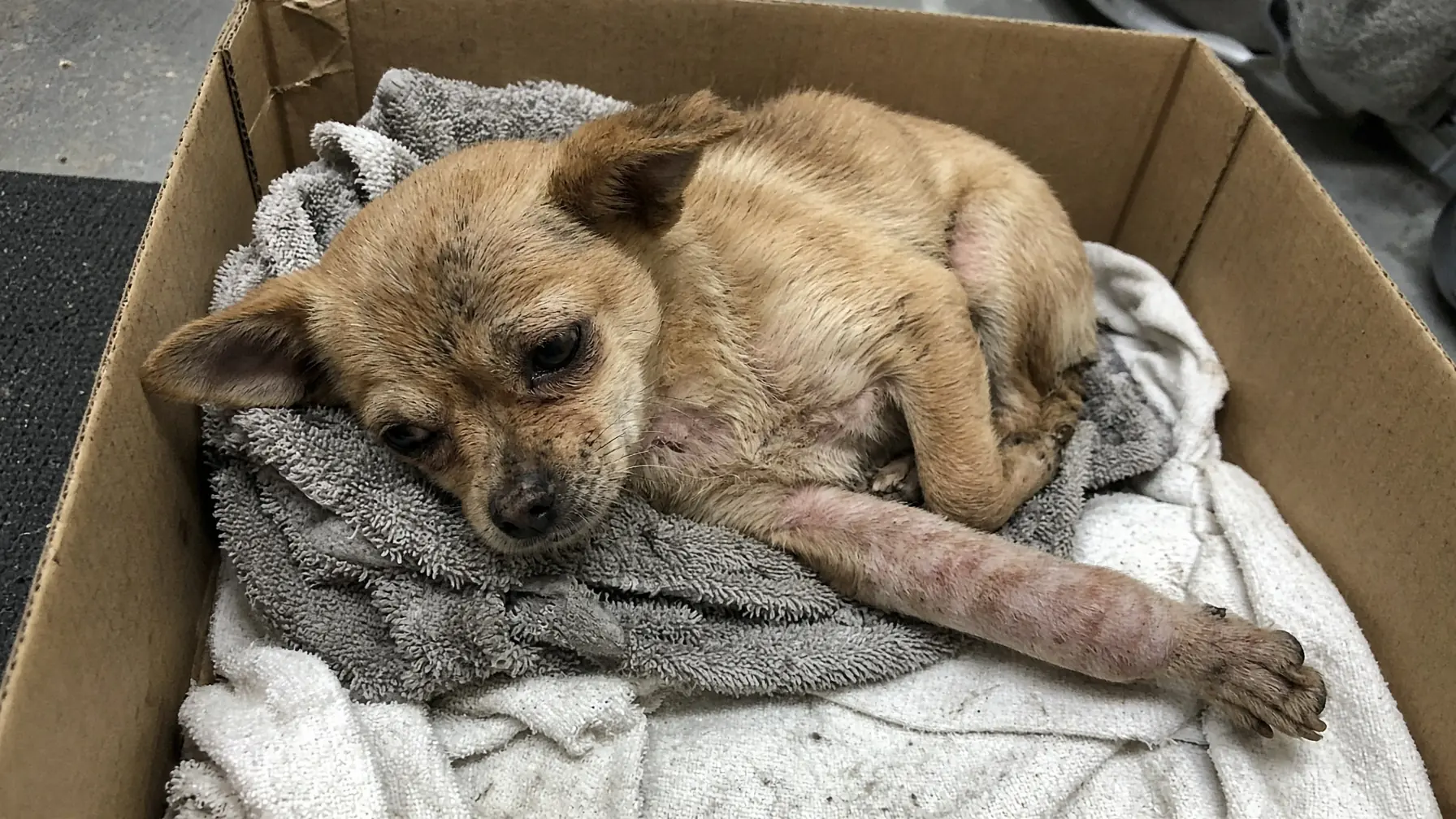
Penny barely takes up one corner of the rescue box.
The Chihuahua mix is approximately three years old, but curled tightly against the towel, she looks even smaller.
Her hind legs are pulled toward her body.
Her back curves against the side of the box.
Her head rests heavily on the folded fabric.
Almost all of Penny seems to be trying to make herself as compact as possible.
Except for one front leg.
That leg cannot follow the rest of her body.
It is visibly swollen.
Its position looks wrong.
Instead of tucking naturally beneath Penny's chest, it remains stretched awkwardly away from her.
Every few moments, Penny attempts to lift her head.
Her eyes open.
Her neck rises slightly.
Then the effort seems to disappear.
Her head sinks back into the towel.
And the injured leg remains exactly where it was.
Penny Was Found Beside the Road
Penny was discovered close to a roadside with injuries consistent with significant trauma.
A vehicle strike was suspected, but without someone witnessing what happened, the exact cause cannot be stated with certainty.
What matters immediately is what rescuers can see.
Penny has an injured front leg.
There is substantial swelling.
There are abrasions around her muzzle and chest.
And she appears exhausted.
For a dog this small, even apparently localized trauma can require urgent evaluation for injuries that are not visible from the outside.
The Front Leg Is the Most Obvious Problem
Penny naturally tries to curl her body.
It is a common resting position.
But the injured limb prevents her from completing it.
When she draws the rest of herself inward, the front leg remains extended.
Trying to pull it closer appears uncomfortable.
So Penny leaves it outside the curve of her body.
The result is an unusual image.
A tiny dog curled into a ball with one limb stretched away from everything else.
That Position Can Reveal Something Important
Dogs frequently adjust their posture to protect painful areas.
They may avoid putting weight on a limb.
Hold it away from the body.
Refuse to bend a joint.
Or repeatedly choose one resting position over another.
Penny cannot explain where the pain is strongest.
Her posture provides information.
The fact that she consistently keeps the injured leg separated from her body suggests that manipulating it unnecessarily would be a bad idea.
The Box Is Meant to Limit Movement
For an injured dog, that can be helpful.
Penny should not be walking around unnecessarily before the extent of her injuries is known.
A small, stable transport space reduces opportunities to jump, stumble, or attempt to run.
The towels provide cushioning.