Pip is exhausted enough to sleep.
He just cannot find a position that lets him do it.
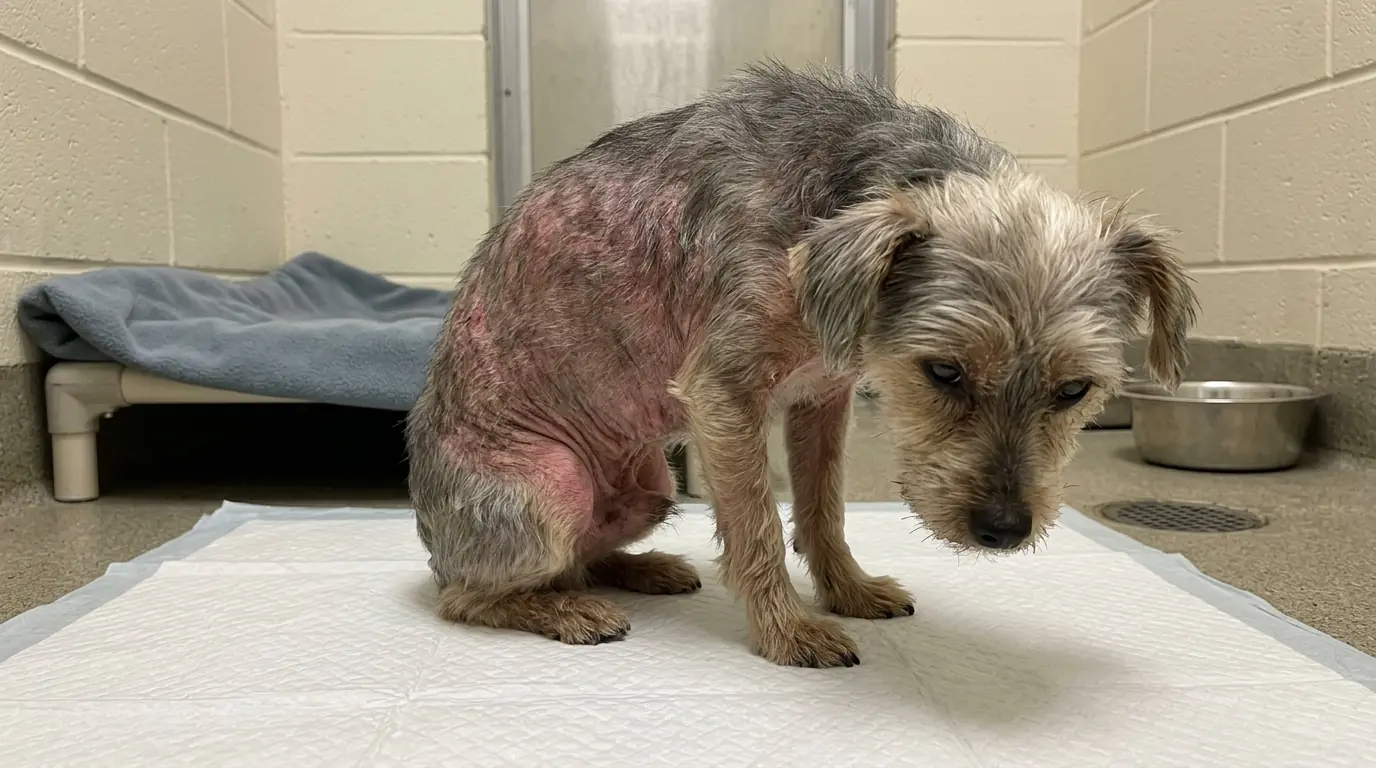
The seven-year-old Yorkshire Terrier mix stands on a clean pee pad inside the medical kennel, his tiny body almost unrecognizable beneath the damage to his skin.
Most of the hair across his back is gone.
His belly is nearly bare.
His legs have extensive hair loss too.
What remains exposed is red, inflamed skin interrupted by crusted areas and raw patches currently undergoing treatment.
Pip's eyes are heavy.
His head keeps dropping.
Eventually, he tries to lie down.
His front legs bend.
His chest lowers.
Then his belly touches the pad.
Pip immediately pushes himself upright.
He stands there for several seconds.
Then tries again.
The result is the same.
By the third attempt, Pip seems too tired to keep searching for another position.
So he sits.
His back rounds.
His thin legs tremble beneath him.
His head slowly drops between his front paws.
And eventually, Pip begins falling asleep sitting upright.
The Pee Pad Is Soft—His Skin Is Just Too Sensitive
Nothing unusual is happening to the bedding.
It is clean.
It is dry.
There is no sharp object beneath Pip.
The problem is the body touching it.
With so much hair missing, Pip has lost much of the natural barrier between his skin and the surfaces around him.
Worse, the exposed skin is already severely inflamed.
Areas along his underside appear particularly difficult for him.
Every time his belly makes contact, Pip reacts.
He Wants to Lie Down
That is important.
Pip is not simply choosing an unusual sleeping position because he prefers it.
His behavior shows repeated attempts to rest normally.
He circles.
He lowers himself.
He almost succeeds.
Then contact with the sensitive skin changes his mind immediately.
It creates a miserable contradiction.
Pip is tired enough to lie down.
His skin is uncomfortable enough to make him get back up.
Severe Skin Disease Can Become Painful
Skin disease is often associated with itching.
But severe cases can involve much more.
Inflamed tissue may become tender.
Secondary infection can increase discomfort.
Repeated scratching or licking can create open areas.
Crusting can pull against surrounding skin when the body bends.
Pressure and friction may become difficult to tolerate.
Pip's behavior cannot tell anyone exactly what sensation he feels.
It does show that contact with certain areas is uncomfortable enough to interrupt one of the most basic things a dog does.
Rest.