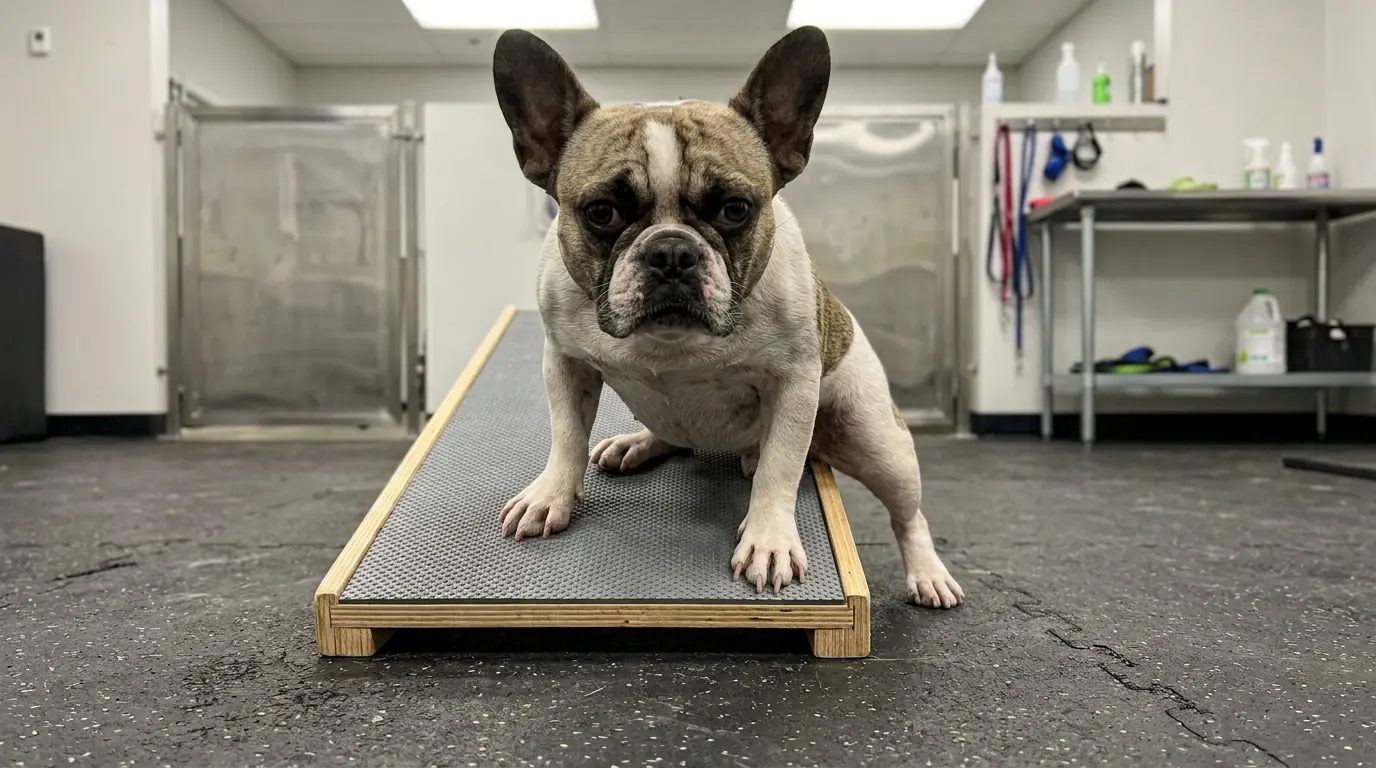
Poppy makes it all the way to the bottom of the ramp.
For the four-year-old French Bulldog, even that matters.
She places one front paw on the low incline.
Then the other.
Her chest rises as she shifts her weight forward.
For a moment, it looks as though the rest of her body will follow.
Then her hind legs begin to tremble.
Poppy tries to push.
Her front paws stay on the ramp, but her back feet start sliding away from it.
Slowly, her hindquarters sink.
Her belly reaches the padded mat beneath her.
And there she stops—front paws still touching the ramp she was trying to climb.
Poppy can reach it now.
What she cannot yet do is lift her body up it.
Her Fracture Has Healed, but Her Body Isn't Finished Recovering
Poppy's original problem was a broken leg.
After weeks of crate rest, that fracture has healed.
But healing a bone and recovering normal physical function are not the same thing.
Extended periods of restricted activity can lead to significant loss of muscle mass and conditioning. In Poppy's case, the muscle wasting is severe enough that even though she can now walk short distances, she does not yet have the strength needed for more demanding movements.
Walking across a level surface is one thing.
Moving uphill is another.
The low ramp exposes that difference immediately.
Poppy has enough ability to reach it.
Her front legs can begin the climb.
But when her hindquarters need to generate enough force to move the rest of her body upward, the trembling starts.
The Ramp Is Low on Purpose
Nothing about Poppy's ramp looks dramatic.
It is not steep.
It is not tall.
It sits over a rehabilitation surface with traction and padding.
For a healthy dog, it might barely register as an obstacle.
For Poppy, the incline changes the physical demand enough to reveal exactly where she is struggling.
On level ground, her body does not have to gain elevation with every step.
On the ramp, it does.
Her hind limbs must contribute to pushing her body upward while maintaining balance.
That requires strength Poppy has not yet rebuilt.
So the ramp does not need to be higher.
Making it more difficult would not tell anyone something they do not already know.
Poppy is not ready to climb it independently.
Her Front Legs Can Get Her Into Trouble
Poppy's front half is capable of starting the task.
That can make the exercise deceptive.
She reaches the base.
Her front paws go up.
Her shoulders move forward.
Her chest rises.
From the front, she appears to be climbing.
But the rear half of her body has to follow.
When the hind legs cannot produce enough controlled force, Poppy ends up in an awkward middle position—front end elevated, back end slipping downward.
Her stronger front half can begin a movement that her weaker hindquarters cannot yet finish.
That is why simply encouraging her forward is not necessarily helpful.
The fact that Poppy wants to continue does not mean her body is ready.
Then the Trembling Starts
The first sign is subtle.
One hind leg shakes.
Then both become less stable.