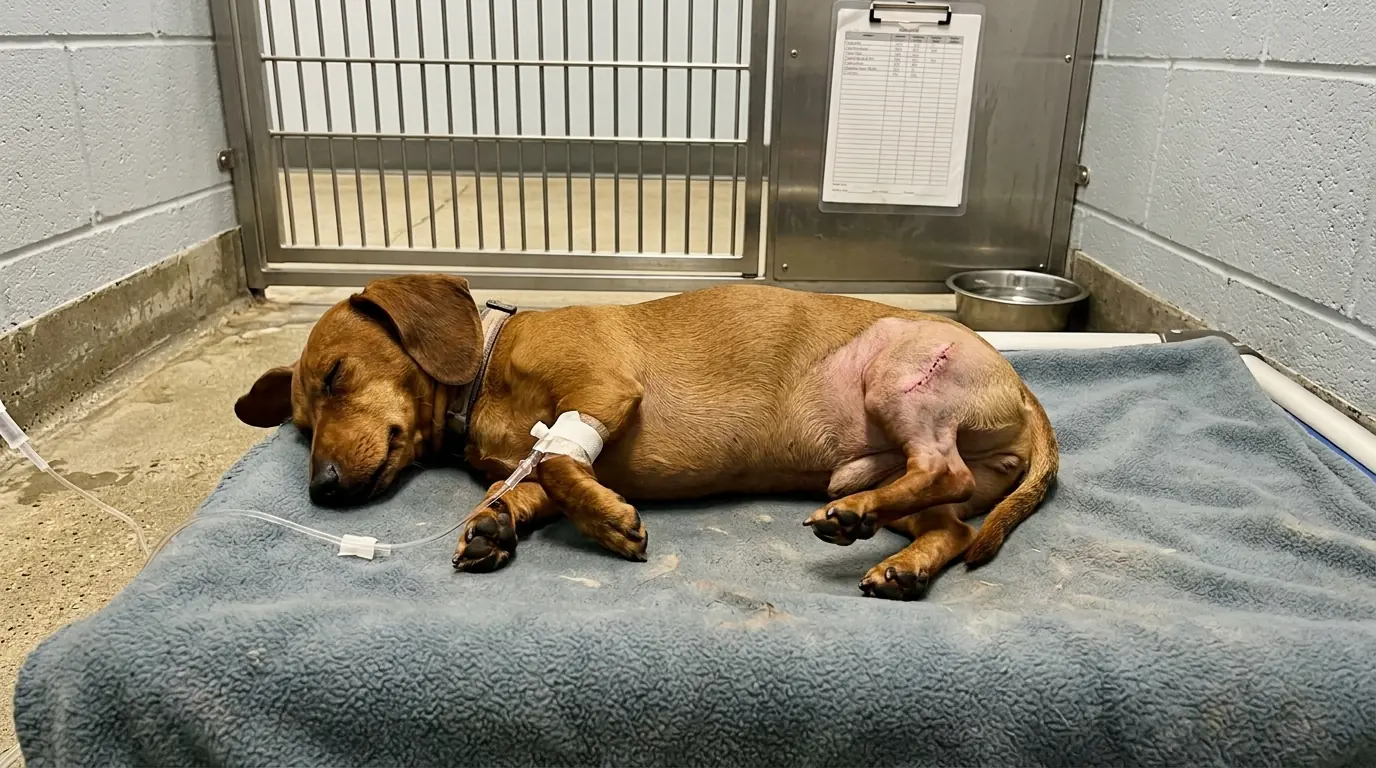
Poppy has three legs now.
When she is awake, there is no mistaking that.
The three-year-old Miniature Dachshund is recovering in a medical kennel after a vehicle accident left one hind leg so badly injured that it had to be amputated.
Her surgical site is healing.
She is learning how to balance differently.
When she stands, her remaining hind leg shifts closer beneath her body to support weight that used to be shared.
When she takes a few careful steps, every movement reflects the new reality of her body.
But when Poppy falls deeply asleep, something strange happens.
Her front paws begin to twitch.
Her remaining hind leg flexes.
The movements grow into the familiar rhythm of a sleeping dog that appears to be running.
Then staff notice Poppy's hip.
On the side where the fourth leg used to be, the muscles move too.
A small contraction.
A release.
Then another.
The rhythm seems to follow the other three legs.
For several seconds, Poppy looks as though her sleeping body is trying to run with all four limbs.
Except one of them is no longer there.
The Accident Changed Poppy's Body Permanently
Poppy survived a serious vehicle accident.
One hind leg could not be saved.
Amputation was not a cosmetic decision or a minor procedure. When a limb is catastrophically damaged and cannot be repaired in a way that offers a comfortable, functional future, removing it can sometimes be the best medical option.
For Poppy, it meant waking up to a body that worked differently than the one she had known for three years.
The injured limb was gone.
The pain associated with that unsalvageable leg could now be addressed through surgery and recovery.
But Poppy still had to learn how to live on three legs.
At First, Standing Was the Hard Part
A hind limb contributes significantly to propulsion and stability.
Losing one changes how weight is distributed.
Poppy's remaining legs suddenly had new jobs.
Her remaining hind leg had to carry more of the work behind her.
Her front limbs helped stabilize her as she adjusted.
Her trunk and back muscles also became important in keeping her balanced.
For a Dachshund, body mechanics deserve particular attention because of the breed's long back and relatively short legs.
Poppy could not simply remove one leg from the equation and move exactly as she had before.
Her entire movement pattern needed to adapt.
She Was Already Trying
During the day, Poppy's progress was visible in small attempts.
She pushed herself upright.
She paused.
Her body swayed slightly as she searched for balance.
Then she took a step.
Sometimes the movement looked awkward.
Sometimes she needed to reposition a paw.
Sometimes she seemed to surprise herself by moving farther than expected.
None of it happened perfectly.
It did not need to.
Poppy was learning.
Sleep Was Supposed to Be the Quiet Part
After the effort of standing and moving, Poppy spent plenty of time resting.
Rest was essential.
Her surgical site needed protection.
Her body needed energy for healing.
Her muscles needed recovery between periods of activity.
In the medical kennel, Poppy could curl into her bedding and finally stop working so hard to balance herself.
That was when staff first noticed the movement.
Poppy was asleep.
One front paw twitched.
Then the other.
Her remaining hind leg flexed.
Nothing about that was especially unusual.
Dogs commonly move during sleep.
Then the muscles around Poppy's amputated side began moving too.
The Missing Leg Seemed to Join the Run
It was subtle.
There was no leg there to extend.
No paw to push against the bedding.
Instead, the movement appeared around the hip and remaining tissues on that side.
A contraction occurred in rhythm with the other limbs.
Then another.
Watching from outside the kennel created an almost impossible visual.
Poppy's body appeared to remember a four-legged pattern even though her waking life now required three.
Dogs Commonly Twitch and Move During Sleep
Sleep movement by itself is not unusual.
Dogs can twitch their paws, move their facial muscles, change their breathing, make small vocalizations, or perform brief running-like motions while asleep.
These movements are often associated with normal sleep processes.
Poppy's case looked especially striking because of the amputation.
Before the accident, running involved four limbs.
Now the visible limb was gone, but muscles and neural pathways elsewhere in the body had not simply disappeared.
That made the movement on her amputated side worth noticing without automatically treating it as something alarming.
Amputation Removes a Limb, Not Every Structure That Once Helped Move It
Movement is produced by a coordinated system.
The brain, spinal cord, peripheral nerves, muscles, joints, and sensory information all contribute.
When a limb is amputated, the removed portion is gone.
But structures higher in the limb and around the pelvis remain.
Some muscles remain.
Some nerves remain.
The nervous system that spent Poppy's entire life coordinating four-legged movement also still exists.
That does not mean anyone can look at a twitch and know exactly what Poppy is experiencing.
But it helps explain why an amputated side can still show muscular activity.
It Was Tempting to Say Poppy Was Dreaming About Running
Maybe she was.
But no one could know.
The sight of three legs moving while the missing side contracts naturally invites a story.
Perhaps Poppy is dreaming about running before the accident.
Perhaps, in her dream, she still has four legs.
It is a touching possibility.
It is not something observers can prove.
All staff could confidently describe was what they saw.
Poppy was asleep.
Her three remaining legs made running-like movements.
Muscles on the amputated side contracted in a similar rhythm.
Whatever Poppy was experiencing remained hers alone.
The Movement Didn't Automatically Mean She Was in Pain
This distinction was important.
A twitch on an amputated side can look unsettling, especially to someone unfamiliar with post-amputation recovery.
But movement alone does not establish pain.
Staff needed to consider the entire dog.
Did Poppy wake suddenly?
Did she cry out?
Was she panting excessively while resting?
Did she repeatedly turn toward the surgical area?
Was the incision swollen, red, opening, or producing abnormal discharge?
Did touching nearby areas produce discomfort?
Those signs would provide different information.
A sleeping muscle contraction by itself could not answer the pain question.
But Post-Amputation Pain Is Something Veterinary Teams Take Seriously
Removing a limb does not mean pain considerations end with surgery.
There is acute postoperative pain from the procedure itself.
There can also be unusual sensory experiences after amputation.
In people, phantom limb sensations and phantom limb pain are well recognized. Veterinary medicine also considers neuropathic and phantom-type pain as possible concerns in animals after limb loss, although animals obviously cannot describe their sensations verbally.
That means caregivers have to rely on behavior, physical examination, and changes in function.
Poppy's sleeping movements therefore deserved observation.
They did not deserve an automatic dramatic diagnosis.
When Poppy Woke, the Running Stopped
The difference between sleep and wakefulness was striking.
A twitch.
Another twitch.
Three paws moving against the bedding.
The amputated side contracting.
Then Poppy opened her eyes.
Everything stopped.
She lifted her head.
For a moment, she remained lying down.
Then she began repositioning herself using the body she actually had now.
Three legs.
One healing surgical site.
A completely new balance.
There was no confused attempt to place a missing paw onto the floor.
Awake, Poppy returned immediately to the practical work of adapting.
Her Waking Body Was Learning Faster Than It Looked
Dogs can often adapt remarkably well to limb loss, although recovery varies with the individual animal, which limb was removed, other orthopedic or neurologic conditions, body condition, age, pain control, and rehabilitation.
Poppy had several things in her favor.
She was young.
She was small.
She still had three functional limbs.
But none of those advantages meant recovery should be rushed.
She needed time.
Her Remaining Hind Leg Now Carried More Responsibility
Every time Poppy stood, the single remaining hind limb had to manage forces that had once been distributed between two.
That made maintaining healthy body weight especially important.
Extra weight would place additional stress on the remaining limbs.
Traction mattered too.
A slippery surface could make balancing much more difficult for a newly three-legged dog.
Her environment therefore needed to support the body she was learning to use.
Stable footing.
Controlled activity.
Comfortable bedding.
Careful monitoring.
Dachshund Anatomy Made Thoughtful Recovery Even More Important
Poppy's long body and short limbs already gave her a distinctive biomechanics before the accident.
Now those mechanics were changing.
Caregivers needed to avoid unnecessary jumping or uncontrolled movement during recovery.
Veterinary guidance would determine when and how activity could safely increase.
The goal was not simply to get Poppy moving as much as possible.
It was to help her develop an efficient, comfortable pattern without overloading the rest of her body.
The First Few Steps Could Look Harder Than the Next Ones
When Poppy rose after resting, she sometimes needed a moment.
Her front paws positioned themselves.
Her remaining hind foot came underneath her.
Her hips adjusted.
Then she stood.
The first step could be hesitant.
The second looked more organized.
After a few steps, Poppy sometimes found a rhythm.
That pattern showed how much coordination was happening behind something as ordinary as crossing a kennel.
Before the accident, Poppy never needed to think about balancing on three legs.
Now every waking movement was practice.
Her Body Was Building a New Pattern
Over time, animals can adapt their gait after limb loss.
Poppy would need to redistribute weight and coordinate her remaining limbs differently.
Muscles that once played supporting roles might work harder.
Her center of mass and balance strategy had changed.
Rehabilitation, when recommended by her veterinary team, could help strengthen the appropriate muscle groups and encourage safe movement.
The fascinating contrast was that Poppy's waking body was building this new three-legged pattern while her sleeping movements sometimes appeared to echo the old one.
One Night, the Motion Lasted Only a Few Seconds
Poppy was curled on her side.
The medical kennel was quiet.
Her breathing had become slow and regular.
Then her front paw moved.
A tiny flick.
Her other front leg followed.
Her remaining hind leg began making short rhythmic motions against the blanket.
Then came the hip contraction on the amputated side.
Once.
Twice.
Again.
The rhythm continued for several seconds.
Poppy did not wake.
Then the movement faded.
Her body became still.
A few minutes later, she shifted deeper into the bedding and continued sleeping.
The Surgical Site Still Needed Protection Even During Normal Movement
Poppy could not understand incision-care instructions.
If she became active too quickly, slipped, jumped, or disturbed the area, complications could occur.
That was one reason the medical kennel mattered.
It limited uncontrolled activity while allowing staff to monitor her.
The incision could be checked.
Pain control could be adjusted if needed.
Her appetite, hydration, elimination, mobility, and overall comfort could be followed.
The quiet environment also gave her something she badly needed.
Time.
Losing a Leg Did Not Make Poppy Fragile Forever
There is a tendency to see a three-legged dog and focus only on what is missing.
Poppy's recovery offered another perspective.
She still had three functioning limbs.
She still had muscle.
She still had curiosity.
She still wanted to move.
Once medically cleared, many tripod dogs can return to satisfying, active lives with appropriate management.
That future could not be promised for any individual dog without knowing the full medical picture.
But amputation itself did not mean Poppy's movement was over.
In some ways, movement was exactly what her body was now relearning.
The Biggest Risk Was Asking Too Much Too Soon
Poppy occasionally seemed ready to do more than her recovery plan allowed.
Young dogs do not necessarily understand why their activity has been restricted.
Feeling better can arrive before tissues are ready for unrestricted movement.
That meant caregivers sometimes had to protect Poppy from her own enthusiasm.
A dog who suddenly tries to hurry on three legs can lose balance.
A slip could strain another limb.
A jump could affect the healing area.
Patience was part of rehabilitation.
Her Sleep Movements Became a Strange Marker of How Much Had Changed
During the day, everyone could see Poppy learning.
Three paws on the floor.
One hind leg doing the work of two.
A careful turn.
A pause before standing.
At night, the picture was different.
Her body relaxed.
The deliberate adjustments disappeared.
Then those little running motions sometimes began.
For a few seconds, the old rhythm seemed to surface.
It made the amputation look both incredibly permanent and strangely recent.
The leg was gone.
The movement pattern had existed for Poppy's entire life until the accident.
Staff Watched Without Waking Her
If Poppy remained comfortable and the movements looked like ordinary sleep twitching, there was no reason to interrupt every episode simply because it looked unusual.
Rest was valuable.
What mattered was watching for changes that might indicate discomfort or a medical concern.
If the episodes became unusual in character, occurred while awake, were accompanied by distress, or raised concern for seizure activity or pain, veterinary reassessment would be important.
Observation mattered more than assumptions.
The Difference Between Twitching and a Medical Emergency Matters
Not every sleeping movement is benign, and not every movement is a seizure.
Context is critical.
Normal sleep twitching tends to occur while an animal is sleeping and can include brief movements of limbs or facial muscles.
More concerning episodes may involve other features, including abnormal activity while awake, loss of responsiveness in an unusual context, prolonged or violent movements, autonomic signs, or difficult recovery afterward.
Anyone concerned about a recovering dog's movements should document what they see and discuss it with the veterinary team rather than trying to diagnose the event from appearance alone.
For Poppy, her known surgical and trauma history made careful monitoring especially appropriate.
Her Missing Side Sometimes Moved More Subtly Than the Others
The three paws made the running illusion obvious.
The amputated side was different.
There was no lower leg tracing the motion.
Instead, staff saw the remaining muscles near the hip tighten and release.
Sometimes the movement was so slight that it could be missed.
Once you knew to watch for it, however, it was difficult not to notice.
Three legs moved.
Then the fourth corner of Poppy's old running pattern seemed to answer.
No One Knew Whether Poppy Noticed the Difference in Her Dreams
That was the question people naturally wondered about.
Did Poppy dream with four legs?
Did her sleeping brain still expect a paw where none remained?
Did she experience any sensation from the missing limb?
There was no way for her to tell anyone.
Turning those questions into certainty would make the story more dramatic.
Leaving them unanswered was more truthful.
Poppy's movements were remarkable enough without pretending to know the content of a dog's dream.
During the Day, She Was Beginning to Trust Three Legs
That was the progress people could actually measure.
Poppy could stand a little more steadily.
Her turns became more controlled.
She needed fewer corrections when repositioning herself.
She was learning where her body ended now.
That learning mattered far more to her recovery than the mystery of what happened during sleep.
Her future depended on the movements she could make while awake.
Then Came Her First Attempt to Move Too Fast
Poppy saw something interesting beyond the immediate area.
Her body reacted with the enthusiasm of a three-year-old dog before her balance caught up.
She pushed forward.
The front legs moved quickly.
Her remaining hind leg followed.
For a moment, her hips shifted toward the missing side.
Poppy corrected herself.
She slowed.
That small stumble was a reminder.
Her mind might be ready to hurry.
Her new gait was still under construction.
Learning to Stop Could Be as Important as Learning to Walk
Forward movement is only one part of mobility.
A three-legged dog also has to turn, stop, sit, lie down, rise, and navigate changes in surface.
Stopping can require quick redistribution of weight.
Turning can challenge balance.
Poppy needed control, not simply speed.
Every careful repetition helped her build a movement strategy appropriate for her new body.
The Old Four-Legged Rhythm May Fade—or It May Occasionally Remain Visible
No one could predict exactly how Poppy's sleeping movements would change.
Perhaps the hip contractions would become less noticeable as her recovery progressed.
Perhaps she would occasionally continue making similar sleep movements.
The behavior did not need a perfect ending to be meaningful.
It was simply one small window into the complicated relationship between anatomy, nervous-system patterns, sleep, and adaptation after a major physical change.
Poppy Is Not Waiting for Her Leg to Come Back
When awake, she is already adapting to its absence.
That distinction is important.
It would be easy to frame Poppy as a dog confused by a missing limb.
Her actual behavior was more capable than that.
She adjusted.
She balanced.
She tried again.
Her remaining limbs began reorganizing around the new demands placed on them.
Poppy was not standing still in recovery.
Her body was learning.
But Sleep Reveals Something Her Waking Steps Don't
Late in the medical kennel, Poppy finally relaxes.
Her head rests against the bedding.
Her breathing slows.
The healing side of her body is supported carefully.
For a while, nothing moves.
Then one front paw twitches.
The second follows.
Her remaining hind leg begins flexing in short, quick movements.
Poppy looks like she is running somewhere.
Then the muscles near the hip where her other hind leg used to be begin contracting too.
Once.
Again.
In rhythm.
For several seconds, all four corners of an old movement seem to exist again, even though only three legs remain.
Then the motion stops.
Poppy keeps sleeping.
By morning, she will wake and continue practicing the new way her body must move—balancing, turning, and taking another careful series of three-legged steps.
But when she falls asleep again, staff may see that old rhythm return.
And it leaves one question that no one standing outside Poppy's kennel can answer:
When her sleeping body starts running with a leg that is no longer there, is it simply an old motor pattern firing through the muscles that remain—or, somewhere inside Poppy's sleeping mind, is she still running on all four?