At seven years old, Tucker has learned that the busiest part of the shelter day usually happens on the other side of his kennel door.
He is a black Labrador Retriever mix, broad through the shoulders, with a dark coat that makes the bright orange ball he carries around the exercise yard impossible to miss.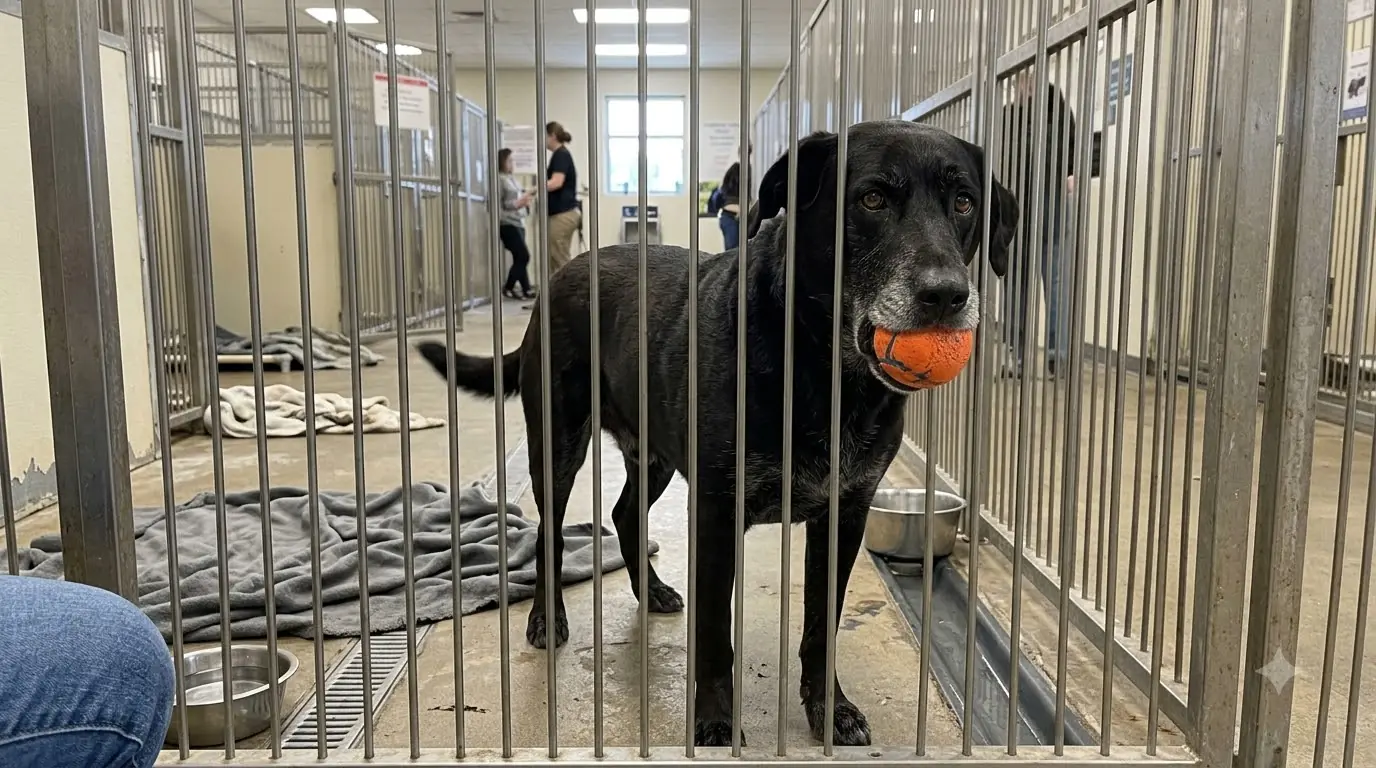
Inside his kennel, though, Tucker is easy to miss.
That has become the central challenge of his search for a home.
When visitors enter the adoption room, some dogs immediately hurry forward. Kennel doors rattle. Tails move. Paws reach toward the glass or gate. A few dogs bark because they are excited or overwhelmed by all the activity.
Tucker usually does none of that.
He stays on his blanket.
He lifts his head when he hears footsteps. He watches people move down the row. Sometimes his tail gives a slow movement against the bedding.
But he rarely gets up immediately.
And in an adoption room where a first impression can happen in seconds, those extra moments matter.
By the time Tucker decides to stand, stretch, and walk toward the front, the person who caught his attention may already be looking at the next dog.
How Tucker Came Into Care
Tucker arrived at the shelter as an adult dog.
There is only limited information about his life before intake, so there is no dramatic backstory attached to his profile. The shelter cannot say with certainty what his previous home was like or explain every behavior he shows today.
What staff can describe is the dog they have come to know since he arrived.
His intake examination showed an adult Labrador mix entering the stage of life when dogs often become a little more settled. He was no longer an adolescent bouncing toward every new sound, but he was still active enough to enjoy walks, yard time, toys, and games of fetch.
The shelter environment required some adjustment.
There were unfamiliar smells everywhere. Dogs barked from nearby kennels. Doors opened and closed throughout the day. Cleaning equipment moved through the building. Different people passed his enclosure.
Tucker responded by observing.
During his first days, he spent a lot of time toward the quieter part of his kennel. He ate, went outside when it was his turn, and gradually became familiar with the daily routine.
He was not constantly hiding.
He was not showing that he wanted to avoid people altogether.
He simply did not compete for attention.
That distinction became increasingly important.
The Dog Who Doesn't Advertise Himself
Shelter visitors often have only a limited amount of time.
They walk down a row and naturally notice movement.
A dog standing at the door is easy to see.
A dog wagging enthusiastically may create an immediate connection.
A puppy bouncing around with a toy can make someone stop before they have even read the kennel card.
Tucker tends to wait.
When footsteps enter his section, he often raises his head from his blanket first.
His eyes follow the visitor.
If the person remains nearby, Tucker may sit up.
Give him a little more time and he will often stand and approach.
But many interactions never reach that third step.
It would be impossible to know why every person who has walked past Tucker chose another kennel. Some may have been looking for a smaller dog. Others may have wanted a puppy, a younger adult, a particular breed, or a dog whose personality seemed obvious immediately.
Tucker also faces two practical realities that can make an individual dog less noticeable in a busy shelter.
He is seven years old, which means families specifically searching for young dogs may pass him by before learning anything else about him.
And his dark coat can make his expressions less visually obvious from a distance or in uneven kennel lighting, especially when he is sitting quietly against his bedding.
Neither characteristic says anything about what Tucker would be like in a home.
But together with his reserved kennel behavior, they mean Tucker often does not make the loudest first impression.
The result is visible almost every adoption day.
Someone enters.
Tucker watches.
The person stops two kennels away.
A leash comes out.
A neighboring dog leaves for a meet-and-greet.
Tucker eventually walks to his door.
The hallway is already quiet again.
What Happens When Tucker Gets Outside
Take Tucker out of the adoption room and the picture changes quickly.
He still isn't the loudest dog in the building.
He doesn't need to be.
Once his leash is clipped on and he realizes he is heading outside, he walks with the steady interest of a dog who knows this part of the routine.
He sniffs along the way without trying to turn every few feet into a race.
Then comes the orange ball.
The ball has become one of the easiest ways to see Tucker's personality.
In the exercise yard, he will carry it in his mouth as he moves around, sometimes holding it while he investigates a patch of grass or watches activity beyond the fence.
When he wants someone to throw it, he doesn't make much of a production.
He brings it close.
He drops it nearby.
Then he waits.
Throw it, and Tucker goes after it.
When he returns, the same quiet transaction begins again.
Ball down.
Wait.
Another throw.
It is an uncomplicated game, and Tucker appears perfectly happy with it.
Afterward, he may settle beside the gate rather than pacing or barking for more attention.
That is the version of Tucker most casual visitors never see.
The dog sitting silently on a blanket inside becomes a companion walking beside someone outside.
The dog who doesn't push himself toward the kennel door begins bringing over a toy.
The dog who looked almost disengaged from across the adoption room starts checking whether someone is ready for another throw.
His personality is not absent inside the kennel.
It simply takes longer to appear.
Seven Is Not Finished
Tucker's age is another part of his adoption story.
At seven, he is not a puppy.
He also isn't necessarily a dog who wants to spend every hour sleeping.
For many Labrador-type dogs, seven can fall somewhere between energetic young adulthood and the slower senior years. Individual health and activity levels vary, which is why the shelter evaluates Tucker based on the dog in front of them rather than a number alone.
Tucker still enjoys going outside.
He still wants his ball.
He still explores.
He still engages with familiar people.
But he also knows how to settle.
That combination may be valuable for the right household.
It simply does not have the immediate visual appeal of a puppy climbing toward the front of a kennel.
People looking specifically for a young dog may continue walking after seeing Tucker's age.
That is not wrong.
Adopters need to choose animals whose expected needs fit their households.
The difficulty for Tucker is that someone who dismisses him based only on age never gets far enough to discover what seven actually looks like for him.
For Tucker, it currently looks a lot like an orange ball traveling across an exercise yard.
His Veterinary Care
Tucker received routine veterinary assessment as part of his care.
Because he is a mature adult dog, his condition is considered in the context of his age rather than treating every normal change as a medical problem.
His mobility is watched during walks and play. His weight and body condition are monitored, and routine preventive care is maintained according to the shelter's veterinary protocols.
At this point, Tucker's story is not centered on a major medical condition.