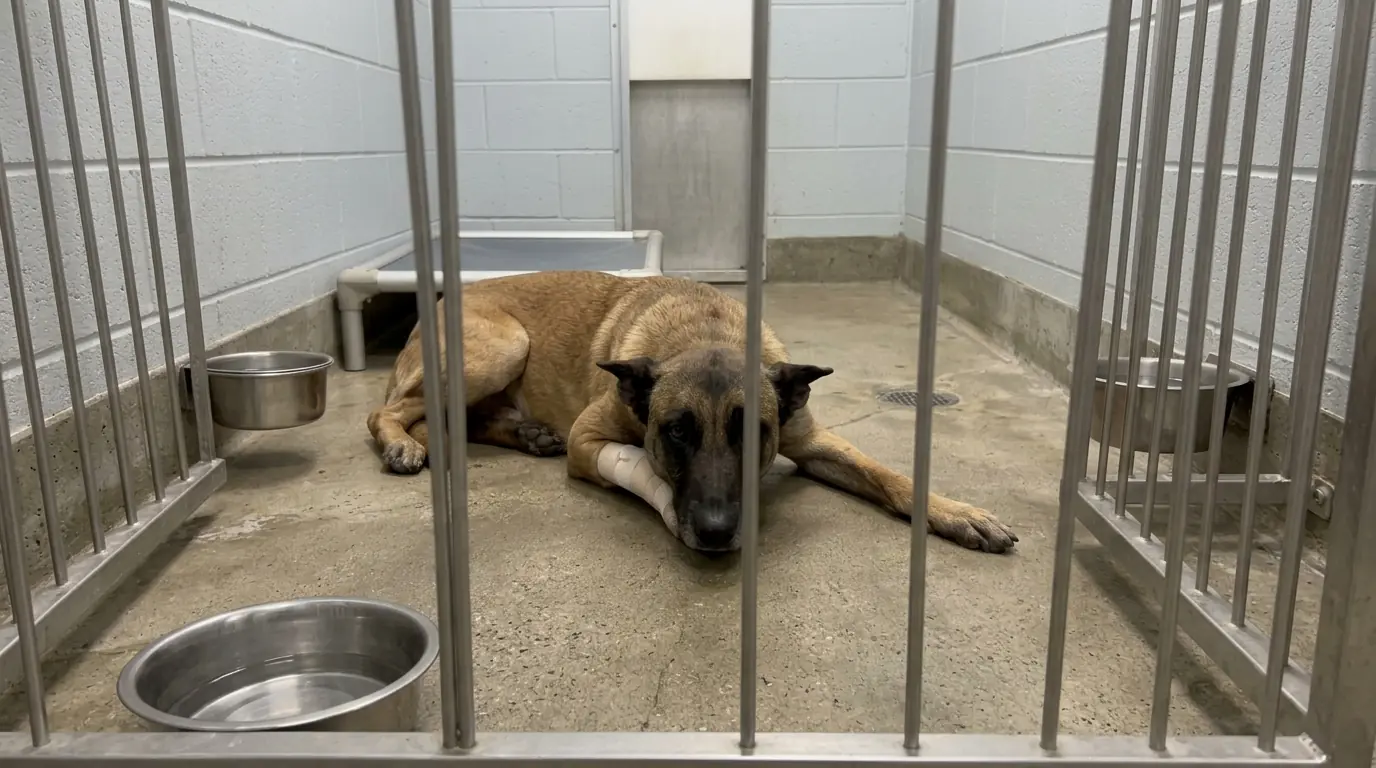
Most of the time, Ranger looks composed.
The eight-year-old Belgian Malinois walks slowly around his shelter kennel, stopping occasionally to sniff near the gate or reposition himself on his bed. One front leg bears the visible signs of the serious injury and surgery that ended his ability to return to police work.
His movement is more careful now.
But he can still walk.
He can still stand.
He can still watch everything happening beyond the kennel door with the intense attention common to dogs accustomed to structured work.
Then somewhere down the hallway, a stainless-steel bowl slips from someone’s hands.
It hits the floor.
CLANG.
Ranger drops instantly.
His chest hits the ground.
His body flattens.
The injured front leg pulls tightly toward his chest.
Then he becomes almost completely still.
The bowl stopped moving seconds ago.
The hallway is quiet again.
But Ranger remains pressed against the floor.
Thirty seconds pass.
Then a minute.
His ears move at another distant sound, but the rest of his body stays down.
Whatever happened in the hallway lasted only an instant.
For Ranger, the reaction lasts much longer.
Ranger’s Working Career Is Over
Before arriving at the shelter, Ranger had served as a police K-9.
That history matters because working dogs live highly structured lives built around repetition, cues, environments, equipment, and close coordination with handlers.
But Ranger’s circumstances have changed.
A serious injury to one front leg required surgery.
Although the exact long-term limitations depend on his orthopedic and rehabilitation assessments, Ranger is no longer physically able to return to the demands of police work.
For a Belgian Malinois accustomed to activity, that is a substantial change in daily life.
Yet the most noticeable behavior in the kennel does not happen when Ranger tries to run.
It happens when metal hits metal.
The Sound Produces a Reaction Before Ranger Seems to Think About It
There is almost no hesitation.
A bowl falls.
A kennel latch slams sharply.
Something metallic crashes in the hallway.
Ranger goes down.
Not several seconds later.
Immediately.
His elbows fold.
His chest drops.
His head lowers.
And the surgically treated leg comes off the floor and tucks toward his body.
It is the consistency of that sequence that gets attention.
The Injured Leg Is Always Protected
When Ranger drops, he does not simply lie down normally.
He protects the same limb.
The injured front leg folds toward his chest while the other front leg takes more of the movement needed to lower him.
That may reflect discomfort, learned protection of the limb, or both.
Dropping rapidly is physically demanding.
For Ranger, it also risks loading or twisting a leg that has already undergone major treatment.
So the reaction is not only emotionally striking.
It can become a physical safety concern.