It explained part of his rapid breathing—but not all of it.
The swelling in his neck contained a combination of blood, injured tissue and air that had traveled beneath the skin. If it continued expanding, it could compress his airway or major blood vessels.
Ranger was fighting two emergencies at once.
The medical team prepared to remove the trapped air from his chest.
A section of fur was clipped and the skin was cleaned. A needle and catheter were carefully introduced into the chest cavity while Ranger remained on oxygen.
Air began filling the attached syringe.
The team withdrew it slowly, pausing to monitor his heart rate and breathing. After the first large volume was removed, Ranger’s chest began moving more evenly.
His breathing remained labored.
More air continued accumulating, suggesting that the leak had not sealed.
A temporary chest tube would likely be necessary.
Before placing it, the team stabilized Ranger’s blood pressure and collected blood for testing. The results showed anemia, elevated markers of tissue damage and changes consistent with shock.
His red blood cell level was concerning but not yet low enough to require an immediate transfusion.
Broad-spectrum antibiotics were started because the bite wounds had driven contamination deep beneath the skin. Pain medication had to be balanced carefully against Ranger’s low blood pressure and respiratory condition.
The collar he had been wearing during the attack was removed.
It was torn through one side and marked with several fresh punctures.
Beneath it, bruising circled much of Ranger’s neck.
The pattern suggested that the attacking animal had attempted to seize him there. His dense Cattle Dog coat and collar may have provided some protection, but the force had still damaged the tissue underneath.
Once Ranger’s circulation became slightly more stable, the chest tube was placed.
Air was removed again, and the tube was secured so the team could continue draining the area without repeatedly inserting a needle.
Ranger’s breathing eased enough for him to rest his muzzle against the folded towel beneath his head.
For the first time since arrival, his heart rate began to slow.
The improvement was encouraging, but the swelling in his neck continued to increase.
Ultrasound showed pockets of fluid within the damaged tissue. Some appeared to be blood, while other areas contained air tracking from the chest wounds.
The veterinarian could not yet rule out damage to Ranger’s throat or esophagus.
If either structure had been torn, infection could spread rapidly through his neck and chest.
A careful examination under anesthesia would eventually be required.
Ranger was not stable enough for it yet.
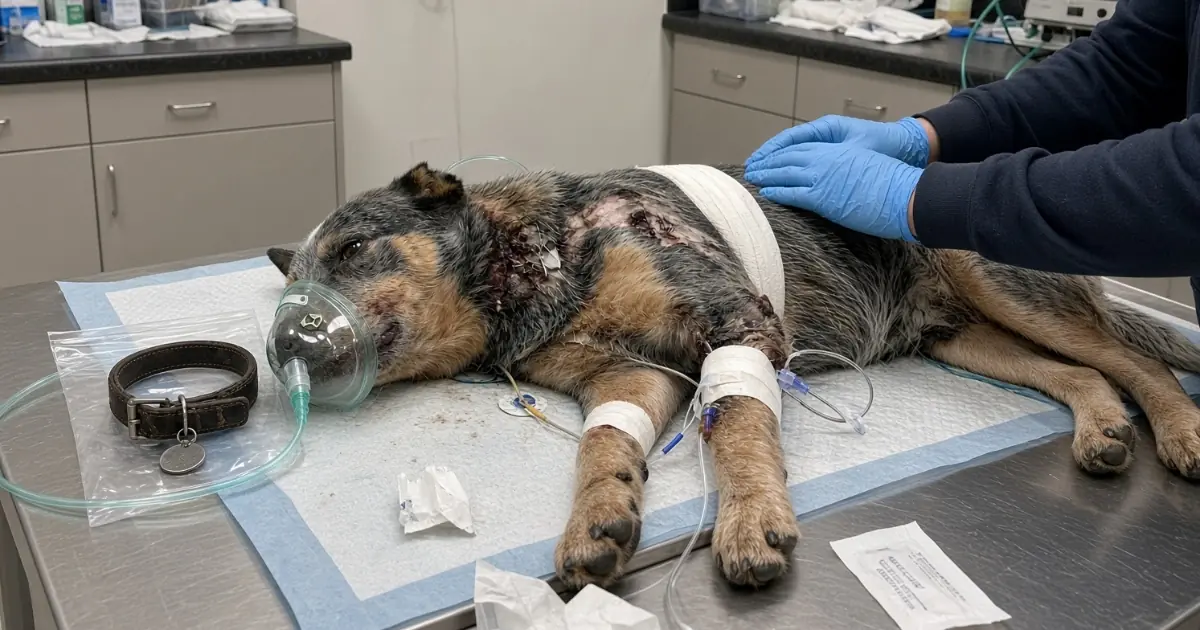
During the first several hours, clinic staff remained beside him almost continuously. Oxygen flowed through a mask positioned over his muzzle, and the chest tube was checked repeatedly.
Ranger rarely moved.
When someone touched his front paw, his toes flexed once against the blanket. When the oxygen mask shifted, he lifted his head less than an inch before letting it fall again.
His eyes stayed open.
They followed activity in the room even when the rest of his body could no longer respond.
By evening, Ranger’s blood pressure had improved enough for additional imaging.
A contrast study did not reveal an obvious tear in his esophagus. His trachea appeared compressed by the swelling but remained intact.
The news offered some relief.