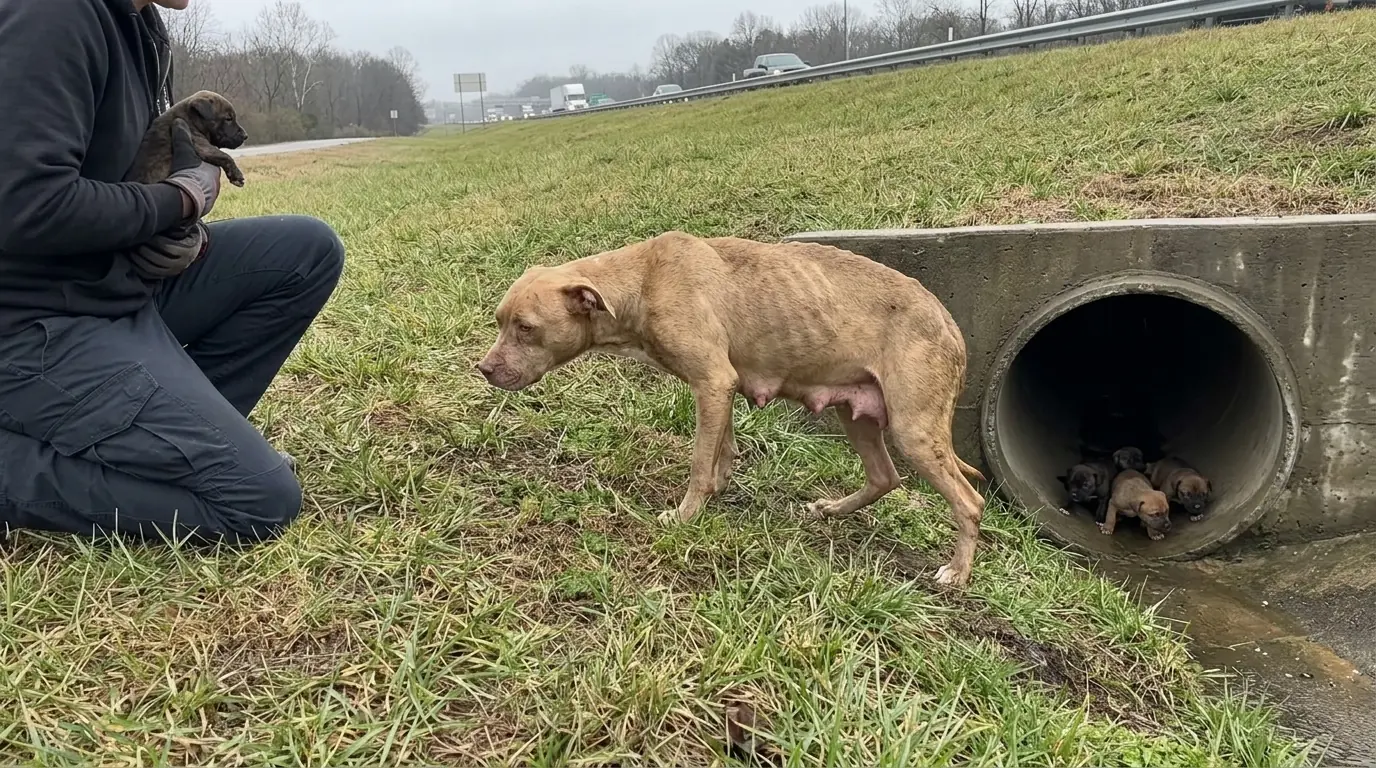
Drivers Kept Seeing the Same Thin Dog Run Toward the Drainage Ditch
Daisy was first noticed near a highway rest area by drivers who saw the same dog appearing again and again along the grassy edge of the property.
She was an adult Pit Bull mix, visibly thin even from a distance.
What caught people's attention was not simply that she was loose near a busy highway.
It was the route she kept taking.
Daisy would appear near the parking area, scan the surroundings, then trot back toward a drainage structure at the edge of the grass.
A short time later, she would come out again.
Then she would repeat the same path.
One driver watched her make the trip several times and contacted animal control.
By the time rescuers arrived, Daisy had moved back toward the drainage area.
She did not run far when people approached.
Instead, she stayed within a relatively small radius, looking toward the ditch and then back toward the rescuers.
Her body condition immediately raised concern.
Her ribs were visible.
Her waist was sharply defined.
Her mammary glands showed that she was actively nursing.
That changed the entire search.
There were almost certainly puppies somewhere nearby.
The Drain Was More Than a Place to Hide
Rescuers began following Daisy's repeated path rather than trying to catch her immediately.
The drainage system ran beneath part of the grassy edge near the rest area.
It was not a large culvert that a person could easily walk into.
The opening narrowed quickly, and visibility inside was poor.
Daisy approached it without hesitation.
She lowered herself and disappeared partly into the opening.
A rescuer crouched several feet away and listened.
At first there was only highway noise.
Then came a faint sound from inside.
Puppies.
Daisy backed out.
She looked toward the rescuers.
Then she went in again.
That was the moment the team knew the rescue would involve more than securing one adult dog.
There was a litter inside the drainage structure.
Four Puppies Were Hidden Far Enough Back to Stay Out of Sight
Using flashlights and careful positioning from outside, rescuers were able to confirm four small puppies inside.
They were still young enough to be nursing.
The puppies had remained beyond casual view from the rest-area parking lot, which likely explained why motorists had repeatedly noticed Daisy without seeing them.
The drainage space had provided some protection from open exposure.
It also created risks.
A sudden storm could change water flow quickly.
The area was close to highway traffic.
The puppies were too young to safely navigate the surroundings on their own.
And Daisy's poor body condition suggested that sustaining four nursing puppies was placing significant demand on a body that already had little reserve.
The priority was clear.
The entire family needed to come out.
Daisy Did Not Simply Leave When Food Appeared
A high-value food lure was placed near the opening.
Daisy was hungry.
That was obvious.
She sniffed the food and took a few bites.
Then she turned back toward the drain.
Rescuers did not try to drag her away.
Doing so could have increased her stress and made recovering the puppies more difficult.
Instead, one team member remained focused on Daisy while the others prepared to remove the puppies safely.
The location made the process awkward.
There was limited space to work.
The puppies had to be reached one at a time.
And Daisy needed to remain secure without being physically restrained more than necessary.
A slip lead was eventually placed on her.
She tolerated it, but her attention stayed almost entirely on the opening.
She Crawled Back Down Before the First Puppy Came Out
As a rescuer prepared to reach into the drainage structure, Daisy moved forward.
She lowered herself and crawled partly inside first.
Nobody forced her back immediately.
The team allowed her a moment to investigate.
Then she backed out.
The first puppy was carefully brought forward.
Daisy immediately approached.
She sniffed the puppy from nose to tail.
Only after she had checked it did the puppy go into a prepared crate lined with clean towels.
Daisy watched.
The rescuer reached in for the next puppy.
Daisy went down again.
The same sequence repeated.
She entered first.
She came back.
A puppy came out.
She inspected the puppy.
Then the puppy was placed with its sibling.
By the time the fourth puppy was removed, staff had seen the pattern enough times to stop treating it as coincidence.
We cannot know what Daisy understood about the rescue effort.
We cannot say what she was thinking.
What we can say is that she repeatedly returned into the drainage space before or during the removal of each puppy and remained intensely focused on each one as it was brought out.
The Last Puppy Changed Her Behavior
Once the fourth puppy was placed into the transport crate, the sound inside the drain changed.
There were no more puppy vocalizations coming from the structure.
Daisy approached the opening again.
She sniffed.
She stepped partly inside.
Then she backed out.
A rescuer checked the area carefully to make sure no additional puppies had been missed.
None were found.
The litter consisted of four.
Daisy returned to the crate.
She stood beside it while the puppies shifted against one another.
This time, when food was offered again, she ate more steadily.
Transport Had to Keep the Family Together Without Letting Nursing Continue Unrestricted
Daisy and the puppies were transported to the rescue together.
The puppies were kept warm and secure.
Daisy was positioned close enough to see and smell them.
Because she was so thin, however, unrestricted nursing was not going to be sustainable without veterinary assessment.
A lactating dog can have extremely high nutritional demands.
When the mother is already underweight, producing milk for multiple puppies can further deplete body fat and muscle.
The goal was not to abruptly separate Daisy from the litter.
The goal was to evaluate everyone and then support the puppies in ways that reduced the burden on their mother.
Daisy's Intake Examination Confirmed Significant Nutritional Depletion
At the clinic, Daisy received a complete physical examination.
She was alert.
She was responsive.
She was clearly tired.
Her body condition was poor enough that the team documented substantial loss of both fat and muscle.
Her ribs were prominent.
The muscles over her spine and hindquarters were reduced.
She had mild dehydration.
Her paws were dirty and worn from being outdoors, but there were no severe open injuries.
Her mammary glands were enlarged from nursing and were checked carefully for heat, pain, abnormal firmness, discharge, or other signs that could suggest mastitis.
Fortunately, the initial examination did not reveal obvious evidence of severe mammary infection.
Her temperature was normal.
Her heart and lungs were assessed.
Her abdomen was palpated.
Her mouth and teeth were examined.
A fecal sample was collected.
Bloodwork was performed because severe weight loss in a nursing dog cannot responsibly be attributed to motherhood alone without checking for other problems.
The Veterinary Team Needed to Know Whether Thinness Was the Whole Story
Daisy's bloodwork showed changes consistent with dehydration and nutritional strain, but there was no immediate evidence of severe organ failure or a major systemic infection.
Her protein status required monitoring because lactation, poor intake, and prolonged nutritional depletion can all affect it.
Fecal testing was performed to screen for intestinal parasites that could complicate weight restoration.
Preventive care was planned according to her condition and nursing status.
There was no dramatic hidden disease discovered on the first day.
That was a good thing.
Her main problem appeared to be exactly what rescuers could already see.
She had been trying to maintain herself while feeding four growing puppies.
Her body had fallen behind.
Each Puppy Was Examined Individually
The puppies were not treated as a single unit.
Each one was weighed.
Each received an individual record.
Hydration was assessed.
Heart and lungs were checked.
Abdomens were palpated.
Skin, eyes, ears, mouths, and limbs were examined.
Because young puppies can deteriorate quickly, staff paid close attention to temperature, energy level, nursing behavior, and body weight.
All four puppies were small but active.
None showed an immediate life-threatening problem at intake.
That did not mean they could simply be left to nurse as often as they wanted.
Daisy needed relief.
The puppies needed predictable nutrition.
Supplemental Feeding Became Part of the Plan Immediately
Based on the puppies' estimated age and physical development, the veterinary team introduced age-appropriate supplemental feeding.
The exact method depended on what each puppy could manage safely.
Because they were still nursing, they were allowed continued access to Daisy during supervised periods.
But the puppies also began receiving nutrition separately so their entire caloric intake did not have to come from her.
That was important for both sides.
The puppies could continue growing.
Daisy could begin keeping more of her own calories.
The transition was gradual.
Nobody expected four nursing puppies to become independent overnight.
Daisy's First Meal at the Rescue Was Carefully Measured
Seeing an emaciated nursing mother creates a strong emotional urge to fill a large bowl and keep refilling it.
That is not always the safest way to restore a severely depleted dog.
Daisy's food was divided into multiple meals.
Her portions were increased according to veterinary guidance and gastrointestinal tolerance.
The diet was nutritionally complete and sufficiently calorie-dense to support recovery.
Staff tracked how much she ate.
They tracked water intake.
They monitored stool.
They watched for vomiting, abdominal discomfort, weakness, or other signs that would require adjusting the plan.
Daisy ate enthusiastically.
But even at the first feeding, the puppies still took priority in her attention.
When they vocalized from the adjacent pen, Daisy stopped eating and looked toward them.
The bowl could wait.
She wanted to know where the sound was coming from.
Her Recovery Area Was Built Around Staying Close Without Being Drained
The puppies were set up in a secure pen directly beside Daisy's medical recovery space.
They could hear one another.
They could smell one another.
Daisy could see them.
But the puppies could not climb onto her or nurse whenever they wanted.
That allowed staff to control contact.
Daisy received a large padded bed with clean blankets.
Her food and water were kept nearby.
She did not need to walk far.
The puppies had warming support as needed, washable bedding, and a feeding area of their own.
Supervised nursing sessions continued.
Afterward, Daisy was allowed to rest separately.
At first, she rarely used the entire bed.
She tended to lie along the edge closest to the puppy pen.
Every Puppy Noise Still Brought Her Up
The first few nights were difficult for Daisy.
She was exhausted enough to sleep deeply for short periods.
Then a puppy would squeak.
Daisy's head would lift.
If the sound continued, she tried to stand.
Staff did not want her repeatedly getting up when she needed rest.
So the environment was adjusted again.
Her bed was moved directly alongside the puppy pen.
Now she could remain lying down and still sniff the puppies through the barrier.
That helped.
When they stirred, Daisy could raise her head without crossing the recovery enclosure.
Sometimes she pressed her nose near the barrier.
The puppies often settled again.
Then Daisy lowered her head.
Rest Was Treatment Too
Nutrition gets most of the attention in stories about underweight dogs.
Sleep mattered just as much.
Daisy had likely been balancing nursing, finding food and water, moving between the drain and the surrounding area, and responding to environmental threats.
At the rescue, she no longer needed to do any of those things.
There was clean water beside her.
Meals arrived.
The puppies were contained safely.
The room stayed warm.
Nobody expected her to patrol anything.
For the first several days, Daisy slept for long stretches between meals, bathroom breaks, and supervised time with the puppies.
Staff protected that sleep.
If a nonessential procedure could wait, it waited.
Her Weight Could Not Be the Only Measure of Recovery
Daisy was weighed regularly.
The first goal was stabilization.
Then gradual gain.
But numbers alone were not enough.
Lactation complicated the picture.
Her caloric output changed as the puppies received more supplemental nutrition.
Hydration affected daily weight.
The team therefore looked at several markers together.
Was her appetite consistent?
Was she maintaining hydration?
Were her stools normal?
Was her energy improving?
Was she beginning to regain muscle?
Were her mammary glands comfortable as nursing frequency changed?
Were the puppies gaining appropriately?
All of those questions mattered.
One Puppy Gained More Slowly Than the Others
During the first week, regular weigh-ins showed that one puppy was not gaining at the same rate as the littermates.
The puppy remained active and continued eating, but the trend was enough to prompt closer evaluation.
Young puppies have little room for prolonged poor intake.
The veterinary team examined the puppy again.
There was no obvious congenital abnormality or acute illness detected on the repeat physical exam.
Feeding was adjusted.
The smaller puppy received more individualized observation during supplemental meals and nursing sessions.
Within several days, the weight trend improved.
That was not a dramatic medical crisis.
But it was exactly the kind of small problem that routine monitoring is designed to catch early.
Daisy Began Standing More Strongly
A few days after intake, caregivers noticed a change in the way Daisy stood up.
At first, she moved like every action required planning.
Front legs first.
Pause.
Hindquarters up.
Pause again.
Then walking.
As calories, hydration, and rest began helping, the sequence became smoother.
She still looked thin.
Her ribs did not disappear in a week.
But she stood with less hesitation.
She walked to the outdoor relief area and returned without immediately collapsing onto the bed.
That was enough progress to encourage the team.
Her Attachment to the Drainage Routine Slowly Faded
During the first days outside, Daisy sometimes pulled toward narrow spaces along walls or landscaping.
We could not know whether this had anything to do with the drainage structure where her puppies were found.
It would have been irresponsible to claim that.
What we could say was that she seemed more comfortable staying near edges than walking through open areas.
Caregivers did not force her toward the center.
They allowed her to choose routes.
As she gained confidence, she began exploring more of the small fenced relief area.
The change happened gradually.
The Puppies Became Noisier as Daisy Became Stronger
The four puppies did what growing puppies do.
They became harder to ignore.
They wrestled.
They crawled over blankets.
They mouthed each other's ears.
They discovered that human shoelaces were extremely interesting.
They became more enthusiastic at mealtime.
Daisy watched them.
But she also started doing something new.
She walked away.
During one supervised session, the puppies crowded around her.
After several minutes, Daisy stood.
She stepped out of the pen.
Then she returned to her own bed and lay down.
Nobody called her.
Nobody lured her away.
She had simply had enough.
That was healthy.
The puppies were beginning to need less from her.
And Daisy was beginning to behave like a dog with needs separate from motherhood.
Weaning Had to Be Gradual
As the puppies' ability to eat independently improved, nursing sessions were reduced.
That process needed to be paced carefully.
Abrupt changes in lactation can be uncomfortable and may contribute to mammary problems.
Daisy's mammary glands were checked daily.
Staff monitored for swelling, heat, redness, pain, or systemic signs of illness.
She remained comfortable.
The puppies continued gaining.
That allowed the weaning plan to move forward without unnecessary pressure.
Follow-Up Bloodwork Showed the Direction We Wanted
Because Daisy had arrived severely underweight and lactating, follow-up laboratory testing was appropriate.
Her hydration-related abnormalities had improved.
Her nutritional status was moving in the right direction.
No new major concern appeared.
Her veterinary team continued the feeding plan while adjusting calories as her nursing demands decreased.
This point is important.
A recovery diet should not remain unchanged forever.
As the body changes, the plan changes too.
Daisy Started Choosing the Larger Bed
During intake, Daisy slept curled tightly along the edge closest to the puppies.
Several weeks later, staff entered one morning and found her stretched diagonally across the entire bed.
Her legs were extended.
Her head was nowhere near the barrier.
The puppies were awake.
They were making noise.
Daisy remained asleep.
That was one of the clearest behavioral changes we had seen.
She knew where they were.
She knew they were safe enough for her to rest.
At least, that was what the observable behavior suggested.
The Puppies Began Spending More Time Without Her
Age-appropriate socialization became increasingly important.
The puppies met caregivers individually.
They experienced different safe surfaces.
They were handled gently.
They heard ordinary household sounds at controlled levels.
They explored toys.
They learned that humans could bring food, comfort, and play without always involving Daisy.
This allowed their personalities to emerge.
One puppy was bold.
Another preferred to observe first.
One was unusually interested in food.
Another seemed more interested in people.
They were becoming four individual dogs rather than simply Daisy's litter.
Daisy Needed Rehabilitation Too
Severe nutritional depletion had reduced her muscle mass.
Even though she did not have a major orthopedic injury, rebuilding strength was important.
Once her veterinarian was comfortable with her progress, Daisy began short controlled walks.
The goal was not exercise for weight loss.
It was the opposite.
She needed to use her body enough to rebuild functional muscle without burning excessive calories.
Her walks remained short.
Rest remained central.
As her strength improved, distance increased gradually.
A Foster Home Offered the Next Step
When Daisy was medically stable and the puppies were moving toward independence, the rescue arranged foster care.
The foster home could provide something the medical area could not.
A normal household rhythm.
Daisy moved first.
The puppies followed through their own foster and adoption preparation plans as they became developmentally ready.
Daisy's foster caregiver received detailed instructions.
Measured meals.
Weight monitoring.
Appropriate activity.
Continued observation of mammary tissue during the final stage of weaning.
Follow-up appointments.
No intense exercise simply because Daisy seemed energetic.
The First Night Without the Puppies Was Quiet
Daisy had spent weeks hearing the litter nearby.
Her first night in foster care without them was therefore something staff watched closely.
She explored the living room.
She checked the hallway.
She drank.
She ate.
At bedtime, she paced briefly.
Her foster caregiver did not crowd her.
Daisy was given a comfortable bed and allowed to settle.
Eventually she lay down.
She slept.
There was no prolonged panic.
No continuous vocalizing.
The transition appeared manageable.
The next morning, she ate breakfast without stopping to search for puppy sounds.
Her Foster Personality Was Very Different From Her Intake Behavior
At the rescue, Daisy had seemed defined by exhaustion and maternal vigilance.
In foster care, more of her personality emerged.
She liked slow sniffing walks.
She enjoyed soft toys.
She often carried one into the living room and left it near her bed.
She was affectionate but not demanding.
With unfamiliar visitors, she preferred to approach at her own pace.
If people ignored her initially, she usually came forward to investigate.
She learned household routines quickly.
She also became much more playful as her body condition improved.
Her Weight Restoration Took Weeks
There was no instant transformation.
Daisy's ribs became less visible gradually.
Muscle returned more slowly.
Her coat improved.
Her stamina increased.
Her food portions were adjusted as she approached a healthier body condition.
By then, she no longer needed the same caloric support used during lactation and early recovery.
The goal shifted from restoration to maintenance.
That transition was important.
Overfeeding a formerly thin rescue dog is not a kindness.
Healthy body condition matters long term.
The Puppies Continued Their Own Medical Schedule
Meanwhile, the four puppies continued routine veterinary care.
Vaccinations were administered according to age.
Parasite prevention continued.
Growth was monitored.
Their weights remained appropriate.
The smaller puppy who had initially gained more slowly continued improving.
No major developmental problem emerged.
As each puppy reached an appropriate age and medical status, adoption planning could proceed.
We did not rush that process simply because puppies attract attention quickly.
Young dogs need appropriate medical and behavioral preparation before placement.
Daisy Was Spayed Only When the Timing Made Sense
Daisy's spay procedure was planned after her body condition had improved and lactation had resolved sufficiently for the veterinary team to consider anesthesia and surgery appropriate.
There was no benefit to rushing elective surgery while she was severely depleted and actively nursing.
By the time the procedure was scheduled, she was stronger, better hydrated, and medically more stable.
Pre-anesthetic evaluation was performed.
Her surgery and recovery were uncomplicated.
She received appropriate pain management and activity restriction afterward.
Even then, healing took time.
She was not treated as fully recovered the next day.
Adoption Planning Focused on Daisy as an Individual
Once the puppies were no longer dependent on her, Daisy's future stopped being defined entirely by the litter.
That was important.
Mother dogs in rescue can become secondary characters in their own stories.
People ask about the puppies.
They apply for the puppies.
They share pictures of the puppies.
Meanwhile, the mother may still need weeks of physical recovery.
We wanted adopters to meet Daisy as Daisy.
An adult Pit Bull mix.
A dog who enjoyed calm companionship.
A dog who had learned to relax indoors.
A dog who needed normal exercise but no longer required a medical feeding plan.
A dog who had spent a difficult period caring for four puppies and was now ready for a life that did not revolve around nursing them.
The Family Who Applied for Daisy Met Her More Than Once
The approved family did not choose Daisy from a single photograph.
They visited.
They walked with her.
They sat quietly while she decided whether to approach.
On the second meeting, Daisy leaned against one person's leg.
On the third, she brought a soft toy into the room.
The family reviewed her medical history.
They understood that her exact circumstances before the highway rest area remained unknown.
We did not know who had left her there.
We did not know exactly how long she and the puppies had been using the drainage structure.
We could not reconstruct a history we had not witnessed.
The family was comfortable with those unknowns.
The Rest Area Was No Longer Part of Her Daily Life
During the adoption transition, Daisy encountered cars, parking lots, and roadside sounds.
She did not show a dramatic reaction to them.
That was another reminder not to project human narratives onto dogs.
The highway rest area was the place where she had been found.
It did not have to define every future behavior.
Daisy was far more interested in the smells around her new yard than in passing traffic several blocks away.
Her life had moved forward.
The Puppies All Moved Forward Too
One by one, the puppies reached the point where they could enter permanent homes.
Each family received medical records, feeding guidance, vaccination schedules, and ordinary puppy-training information.
The smallest puppy continued to grow normally.
The litter that had once been hidden inside a drainage structure was now four separate young dogs developing their own routines.
Daisy did not need to oversee any of it.
That job was finished.
The Strongest Memory Is Still Her Returning to the Drain
There are many moments from Daisy's recovery that mattered medically.
The first stable bloodwork.
The first weight gain.
The successful weaning process.
Her improving muscle condition.
Her uncomplicated spay recovery.
But the image that staff remember most happened before any of that.
Daisy was standing beside a highway drainage opening.
Her body was thin enough that every rib was visible.
Rescuers were trying to remove four nursing puppies from inside.
And each time they reached for another puppy, Daisy went back down first.
She would crawl into the opening.
Return.
Watch one puppy come out.
Check that puppy.
Then do it again.
We do not need to claim that she understood the rescue plan.
We do not need to say she knew those people were saving her family.
The behavior itself is enough.
Her Life No Longer Requires Her to Keep Going Back
These days, Daisy sleeps in a house.
Her bed is large enough for her to stretch completely across it.
Her meals arrive on schedule.
Her body condition is healthy.
She walks with confidence.
She plays in the yard.
She rests without lifting her head at every small sound.
There are no puppies calling from inside a drainage pipe.
There is no highway shoulder to cross.
No narrow opening to crawl into.
No reason to count four small bodies again and again.
That may be the quietest measure of how far she has come.
When Daisy was found, every trip away from the drain seemed temporary.
She kept going back because her four nursing puppies were still inside.
Now she walks away from her food bowl, crosses a dry living room, finds her favorite bed, and lies down.
Nothing behind her needs rescuing anymore.