An adult bald eagle rescued in Wabasha County, Minnesota, is recovering at a licensed raptor rehabilitation center in southeastern Minnesota after arriving with multiple traumatic injuries and enough weakness to prompt veterinarians to look beyond the wounds they could see.
The bird had been found grounded near the Upper Mississippi River corridor and was unable to leave the area normally when wildlife responders approached. Although the eagle remained conscious and responsive, staff immediately recognized that something was wrong.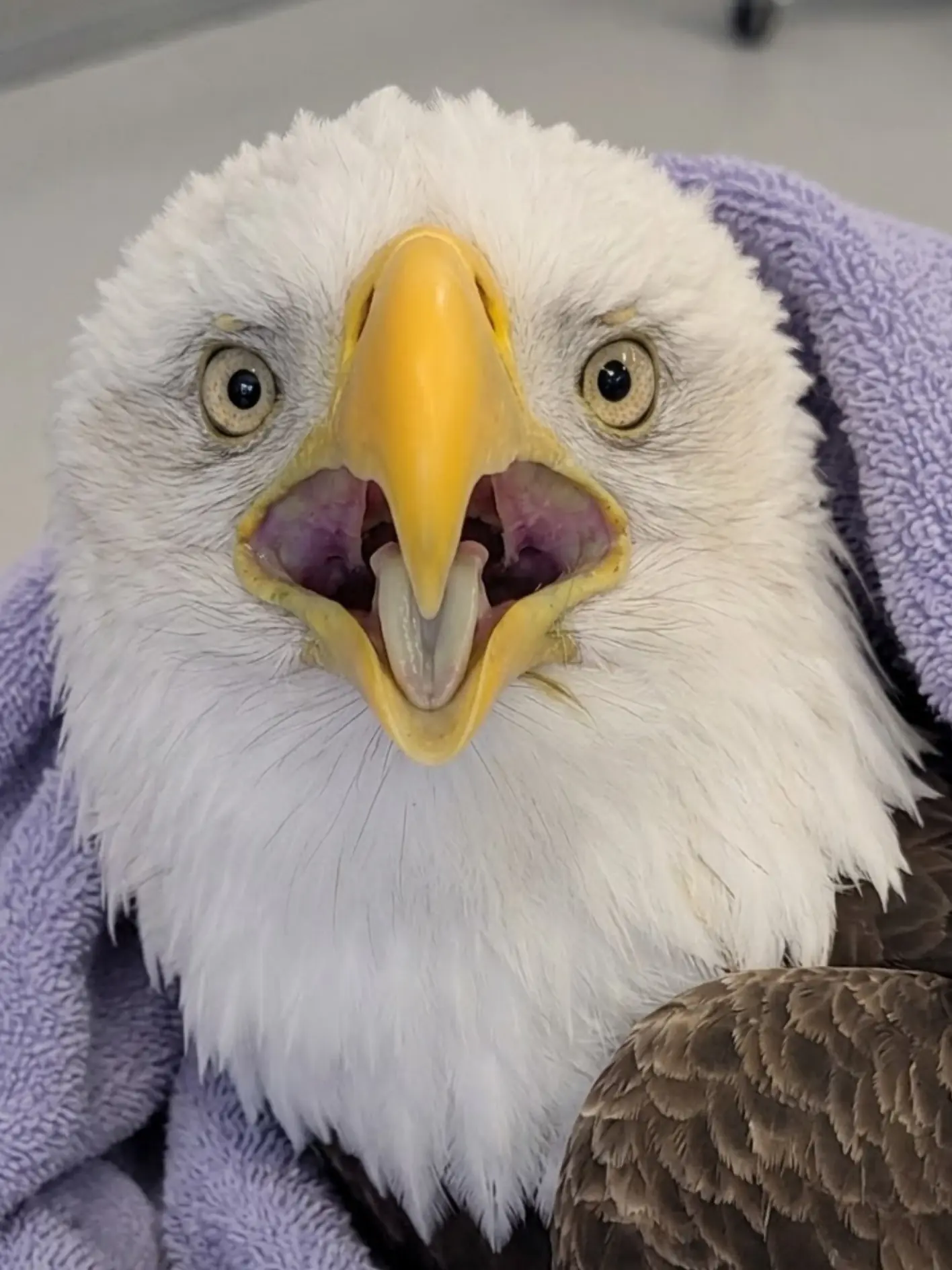
Several wounds were visible beneath the plumage.
The bird appeared weak.
Its movements were less forceful than expected from a healthy adult bald eagle.
After capture, the eagle was transferred to a rehabilitation center where veterinary staff began a complete medical evaluation.
The first priority was to identify and treat the injuries.
The second was to determine whether those injuries alone could explain the eagle’s condition.
They could not assume that they did.
Radiographs did not reveal a major displaced fracture, and although several areas of soft-tissue trauma required treatment, the bird’s overall weakness raised another concern routinely considered in compromised bald eagles: possible exposure to lead.
Blood samples were collected.
The wounds were cleaned.
Supportive care began.
And while the eagle’s physical injuries slowly started to improve, the veterinary team began watching a second problem that could not be seen through feathers, skin, or X-rays.
What was happening in the bird’s bloodstream?
“The wounds were the problem we could see immediately, but they were not the only concern,” one veterinarian involved in the case said. “When a bald eagle comes in weak or unable to fly, we also have to consider problems that may not be visible externally. Lead exposure is one of those possibilities.”
For now, the eagle remains under close observation.
Its injuries are being treated.
Its appetite, posture, neurological function, and blood values are being monitored.
And any eventual release will depend on more than wound closure.
The bird must also demonstrate that no significant toxicological problem remains and that it can once again function like a healthy wild bald eagle.
Found Grounded Near the Mississippi River
The adult eagle was discovered in Wabasha County, an area where bald eagles are a familiar part of the landscape.
The Upper Mississippi River corridor provides extensive habitat for the species.
Fish.
Waterfowl.
Carrion.
Large trees suitable for perching and nesting.
Open stretches of river used for travel and feeding.
Seeing a bald eagle in the region is not unusual.
Seeing one remain on the ground is different.
A healthy adult may occasionally descend to feed, but it should generally be capable of taking flight when sufficiently disturbed.
This bird did not respond that way.
The eagle remained grounded and appeared unable or unwilling to make a normal escape flight.
A wildlife responder was contacted.
When the officer reached the bird, the eagle was still alert enough to react to the approach, but its condition made it clear that it should not simply be left in place.
The bird was carefully captured and placed into a secure transport carrier.
Even a weakened eagle can inflict serious injury with its talons.
Proper restraint was therefore necessary to protect both the bird and the responder.
The eagle was then transported to the rehabilitation center for a full medical examination.
The Wounds Were Obvious — But Their Cause Was Not
Once the bird was safely restrained, veterinary staff began working through the dense feathers.
Several injuries were identified.
Some were superficial abrasions.
Others were deeper laceration- or puncture-type wounds involving soft tissue.
There was bruising around portions of the body.
Feathers surrounding several injured areas were disturbed or matted.
None of those findings, by themselves, established exactly what had happened.
The eagle could have been injured during a conflict with another bird.
It could have collided with something.
It could have experienced more than one traumatic event.
There was no reliable witness who could reconstruct the circumstances.
For wildlife clinicians, that uncertainty is common.
They often receive the patient after the event, with no history beyond where the animal was found and what it was doing at the time.
The body has to provide the evidence.
Each Wound Had to Be Evaluated Individually
The rehabilitation team carefully separated feathers around the damaged areas.
Wounds were flushed and cleaned.
Debris was removed where present.
The depth of each injury was assessed.
Staff looked for swelling, dead tissue, contamination, and evidence that deeper structures might be involved.
This is particularly important with puncture wounds.
A small opening at the surface can extend much farther into muscle than it appears.
If bacteria are carried deep into tissue, infection can develop after the skin begins to close.
The veterinary team therefore treated the wounds as medical problems in their own right rather than simply cosmetic injuries.
Pain control was provided as appropriate.
Antibiotic treatment could be considered based on the location, depth, and appearance of the wounds.
The bird would need repeated checks over the following days.
A clean-looking wound on intake can still become swollen or infected later.
Radiographs Looked for Hidden Skeletal Trauma
Because the eagle had been found unable to fly normally, X-rays were an important part of the evaluation.
Veterinarians examined the major bones of the wings.
The shoulders.
The chest.
The legs.
They were looking for fractures, dislocations, or other skeletal abnormalities that might explain why the bird remained grounded.
The initial imaging did not reveal a major displaced fracture.
That was encouraging.
A severe fracture can significantly reduce the chance of release, depending on location, alignment, and involvement of the joints.
This eagle did not appear to be facing that immediate orthopedic problem.
But the normal skeletal findings created another question.
Why was the bird so weak?
Soft-tissue trauma could account for some of it.
Pain could reduce flight.
Bruising could interfere with wing movement.
But the medical team did not want to assume the visible injuries explained the entire clinical picture.
Grounded Bald Eagles Are Often Evaluated for More Than Trauma
Wildlife veterinarians frequently have to think in layers.
A bird may have been injured because it was already sick.
An eagle weakened by another medical problem may be more likely to collide with an object, remain on the ground, or lose a confrontation.
Alternatively, an otherwise healthy eagle may suffer trauma and then develop secondary complications.
That means the first visible injury is not always the first problem chronologically.
For a bald eagle showing unexplained weakness, lead exposure is one recognized concern.
Bald eagles are opportunistic predators and scavengers.
They may consume carrion, gut piles, or animal remains containing small fragments of lead ammunition.
Those fragments can be too small to notice visually.
The eagle does not need to swallow an intact bullet to be exposed.
Small particles embedded in tissue may be enough.
Lead Was a Possibility — Not a Diagnosis
The team submitted blood for lead testing.
That decision did not mean the bird had confirmed lead poisoning.
It meant clinicians considered the possibility important enough to investigate.
There is a difference between detecting lead exposure and diagnosing clinically significant lead toxicosis.
A bird may have a measurable amount of lead in the bloodstream without every symptom being caused by it.
The significance depends on the concentration, clinical signs, other laboratory findings, and how the value changes over time.
Veterinarians therefore needed more than one piece of information.
What was the initial blood lead level?
Were there changes in red blood cell values?
Were there neurological abnormalities?
Did the bird’s condition improve with supportive care?
Would repeat testing show the level falling?
The answers would shape the treatment plan.
Why Bald Eagles Are Vulnerable to Lead
The risk is closely tied to feeding behavior.
Bald eagles are effective hunters, but they also scavenge readily.
An animal carcass can represent an efficient food source.
If that carcass contains lead fragments from ammunition, a scavenger can ingest those particles without recognizing them.
Once lead enters the gastrointestinal tract, some of it may be absorbed.
The consequences vary.
Lead can affect the nervous system.
It can interfere with gastrointestinal function.
Weakness, poor coordination, altered behavior, and reduced appetite may occur.
Blood abnormalities can develop.
Severely affected birds may become unable to fly or even stand normally.
Those effects are why lead screening remains an important diagnostic tool in compromised bald eagles.
But clinicians still have to avoid assuming that every weak eagle has lead toxicosis.
This bird had real traumatic injuries too.
The case had to be evaluated as a whole.
The Image Shows an Alert Bird — Not the Entire Medical Picture
A close-up treatment image shows the adult bald eagle with its eyes open and beak parted while resting against a padded surface.
The bird appears responsive.
That matters.
It suggests the eagle retained awareness during this stage of care.
But a photograph cannot show blood lead concentration.
It cannot reveal whether the bird is mildly anemic.
It cannot demonstrate endurance.
It cannot show whether the bird can sustain flight.
That distinction is central to wildlife medicine.
An eagle can look impressive at close range and still have serious systemic problems.
Likewise, a bird can appear weak during restraint but improve rapidly once stress is reduced.
The veterinary team therefore relied on repeated examinations rather than one visual impression.
Bloodwork Looked Beyond Lead Alone
Lead testing was only one part of the laboratory evaluation.
Staff also monitored general blood parameters.
A complete blood count can help identify anemia or inflammatory changes.
Packed cell volume can provide information about red blood cell status.
Chemistry testing can offer clues about hydration, organ function, and metabolic stability.
If inflammation was present, the team needed to know whether it reflected the wounds, systemic illness, or another process.
If anemia was identified, they would need to determine its severity and whether it was stable.
The goal was to build a medical picture rather than chase a single suspected toxin.
Mild-to-Moderate Anemia Would Add Another Layer
Lead exposure can contribute to blood abnormalities in some cases, but trauma and inflammation can also affect blood values.
For that reason, a lower-than-ideal packed cell volume would not automatically prove lead was responsible.
The trend matters.
A stable mild or moderate anemia may be monitored while the bird recovers.
A rapidly falling PCV would require a much more urgent investigation.
In this case, the team’s concern centered on following the eagle over time rather than assuming one laboratory value would answer everything.
The staff wanted to know whether the bird’s blood values improved alongside its physical recovery.
Supportive Care Began While Results Were Pending
The eagle did not have to wait for every laboratory result before receiving treatment.
Supportive care focused on the problems that could be addressed immediately.
Hydration.
Pain.
Wound care.
Nutrition.
A quiet environment.
Reduced handling.
Fluids could be administered when necessary to correct dehydration and support circulation.
They do not remove lead directly from the body.
Their role is to support the patient while the underlying problem is being evaluated and treated.
The bird was kept in a low-stimulation enclosure where it could rest without repeatedly attempting to fly.
This was especially important while wounds remained open or painful.
Appetite Became One of the First Signs Staff Watched
Wildlife rehabilitators pay close attention to whether a raptor eats independently.
An eagle refusing food can deteriorate rapidly.
A returning appetite is often an encouraging sign that pain, stress, or systemic illness is beginning to improve.
During the early phase of care, staff monitored the bird’s food intake closely.
The goal was to maintain appropriate body condition while avoiding unnecessary handling.
If the eagle began eating consistently on its own, that would reduce the need for nutritional intervention and provide an important behavioral milestone.
A bird that feeds voluntarily is not automatically healthy.
But it is moving in a more favorable direction than one that continues refusing food.
Neurological Function Was Monitored Closely
Because lead can affect the nervous system, the veterinary team watched more than appetite.
They observed balance.
Posture.
Head position.
Visual focus.
Foot placement.
Grip strength.
Any tremor or unusual movement would matter.
The eagle’s ability to stand symmetrically was important.
So was the ability to coordinate both feet.
Even subtle neurological impairment could affect release.
A bald eagle in the wild has to react quickly.
It must judge distance accurately.
It has to coordinate wings, tail, eyes, and feet during landing.
A bird that looks normal in a medical enclosure may still reveal deficits later during flight.
The Feet Provided Useful Neurological Information
Bald eagle feet are powerful, but strength alone is not enough.
The toes have to flex normally.
Grip must be coordinated.
The bird must be able to perch for long periods and release its grip when necessary.
Clinicians therefore assessed whether the eagle used both feet normally.
A strong, symmetrical grip would be reassuring.
Weakness or poor coordination could suggest neurological involvement or another injury.
If lead exposure were clinically significant, these functional observations could become as important as the laboratory result itself.
Lead Levels Need to Be Followed Over Time
One blood test provides a snapshot.
Repeat testing provides a direction.
That distinction is important.
If a lead concentration is elevated, clinicians want to know whether it is falling naturally, remaining high, or rising.
A declining value combined with improving clinical signs would be encouraging.
A persistently significant concentration could support more active treatment.
If chelation therapy were started, repeat testing would help determine whether the therapy was effective.
The team therefore focused on trend rather than a single isolated result.
“What matters now is the direction,” the veterinarian said. “We want the wounds healing, the bird getting stronger, and the blood lead level moving the right way.”
Chelation May Be Used When Clinically Indicated
Chelation therapy is designed to bind certain metals, including lead, and help the body eliminate them.
It can be lifesaving in appropriately selected cases.
But it is not automatically given to every eagle with any detectable lead exposure.
The decision depends on the blood concentration, clinical signs, and the overall patient.
If the level is high enough to create concern for clinically significant toxicity, treatment may begin.
Some birds require more than one treatment cycle.
Blood values may be rechecked between courses.
The goal is not simply to make the laboratory number smaller.
The goal is to reduce the toxic burden while allowing the bird’s neurological, gastrointestinal, and general condition to recover.
Chelation Does Not Replace Wound Care
Even if lead exposure proves important, the eagle still has traumatic injuries.
Those wounds continue to require attention.
The medical team has to manage both problems at the same time.
Visible trauma may become infected.
Systemic toxic exposure may cause weakness.
One problem can slow recovery from the other.
A bird with poor appetite due to toxicity may heal wounds more slowly.
A bird in pain from wounds may appear neurologically weak even when blood lead levels are improving.
That is why veterinarians have to interpret the entire patient rather than one diagnosis.
Wound Rechecks Are an Important Part of Daily Care
As the eagle settles into rehabilitation, the wounds are monitored for signs of normal healing.
Staff look for decreasing swelling.
Healthy tissue.
Absence of discharge.
No foul odor.
No new areas of redness or heat.
A wound that remains clean and gradually closes is moving in the right direction.
Increasing swelling or drainage would raise concern for infection.
In that case, clinicians might adjust treatment or collect samples for additional testing.
A puncture wound can become problematic beneath the surface even when the skin begins to look better.
Daily observation helps catch those changes early.
The Eagle’s Posture Can Reveal Improvement
One of the easiest changes to notice over time is posture.
A sick or painful eagle may sit low.
It may hold the wings slightly away from the body.
It may appear reluctant to move.
As discomfort decreases and strength returns, the bird often begins standing more upright.
It becomes more alert to activity outside the enclosure.
It may become increasingly resistant to human proximity.
For a wild raptor, that defensiveness can be positive.
The rehabilitation team does not want the bird to become comfortable around people.
They want normal wild behavior to return.
A Stronger Appetite and More Alert Posture Would Be Encouraging
If the eagle begins feeding consistently and becomes more responsive, staff can start looking toward the next stage.
That does not mean immediate flight.
The wounds must be sufficiently healed first.
Blood results must also be moving in a reassuring direction.
But improved appetite and posture indicate the bird has more physiological reserve for rehabilitation.
The staff can then begin evaluating functional strength more deliberately.
Perching Comes Before Flight
A recovering bald eagle must demonstrate that it can perch normally before being placed into demanding flight exercise.
Perching tests: