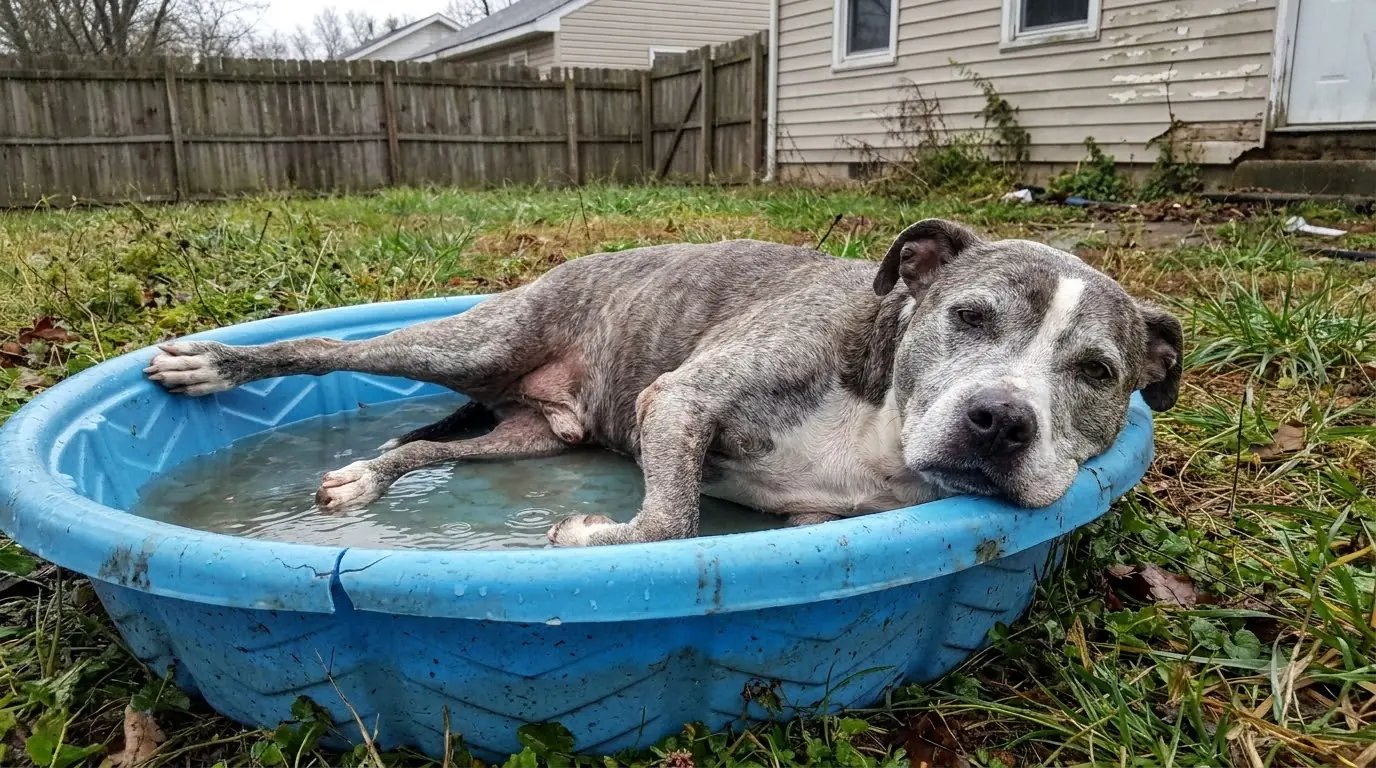
The pool was not big enough to keep her dry.
That was the first thing rescuers noticed.
It was an old plastic kiddie pool sitting behind a vacant house, cracked along one side and faded from years of sun. Leaves had collected in the bottom. Dirt lined the edges. After rain, shallow water gathered across the plastic floor.
And curled inside it was a senior Pit Bull mix.
She was thin.
Her elbows were covered in thick calluses.
One hind leg stayed noticeably stiff even when she shifted position.
The bottom of the pool was wet.
Her body was wet too.
But she had arranged herself so that her head rested on the raised plastic rim.
The rest of her remained curled inside the water.
Her chin stayed dry.
That was how responders first saw her.
Not running.
Not barking.
Not hiding deep beneath the house.
Just lying in a broken child's pool behind a home where nobody appeared to be living anymore.
At first, one rescuer wondered whether she had climbed in only recently.
Then neighbors began describing the same sight.
The dog had been there before.
The pool was where they kept seeing her sleep.
And when rain came, she apparently did not leave it.
She simply curled tighter and lifted her head onto the dry edge.
The House Was Empty
The property itself provided some information.
The house had been vacated.
There were no signs of normal daily occupancy.
No one answered the door.
The yard had been left unattended long enough for debris to collect.
The rescue was able to establish that the dog had remained at the property after the residents left.
Beyond that, staff were careful.
They could not say exactly why she had been left behind.
They did not know whether someone had intended to return.
They did not know how long she had been alone before neighbors began noticing her.
They did not invent an owner confession.
They did not create a detailed timeline they could not verify.
What they could document was enough.
A senior dog was living behind an empty house.
She was underweight.
She had chronic-looking pressure calluses.
One hind leg moved abnormally.
And her chosen sleeping place was a damaged plastic pool that collected rainwater.
The Pool Had Become More Than a Random Object
There were other places in the yard.
A narrow strip under an overhang.
Patches of dirt near the fence.
A porch area.
Yet the dog repeatedly returned to the kiddie pool.
That was the part rescuers found difficult to understand.
The pool did not provide warmth.
It did not provide real shelter from rain.
It was not padded.
In wet weather, it actually held water around her body.
Still, she climbed into it.
Neighbors reported seeing her there early in the morning.
Again in the evening.
Sometimes during rain.
The dog seemed to treat the cracked pool as a bed.
Rescuers Did Not Walk Straight Toward Her
A senior dog can still bite if frightened or painful.
This one had multiple reasons to be cautious.
She was alone on familiar property.
Her hind leg was stiff.
Her body condition suggested she had not been receiving consistent nutrition.
The rescue team approached slowly.
They did not surround the pool.
One person remained sideways rather than facing her directly.
Food was tossed from a distance.
The Pit Bull mix lifted her head.
She watched.
She did not rush forward.
She did not immediately retreat either.
Her nose moved.
She sniffed the food.
Then the people.
The first few treats were ignored.
That was fine.
Nobody forced the interaction.
Standing Up Showed How Much Her Body Was Struggling
Eventually, she shifted.
Her front legs came underneath her.
She pushed herself upright.
The hindquarters followed more slowly.
One back leg barely flexed.
Instead of moving through a normal stride, it remained stiff and shortened the movement of that entire side.
She stood in the shallow water for several seconds before stepping over the pool edge.
The motion looked difficult.
Her front end cleared first.
Then the healthier hind leg.
The stiff leg came last.
She nearly caught it against the plastic rim.
That detail changed the rescue plan immediately.
This was not simply a thin senior dog who needed food.
She had a mobility problem.
Nobody Chased Her
Once she was out of the pool, she moved several feet away.
Her gait was uneven.
The rescuers slowed down even more.
A loose dog with pain can panic if pressured.
So the team used distance.
Food.
Time.
A slip lead was prepared only when she was close enough and calm enough for safe handling.
No one grabbed at the stiff hind leg.
No one tried to lift her without warning.
When the dog finally allowed the lead to be placed, the movement was deliberate and low-key.
She did not fight.
That did not mean she was relaxed.
Her posture remained guarded.
The Pool Was Still Behind Her
As she was guided toward the vehicle, the Pit Bull mix turned once.
She looked back toward the yard.
Rescuers did not interpret that as proof she wanted to stay or understood she was leaving.
Dogs look back for many reasons.
The place was familiar.
The people were not.
What mattered was that she continued walking.
Slowly.
Stiffly.
Away from the cracked pool.
Getting Into the Vehicle Was Another Problem
The step was too high.
The dog tried to lift the stiff hind leg and could not clear it comfortably.
Rescuers did not make her repeat the attempt.
A lower step and support were provided.
Her body was guided carefully.
Once inside, she chose the floor.
A blanket had been placed there.
She circled.
Lowered herself.
And immediately positioned her head along the raised edge of the blanket.
That posture looked familiar.
Head elevated.
Body lower.
The pool had taught staff something about how she preferred to rest.
Her Elbows Told Their Own Story
At intake, the thickened skin over both elbows was obvious.
Pressure calluses develop when areas of the body repeatedly contact hard surfaces.
Large dogs are particularly prone to them.
The calluses did not prove exactly where she had slept throughout her life.
They did suggest that hard surfaces had been part of her resting routine for some time.
The rescue did not say the pool had caused all of them.
That would have been impossible to prove.
The plastic yard pool was only one hard surface.
Concrete, wood, dirt, and other flooring could produce similar changes.
Still, her elbows fit the picture of a dog accustomed to sleeping without much cushioning.
Her Weight Needed Attention
The Pit Bull mix was noticeably underweight.
Her ribs were easier to feel than they should have been.
There was reduced muscle over the hindquarters.
Her waist was more pronounced than expected for a healthy senior dog.
The veterinary team performed a full examination rather than assuming food deprivation was the only issue.
Senior dogs can lose weight for many reasons.
Dental disease.
Chronic organ disease.
Gastrointestinal problems.
Pain.
Cancer.
Endocrine disease.
Inadequate intake.
Parasites.
The rescue needed evidence.
Senior Bloodwork Was Appropriate
Basic laboratory testing helped establish a baseline.
Her hydration was assessed.
Bloodwork could identify or raise concern for systemic issues that might contribute to poor body condition.
Urinalysis was considered when appropriate.
A fecal examination could help evaluate intestinal parasites.
Her teeth were examined.
The team listened to her heart and lungs.
Her abdomen was palpated.
Nothing about being found behind a vacant house meant every possible diagnosis should be assigned to her.
The medical story had to come from the dog.
The Hind Leg Needed Its Own Workup
The stiffness appeared chronic.
That was important.
A fresh fracture often produces a different kind of pain and instability.
This dog's gait suggested a long-standing limitation.
The veterinary team performed an orthopedic examination.
They assessed hip movement.
Knee stability.
Muscle mass.
Joint range.
Spinal discomfort.
They watched how the leg moved during walking.
Imaging was used because the abnormal gait was persistent and significant.
The findings were more consistent with an old injury and chronic degenerative change than with a new emergency.
There was no reason to invent a recent accident.
Whatever had happened to the leg had happened before rescuers found her.
Exactly when remained unknown.
Surgery Was Not Automatically the Answer
A visibly abnormal limb can make people expect a dramatic orthopedic operation.
That was not necessarily appropriate.
In a senior dog with a chronic injury, the medical team had to consider current pain, function, joint changes, overall health, and whether surgery would realistically improve quality of life.
If the limb was stable enough for controlled use and the pain could be managed conservatively, non-surgical management could be preferable.
That included pain control.
Weight restoration without excess weight gain.
Nonslip surfaces.
Short controlled walks.
Potential rehabilitation.
Supportive bedding.
Regular reassessment.
The goal was not to make the leg look normal.
It was to make movement comfortable.
Her Skin Needed Care Too
The calluses were thick but not all actively infected.
That distinction mattered.
Some pressure calluses can remain dry and stable.
Others can crack, become inflamed, or develop deeper sores.
Staff examined them carefully.
The dog also had areas of dirt, moisture irritation, and coat thinning consistent with prolonged outdoor exposure.
She was cleaned gradually.
There was no reason to subject a tired senior dog to an overwhelming grooming session on the first day.
Warm water.
Gentle handling.
Thorough drying.
Then rest.
Drying Her Took Longer Than Expected
The fur along her underside held more moisture than staff initially realized.
That brought the kiddie pool back to mind.
If she had been spending rainy nights curled in collected water, her skin may have remained damp for long periods.
Moisture against skin can contribute to irritation, especially where the coat is thin or where the body presses against a surface.
Staff monitored the underside of her body closely.
They did not assume severe skin disease where it was not present.
They simply gave the tissue a chance to remain clean and dry.
Her First Bed Was Too Thick
That surprised everyone.
The rescue placed a plush orthopedic bed in her recovery space.
It looked ideal for an aging dog.
She approached.
Sniffed.
Put her front feet on it.
Then backed away.
Instead, she lay on the floor beside it.
Her head went onto the edge.
The same position as the kiddie pool.
Body low.
Head elevated.
Staff tried again later.
Same result.
Familiar Posture Was Stronger Than Softness
That became one of the central parts of her recovery.
The dog had access to comfort.
She did not immediately know what to do with it.
Or perhaps the bed was physically too difficult.
A senior Pit Bull with a stiff hind leg may struggle with high, soft surfaces.
A thick bed can shift under the feet.
It can require more effort to step onto.
A dog accustomed to firm ground may also simply prefer something more stable.
The rescue did not force her.
They changed the bed.
A Low Mat Worked Better
A flatter orthopedic mat was placed directly on the floor.
No raised edge.
No deep cushion.
No step.
The Pit Bull mix approached it.
She sniffed.
Walked partly onto it.
Then lowered herself.
Her body was finally supported.
Her head still rested at the edge.
That was fine.
The goal was not to change every part of her sleeping posture.
It was to remove the hard surface beneath her body.
Rain Became an Unexpected Trigger
The first time it rained after she entered care, staff noticed a change.
Rain struck the roof.
Water ran against exterior surfaces.
The sound filled the building.
The Pit Bull mix lifted her head.
She became more alert.
She did not panic.
But she had difficulty settling.
A caregiver moved quietly near her recovery area.
The dog sniffed.
Then returned to the mat.
That response did not prove a trauma association.
Rain may simply have been a familiar environmental cue.
Still, staff began watching.
In Foster Care, She Found the Patio
Once she was medically stable enough, a senior-friendly foster home became an option.
The house had rugs.
Low beds.
No required stairs.
A small covered patio opened onto the yard.
The first several days were quiet.
The Pit Bull mix explored slowly.
She slept on the floor mat.
She learned the feeding routine.
She followed the foster outside for short bathroom breaks.
Then it rained.
The dog stepped onto the patio.
There was a dry bed under the roof.
She ignored it.
Instead, she walked toward a shallow plastic planter tray near the wall.
The foster redirected her before she could curl into it.
The resemblance was difficult to miss.
Staff Did Not Turn That Into Proof of Memory
The behavior was notable.
It was not evidence that the dog was consciously searching for the kiddie pool.
She may simply have preferred shallow, contained spaces.
The raised edge may have provided a place for her head.
Hard, enclosed sleeping surfaces may have been familiar.
Behavior can persist without humans knowing the exact origin.
The foster team responded practically.
They created a safer version of the same shape.
They Built Her a Low Nest
A very low-sided bed was used.
Firm base.
Minimal step.
A slightly raised bolster along one edge.
The dog could walk directly onto it without lifting the stiff hind leg high.
She could rest her head against the edge.
Her body stayed dry.
The first night, she used it.
The foster sent a photo.
Her posture looked almost exactly like the pool.
Curled body.
Head on the rim.
The difference was what was underneath her.
Padding.
Dry fabric.
Warmth.
Her Appetite Improved Before Her Weight Did
That was expected.
She began eating consistently.
The food was nutritionally complete and portioned according to the veterinary plan.
Staff did not try to put weight on her as quickly as possible.
Senior dogs with reduced muscle need controlled nutritional support, not endless calories.
Her stool was monitored.
Her body condition was checked regularly.
Her weight rose slowly.
The sharpness around the ribs became less obvious.
The hindquarters still looked thin.
Muscle restoration takes longer than weight gain.
Her Stiff Leg Did Not Improve Just Because She Was Eating Better
The chronic injury remained.
Some mornings she moved more comfortably.
Other days, stiffness was obvious.
Pain management helped.
Traction helped.
Short walks helped maintain movement.
Overdoing it did not.
The foster learned her limits.
A few minutes of sniffing could be enough.
If the hind leg began dragging more or her stride shortened, they turned back.
She Loved Sniffing More Than Walking
That made exercise easier to adapt.
Distance did not matter to her as much as information.
She could spend several minutes investigating one patch of grass.
The foster allowed it.
A senior dog does not need mileage to receive enrichment.
She needed movement within her limits.
She needed scent.
She needed choices.
That kind of outing was easier on the old leg.
Her Elbows Began Looking Better
The calluses did not disappear.
Chronic thickening can remain.
But the surrounding skin stayed healthier.
No constant pressure against wet plastic.
No long nights on hard surfaces.
No need to keep shifting because the ground beneath her was uncomfortable.
The low bed distributed pressure more evenly.
Staff used skin care as indicated and monitored for cracks or sores.
The improvement was gradual.
She Still Chose Hard Floors Sometimes
That was important.
Even after learning to use the bed, the Pit Bull mix occasionally slept on a cool floor.
Especially during warmer days.
The foster did not panic.
Dogs have preferences.
The difference was that she had an appropriate bed available and could use it comfortably.
Choice is different from having no better option.
The First Heavy Rain Was Harder
A storm moved through in the evening.
Rain hit the roof loudly.
Water collected outside.
The Pit Bull mix became restless.
She walked toward the patio door.
The foster let her look outside from a dry position.
She stood there for a while.
Then turned back.
The low-sided bed was nearby.
She approached.
Circled.
Lay down.
Head on the raised edge.
The storm continued.
She stayed dry.
That Was the Moment the Pool Story Changed
At the vacant house, rain had not changed where she slept.
She remained inside the cracked pool even as water collected around her body.
In foster care, rain could happen without forcing discomfort.
She did not need to find another dry place because one already existed.
She did not need to keep her chin above water.
She could simply lie down.
That is what safety looked like for her.
The Rescue Continued Trying to Understand the Old Injury
Follow-up veterinary visits monitored the hind leg.
Chronic stiffness can worsen with inactivity or overuse.
The medical team looked for changes in pain.
Muscle loss.
Joint range.
Weight-bearing.
If the leg became significantly worse, the plan could change.
Nothing about choosing conservative management meant ignoring future problems.
For now, the dog remained functional.
Slow.
Stiff.
But functional.
A Support Harness Was Introduced for Hard Days
Not the kind that sat near her painful leg.
A mobility support system was selected and fitted carefully.
The foster used it only when needed.
Getting into a vehicle.
Navigating a slightly uneven surface.
Standing on particularly stiff mornings.
The goal was assistance, not carrying.
She still used her own legs.
The harness simply reduced the risk of a fall.
She Did Not Like Being Lifted
That was another reason to support rather than carry.
The Pit Bull mix became tense when her entire body left the ground.
Perhaps it was unfamiliar.
Perhaps the old leg hurt when held certain ways.
The rescue did not need to know why to respect the reaction.
Transfers were kept low.
Ramps were used when appropriate.
People stopped trying to solve every obstacle with lifting.
She Started Following the Foster Indoors
At first, she spent long periods in one room.
Later, she moved between spaces.
Slowly.
The foster kept rugs along the route.
She might stop halfway.
Rest.
Then continue.
That expansion of movement showed confidence as much as physical adaptation.
The vacant yard had been her entire world when rescuers arrived.
Now she had choices about where to be.
Her Favorite Spot Was Still Something With an Edge
Even after several weeks, she preferred beds with a low boundary.
A completely flat blanket was less appealing.
A high-sided bed was too difficult.
The compromise was perfect.
A firm mattress with one shallow bolster.
Her head almost always found it.
The foster stopped trying to change that preference.
Some parts of a dog's old routine can be preserved safely.
Nobody Removed the Kiddie Pool From the Story
It remained the detail people remembered.
Not because the rescue wanted to romanticize suffering.
Because it showed how animals adapt when good options disappear.
The pool had been cracked.
Wet.
Hard.
Yet it had a shape.
It had an edge.
It was in a familiar place.
For the dog, that may have been enough to become a sleeping spot.
Humans could look at it and see something unacceptable.
The dog had simply used what was available.
Her Recovery Was Not About Teaching Her She Deserved Better
Dogs do not need moral lessons about deserving comfort.
They need access to comfort.
The Pit Bull mix did not have to understand that a padded bed was a symbol of a new life.
She only had to discover that it was stable.
Dry.
Easy to step onto.
Comfortable enough to rest.
That happened through repetition.
The Old Pool Could Have Become a Prop
The rescue refused to use it that way.
They did not bring the dog back to the vacant property for photos.
They did not make her climb into another kiddie pool to recreate the rescue scene.
They did not pour water around her to demonstrate what rainy nights looked like.
The original situation had been documented.
That was enough.
Recovery should reduce hardship, not reenact it.
Her Coat Began Looking Different
Regular nutrition and indoor care improved its overall condition.
The fur became less dull.
Areas of friction around the elbows remained sparse.
Age still showed.
Her face remained graying.
Her skin remained that of a senior dog who had spent years carrying a heavy body close to hard ground.
She did not become glossy and young.
She became healthier.
That was enough.
Her Hindquarters Remained Thin
This was another realistic limit.
Senior muscle loss is slow to reverse.
A chronic stiff leg discourages normal use.
Even with nutrition and controlled activity, the asymmetry may remain.
The foster celebrated smaller changes.
Standing with less hesitation.
A smoother turn.
Walking across a rug without slipping.
Lowering into bed without dropping abruptly.
Those mattered more than appearance.
She Began Sleeping Through Rain
That took time.
At first, the sound made her alert.
Later, she might lift her head once.
Then put it back down.
During one overnight storm, the foster checked on her.
The Pit Bull mix was asleep.
Fully asleep.
Her body was curled inside the low-sided bed.
Her chin rested on the bolster.
Rainwater ran down the window outside.
She did not move.
That Was a Bigger Change Than It Looked
Months earlier, rain meant water accumulating beneath her.
Her body staying curled in it.
Her head balanced on the plastic rim because that was the driest part available.
Now rain was only sound.
It did not change the surface beneath her.
It did not force her skin to stay damp.
It did not require her to arrange herself around standing water.
The weather had stopped entering her bed.
Placement Planning Focused on Accessibility
Anyone considering adopting her needed to understand the realities.
She was senior.
The old hind-leg injury would remain part of her life.
She needed low beds.
Traction.
Minimal stairs.
Controlled exercise.
Weight management.
Ongoing pain assessment.
A home willing to move at her pace.
She might never be a dog who climbed onto furniture.
She did not need to.
The Right Home Did Not Need a Pool
It needed a predictable resting place.
That was the lesson the foster learned.
A bed with the right shape could preserve what she seemed to like about the kiddie pool without preserving what had made it harmful.
Low edge.
Firm surface.
Head support.
No standing water.
Simple.
She Sometimes Sleeps Halfway Out of the Bed
The posture still makes people laugh softly.
Her body can be on the mattress.
One front paw on the floor.
Her head on the bolster.
Or she may rotate until only her shoulders are supported.
Staff do not constantly reposition her if she looks comfortable.
She has earned the right to be a little strange about sleeping.
The Calluses May Never Fully Disappear
That is okay.
They are part of her body now.
The goal is healthy skin.
No cracking.
No infection.
No constant pressure injury.
The same is true of the hind leg.
The goal is not visual perfection.
It is function and comfort.
The Rescue Still Does Not Know How Many Rainy Nights She Spent There
That question cannot be answered.
Neighbors remembered seeing her in the yard over time.
The condition of the pool suggested it had been outside for a long while.
Her habit of using it looked established.
But no one had watched every night.
There is no responsible exact number.
The uncertainty remains.
They Do Know What She Did When It Rained
She stayed in the pool.
She curled her body inside the shallow basin.
Water collected around her.
She rested her head on the plastic rim.
That behavior was repeated enough to be documented by people who saw her.
It is the detail that explains why her current sleeping arrangement matters so much.
Recently, Another Storm Came Through
The foster home grew dark early.
Rain hit the roof.
The senior Pit Bull mix was already on her bed.
Her hind leg had been a little stiffer that day, so the evening walk had been shortened.
She circled once.
Then again.
Lowered herself carefully.
Her body settled onto the dry mattress.
Her head went to the raised edge.
Outside, rainwater began collecting in a shallow planter tray on the patio.
The foster noticed it and moved it under cover.
The dog never got up.
Her Head Was Still on the Rim
That part looked almost unchanged.
The same basic posture rescuers had seen behind the vacant house.
Chin elevated.
Body curled lower.
Eyes closing.
But now the similarity ended there.
Her belly was dry.
Her elbows were cushioned.
Her stiff hind leg was supported.
There was no cracked plastic beneath her.
No standing water gathering around her ribs.
No empty house behind her.
Sometimes Recovery Looks Like Keeping the Habit and Changing Everything Around It
The Pit Bull mix still likes a low, contained bed.
She still rests her head on an edge.
She may always prefer that shape.
Nobody needs to train it out of her.
The rescue simply replaced the dangerous version with a safe one.
That is enough.
The Kiddie Pool Was Once the Best Option She Had
That is difficult to think about.
Not because the object itself was uniquely terrible.
Because it showed how little choice remained.
A senior dog with a bad hind leg had found a place she could step into.
A place with edges.
A place that had become familiar.
So she kept using it.
Even when it filled with rain.
She Has More Choices Now
She can lie on the rug.
The low bed.
A cool section of floor.
The covered patio when it is dry.
She can move closer to the foster caregiver.
She can stay alone.
She can get up.
Or not.
Her world has become larger without demanding that her old body do more than it can.
On Rainy Nights, Staff Still Think About the Pool
The image is hard to forget.
Thin senior body.
Thick calluses.
Stiff hind leg.
Cracked blue plastic.
Water beneath her.
Head on the rim.
That was the dog they met.
The dog now sleeping through storms is the same dog.
The injury remains.
The age remains.
The calluses remain.
What changed is everything she has to lie on.
She Still Puts Her Head on the Edge Before She Sleeps
Even now.
She walks slowly toward the bed.
Front feet first.
The stiff hind leg follows.
She turns.
Lowers herself.
Then shifts forward until her chin finds the bolster.
That is usually the last movement.
Her eyes close.
The rain can start.
It can continue all night.
She no longer has to curl tighter to keep part of herself dry.
She no longer has to balance her head above water collected in the bottom of a broken pool.
The habit stayed.
The hardship did not.
And for this senior Pit Bull mix, that is what recovery looks like.