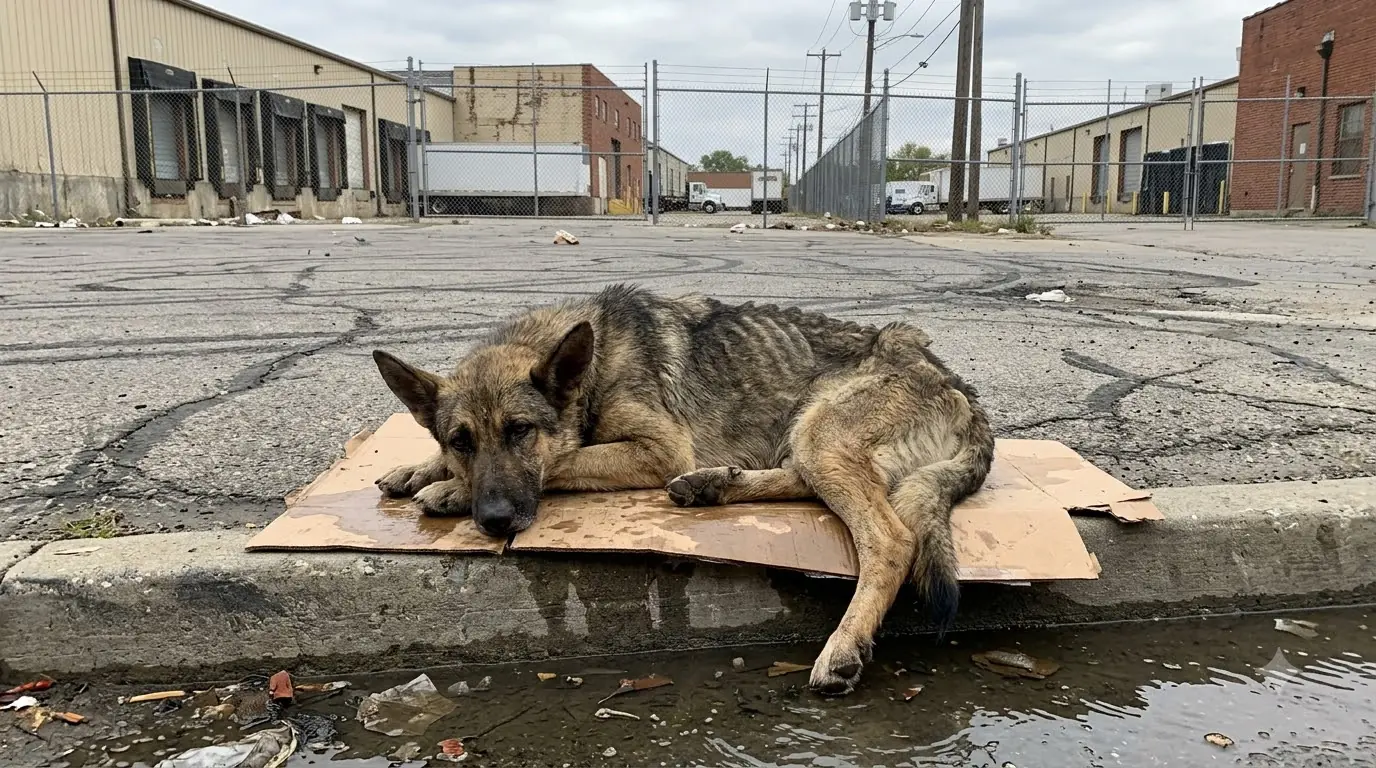
The Leg Never Came Up Onto the Cardboard
The German Shepherd mix had found a piece of wet cardboard near the edge of an industrial road.
It was barely large enough for his chest and ribs.
The cardboard had softened from rain and runoff. One corner was folded into the gutter. Dirt had collected along the edges.
Still, whenever the dog became too tired to keep moving, that was where he went.
He lowered himself carefully beside the curb.
His front legs folded first.
Then his chest.
His good rear leg tucked beneath him.
The injured leg did not.
It remained stretched stiffly behind and to the side, swollen from the hock upward and held away from his body as though even trying to bend it caused too much discomfort.
When the Shepherd finally settled, most of his thin body rested on the cardboard.
The bad leg hung over the curb.
His paw dropped into the shallow gutter below.
That was how rescuers first saw him resting.
Not because he preferred the dirty water channel.
Because he appeared unable to fold the leg far enough to bring it beneath himself.
Workers Had Been Seeing Him Around the Same Industrial Blocks
The first reports came from people working in the surrounding warehouses.
Someone had seen a large, thin dog moving behind loading docks early in the morning.
Another person noticed him crossing an access road after most employees had gone home.
A delivery driver began seeing him near the same row of buildings several days in a row.
He never came close.
He kept to the edges.
Behind dumpsters.
Along chain-link fences.
Near stacks of pallets.
Under the shadow of parked trailers.
The industrial district was a difficult place for any loose dog.
Large vehicles moved through constantly.
There was little grass.
Most of the ground was asphalt, gravel, or concrete.
Water collected in low drainage channels after rain.
And for this Shepherd, every movement was made harder by one rear leg he would not put on the ground.
From a Distance, the Swelling Was Obvious
Rescuers did not need to get close to recognize that the dog was injured.
When he walked, the affected leg remained elevated.
He moved in a three-legged hop, shifting enormous amounts of weight toward the front of his body.
The swollen limb looked thicker than the opposite rear leg.
The fur over parts of it was dirty and clumped.
His entire frame was extremely thin.
The ribs were prominent.
His waist was deeply tucked.
His hips stood out sharply beneath the coat.
Even the muscles along his shoulders looked reduced.
The Shepherd was not simply limping.
His body looked depleted from compensating for an injury that appeared to have been present for some time.
Exactly how long, no one could know from the roadside.
Staff Would Not Invent How the Injury Happened
The visual invited explanations.
Perhaps he had been struck by a vehicle.
Perhaps his leg had been caught somewhere.
Perhaps there had been an old untreated fracture.
Perhaps another type of trauma had occurred.
All of those possibilities existed.
None were yet facts.
The rescue had no witness to the original injury.
No medical record.
No owner history that could be verified.
So the team documented what was observable.
The leg was severely swollen.
The dog would not bear weight on it.
The joint could not be seen moving normally.
And whenever he lay down, he positioned the limb away from the rest of his body rather than folding it underneath.
That was enough to make the situation urgent.
Getting Close Took Time
The Shepherd did not approach people simply because they brought food.
He was hungry.
That much became obvious as soon as food was placed on the ground.
But hunger and trust are not the same thing.
A rescuer left a small amount of high-value food several yards away and stepped back.
The Shepherd watched.
Traffic passed behind him.
A loading dock gate rattled somewhere nearby.
His ears moved.
He remained still.
Only after the rescuers created more distance did he approach the food.
He ate quickly.
Then moved away.
The injured leg never touched down.
The next food placement was closer to a safer containment area.
Again, he waited until people backed away.
Again, he ate.
The team did not chase him.
A frightened large dog with only three usable legs could still run into traffic if panicked badly enough.
Low-stress capture mattered.
The Cardboard Helped Them Understand His Routine
During the waiting period, rescuers noticed where he went when exhausted.
The same curb.
The same softened cardboard.
He approached it slowly.
Turned with difficulty.
Then began lowering himself.
The swollen leg stayed straight.
When his body reached the ground, the limb extended beyond the cardboard.
The paw settled into the gutter.
His head dropped onto his front legs.
Within minutes, his eyes closed.
The position looked miserable.
But it revealed something important.
He had found a way to rest without forcing the injured leg into a bend it apparently could not tolerate.
His entire sleeping arrangement had been built around the limitations of that one limb.
The Rescue Plan Changed Once They Saw How Tired He Was
The Shepherd's extreme body condition meant the team did not want a prolonged capture effort.
He was already spending too much energy simply moving from one place to another.
A safe containment strategy was established using food, controlled positioning, and minimal pressure.
Eventually, the dog moved into a space where rescuers could secure him without a chase.
When the lead first became taut, he froze.
His body lowered.
His eyes widened.
The handler immediately reduced pressure.
No one dragged him upright.
After several seconds, the Shepherd shifted forward.
One front paw.
Then the other.
The good rear leg followed.
The injured leg remained lifted.
The trip to the rescue vehicle was slow.
He Could Not Climb Into the Vehicle Normally
The height of the vehicle entrance was too much for him.
A healthy Shepherd might have stepped or jumped in.
He could not safely do that.
A ramp with good traction was positioned.
Even then, moving upward on three limbs was difficult.
His front paws reached the ramp first.
He leaned forward.
The healthy rear leg pushed.
The swollen leg stayed suspended awkwardly.
A support sling was used to reduce the load and keep his pelvis stable.
He paused several times.
Then finally entered.
Once inside, he did not investigate.
He moved toward the side wall.
Lowered himself.
And extended the injured leg away from his body.
The same pattern from the gutter followed him into the rescue vehicle.
The First Medical Examination Focused on Stabilization
At the clinic, staff did not immediately force the Shepherd through every possible test.
He was severely underweight.
He was dehydrated.
He was exhausted.
And the injured leg was clearly painful.
Pain management came early.
Hydration was assessed.
His heart rate, respiratory rate, temperature, gums, and general perfusion were checked.
The veterinary team looked for signs of immediate shock or systemic instability.
Once he was stable enough, the leg could be evaluated more thoroughly with appropriate sedation or analgesia.
That approach reduced stress and allowed the examination to be more accurate.
A painful frightened dog does not benefit from repeated forced manipulation.
Imaging Finally Explained Why He Would Not Bend the Leg
Radiographs showed that the rear limb had suffered an old fracture involving the lower portion of the leg.
The bone had healed badly.
There was severe chronic remodeling.
The alignment was abnormal.
Arthritic changes had developed around the injured area.
The swelling was partly related to chronic inflammation and soft-tissue changes around the old injury.
There was no fresh fracture line suggesting the entire problem had just happened.
This was an old injury whose consequences were still controlling how he moved.
That explained the strange sleeping position.
The leg could not flex through a normal range comfortably.
Trying to tuck it beneath his body would have required movement through joints and tissues that had become stiff, painful, and mechanically altered.
So he did the only thing that worked.
He left it out.
The Question Was Whether the Leg Could Be Saved Functionally
An old malunited fracture creates difficult choices.
Surgery is not automatically the answer.
Corrective procedures can be extensive.
They may require cutting and realigning bone, stabilizing the limb, prolonged recovery, and significant rehabilitation.
The decision depends on the dog's overall condition, the location and severity of deformity, joint involvement, pain, expected function, and whether surgery would realistically improve quality of life.
For this Shepherd, the medical team first needed him stronger.
He was too depleted for anyone to rush into a major orthopedic procedure simply because the X-rays looked dramatic.
His body needed stabilization.
Nutrition.
Hydration.
Pain control.
Skin care.
And time for the team to assess how much function remained.
His Thinness Needed a Separate Investigation
The Shepherd's body condition was severe enough to require more than simply increasing food.
The veterinary team performed bloodwork and urinalysis.
A fecal sample was evaluated.
His mouth and teeth were checked.
The team looked for evidence of kidney disease, liver dysfunction, severe anemia, infection, protein loss, gastrointestinal disease, or other problems that could contribute to wasting.
No single catastrophic disease explained the full picture.
His results were most consistent with prolonged inadequate nutrition and chronic physical stress, with dehydration contributing at intake.
That was useful information.
It meant nutritional rehabilitation could proceed, but it still had to be controlled.
He Was Not Given One Giant Meal
His first portions were measured.
Small enough to tolerate.
Large enough to begin meeting his needs.
His appetite was strong.
He ate rapidly if allowed.
So staff slowed him down.
Meals were divided.
Water remained available and intake was monitored.
His stool was watched closely.
A severely depleted dog does not rebuild by eating an enormous amount in one sitting.
The body needs time to process increased nutrition.
Staff looked for steady improvement rather than dramatic short-term weight gain.
The Leg Continued Dictating How He Slept
Inside the medical kennel, the Shepherd received thick supportive bedding.
At first, staff thought the larger surface might allow him to find a more comfortable position.
He still moved to the edge.
He lowered his chest onto the bed.
His healthy rear leg folded.
The injured limb remained extended beyond the mattress.
If the bed was high enough, the paw hung toward the floor.
The posture looked nearly identical to the cardboard beside the industrial road.
That told staff the sleeping behavior was not about the gutter itself.
It was about the leg.
His Bed Had to Be Redesigned Around the Injury
A high-edged mattress was not ideal.
Neither was a completely flat hard mat.
The Shepherd needed cushioning because his body was so thin.
But he also needed space for the stiff limb to remain extended without hanging unsupported.
Staff began experimenting with the setup.
A low orthopedic pad reduced the drop to the floor.
Additional padding extended beyond one side so the injured leg could lie straight without being forced to bend.
The arrangement looked unusual.
A large soft central bed with an extra padded strip extending from it.
He used it immediately.
His body rested on the main mattress.
The injured leg lay along the extension.
For the first time, the entire limb was supported without being tucked beneath him.
Pain Control Changed His Rest Before It Changed His Walking
The first improvement appeared while he was lying down.
He slept longer.
He shifted his head less.
His breathing looked calmer.
He did not repeatedly lift his chest and reposition as often.
The leg remained extended.
The deformity remained.
But the rest of his body seemed less guarded.
That was important.
Good pain control was not expected to make the leg mechanically normal.
It was meant to reduce the suffering caused by the condition he already had.
Standing Still Exhausted Him Quickly
The Shepherd could rise independently, but it required effort.
His front legs pushed first.
The healthy rear limb moved underneath.
The injured leg remained suspended.
Once upright, the entire body leaned forward.
He could stand for only a limited period before the good rear leg began trembling.
That made everyday tasks challenging.
Drinking.
Eating.
Bathroom trips.
All had to be planned around endurance.
Staff Brought Food and Water Closer
There was no benefit in forcing him to cross the kennel repeatedly.
Food and water were positioned near the bed while still keeping the sleeping area dry and clean.
He could reach both with only a few careful steps.
If he became tired while eating, the bowl could be adjusted so he could continue from a lower position.
Independence did not require unnecessary hardship.
His energy needed to go toward healing and maintaining strength.
The Good Rear Leg Needed Protection Too
The entire weight of his hindquarters was being carried through one functional rear limb.
That leg had not been injured originally.
It was now at risk of overuse.
The front limbs were also working much harder than normal.
Staff monitored all three supporting legs for soreness, skin wear, swelling, and fatigue.
His nails were kept at an appropriate length for traction.
The kennel floor remained nonslip.
A slip could be dangerous.
For a dog balancing on three limbs, stability was part of medical care.
The Worn Areas on His Body Began Healing
The Shepherd had several superficial abrasions and areas of poor coat condition from living outdoors.
Those were cleaned and treated according to what the skin actually showed.
No one assumed every missing patch of fur represented abuse or a specific incident.
Some were consistent with friction.
Some with poor skin condition.