The harness looked wrong before anyone touched it.
The young Shepherd mix had been spotted wandering around an apartment complex, moving between parked cars and strips of landscaping with the uneven caution of a dog that had been outside long enough to stop reacting strongly to every passing person.
He was not skeletal.
He was not collapsing.
He was not covered in dramatic open wounds.
What stood out was the harness.
It was old, faded, and much too tight.
The chest strap sat high and rigid against his body. The sections passing beneath his front legs had sunk so deeply into the fur that at first glance it was difficult to tell how much space remained between nylon and skin.
When responders finally got close enough to evaluate him, the problem became obvious.
The harness had not simply been fastened snugly.
He had grown around it.
Once it was removed, the shape remained.
Lines of missing fur ran across his chest and into both armpit areas. The skin underneath was red and irritated in places. In the deepest pressure points, the surface had become rubbed and raw from repeated friction.
It looked almost as if the harness were still there.
Only now, its outline had been left behind on his body.
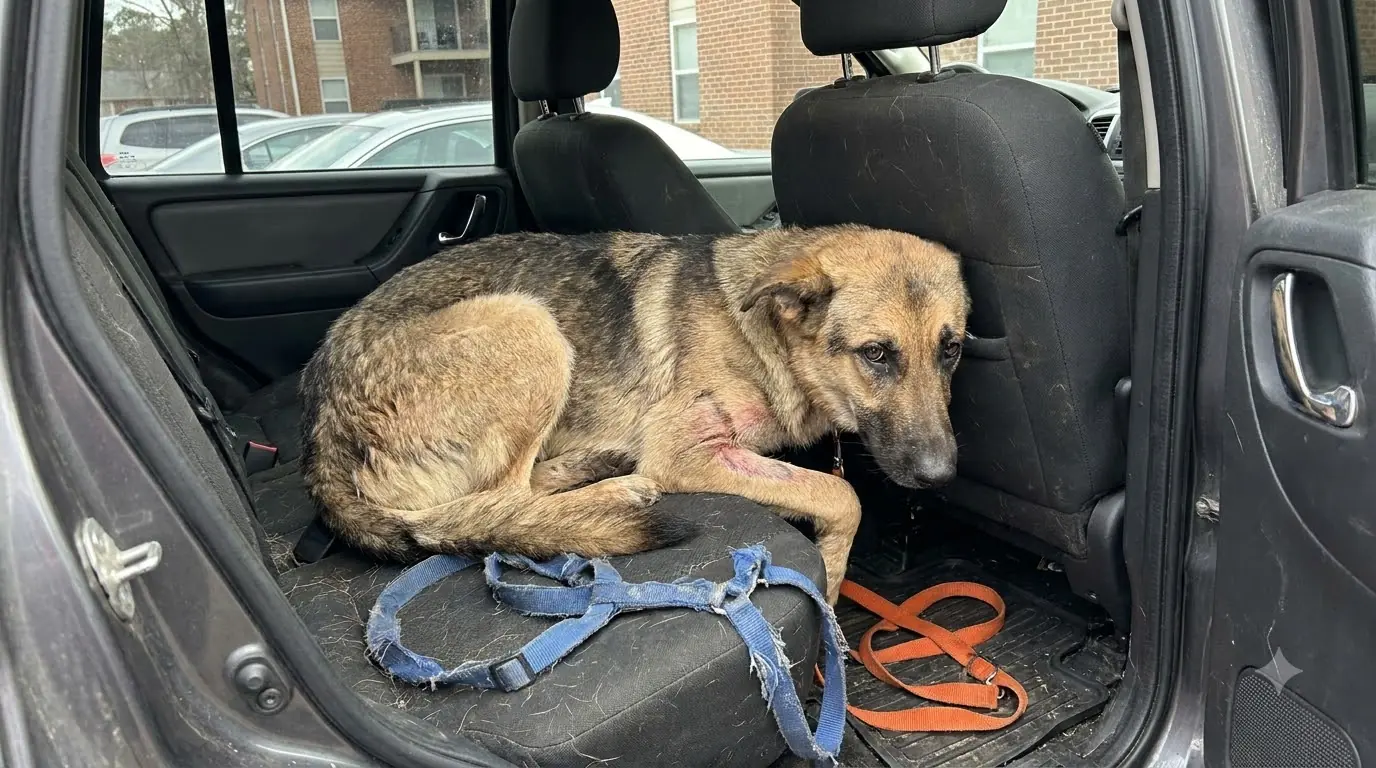
The young dog was loaded into the rescue vehicle shortly afterward.
There was an open seat.
A blanket had been placed there.
He did not use it.
Instead, he climbed into the rear footwell and curled himself tightly against the floor.
Then he began licking the places where the straps had just been removed.
Again.
And again.
By the time the vehicle pulled away from the apartment complex, staff were watching one of the clearest physical clues they had to how long something had been wrong.
The harness was gone.
His body was still responding as though it were there.
The Apartment Complex Gave Rescuers a Location, Not a History
Several people in the area had seen the Shepherd mix before responders arrived.
He had been moving around the property alone.
There was no reliable information establishing exactly where he had come from, how long he had been loose, or who had originally placed the harness on him.
That mattered.
A harness that becomes embedded or chronically restrictive can result from prolonged oversight, poor fit, rapid growth, lack of monitoring, or other circumstances.
But the rescue did not have enough information to say which of those explanations applied here.
They did not claim intentional cruelty.
They did not invent an owner who had deliberately left the dog in pain.
They could document only what they could see.
A young dog had been found loose.
He was wearing a harness that no longer fit his body.
The pressure beneath it had caused visible hair loss and skin injury.
And judging by the way the straps sat, the problem had not developed in a single afternoon.
He Was Still Young Enough That the Harness Explained Part of the Mystery
His age mattered.
The Shepherd mix had not finished maturing.
His proportions still carried some of the lankiness common in adolescent dogs.
His chest had broadened.
His shoulders had developed.
The areas beneath the front legs had filled out as his body grew.
A harness that may once have fit a much smaller puppy can become dangerously tight if it is never adjusted or replaced.
That does not mean staff knew for certain that this was exactly what happened.
But the fit was consistent with equipment that had remained on while the dog grew.
The straps had no room left.
The skin showed the consequences.
Removing It Had to Be Done Carefully
The rescue did not simply yank the harness over his head.
The material was tight enough that manipulating it caused discomfort.
The dog was already stressed by capture, handling, unfamiliar people, and the new environment.
So staff kept the process controlled.
The dog was restrained only as much as necessary for safety.
A calm handler worked from the least sensitive areas first.
Where buckles could be opened without dragging straps across irritated skin, they were.
Where the harness could not be removed safely in its normal configuration, material could be cut rather than forced.
The goal was not to preserve the equipment.
It was to preserve the skin underneath it.
When the final section came free, the dog's coat did not spring back into place.
There was not enough coat left in some areas to do so.
The Strap Lines Stayed on His Body
That was the detail everyone noticed.
Across the chest, the fur was thinner.
Near the armpits, it disappeared almost completely along narrow paths matching the harness.
The skin in those areas was inflamed.
Some sections looked irritated from pressure.
Others showed superficial abrasions caused by movement of the nylon against skin.
Every step would have moved those straps.
Every time his front legs swung forward, the harness would have rubbed the same compromised areas again.
It explained why the dog had been moving carefully.
It also explained what happened inside the rescue vehicle.
He Would Not Sit on the Seat
The vehicle was quiet.
The seat had been covered.
The dog was given enough leash room to choose a stable resting position without moving loose through the car.
He investigated the seat briefly.
Then he stepped down.
The rear floor space was smaller.
Lower.
Protected on several sides.
He turned.
Curled.
And stayed there.
Staff did not pull him back onto the seat simply because the seat looked more comfortable.
A frightened or overwhelmed dog often chooses confined spaces.
The floor also allowed him to brace his body without worrying about shifting off an unfamiliar elevated surface.
So they let him remain.
Then the licking began.
His Tongue Kept Returning to the Same Places
First one armpit.
Then the chest.
Then back to the other side.
The harness had been removed, but the skin beneath it still felt abnormal.
Raw skin can sting.
Inflamed skin can itch.
Pressure release itself can create unusual sensations.
The dog licked repeatedly.
Staff allowed brief self-directed grooming while monitoring closely, but they did not want him traumatizing already damaged tissue.
That meant the skin needed treatment soon.
The drive to care remained quiet.
No unnecessary handling.
No attempt to make him interact.
No emotional reunion scene.
The dog had just lost the object that had been pressing into his body.
He needed time to process the absence of it.
His First Examination Focused on the Skin
Once at the rescue clinic or partner veterinary facility, the Shepherd mix received a more complete assessment.
His overall body condition was recorded.
Hydration was checked.
His heart and lungs were evaluated.
His mouth, ears, eyes, abdomen, joints, and gait were examined.
But the skin beneath the harness remained the most immediate visible concern.
The medical team clipped additional fur only where necessary to see the affected areas clearly.
They cleaned the irritated skin.
They checked for deeper wounds.
They assessed whether pressure had caused ulceration.
They looked for secondary bacterial or yeast infection.
The armpits deserved particular attention because those areas stay warm, experience constant motion, and can be difficult to keep dry.
Not Every Mark Needed Aggressive Treatment
Some areas were superficial.
Red.
Hairless.
Tender.
Those could often heal with removal of the pressure source, careful cleansing, protection from further friction, and treatment based on the actual condition of the skin.
Other areas might need topical or systemic medication if infection or deeper inflammation was present.
The rescue avoided using dramatic terminology that the wounds did not justify.
The harness had caused injury.
That was serious enough.
There was no need to exaggerate it into something more extensive than the examination supported.
The Bigger Concern Was Whether the Skin Had Been Compressed for Too Long
Chronic pressure can do more than remove hair.
It can impair skin integrity.
Constant friction can deepen abrasions.
Moisture and trapped debris can encourage infection.
In severe cases, equipment can become embedded enough to require more involved wound management.
The Shepherd mix was evaluated with those possibilities in mind.
Fortunately, not every tight harness case reaches that extreme.
His treatment plan was based on what veterinarians actually found.
The most important first step had already happened.
The pressure was gone.
Then Came the Problem of Keeping Him From Licking
For the dog, licking probably felt like the most obvious solution.
For the skin, it could become another source of irritation.
Repeated licking adds moisture.
It can disrupt fragile healing tissue.
It can introduce bacteria from the mouth.
Staff used the least stressful management option appropriate for him.
Depending on exactly where the wounds were located, a recovery garment, carefully fitted protective clothing, or another barrier could be considered.
A traditional cone might be used if necessary, but every device had to avoid putting new pressure on the same injured chest and shoulder areas.
That was an important constraint.
The solution to a harness injury could not be another poorly fitted piece of equipment.
Even a Normal Collar Had to Be Considered Carefully
The Shepherd still needed safe handling.
But staff were cautious about what touched his body.
A properly fitted collar could be used for identification and controlled handling if it did not interfere with injured skin.
Walks could be managed with equipment selected specifically around the damaged areas.
There was no rush to put him into another chest harness.
Not until the skin healed.
Not until the medical team was confident a future fit would avoid every irritated zone.
And not until the dog had enough time to stop associating pressure around his torso with discomfort.
His Body Condition Told a More Complicated Story Than the Harness Alone
The Shepherd mix was not severely emaciated.
That mattered.
Rescue stories sometimes become less believable when every stray animal is assigned every possible medical problem at once.
This dog had a clear issue.
The harness.
His other findings were addressed separately.
If he was slightly underweight, that was documented.
If he had normal bloodwork, that mattered too.
If parasite screening was indicated, it was performed.
The rescue did not need to add heartworm disease, anemia, multiple fractures, or another major diagnosis simply to make the story more serious.
The harness marks already told a complete medical story.
His First Night Indoors Was Restless
He had a kennel or quiet recovery space.
A soft bed was available.
Water was nearby.
His meals were introduced normally based on his body condition and medical needs.
At first, he did not settle on the bed.
He chose the floor.
Again.
He curled near a wall with his front legs tucked awkwardly beneath him.
Staff saw his head move toward one armpit.
He tried to lick.
The protective plan prevented repeated access.
He stopped.
Rested for a moment.
Then shifted.
The irritated areas were probably uncomfortable in more than one position.
That meant bedding needed to be supportive without rubbing.
He Kept Checking the Places Where the Harness Had Been
This became one of the most persistent behaviors during the first days.
He would stand.
Turn his head.
Sniff along his chest.
Try to reach an armpit.
Sometimes he licked the air when he could not reach the exact location.
The harness was physically gone.
But the sensory irritation remained.
That made staff realize how important it was not to treat removal itself as the happy ending.
The object was gone.
The injury it left behind still needed time.
Hair Loss Is Slow to Reverse
The lines on his body did not disappear after a bath.
The follicles needed time.
Inflammation had to settle.
Skin had to repair.
If repeated friction had damaged certain follicles more severely, regrowth could be uneven.
For weeks, the Shepherd carried a visible outline where the harness had been.
That outline became one of the easiest ways to track recovery.
At first, bright skin beneath missing coat.
Then less redness.
Then fine fuzz.
Then short hair.
The process was gradual.
His Behavior Around Hands Was Cautious
That was understandable, though staff did not automatically attribute it to the harness.
The dog's full handling history was unknown.
When someone reached toward his chest, he sometimes leaned away.
That could have been pain.
It could have been stress.
It could have been ordinary uncertainty in a young stray dog.
So caregivers changed how they handled him.
Hands approached from the side.
Treats were used.
The dog was allowed to sniff first.
Nobody repeatedly touched the damaged areas just to teach him that humans were safe.
Medical handling remained necessary.
Unnecessary touching did not.
He Started Approaching People From the Front
After several days, the Shepherd mix became more curious.
His ears came forward when familiar caregivers entered.
He accepted food more readily.
He approached the kennel door instead of remaining at the back.
He still kept his body slightly low during some interactions.
That was fine.
Confidence did not need to look dramatic.
A few voluntary steps toward someone were enough.
The Floor Remained His Preferred Resting Place for a While
Even with a bed available, he often chose the lower, more enclosed area.
Staff experimented.
A thinner mat.
A bed placed against a wall.
A blanket on the floor.
He preferred the flatter setup.
That may have been because high-sided bedding contacted the irritated armpit areas.
Or because the floor felt more predictable.
Or simply because that was where he felt safest.
The rescue did not know.
They adapted rather than forcing him onto the nicer-looking bed.
Healing Made His Posture Change
As the skin became less painful, he started stretching his front legs farther forward.
That was subtle.
But important.
With raw areas beneath the arms, extending the legs can pull and rub the skin.
Early on, he often kept himself tighter.
Later, his elbows moved away from the chest.
He slept more fully on one side.
He changed positions without immediately turning to lick.
Those were better indicators of comfort than coat appearance alone.
The First Time He Used the Bed All Night Came Quietly
No one had trained him to.
The bed had simply remained available.
A caregiver checked him late in the evening.
He was curled on it.
Hours later, he was still there.
His body was loose.
His head rested on the edge.
No attempt to crawl back to the floor.
That was the kind of progress staff wanted.
The dog was beginning to choose comfort without being asked.
His Skin Treatment Became Less Intensive
As the abrasions healed, daily care simplified.
Open or irritated areas closed.
Inflammation decreased.
Any infection identified during the initial workup responded to appropriate treatment.
The dog no longer needed the same degree of protection from licking.
That transition was gradual.
Staff did not remove safeguards all at once and hope for the best.
They monitored what he did when given more access.
If licking returned intensely, the plan changed.
If he ignored the skin, more freedom followed.
The Harness Outline Stayed Longer Than the Wounds
That was emotionally striking.
The skin could be healed enough that touching no longer caused obvious discomfort, while the fur still clearly traced the old straps.
A narrow line across the chest.
Curving hairless areas behind the front legs.
A visible map of where the equipment had sat.
Visitors often noticed it immediately.
The rescue explained it carefully.
No, the harness was no longer embedded.
No, he was not currently wearing anything too tight.
What they were seeing was the aftermath.
Staff Eventually Introduced New Equipment
Only after healing had progressed enough.
A young Shepherd mix still needed to learn how to walk safely on leash.
The rescue chose equipment based on fit rather than appearance.
Straps had to clear the previously injured armpits.
Two fingers of appropriate space mattered, but fit had to be judged dynamically too.
Could the dog move his front legs freely?
Did anything migrate backward into the axilla?
Did the harness twist?
Did the chest strap sit where it was designed to sit?
The dog was watched in motion.
Not just standing still.
The First Fitting Was Short
The new harness touched him differently.
Staff did not buckle it on and leave it there for hours.
He sniffed it first.
Treat.
The material touched his shoulder.
Treat.
A strap passed loosely around the torso.
Pause.
The dog remained able to move away.
Sessions stayed brief.
The goal was not only correct physical fit.
It was to prevent the equipment itself from becoming something he anticipated with tension.
He Did Not Panic
That was encouraging.
He was cautious.
He turned his head once to investigate the strap.
But he did not freeze completely or throw himself backward.
The harness came off after a short session.
The next day, another.
Slowly, the Shepherd learned that something touching his chest did not have to tighten until it hurt.
Staff Checked the Fit Every Single Time
That was non-negotiable.
Young dogs continue changing shape.
A harness that fits today may not fit months later.
His story had made that lesson painfully visible.
Caregivers checked the chest.
Shoulders.
Armpits.
Strap position.
Movement.
Skin after use.
Nothing was left on simply because it had fit last week.
He Began Enjoying Walks
Once medically cleared and equipped safely, the Shepherd mix discovered the outside world in a different way.
At first, his walks were mostly sniffing.
He investigated grass.
Tree bases.
Parking-lot edges.
He sometimes stopped when apartment-like building sounds occurred in the distance.
Staff gave him time.
There was no need to pull him forward.
His confidence grew through repetition.
He Was Still Young
That became more obvious as pain and irritation decreased.
He wanted to move faster.
He became interested in toys.
He had bursts of energy.
He sometimes forgot leash manners completely when a new smell appeared.
The dog who had curled silently in the rescue vehicle footwell began looking more like an adolescent Shepherd mix.
That was another reason staff were careful about the narrative.
He was not permanently defined by the harness.
He was a young dog with a lot of ordinary development still ahead of him.
The Rescue Vehicle Became Part of His Rehabilitation Too
Eventually, staff needed to transport him again.
The first ride had ended with him curled tightly on the floor, licking newly exposed skin.
The second time, the setup was familiar.
He entered with less hesitation.
The rear footwell was still available.
So was a secured, padded resting option.
He sniffed both.
Then climbed down to the floor.
Staff allowed it.
The difference was what happened next.
He did not immediately start licking his chest.
He looked out.
Sniffed.
Then lay down.
On a Later Ride, He Chose the Seat
It took longer.
No one coaxed him repeatedly.
No one lifted him onto it.
He stepped in.
Paused.
Put his front paws onto the covered seat.
Then climbed up.
He circled once.
Lay down.
The same part of his body that had once been compressed by an undersized harness now stretched freely against the blanket.
Nothing rubbed under his arms.
Nothing dug into his chest.
He slept for part of the drive.
The Hair Started Filling Back In
The change was easiest to see in comparison photos.
The angry red lines softened first.
Then tiny hairs appeared.
The armpits took longer because of natural friction and movement.
Eventually, the contrast became less obvious.
The old harness shape faded.
Not perfectly all at once.
But enough that strangers no longer noticed it before they noticed the dog.
That was a good milestone.
His Foster Placement Had Different Goals
By the time he moved into a foster home, the immediate skin problem was largely controlled.
Now the focus shifted.
Household routine.
Confidence.
Leash skills.
Rest.
Normal adolescent behavior.
Learning that equipment appeared only for specific activities and came off afterward.
The foster family was explicitly told not to leave the harness on continuously.
It was checked before each walk.
Removed after.
His skin was inspected.
That level of attention was not excessive.
It was preventive care.
He Slept on the Floor the First Night There Too
Some habits followed him.
A dog bed sat near the foster's couch.
He sniffed it.
Then curled on the rug.
Nobody forced him to move.
The second night, he used part of the bed.
By the end of the week, he was often sprawled across it with his front legs fully extended.
The posture would have put direct pressure and friction through the same areas that had been painful before.
Now he could do it comfortably.
The Old Harness Was Not Kept on Him for a Photo
The rescue had saved enough documentation to explain the condition.
There was no reason to put the object back onto his body.
No reenactment.
No staged before-and-after scene.
No tightening it again to show how bad the fit had been.
His body had already provided the evidence.
Once the harness was removed, it stayed removed.
No One Could Say How Long He Had Worn It
That question remained unanswered.
The degree of hair loss and irritation suggested the fit had been problematic for more than a brief period.
But staff could not convert skin changes into an exact timeline.
Days?
Weeks?
Longer?
There was no responsible way to know.
The rescue said so.
The unknown did not diminish the problem.
It simply kept the story honest.
No One Could Say Why He Was Wandering Either
He may have slipped away.
He may have been lost.
He may have been left outside.
He may have come from elsewhere in the neighborhood.
Without verified information, all of those remained possibilities.
The apartment complex was where he was found.
Not necessarily where his story began.
That distinction protected the dog from becoming the center of an invented cruelty narrative.
What Could Be Proven Was Written on His Skin
The harness had been too tight.
His body had grown.
The straps had not adjusted with it.
Fur was gone beneath the pressure points.
The skin was damaged.
He repeatedly licked the areas once they were exposed.
Those facts required no speculation.
His Medical Record Eventually Became Much Less Interesting
That was a good thing.
No new skin breakdown.
No infection.
No persistent severe irritation.
Normal appetite.
Appropriate activity.
Improving coat.
The kinds of notes that do not produce dramatic headlines are often exactly what rescuers want.
He no longer needed to be a wound-care case.
He could become a dog looking for the right next placement.
The New Harness Never Stays on Indoors
That rule followed him.
Walk begins.
Fit is checked.
Harness goes on.
Walk ends.
Harness comes off.
Skin checked.
Simple.
The foster noticed that after a few weeks, the Shepherd barely looked back when the straps were removed.
That was another subtle change.
Early on, removing equipment had exposed painful skin and triggered repeated licking.
Now removal simply meant the walk was over.
The Armpits Became Ordinary Again
Fur covered most of the old lines.
The skin was no longer inflamed.
He could run his front legs through a normal range of motion without nylon rubbing the same damaged tracks.
When he stretched on the floor, the areas that had once looked raw were simply part of his chest again.
That was the physical endpoint staff had wanted from the beginning.
Not a perfect cosmetic restoration.
Comfortable, healthy skin.
He Still Prefers the Floor of the Car Sometimes
That has not completely changed.
Even now, given a safe choice, he occasionally climbs into the rear footwell instead of the seat.
The rescue does not treat it as a sign that he is reliving the first ride.
Dogs can prefer enclosed spaces for many reasons.
What matters is what he does once he gets there.
He curls up.
Looks around.
Sometimes sleeps.
He no longer twists repeatedly toward his armpits.
He no longer licks the bare lines beneath straps that are not there.
The Seat Is an Option Now
On other trips, he climbs up.
That is the larger change.
He has choices.
Seat.
Floor.
Blanket.
Crate, when appropriately conditioned and secured.
His body is not being forced into a position.
His equipment is not being left on until he grows through it.
The world around him is finally adjusting as he grows.
One Recent Ride Looked Nothing Like the First
The Shepherd mix jumped into the rescue vehicle.
His current harness fit correctly.
It sat away from the healed armpits.
The handler checked the straps before attaching the leash.
Then the dog climbed onto the back seat.
He turned twice.
Lay down.
His front legs stretched forward.
The old pressure lines were difficult to see beneath the regrown coat.
At the destination, the leash was unclipped.
The harness came off immediately.
The Shepherd shook his body.
Looked toward the door.
And moved on.
He did not turn to lick.
Staff Still Remember the First Ride
They remember the dog on the floor.
Curled tightly.
The old harness finally gone.
Bare lines exposed beneath his front legs.
His tongue returning again and again to skin that had spent too long underneath straps that no longer fit.
That was the behavior that made the condition feel more immediate than any photograph.
The pressure had ended.
His body had not realized it yet.
That Is What Took the Longest to Change
Removing the harness took minutes.
Healing the abrasions took longer.
Growing the coat back took longer still.
Learning that new equipment would not hurt him happened over repeated, carefully managed experiences.
The rescue could not solve all of that by cutting one piece of nylon.
But cutting it off was the first necessary step.
His Body Has Almost Outgrown the Evidence Now
He is still maturing.
His shoulders have broadened further.
His chest is deeper than it was on intake.
That makes the old harness even more difficult to imagine fitting around him.
And that is perhaps the clearest lesson his case leaves behind.
Young dogs grow quickly.
Equipment does not.
Anything worn around a growing body has to be checked.
Adjusted.
Replaced.
Removed when not needed.
The Harness Is Gone
That part of the story ended the day rescuers cut it away.
But for weeks afterward, the shape remained.
First as raw skin.
Then as bald lines.
Then as short regrowth.
Now, only subtle differences remain.
The young Shepherd mix no longer curls in the back of the vehicle licking the places where nylon used to dig into him.
He still chooses the floor sometimes.
He still chooses the seat sometimes.
He has learned that both are safe.
And whenever a new harness is placed on him now, staff do something that someone in his past either could not or did not do often enough.
They stop.
They put their fingers beneath the straps.
They watch him walk.
They check the skin under his front legs.
And before he goes back inside, they take it off.