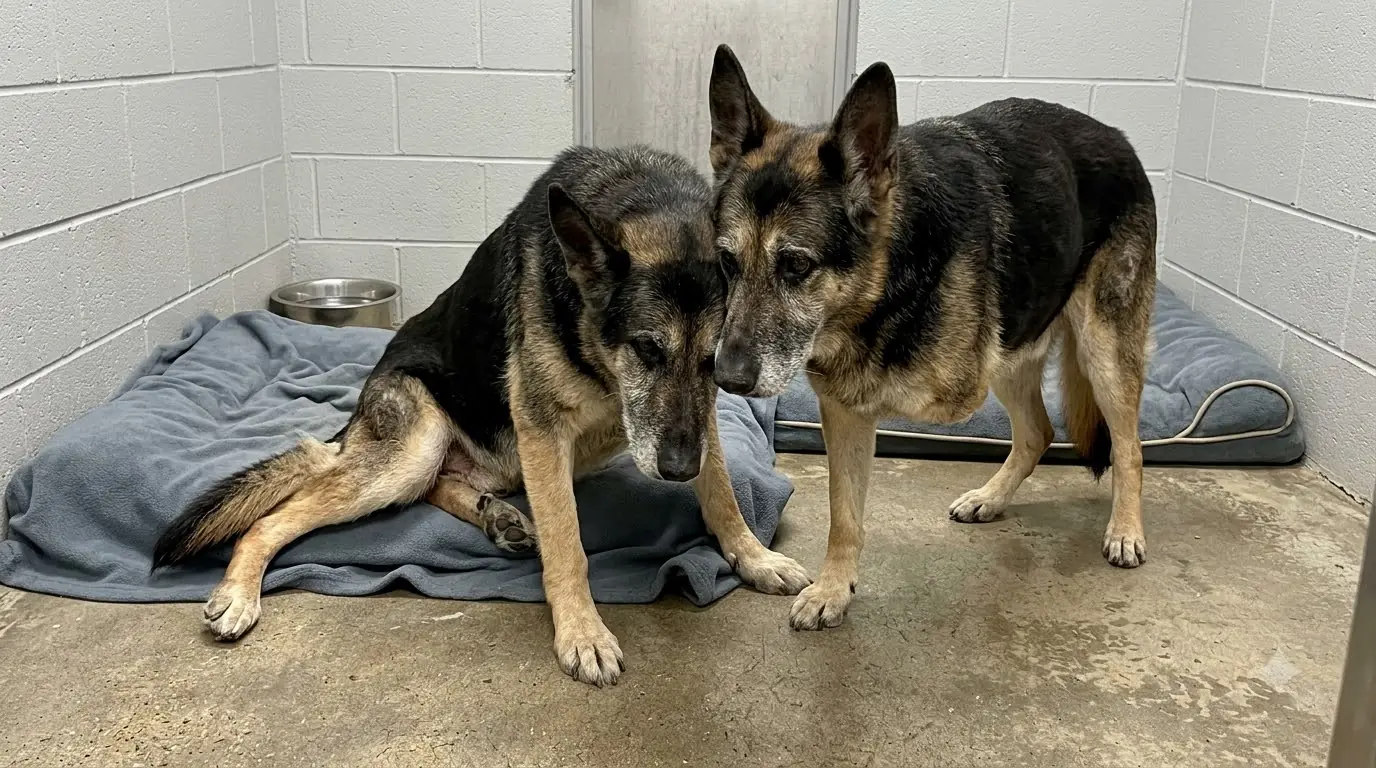
Major tries to stand almost every morning.
He plants his front paws against the bedding and lifts his chest. For a moment, the senior German Shepherd looks as though the rest of his body might follow.
It rarely does.
Degenerative disease in his spine has left his hind legs with almost no useful strength. His rear paws slide behind him, his hips sink, and within seconds Major is back down.
Across the medical kennel, Rex notices.
Getting to Major is not easy for him either.
Rex is missing one front leg.
The three-legged senior Shepherd shifts his weight onto his remaining front limb, pushes himself away from his bed, and begins the uneven trip across the short distance between them.
He does not move gracefully. He cannot.
But he reaches Major.
Then Rex turns his body until his stronger shoulder is pressed alongside his old partner.
For a few moments, the two elderly dogs remain like that.
Eventually, Major stops trying to rise.
Rex lowers himself too.
And when shelter staff begin their morning rounds, they often find both German Shepherds lying together—the dog who can barely use his back legs pressed against the dog who has only one front leg left.
Their Working Years Were Long Behind Them
Rex and Major had spent years serving in the same K-9 unit.
They were working dogs then: conditioned, trained and physically capable of performing demanding tasks alongside their handlers.
Those years eventually ended.
Both dogs retired.
By the time they came into medical shelter care, age had already changed them considerably.
Their faces had gone gray. Their movements were slower. Long periods of rest had replaced the demanding routines of their working lives.
But ordinary aging was only part of what staff were dealing with.
Each dog had lost a different part of his mobility.
Rex had lost a front leg.
Major still had all four limbs, but his two rear legs could barely support him.
Keeping both senior dogs comfortable would require much more than simply giving them a quiet kennel.
Rex Had Learned to Live on Three Legs
A dog can adapt remarkably well after losing a limb, but that does not mean amputation becomes physically irrelevant.
A front-leg amputation is especially significant because dogs naturally carry a large portion of their weight over their forelimbs.
Rex's remaining front leg now had to absorb considerably more load.
His gait had changed accordingly.
Every step required him to shift and stabilize his body differently. Getting up from the floor required careful balance. Long periods on hard or slippery surfaces could make movement even more difficult.
For a younger dog, adaptation might be easier.
Rex was already a senior.
Staff therefore watched his remaining limbs and joints closely. His weight mattered. His footing mattered. So did keeping his nails appropriately maintained and giving him supportive places to rest.
He could still move independently.
But every unnecessary trip across the kennel asked more from the three legs he had left.