During the day, Riley barely comes t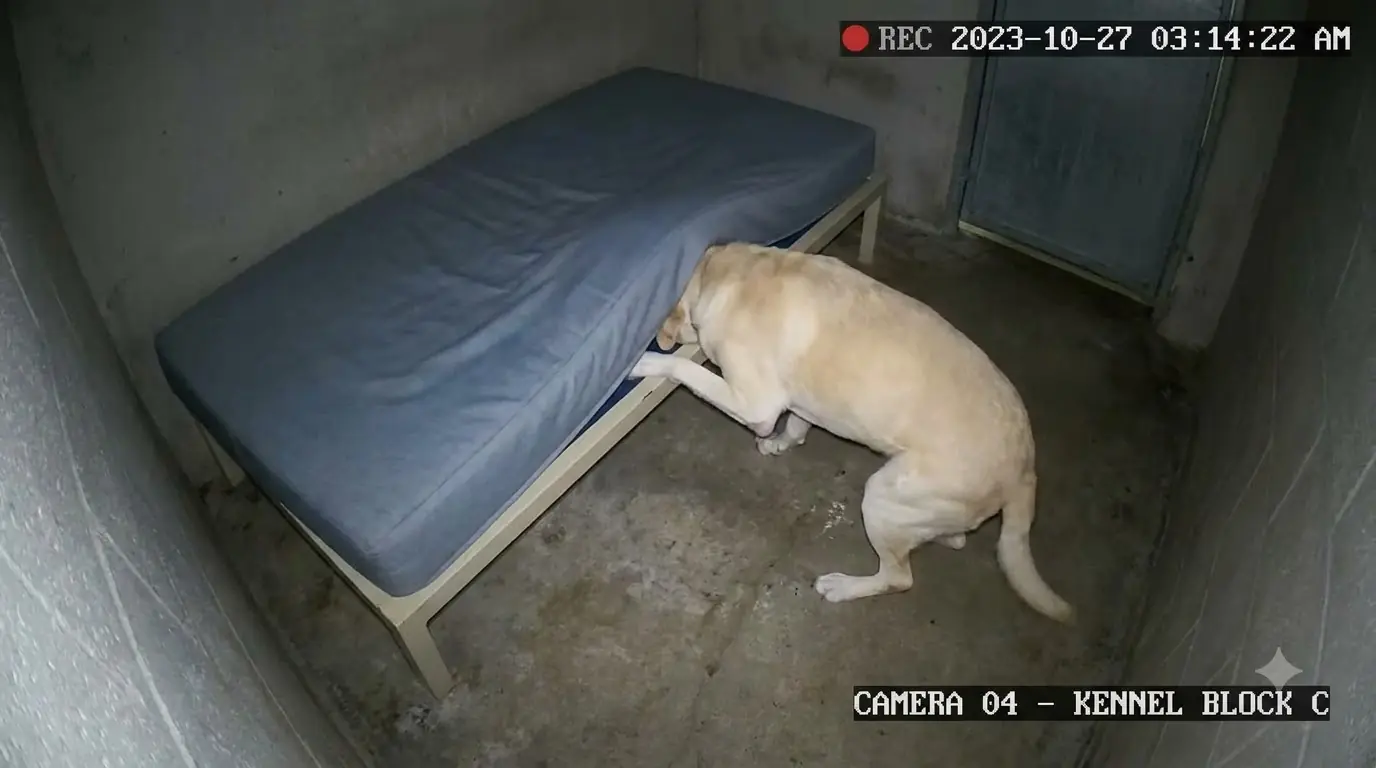 o the front of his kennel anymore.
The 8-year-old Labrador Retriever used to notice people walking through the shelter hallway.
Now someone can pass his gate and sometimes get almost no reaction.
Riley stays toward the back.
He rests.
He watches less.
And after weeks in the shelter, staff began worrying that he was withdrawing from the environment around him.
Then they checked the overnight camera.
What Riley was doing after the building became quiet was even stranger.
He walked to his mattress.
Hooked both front paws beneath its edge.
Lifted it.
Then began pushing his face underneath.
Riley didn't stop when his muzzle disappeared.
He kept working until his entire head—and sometimes part of his shoulders—was beneath the mattress.
Then he became completely still.
And he could remain that way for hours.
At First, It Looked Like Riley Was Just Rearranging His Bed
Dogs paw at bedding for many ordinary reasons.
They circle before lying down.
They bunch blankets together.
They push mattresses around.
So finding Riley's bed disturbed in the morning did not immediately raise an alarm.
Then staff noticed the same pattern again.
One side of the mattress would be lifted.
Riley would be positioned partly underneath it.
Sometimes only his head was hidden.
Other times his shoulders were pushed beneath the edge too.
It was unusual enough that caregivers wanted to know when it was happening.
The nighttime footage gave them the answer.
Riley Was Doing It Deliberately
On camera, the sequence was clear.
Riley approached the mattress.
He lowered his head.
One front paw scraped beneath the edge.
Then the other.
He lifted enough of the mattress to create a narrow space.
Riley pushed his muzzle into it.
Then farther.
He kept shifting forward until his face was completely covered.
Once he reached the position he wanted, the movement stopped.
Riley simply lay there.
The first question was obvious.
Why?
His Behavior Had Already Been Changing
The mattress behavior did not appear in isolation.
Riley had been living in the shelter for weeks.
Over that time, staff had noticed that he was becoming less engaged with normal activity around his kennel.
He stopped regularly approaching the front.
People passing no longer produced the same response.
He spent increasing amounts of time resting away from the gate.
Those changes could be consistent with a dog struggling in a shelter environment.
But caregivers could not simply label Riley “depressed” and stop investigating.
Behavioral withdrawal can overlap with physical illness.
And Riley could not tell anyone whether he was hiding because the environment felt overwhelming—or because something hurt.
The Mattress Created Another Concern
If Riley had merely tucked his nose under a blanket for a few minutes, the behavior might have seemed less significant.
But he was trying to put much more of himself underneath a relatively heavy object.
His head disappeared.
His shoulders sometimes followed.
Then he remained there for prolonged periods.
Staff needed to make sure the setup itself was safe.
Could Riley breathe comfortably?
Could he get himself out easily?
Was the mattress placing unwanted pressure on his neck or body?
Was he becoming trapped?
Whatever the reason for the behavior, caregivers could not allow Riley's attempt to hide to create another problem.
So They Didn't Just Pull the Mattress Away and Call It Solved
Removing it would have stopped that specific behavior.
It would not have answered why Riley was doing it.
And Riley still needed a comfortable place to rest.
At 8 years old, spending hours on a hard kennel floor was not a better alternative.
The shelter needed to think about both sides of the problem.
Riley needed safe bedding.
But if he was seeking cover, perhaps he also needed a safer way to get it.
First, Staff Had to Rule Out the Physical Possibilities
Riley's declining engagement deserved medical attention.
A dog who suddenly becomes less responsive or stops interacting normally may be experiencing more than stress.
Pain can change behavior.
Illness can reduce activity.
Neurological problems can alter responsiveness.
Changes involving vision, hearing or other physical functions can also affect how a dog interacts with the environment.
Staff therefore paid attention to Riley's entire daily pattern.
Was he eating?
Drinking?
Walking normally?
Did he respond to sound?
Did he appear painful when rising or lying down?
Was his behavior different at certain times?
Could he move his neck normally?
Did he seem disoriented?
The mattress alone could not answer those questions.
They Also Watched What Happened Before Riley Hid
The nighttime footage became useful for another reason.
Caregivers could see the sequence leading up to the behavior.
Did Riley immediately bury himself when the lights went out?
Did barking trigger it?
Did someone walking through the hallway cause him to retreat?
Did he emerge when the building became quieter?
Or did he remain hidden regardless of what was happening outside?
Patterns could help staff understand whether environmental stimulation was playing a role.
But they were careful not to overinterpret what a camera could show.
It could document Riley's behavior.
It could not tell them what Riley was feeling.
One Night, Riley Stayed Under the Mattress for Hours
The shelter quieted.
Riley moved to his bed.
He lifted the familiar edge.
His head disappeared beneath it.
Then his shoulders.
For a long time, almost nothing changed.
Occasionally his body shifted slightly.
Otherwise, Riley remained still.
When staff reviewed the footage, that duration concerned them.
Whatever Riley was getting from that position, he seemed strongly motivated to remain there.
Simply stopping him from doing it would not address that need.
The Shelter Began Giving Him a Safer Place to Withdraw
If Riley was seeking reduced visual stimulation or a more enclosed resting space, caregivers could offer that without requiring him to wedge himself beneath a mattress.
His kennel environment was adjusted so he could have a quieter, appropriately sheltered resting option while still being safely monitored.
The goal was not to seal Riley away from everything.
It was to give him some control over how exposed he felt.
A dog should not have to physically bury his head beneath bedding just to get away from constant stimulation.
Staff Stopped Expecting Him to Come to the Gate
Riley's withdrawal created another temptation.
People wanted to call him forward.
“Come on, Riley.”
A person might crouch outside the bars.
Another might try to interest him in interaction.
But repeatedly asking Riley to leave the place where he felt able to settle could add pressure.
So caregivers changed the expectation.
They could go closer to him when appropriate.
They could sit nearby without demanding contact.
Food, enrichment and necessary care could be offered in ways that did not require Riley to perform enthusiasm at the kennel door.
If he chose to approach, that was different.
For Several Days, Riley Still Preferred the Mattress
The new setup did not instantly erase the behavior.
Night came.
Riley pawed at the mattress.
His face disappeared beneath it again.
The next night, he repeated the sequence.
That did not mean the environmental changes had failed.
A behavior repeated for days or weeks may not disappear simply because another option becomes available.
Riley needed time to investigate whether the alternative actually felt useful to him.
Then Staff Found Him Resting Somewhere Different
One afternoon, Riley was not beneath the mattress.
He was lying in the quieter resting area that had been made available to him.
His head was visible.
His body was loose enough to rest normally.
Someone passed the kennel.
Riley opened his eyes.
But he did not immediately move.
The person continued down the hallway.
Riley lowered his head again.
It was an ordinary moment.
For Riley, ordinary was encouraging.
That Night, He Still Buried His Face Again
Progress did not move in a straight line.
The overnight footage showed Riley lifting the mattress and pushing his head underneath.
Staff did not interpret that as losing everything gained during the day.
Shelter environments change constantly.
Some periods are louder.
Some days contain more activity.
Dogs can respond differently depending on what has happened around them.
Riley was allowed to have harder days without being forced through them.
His Lack of Response to People Needed Attention Too
The mattress behavior was visually unusual.
But staff remained concerned about something less dramatic.
Riley had stopped showing much interest when people passed.
That change mattered.
A dog who becomes increasingly withdrawn over a long shelter stay may need more than extra toys.
Caregivers looked at his routine as a whole.
How much meaningful time did he spend outside the kennel?
What kinds of interaction did he tolerate or enjoy?
Did he engage differently in a quieter environment?
Were there specific people he responded to more readily?
Could his daily routine become more predictable?
And, importantly, had medical evaluation identified anything that could be contributing to his change?
One Familiar Worker Tried Sitting Near Him
There was no attempt to pull Riley out.
The person sat quietly at a comfortable distance.
Riley stayed where he was.
Minutes passed.
He did not approach.
The worker remained.
Eventually, Riley lifted his head.
He looked toward the person.
Then rested again.
That was all.
The next session was similar.
No dramatic transformation.
No sudden tail wagging.
But the interactions gave Riley exposure to a person without requiring him to do anything.
Then He Came Forward on His Own
It happened quietly.
A caregiver was near the kennel.
Riley stood.
For several seconds, he remained at the back.
Then he walked forward.
Not quickly.
He stopped before reaching the gate.
Looked through the bars.
Then remained there.
The person did not immediately reach toward him.
Riley was allowed to decide how close was close enough.
Eventually he returned to his resting area.
But staff had seen something they had not seen often lately.
Riley had chosen the front of the kennel again.
Nobody Treated That as Proof the Problem Was Over
One approach could not erase weeks of withdrawal.
Nor could behavioral improvement rule out future medical concerns.
If Riley became unusually lethargic, stopped eating, developed pain, appeared confused or showed other physical changes, he would still need appropriate veterinary attention.
Shelter stress should never become an automatic explanation for every new symptom.
That was one of the reasons staff had taken his strange mattress behavior seriously in the first place.
The Nighttime Pattern Began to Change
Some nights, Riley still pawed at the mattress.
But he did not always push his entire head beneath it.
Sometimes he tucked only his muzzle under the edge.
Other nights, he chose the quieter resting space instead.
Then came a night when the camera recorded something staff had been waiting to see.
Riley walked toward the mattress.
He sniffed the edge.
He pawed it once.
Then stopped.
He turned around.
Walked to the alternative resting area.
And lay down.
His face remained uncovered.
It Was a Small Change, but It Answered an Important Question
Riley was capable of choosing another place to settle.
That did not reveal exactly why he had been hiding beneath the mattress.
Maybe reduced stimulation was helping.
Maybe increased predictability mattered.
Maybe several parts of his care were contributing at once.
Staff did not need to turn one better night into a definitive behavioral diagnosis.
They simply continued giving Riley options that were safer than wedging his head beneath heavy bedding.
Some Nights, He Still Goes Back
The lights dim.
The hallway quiets.
Riley gets up.
He walks to the mattress.
Both front paws reach toward the edge.
He lifts it.
His muzzle disappears.
Sometimes he stops there.
Sometimes he pushes farther until most of his head is covered.
When staff see the behavior, they continue monitoring him rather than assuming it is harmless simply because he has done it before.
A repeated behavior can still change in intensity or meaning.
Riley's physical health and safety remain part of the picture.
But He Is No Longer Spending Every Night That Way
There are nights when Riley stretches out normally.
There are days when he notices a familiar caregiver.
Occasionally, he walks toward the front again.
None of those changes are dramatic enough for a perfect before-and-after story.
That is probably more realistic.
A dog who has withdrawn over weeks does not necessarily return to his old behavior overnight.
Sometimes improvement is simply the return of choices.
Where to sleep.
Whether to approach.
Whether to watch the hallway.
Whether to hide.
Staff Still Don't Know Exactly Why Riley Started Doing It
They know when it appeared.
They know it coincided with a period when Riley became increasingly withdrawn after weeks in the shelter.
They know he repeatedly lifted the mattress himself.
They know he pushed his head and shoulders beneath it.
And they know he sometimes remained there for hours.
Those facts support concern.
They do not prove a specific emotional story.
Perhaps the behavior was primarily an attempt to reduce stimulation.
Perhaps another factor contributed.
That is why staff looked at both Riley's health and his environment rather than choosing the most emotional explanation and stopping there.
Tonight, the Camera May Capture the Same Strange Scene
The shelter grows quiet.
Riley walks toward his mattress.
His paws catch the edge.
For a moment, it looks as though he is going to disappear underneath again.
He lifts it.
Then pauses.
Across the kennel is another place to rest.
Quieter.
More sheltered.
But without a mattress pressing over his head.
Riley looks toward it.
Some nights, he still chooses the mattress.
Other nights, he lets the edge fall back to the floor and walks away.
That difference is what staff are watching now.
They may never know exactly what Riley was trying to escape when he began burying his face beneath his bed.
But they do know something was changing in a dog who had slowly stopped coming to the kennel gate, stopped responding to the hallway and started spending hours with his head hidden from view.
So instead of simply pulling the mattress away, they started asking a more important question:
What would make Riley feel like he no longer needed to disappear underneath it?