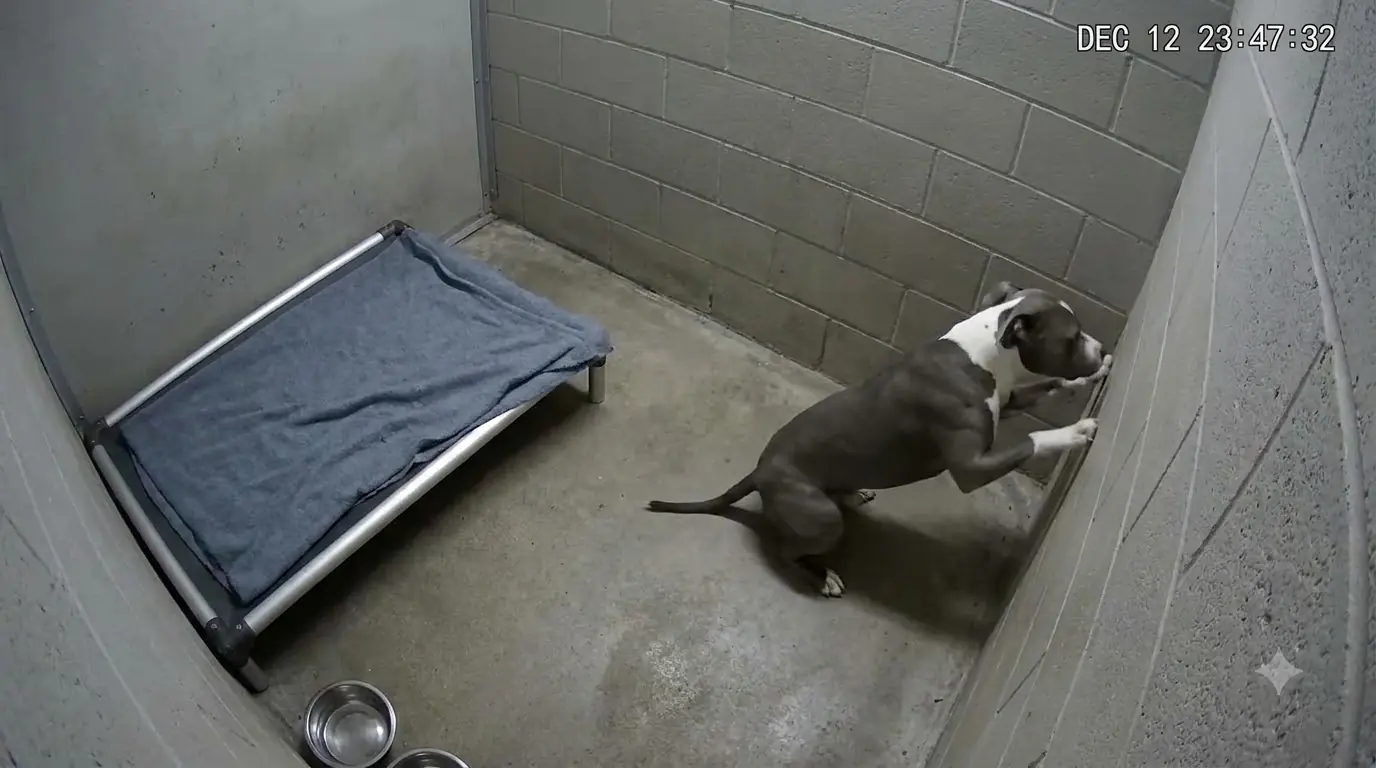
The kennel was quiet when Rocco suddenly jumped off his bed.
There was no person standing at the gate.
No dog had entered his space.
Nothing obvious had changed in the room.
But the 7-year-old American Pit Bull Terrier moved with startling urgency.
He rushed across the kennel.
Straight to one particular corner.
Then he began attacking the wall.
Rocco scraped both front paws against the cinderblock. He pushed his muzzle toward the same spot and repeatedly bit at the hard surface.
His nails dragged across concrete.
His teeth struck the wall.
Within moments, the behavior became so intense that staff watching from outside had to intervene.
Rocco eventually stopped.
Several minutes later, he was back on his bed.
Exhausted.
Quiet.
Almost as if the violent episode at the wall had never happened.
Then another night, he did it again.
Same corner.
Same frantic scratching and biting.
And increasingly, the shelter was no longer asking how to stop Rocco from damaging the wall.
They were asking what could be happening inside his body that made him keep doing it.
The First Episode Looked Like Destructive Behavior
Shelters see dogs scratch at doors and kennel surfaces for many reasons.
Stress can produce repetitive behavior.
Some dogs paw at barriers when they hear activity outside.
Others chew bedding, push bowls, dig at corners, or become restless during periods of confinement.
So when Rocco first began scratching the wall, the behavior itself did not provide an obvious medical explanation.
But then it escalated.
He wasn't casually pawing.
He wasn't slowly chewing an edge out of boredom.
Rocco seemed to switch abruptly from resting to intense, repetitive activity focused on one specific section of wall.
That sudden onset made staff pay closer attention.
It Was Always the Same Place
That detail quickly became difficult to ignore.
Rocco did not move around the kennel attacking different surfaces.
He returned to one corner.
Again and again.
Sometimes he had been lying quietly immediately beforehand.
Then he would rise abruptly and rush toward that spot.
His paws scraped.
His mouth went toward the cinderblock.
If nobody interrupted, he continued long enough to hurt himself.
His Nails Were Beginning to Show the Cost
Repeated contact with a rough wall can damage paws and nails.
Rocco's front feet began showing abrasions from the scratching.
Then staff became concerned about his mouth.
Biting a cinderblock surface can injure lips, gums, teeth, and other oral tissues.
Whatever was causing the episodes, allowing him to continue until he physically exhausted himself was no longer safe.
The shelter had to intervene.
But intervention created another challenge.
Staff Couldn't Simply Rush Into the Kennel
Rocco was not behaving normally during the most intense moments.
A dog repeatedly biting at a wall may redirect unexpectedly if someone suddenly reaches toward his face or tries to physically restrain him.
Even if Rocco had never shown ordinary aggression toward staff, that did not make putting hands near his mouth during an abnormal episode safe.
So caregivers had to think about protecting Rocco without placing themselves directly into the path of frantic movement.
Whenever possible, intervention began from outside the immediate space.
The goal was to interrupt or reduce the dangerous behavior safely—not punish him for it.
Punishment Wouldn't Answer the Medical Question
If Rocco were simply labeled destructive, the response might focus on stopping the scratching.
But stopping the visible behavior would not explain why it had suddenly appeared.
Especially because of what happened afterward.
Rocco didn't remain agitated for the rest of the night.
He didn't continue pacing for hours.
After an episode, he often became profoundly tired.
He returned to his bed.
Lay down.
And appeared almost disconnected from the intensity of what had just happened.
That post-episode change made the veterinary team increasingly concerned.
Nobody Could Say Rocco “Didn't Remember”
It was tempting to describe him that way.
He attacked the wall.
Then minutes later, he appeared normal or exhausted.
But the shelter could not know what Rocco remembered.
Dogs cannot report their awareness before, during, or after an event.
What staff could say was more precise:
During these episodes, Rocco showed sudden, intense, repetitive behavior.
Afterward, his behavior changed dramatically.
He became quiet and exhausted.
That sequence could be medically meaningful.
The Veterinary Team Needed to See the Entire Episode
The wall damage alone wasn't enough.
Staff began documenting what happened before Rocco reached the corner.
Was he asleep?
Did he suddenly wake?
Did his head or eyes move strangely first?
Did he appear to react to something that wasn't obvious to people?
Was there facial twitching?
Jaw movement?
Staring?
Drooling?
Abnormal swallowing?
Did one side of his body behave differently?
Could staff get his attention?
How long did the episode last?
And what happened immediately afterward?
Those details might help distinguish behavioral distress from pain, seizure-like activity, or another neurological process.
A Focal Seizure Became One Possibility
Not all seizures look like the dramatic whole-body convulsions people commonly imagine.
Some seizure activity can involve more localized or unusual signs.
Depending on the area of the brain involved, abnormal episodes may affect movement, sensation, awareness, or behavior.
That meant a sudden repetitive behavior could potentially deserve neurological consideration—especially if it occurred in discrete episodes and was followed by an abnormal recovery period.
But Rocco's behavior alone could not confirm a focal seizure.
That remained one possibility among several.
Neuropathic Pain Was Another Concern
Pain involving nerves can produce sensations that are difficult to infer from outward behavior.
Rocco could not tell staff whether he felt pain, tingling, burning, abnormal sensation, or something else immediately before attacking the wall.
If an abnormal sensory experience was driving the episodes, his behavior might look bizarre to people who could not feel what he was experiencing.
Again, that was a hypothesis.
Not an explanation staff could declare as fact.
Other Neurological Problems Also Had to Stay on the Table
The veterinary team could not narrow the case to two possibilities simply because they sounded plausible.
A neurological examination would help determine whether Rocco showed abnormalities between episodes.
His gait mattered.
His awareness mattered.
His vision and responses could matter.
Changes in posture, coordination, facial movement, or other behaviors might provide additional clues.
The dramatic wall episodes were only one part of the medical picture.
Then the Shelter Camera Captured an Episode From the Beginning
Rocco was on his bed.
His body appeared relaxed.
For a while, almost nothing happened.
Then he lifted his head.
He remained still briefly.
Suddenly he stood.
He crossed the kennel quickly and went directly to the familiar corner.
The scratching began.
Front paws against cinderblock.
Repeated movement.
Then his mouth went toward the wall.
Staff watching the recording later could see how abrupt the transition had been.
Resting dog.
Then intense, highly focused behavior.
The Video Didn't Provide a Diagnosis
But it gave the veterinary team something more useful than a description such as “Rocco goes crazy at night.”
They could see the sequence.
They could see the speed of onset.
They could see his body position.
They could see how repetitive the movement became.
And they could compare that footage with what Rocco looked like during an ordinary period.
Video can preserve an intermittent symptom.
It cannot determine its cause by itself.
Rocco Was Moved for Closer Medical Observation
The episodes were becoming physically dangerous.
His paws were already being damaged.
His mouth was at risk.
He needed an environment where staff could monitor him more closely while the veterinary investigation continued.
The move also allowed caregivers to reconsider what surfaces were accessible during an episode.
Rocco did not need another rough wall against which he could repeatedly injure himself.
But Simply Padding the Wall Wasn't the Answer
Physical protection could reduce injury.
It could not explain the behavior.
If Rocco's episodes came from neurological dysfunction, pain, or another medical problem, covering the cinderblock would only change what his body encountered during the event.
The underlying episode could still occur.
So environmental safety and medical investigation had to happen together.
His Paws and Mouth Needed Care Too
The original mystery had now created secondary injuries.
Rocco's nails and paws required monitoring.
Any oral injury from biting hard surfaces needed attention.
Staff also had to watch for damaged teeth or other complications depending on what the veterinary examination showed.
These injuries were consequences.
They were not necessarily the cause.
That distinction mattered.
Treating Rocco's scraped paws would not stop another neurological episode if something deeper was driving the behavior.
During the Day, He Could Look Surprisingly Normal
That made his case particularly unsettling.
A worker could visit Rocco in the afternoon and find him resting quietly.