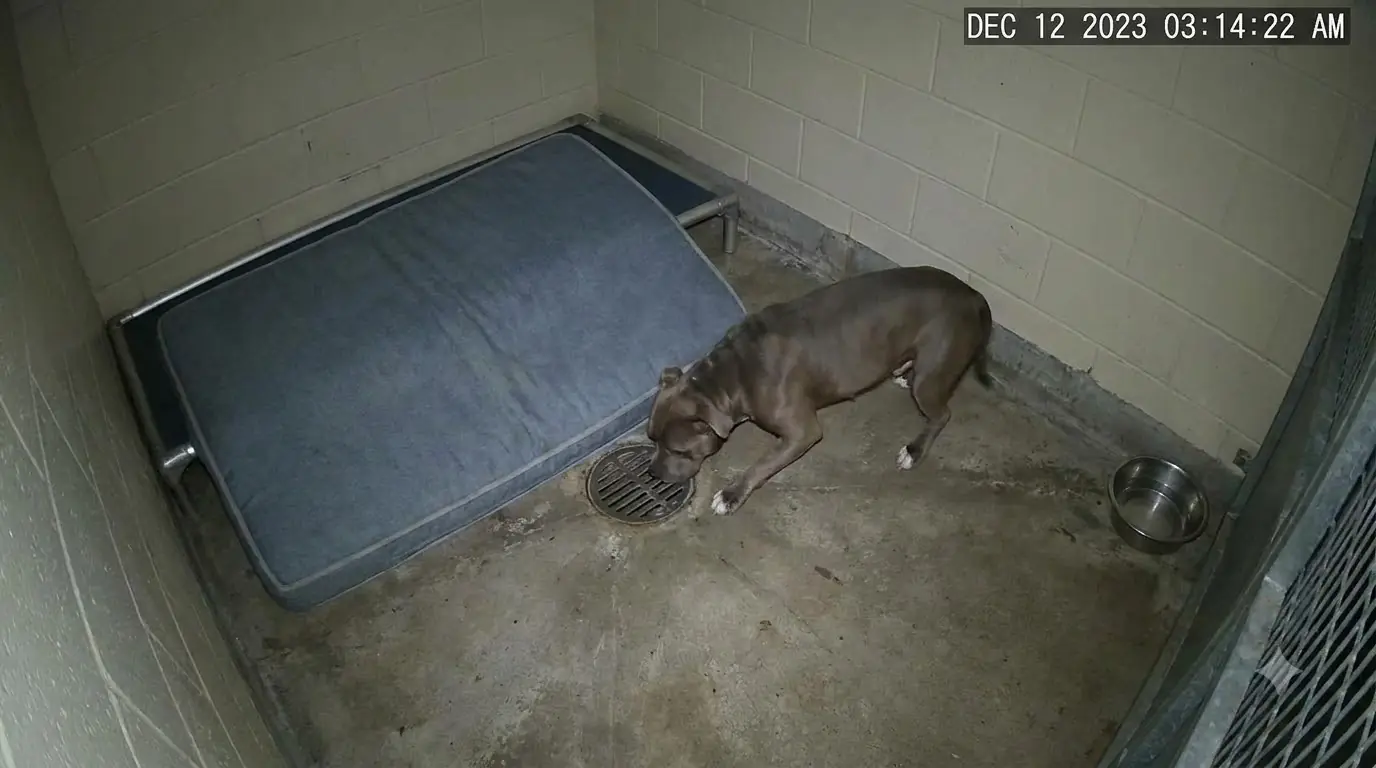
Rocky had a bed.
After months in the shelter, the 8-year-old American Pit Bull Terrier knew exactly where it was.
But recently, staff began finding that bed empty.
Rocky was sleeping in the corner instead.
Not simply on the concrete.
He had chosen one extremely specific place.
The floor drain.
Rocky would lower himself beside the small metal drain and press his muzzle down close to its opening. Sometimes his nose seemed almost tucked against the grate.
Then he would stay there.
For hours.
The first time, a worker assumed Rocky had simply chosen an odd sleeping position.
Then he did it again.
And again.
Eventually staff dragged his mattress across the kennel and placed it over the spot.
Rocky walked over.
Put his paws against the mattress.
Pushed it aside.
Then lowered himself back down beside the exposed drain.
That was when the question changed.
Rocky wasn't merely avoiding his bed.
Something kept bringing him back to one exact spot.
This Wasn't How Rocky Had Always Slept
That detail mattered.
Rocky had already spent months at the shelter.
Staff knew some of his ordinary routines.
Dogs choose strange sleeping positions all the time, and kennel environments can influence where they feel comfortable resting.
But Rocky's fixation on the drain was new.
He had previously used other areas.
Now the bed was increasingly empty.
The corner wasn't.
A new behavior in a dog who has already lived in the same environment for months deserves more attention than a quirky habit he has shown since arrival.
Something had changed.
The difficult part was figuring out what.
At First, Staff Thought the Concrete Might Simply Feel Better
Kennel floors and bedding can differ significantly in temperature and texture.
A dog may move away from a warm mattress and choose a cooler surface.
Rocky might have discovered that the area around the drain felt different.
That was a practical possibility.
But it did not fully explain the specificity of the behavior.
Rocky wasn't choosing just any section of bare floor.
He repeatedly positioned his face at the drain.
If his mattress covered that exact area, he moved it.
Then he returned.
Staff Started Watching How He Positioned Himself
Rocky usually lowered his body first.
Then his head followed.
His muzzle ended up close to the drain opening.
He might remain in that position for a surprisingly long time.
Sometimes he appeared to be sleeping.
At other times he simply rested quietly.
Staff began checking whether he was actually licking the drain, trying to eat something from it, or repeatedly pawing at it.
Those details could point toward different explanations.
But Rocky's most consistent behavior was much simpler.
He wanted his face there.
The Obvious Question Was Why
Was the drain cooler?
Did air move through it?
Was there a smell coming from below?
Could Rocky hear something staff couldn't easily detect?
Was the position physically more comfortable for some reason?
Or was a new medical or behavioral problem changing where and how he wanted to rest?
Nobody had enough evidence to choose an answer.
And the stranger the behavior looked, the more important it became not to invent one.
The Shelter Didn't Call It an Obsession and Stop There
Describing Rocky as “obsessed with the drain” captured how repetitive the behavior appeared.
It did not explain the cause.
Behavioral changes can be influenced by environment, stress, learning, sensory stimulation, physical discomfort, or medical conditions.
Sometimes several factors overlap.
So the behavioral team and veterinary team both had reasons to pay attention.
Rocky needed observation from more than one angle.
First, the Drain Itself Had to Be Checked
Before assuming something was happening inside Rocky, staff needed to consider the environment around him.
Was the drain unusually cold?
Was there persistent moisture?
Was there a strong odor?
Was air moving through it?
Could cleaning products or residue be present?
Was there anything around the grate that might irritate his skin or nose?
Was the surface safe for prolonged contact?
Rocky's behavior was unusual, but the object he had chosen was part of the equation too.
Sleeping With His Face There Created Practical Concerns
A floor drain is not designed to be a dog bed.
Even if Rocky preferred the location, staff still needed to think about hygiene and physical comfort.
Prolonged pressure against a hard grate could irritate the muzzle.
Moisture could affect skin.
Anything accumulating around the drain needed to be kept away from his nose and mouth.
The goal was not necessarily to ban Rocky from the corner immediately.
It was to understand why he was there while making sure the position itself was not creating another problem.
Then Staff Tried Moving His Mattress
It seemed like the simplest solution.
If Rocky wanted that corner, perhaps he could have the corner without lying directly on hard concrete.
A worker pulled his mattress across the kennel.
The bed was positioned over the drain.
Rocky approached.
For a moment, he stood looking at it.
Then he began using his front paws.
Push.
Pause.
Push again.
The mattress shifted.
Rocky kept working until part of the drain was exposed.
Then he stepped around the bedding and lowered himself.
His muzzle went back toward the grate.
That Made the Drain Harder to Ignore
If Rocky had simply wanted the corner, the mattress should not necessarily have been a problem.
But covering the drain changed something.
Rocky actively moved the obstacle.
That suggested the exact location—or something associated with it—was important to the behavior.
It still did not reveal why.
Staff Didn't Keep Covering It as a Test
Once Rocky had demonstrated the response, there was little value in making him repeat it over and over.
The shelter did not need to spend every day placing the mattress over the drain just to watch Rocky push it away.
That could turn an unexplained behavior into an unnecessary conflict.
Instead, the team began looking for ways to preserve comfort while continuing the investigation.
His Regular Bed Still Stayed Available
Rocky wasn't deprived of bedding because he refused to use it.
The mattress remained an option.
Staff could also consider alternative resting surfaces or arrangements that gave him more choice without blocking the location he repeatedly sought.
If he wanted a firmer or cooler surface, that information mattered.
If he wanted the drain specifically, that mattered too.
The important thing was to observe what Rocky chose when several safe options were available.
Then Came the Medical Question
Rocky was eight years old.
A newly appearing, persistent change in resting behavior deserved consideration alongside his physical health.
Was he painful?
Was lying on the mattress uncomfortable?
Had arthritis or another musculoskeletal problem made certain positions harder?
Was he experiencing gastrointestinal discomfort, nausea, breathing difficulty, or another condition that changed how he wanted to position his head and body?
Were there neurological or cognitive changes?
The behavior alone could not answer those questions.
A veterinary assessment could help determine whether other clinical signs existed.
Staff Paid Attention to How Rocky Used the Rest of His Body
Did he lower himself normally?
Was he stiff when getting up?
Did he hesitate before lying down?
Did he favor one side?
Was he panting while resting?
Did his breathing change in different positions?
Could he turn his neck normally?
Was his gait different?
Had his appetite changed?
Was he drinking more or less?
The drain was the most visible clue.
But the rest of Rocky's body might explain why that clue had appeared.
His Face Needed Attention Too
Because Rocky repeatedly placed his muzzle against the floor, caregivers checked for problems around his mouth and nose.
Pain or irritation in the face can alter behavior.
So can dental problems or other discomfort.
Again, no single explanation could be assumed.
Staff needed to know whether Rocky's strange sleeping position was accompanied by any physical abnormality that had previously gone unnoticed.
There Was Also the Possibility That Rocky Was Responding to Something Humans Barely Noticed
Dogs experience the environment differently from people.
Smells that seem insignificant to humans may be obvious to them.
Sounds or vibrations can also attract attention.
A drain connects a kennel to spaces beyond what people see at floor level.
That made environmental investigation reasonable.
But it would still be speculation to say Rocky was definitely listening to something underground or following a particular scent.
The shelter could check.
It could not read his mind.
One Night, Rocky's Bed Stayed Completely Untouched
A worker checked the kennel late in the evening.
Rocky was in the corner.
Muzzle down.
Drain beneath his face.
Hours later, he was still there.
His body had shifted slightly.
His head had not moved far from the grate.