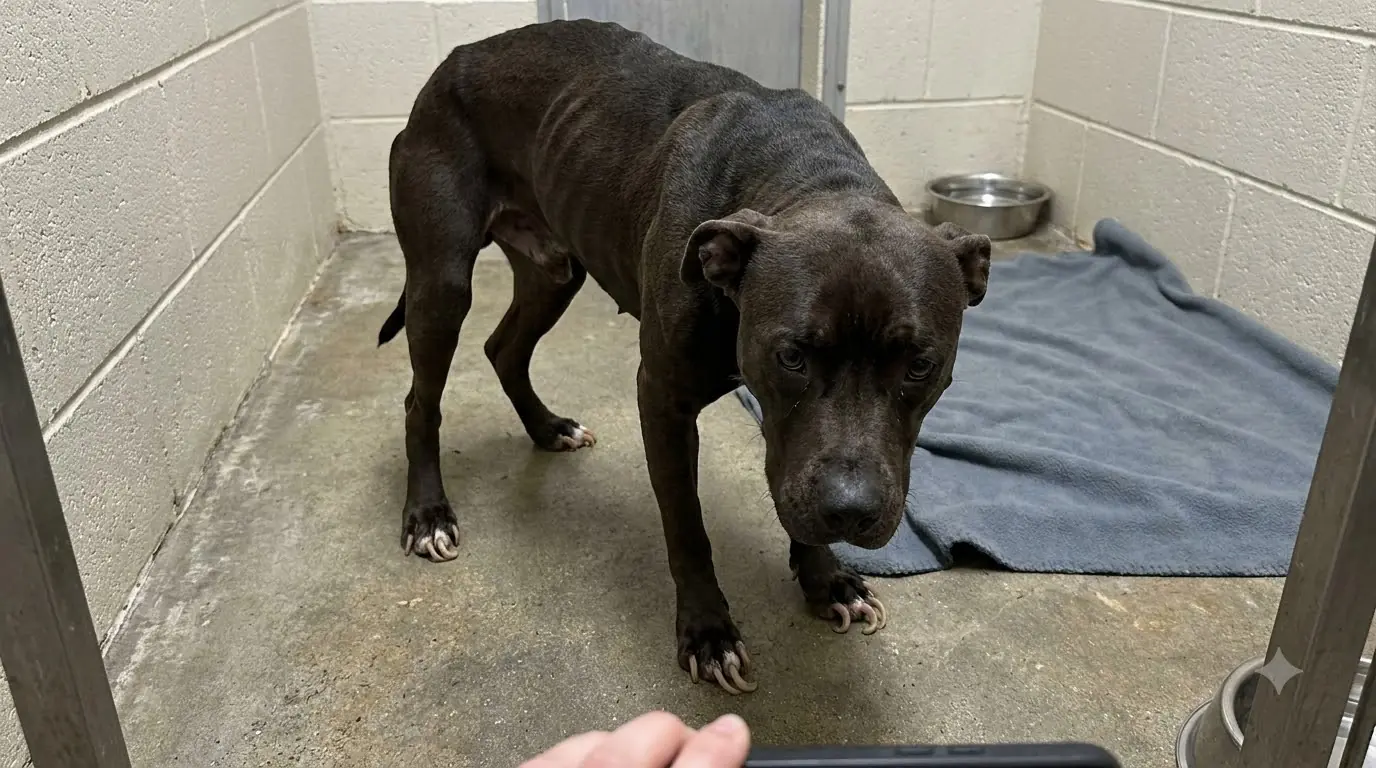
When animal control opened the garage, Rocky was still inside.
The adult American Pit Bull Terrier had been left in the garage of a vacant house with no one regularly coming back to care for him.
By the time help reached him, his body showed the effects.
His ribs and hips were more visible than they should have been. His overall condition suggested he had gone without adequate nutrition and routine care for some time.
But it was when Rocky tried to move that another problem became impossible to ignore.
His toenails had grown extremely long.
Some altered the way his paws met the ground, making every step awkward. Rocky moved slowly, shifting his weight carefully as he tried to follow the people who had finally entered the garage.
His legs trembled beneath him.
Animal control knew getting him out of the building was only the first step.
They still needed to find out what those days without care had done to the rest of his body.
His Feet Were Only the Most Visible Problem
Once Rocky was out of the garage, his condition could be evaluated more closely.
He was significantly underweight.
There was little padding over parts of his frame, and his muscles lacked the strength expected in a healthy adult Pit Bull.
Then there were his feet.
Overgrown nails are not simply cosmetic when they become severe enough.
They can change how a dog places weight on the paws and make normal walking uncomfortable or difficult. After enough time, a dog may compensate by changing its stance or gait.
For Rocky, that problem was occurring in a body that was already weak.
Staff could see the result every time he tried to take several steps.
He could walk.
But he did not move like a dog who had been receiving normal daily care.
And there was no way to know from his appearance alone whether weakness and overgrown nails were the full extent of the problem.
The Veterinary Team Needed to Know How Stable He Really Was
Rocky was moved into medical care rather than being expected to immediately adjust like a healthy shelter intake.
The first priority was basic stabilization and assessment.
His hydration mattered.
So did his nutritional condition, mobility, skin, paws and general strength.
Because Rocky had been found without anyone present to provide a reliable medical history, the team had to work from what they could observe.
They could not know exactly how every part of his condition had developed.
What they did know was that he had been without adequate care long enough for the effects to become visible.
His recovery would have to start slowly.
For an underweight dog, simply providing unlimited food is not always the appropriate answer. His meals needed to be managed while staff watched how his body responded.
And his feet required attention too.
But another concern became clearer once Rocky had been on his feet for a little longer.
His Legs Tired Very Quickly
Rocky could stand, but maintaining that position took effort.
After short periods upright, trembling became more noticeable.
Staff did not want to assume the weakness came from a single cause.
Poor body condition and loss of muscle could contribute. So could discomfort from the way his overgrown nails affected his footing.
What mattered immediately was preventing unnecessary strain.
Rocky was given a place to rest where he did not have to repeatedly cross long distances for food, water or attention.
His nails also had to be addressed carefully.
After prolonged overgrowth, trimming them back to a normal length may not always be something that can be accomplished aggressively in one moment. The sensitive tissue inside the nail can extend as nails grow, so appropriate gradual care may be needed.
The goal wasn't to make Rocky's paws look normal overnight.
It was to make standing and walking progressively easier and safer.
Then Staff Noticed What Happened at the Kennel Door
Inside the medical kennel, Rocky spent long stretches doing very little.
Sometimes he rested.
Other times he stood near the front with his head lowered.
He rarely wasted energy pacing.
But there was one sound that consistently changed his posture.
Keys.
When a staff member approached and the keys reached the kennel lock, Rocky would look up.
Then his tail would begin to move.
Not a large, sweeping wag.
At first, he could barely lift it.
Still, he tried.
And when the lock turned, Rocky often attempted to step forward.
His legs might still be trembling.
His head might still be low.
But he would take those few steps toward the opening door.
Staff began seeing the same response again and again.