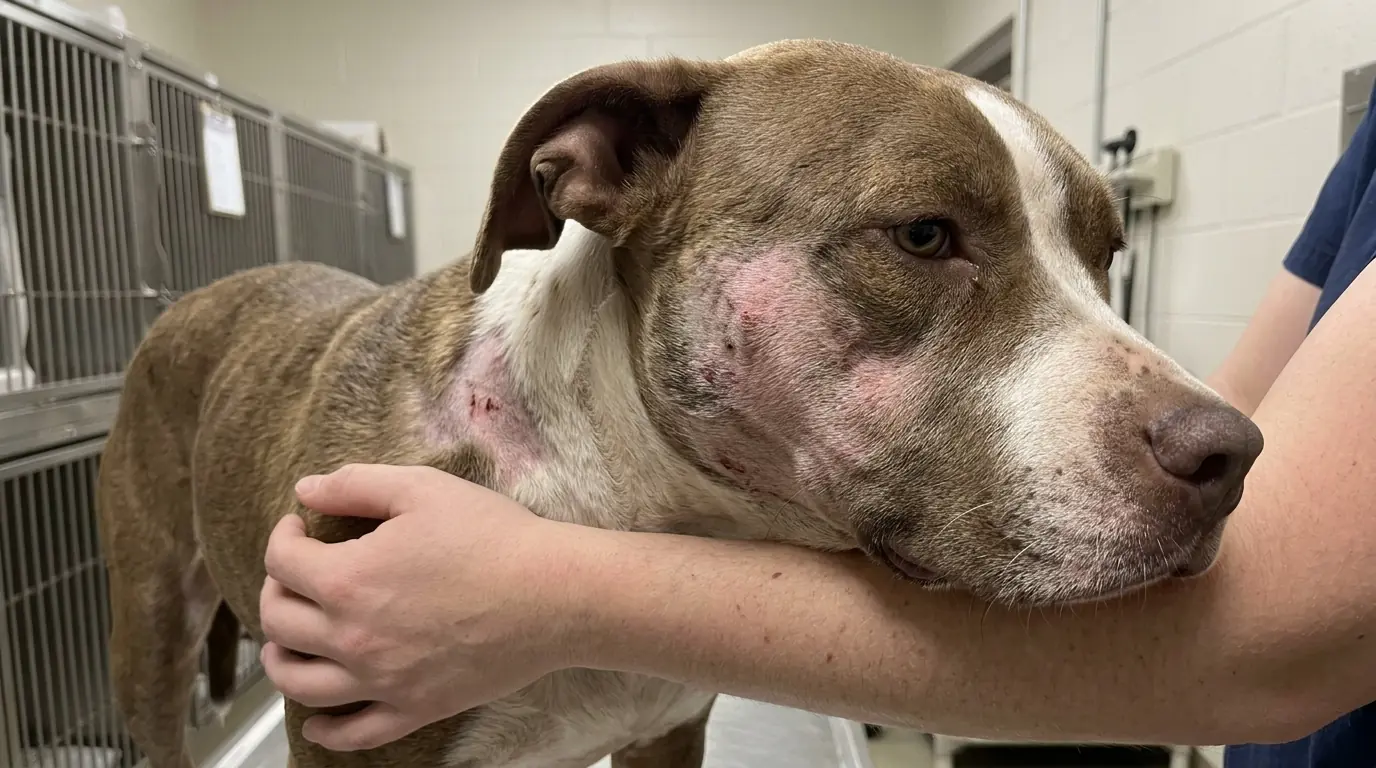
Rosie is exhausted.
Her eyes close easily now.
Her body wants to sleep.
But the six-year-old Pit Bull mix has only one position in which sleep seems to last.
One side of her face is badly swollen. Several areas have been shaved for treatment, and wounds around the same shoulder are still healing after Rosie was found injured outside.
Her bed is wide enough for her to stretch out.
Yet Rosie occupies only one side of it.
She lowers herself carefully with the healthier side against the mattress, leaving the swollen half of her face and injured shoulder facing upward.
Eventually, her muscles relax.
Her breathing slows.
Then, deep in sleep, Rosie begins to roll.
Her head turns.
Her injured cheek moves toward the mattress.
The moment it touches, Rosie's eyes snap open.
She jerks her head away.
For several seconds, she remains awake and tense.
Then she slowly shifts her entire body back to the only side that does not hurt.
And tries to fall asleep again.
Rosie Arrived With Injuries That Made One Side of Her Body Look Completely Different
The facial swelling was impossible to miss.
One side appeared significantly larger than the other.
Hair had been shaved from several areas so the injuries beneath could be examined and treated.
There were also wounds around Rosie's shoulder.
Exactly what happened before she was found remained uncertain.
She had been discovered injured outside, but that fact alone could not explain the cause.
Vehicle trauma, an altercation with another animal, a fall, or other forms of injury might produce different combinations of wounds.
Without reliable evidence, those possibilities remain possibilities.
What mattered immediately was the condition Rosie was in now.
Facial Swelling Can Hide More Than the Eye Can See
A swollen face is not simply a cosmetic problem.
Veterinary examination may need to determine whether the injury involves only superficial tissues or deeper structures.
The eye matters.
The mouth matters.
The jaw and teeth matter.
Infection may need to be considered.
Depending on the location and severity of the trauma, imaging or other diagnostics may be appropriate.
Rosie cannot point to where the pain begins and ends.
Her behavior provides additional information.
And sleeping is when that information becomes especially obvious.
During the Day, Rosie Can Protect the Painful Side
When she is awake, Rosie controls her position.
She can turn her head.
She can shift her weight.
She can avoid rubbing the swollen cheek against anything.
She can keep pressure away from the injured shoulder.
Sleep changes that.
As her muscles relax, the careful control begins disappearing.
Rosie's body naturally shifts.
Then pain wakes her before the movement can finish.
The First Few Nights Follow the Same Pattern
Rosie lowers herself onto the healthy side.
Her injured shoulder stays uppermost.
The swollen side of her face never touches the bed.
She falls asleep.
Twenty minutes later, perhaps longer, one hind leg moves.
Her hips rotate slightly.
Her chest follows.
Then her head begins rolling toward the mattress.
Contact.