Roxy Has Barely Any Fur Left—And Even Trying to Scratch Her Damaged Skin Makes Her Stop
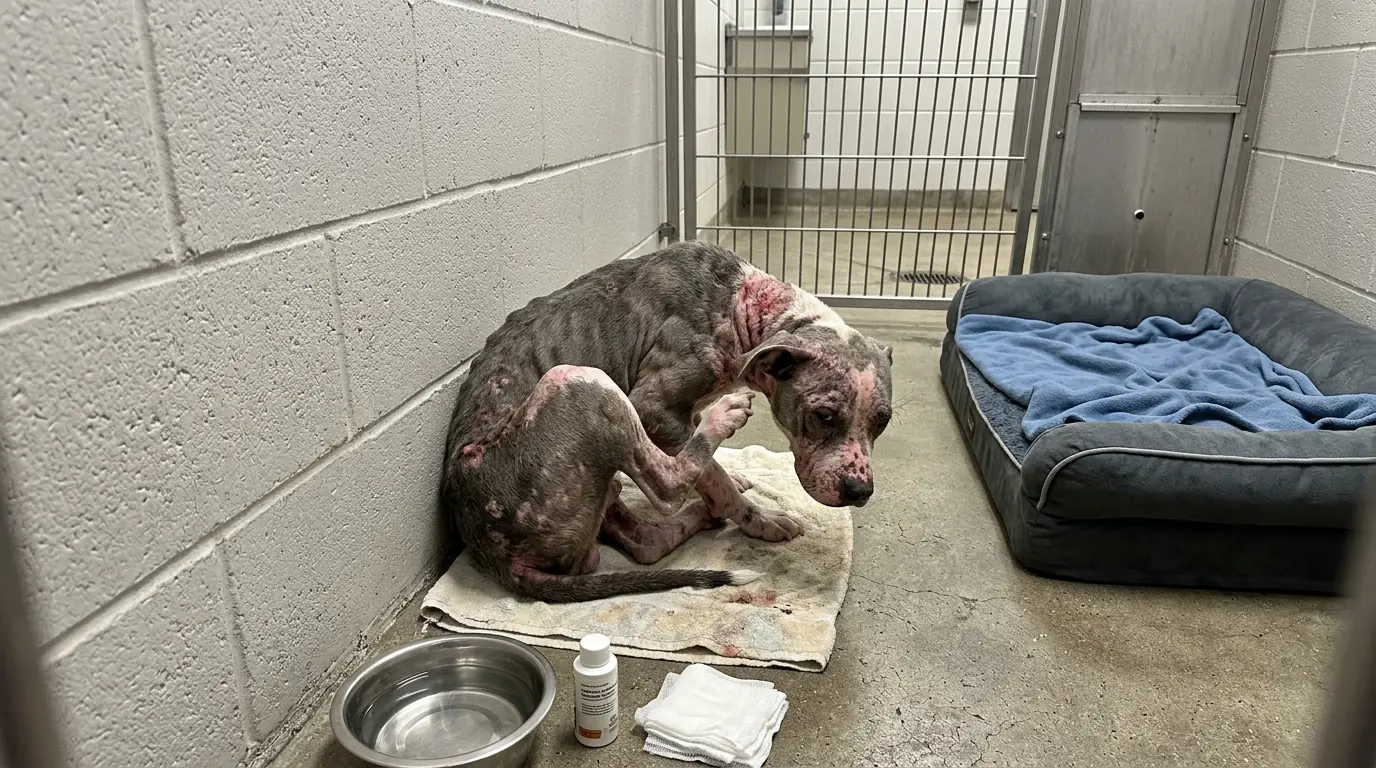
When Roxy first arrived at the shelter, there was almost nowhere on her body that looked comfortable.
The seven-year-old American Pit Bull Terrier had lost so much fur that large portions of her face, neck, shoulders, sides, and back were completely exposed. What should have been protected by a short, smooth coat was instead covered by thickened, irritated skin.
Some areas were rough and scaly.
Others were crusted or discolored.
Several patches were already being treated, and the damage extended across enough of her body that it was difficult to identify a single place as the main problem.
But one of the most painful details was not simply what Roxy's skin looked like.
It was what she kept trying to do.
Inside the shelter's isolation area, Roxy would occasionally raise a back leg toward her neck as if she were about to scratch.
Then she would stop.
Her paw would hover for a moment before slowly returning to the towel beneath her.
Whatever relief scratching might normally have provided seemed to have become something her damaged skin could no longer tolerate.
And for staff, that tiny interrupted movement revealed just how uncomfortable Roxy's condition had become.
Roxy Didn't Look Like a Dog Who Had Suddenly Become Sick
Severe skin disease rarely transforms a dog's coat overnight.
Roxy's condition appeared extensive and chronic enough that the shelter's medical team knew they were not simply dealing with one irritated patch.
Her skin had changed.
Areas that would normally be soft and flexible had become visibly thickened and rough. Large sections of fur were gone, leaving her skin exposed to every surface she touched.
Her body was also thin.
When Roxy curled against the wall of the isolation kennel, the outline of her frame was easy to see beneath the damaged skin.
There was a bed available.
She did not use it.
Instead, Roxy repeatedly chose a simple towel positioned near the wall.
She curled herself tightly there, keeping her movements small and resting for long stretches.
It was impossible to know exactly how long her skin had been deteriorating before she arrived.
But this did not look like something that had started yesterday.
Severe Hair Loss Is a Symptom, Not a Diagnosis
A dog arriving with widespread hair loss can have many possible underlying problems.
Parasites, allergies, bacterial or fungal infections, endocrine disorders, immune-related conditions, nutritional problems, chronic irritation, and combinations of multiple issues can all affect the skin and coat.
That distinction matters.
Looking at Roxy and saying she had "bad skin" would not explain why it happened.
The visible damage was the result.
The cause still needed to be investigated.
Veterinary teams evaluating severe dermatologic cases may consider the pattern of hair loss, the appearance of the skin, the dog's history when available, the presence of itching, odor, crusting or discharge, and results from appropriate diagnostic testing.
For a stray or shelter intake dog like Roxy, one major piece of that puzzle may be missing entirely:
Her medical history.
No one could ask how the condition started.
No one knew whether Roxy had previously received treatment.
There was no reliable timeline explaining when she began losing fur or whether the problem had improved and returned before.
The shelter could only begin with the dog standing—or in Roxy's case, mostly lying—in front of them.
The Itching Created a Cruel Problem
Anyone who has experienced a severe itch knows how automatic scratching can feel.
For dogs, scratching is also a normal response to irritation.
But damaged skin can create a vicious cycle.
An underlying problem causes itching.
The dog scratches, licks, rubs, or chews the area.
That mechanical trauma further damages the skin barrier.
The damaged skin becomes increasingly irritated and may become more vulnerable to secondary infection.
That can produce even more discomfort.
Then the dog wants to scratch again.
Roxy appeared caught somewhere inside that cycle.
She would shift slightly on her towel.
Her back leg would rise toward her neck.
Then she would hesitate.
Sometimes she barely touched the area before stopping.
Staff began noticing the pattern because it happened repeatedly.