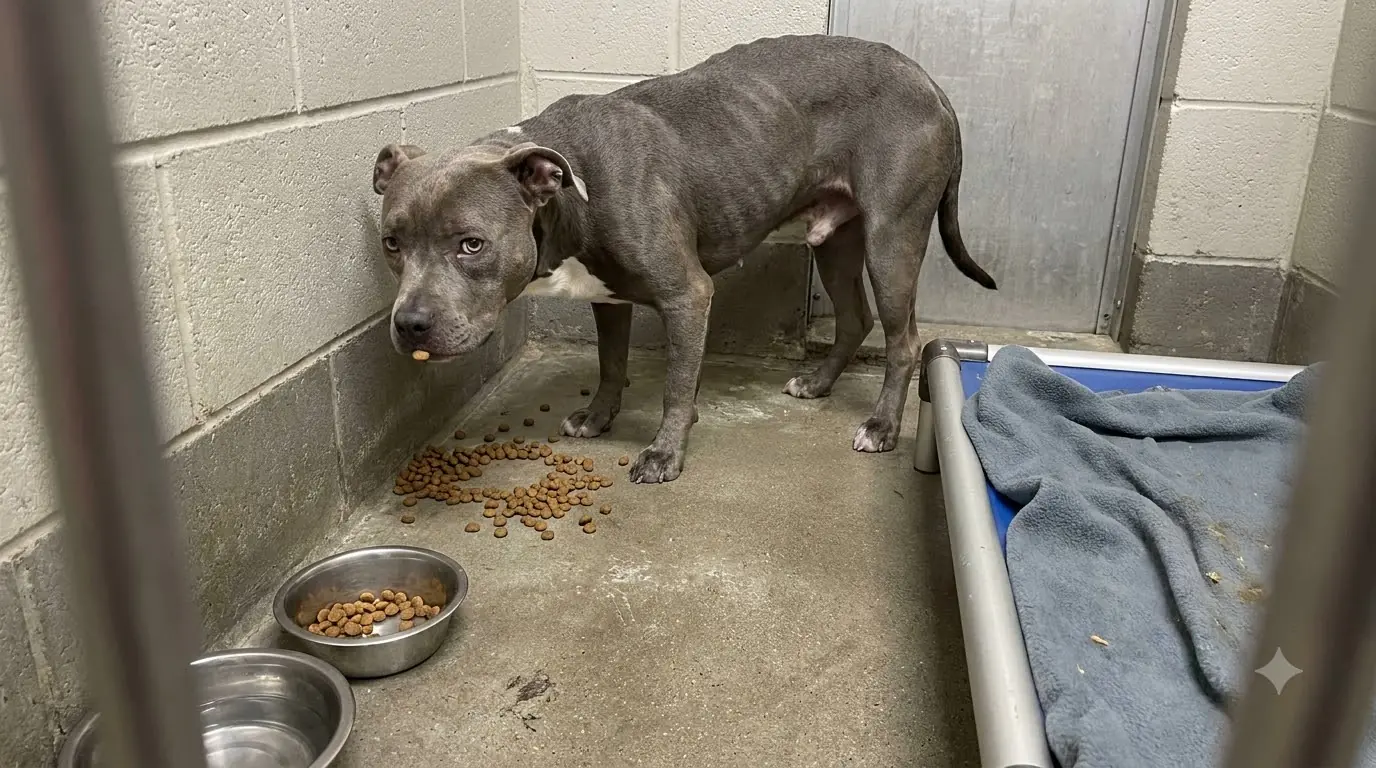
Ruby's food bowl can be full.
That does not mean she will immediately eat from it.
The 6-year-old American Pit Bull Terrier arrived at the shelter severely underweight after a long period without consistent access to food.
At mealtime, staff expected hunger to take over.
Instead, Ruby developed a routine that made them watch more closely.
She approaches the bowl.
Takes several pieces of kibble into her mouth.
Then walks away.
Ruby carries the food to the same corner of her kennel, lowers her head and drops it onto the floor.
Then she goes back.
A few more pieces.
Another trip.
Slowly, a small pile forms in the corner.
When Ruby seems satisfied with what she has moved, she lies down beside it.
And waits.
People can walk past.
Kennel doors can open.
Staff can move through the hallway.
Ruby usually leaves the little pile untouched.
Only when the shelter becomes quiet does she finally lower her head.
Then, piece by piece, she begins to eat.
At First, Staff Were Concerned That Ruby Wasn't Eating Enough
For a severely underweight dog, food intake matters.
Ruby did not have much body reserve left.
Her ribs and overall condition showed how much weight she had lost.
But restoring nutrition after prolonged inconsistent feeding is not simply a matter of placing unlimited food in front of a depleted dog.
Her intake needed to be managed appropriately while staff monitored how her body responded.
So when Ruby began carrying food away instead of immediately eating it, caregivers paid attention.
Was she nauseated?
Was chewing uncomfortable?
Was she refusing the diet?
Was something in the kennel making it difficult for her to eat?
Then the pattern became clearer.
Ruby did want the food.
She simply wasn't eating it right away.
She Was Moving It Somewhere Else First
Ruby's chosen corner was not far from the bowl.
But she made the trip repeatedly.
She would take only a small amount at a time.
Walk over.
Drop it.
Return.
Sometimes a few pieces scattered across the concrete.
Ruby carefully picked them up and moved them toward the others.
Then she settled her body beside the pile.
She did not bury it.
There was nothing to bury it with.
She did not immediately consume it either.
She simply stayed close.
When footsteps approached, her head often rose.
When someone stopped outside, Ruby watched.
The kibble remained where she had placed it.
Her History Made the Behavior Impossible to Ignore
Ruby had not been receiving food consistently before entering the shelter.
That much was known.
Staff did not know exactly what every meal had looked like before her rescue.
They could not know how often Ruby had gone hungry, what she had learned to do around food, or what she believed might happen to the kibble she carried away.
So they did not label the behavior with a dramatic explanation they could not prove.
They stayed with what they knew.
Ruby had experienced prolonged food inconsistency.
Now, even with regular meals available, she repeatedly separated part of her food and remained close to it before eating.
Her body had entered a safer environment.
Her mealtime behavior had not changed as quickly.
The Quiet Hallway Changed Everything
One evening made the pattern especially obvious.
Ruby had already built her little pile.
She lay beside it while normal shelter activity continued.
People walked through.
Other dogs reacted to noises.
Doors opened and closed.
Ruby occasionally sniffed the kibble.
But she did not begin eating.
Eventually, activity decreased.
Footsteps became less frequent.
The hallway went quiet.
Ruby waited a little longer.
Then her head lowered.
She took one piece.
Chewed.
Paused.
Then another.
There was no rush.
No frantic swallowing.
She ate slowly until the pile began disappearing.
That told staff something useful.
Ruby's appetite was there.
The environment around the meal seemed to matter.
So They Stopped Treating Mealtime Like a Deadline
Ruby still needed careful nutritional management.
But staff could also make the act of eating easier for her.
Whenever practical, she was given time and space rather than having people repeatedly hover over the bowl to see whether she had finished.
The kennel environment could be kept calmer during meals.
Caregivers could monitor her intake without standing directly over her.
And if Ruby wanted to move a few pieces before eating them, staff did not automatically stop her.
The goal was for Ruby to consume the nutrition her recovering body needed.
There was no prize for making her do it in the exact way people expected.
They Also Had to Make Sure the Behavior Wasn't Hiding a Medical Problem
Ruby's history could easily tempt someone to explain everything as a response to food insecurity.
But severe weight loss can have medical consequences, and unusual eating behavior deserves attention on its own.
Staff continued watching whether Ruby could chew comfortably.
They paid attention to appetite, energy, hydration and gastrointestinal tolerance.
They monitored whether she was actually consuming the food she moved.
If she had begun carrying food away and never eating it, that would have been a different concern.
But Ruby consistently returned to the pile once conditions became quiet enough.
She wasn't forgetting the food.
She was waiting.
Her Body Needed Consistency More Than One Huge Meal
For Ruby, recovery was never going to come from a single overflowing bowl.
Her body needed a controlled, appropriate feeding plan and ongoing monitoring.
Meals arriving reliably also created something that had apparently been missing before she entered the shelter:
predictability.
Morning came.
Food appeared.
Later, another meal came.