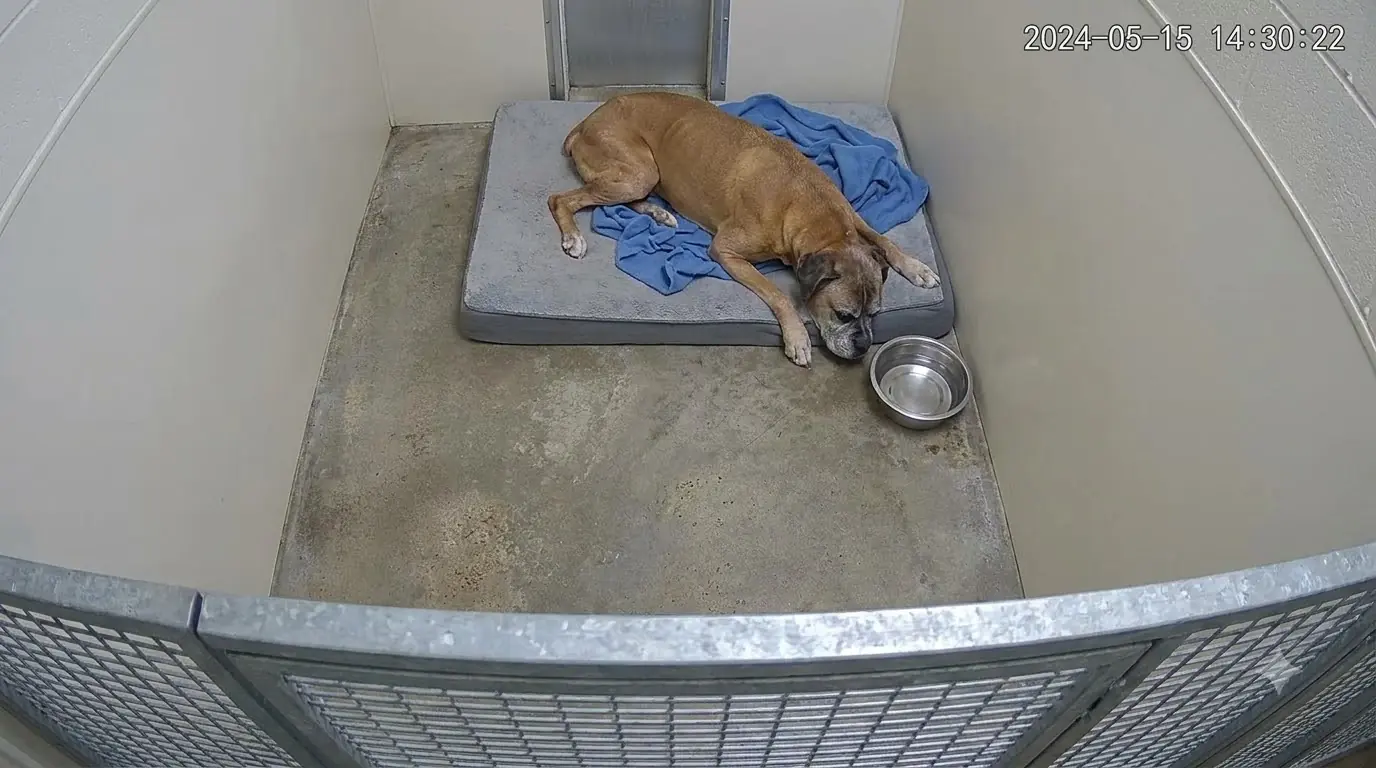
Rufus no longer gets out of bed when he is thirsty.
The 10-year-old Boxer spends most of his time lying on a medical mattress, his hind legs stretched or folded behind him depending on which position is most comfortable.
His water bowl sits only inches away.
Staff put it there deliberately.
When Rufus wants a drink, he lifts his head from the bedding and begins shifting forward.
One front leg moves.
Then the other.
His chest slides toward the edge of the mattress while his weakened hindquarters barely participate.
Eventually, his muzzle reaches the bowl.
Rufus drinks without standing.
A few laps.
A pause.
Then a few more.
By the time he finishes, he is often too tired to move back to where he started.
His head lowers beside the stainless-steel bowl.
And for a while, that is where he rests.
It is a routine staff have learned to accommodate.
Because Rufus did not always drink this way.
There Was a Time When Rufus Could Still Walk to the Bowl
Rufus is living with advanced cancer.
He is also experiencing severe muscle wasting in his hind legs.
Earlier in his medical care, he could still get himself upright.
Standing was slow, and his movements were becoming increasingly deliberate, but he could bear enough weight to reach what he needed.
Over time, that changed.
His hindquarters became weaker.
Getting up required more effort.
Then maintaining a standing position became difficult too.
Staff began noticing that Rufus would reach his water but struggle to remain over the bowl long enough to drink comfortably.
Eventually, the distance between his bed and the water became more than his body could reliably manage.
That was when the bowl moved.
Not because Rufus had stopped wanting water.
Because staff no longer wanted him exhausting himself just to reach it.
His Hind Legs Had Lost Too Much Strength
Severe muscle wasting changes more than the appearance of a dog's legs.
Muscle is part of what allows a dog to rise, stabilize the joints, maintain posture and move weight from one limb to another.
For Rufus, the loss was particularly obvious in his hindquarters.
His rear legs could no longer provide the support they once had.
That meant his front half was increasingly doing the work.
When Rufus repositioned himself, he pulled with his front legs.
When he moved toward the edge of the bed, his chest and shoulders carried much of the effort.
And when he became tired, there was little reserve left to help him recover his position.
With advanced cancer in the background, the veterinary team had to look at those changes realistically.
The goal was not to force Rufus back onto his feet.
The question was becoming how to preserve his comfort and independence as his abilities changed.
Then Even Drinking Became Exhausting
Moving the bowl closer solved one problem.
It did not solve everything.
Rufus no longer had to cross the medical kennel.
But staff could see how much effort the remaining inches still required.
He would notice the water.
Lift his head.
Pull his chest forward.
Drink.
Then stop.
Sometimes his muzzle remained just above the surface while he rested between laps.
Other times he finished and immediately lowered his head beside the bowl.
That was the detail that made staff pay closer attention.
Rufus wasn't simply choosing to drink while lying down because it was convenient.
Standing had become too demanding.
Even the modified routine could tire him.
For a dog with advanced disease, that mattered.
His Care Shifted Toward What Rufus Could Still Do Comfortably
The medical team could not treat severe progressive illness as though Rufus simply needed more exercise.
His activity had to match his condition.
Cancer does not disappear because a dog is encouraged to try harder.
And muscle lost during serious illness may not return normally when the underlying disease remains advanced.
So the kennel began changing around Rufus instead.
Water stayed beside the bed.
Anything he needed regularly could be kept within easy reach.
His bedding provided support while allowing caregivers to help reposition him when necessary.
Staff monitored areas of his body that spent long periods against the bed.
They also watched his appetite, hydration, breathing, ability to rest, response to interaction and signs of discomfort.
Most importantly, they stopped measuring a good day by whether Rufus stood.
There were other things worth watching.
One Morning, He Pulled Himself to the Bowl More Easily
The difference was small.
Rufus woke and looked toward his water.
Usually, there was a long pause before he began moving.
That morning, his front paws came forward almost immediately.
He shifted his chest.
Reached the edge.
And began drinking.
His hind legs still did not bring him to a stand.
Nothing about the movement suggested his cancer had suddenly improved.
But Rufus had enough energy to reach the bowl without stopping halfway.
He drank several times.
Then lifted his head from the water instead of immediately dropping it beside the bowl.
For a few seconds, he remained alert and looked toward the person sitting nearby.
Then he rested.
That was a better morning.
Staff allowed it to be exactly that.
Not a recovery.
A better morning.
Other Days Are Much Harder
Rufus's condition is not linear.
There are times when he is more alert and responsive.
There are also periods when simply repositioning himself appears exhausting.
On those days, caregivers reduce what is being asked of him even further.
The bowl can be moved closer.
His body can be supported.
He can receive assistance without being required to demonstrate that he can still do something independently.
That distinction has become increasingly important.
Independence is valuable when it is comfortable.
It is not valuable when preserving it requires unnecessary suffering.
For Rufus, quality of life now matters more than maintaining old routines.
Staff Began Watching What Happened After He Drank
The drinking itself was only part of the picture.
Could Rufus settle afterward?
Was his breathing comfortable?
Could he move his head away from the bowl if he wanted?
Did he remain interested in people entering the medical area?
Would he eat?
Could he sleep?
Did gentle interaction still produce a response?
Those questions mattered because advanced cancer cannot be judged by one behavior.
A dog can still drink water and be medically very unwell.
A dog can still look toward a caregiver and need significant palliative support.
So nobody uses Rufus reaching the bowl as proof that everything is okay.
It is simply one part of how he is doing that day.
Sometimes Staff Find His Face Beside the Bowl
After drinking, Rufus often leaves his muzzle resting near the rim.
His eyes become heavy.
His front paws remain close to the edge of the bed.
The water is right there if he wants more.
There is no reason to immediately make him pull himself backward just to place him in a more conventional sleeping position.
If he is comfortable and safely positioned, staff let him rest before helping him adjust.
That image has become familiar in the medical kennel.
A large senior Boxer.
A body much thinner and weaker than it once was.
A stainless-steel water bowl touching the edge of the mattress.
And Rufus's head resting only inches away.
It is not the way a healthy dog normally drinks.
For Rufus, it is how access to something as basic as water remains possible.
His Medical Care Is About Comfort Now
With advanced cancer and profound weakness, Rufus's needs are different from those of a dog expected to complete a conventional rehabilitation program.
His veterinary team continues managing his condition according to his medical needs and monitoring his quality of life.
Pain and other symptoms have to be addressed appropriately.
Nutrition and hydration matter.
So does hygiene.
So does preventing prolonged pressure on vulnerable parts of his body.
But there is another part of his care that cannot be reduced to medication.
The environment has to keep changing with him.
If Rufus cannot go to something he needs, it comes to Rufus.
That may mean moving a bowl six inches.
It may mean supporting his body while he changes position.
It may mean sitting beside the bed rather than waiting for him at the kennel gate.
The adjustments are small.
For Rufus, they can determine whether an ordinary need becomes an exhausting task.
Nobody Is Waiting for a Miracle Stand
There may be days when Rufus manages more movement.
There may also be days when he manages less.
His caregivers understand the reality of advanced disease.
A sudden return to normal strength is not the expectation.
What they want instead is something much more modest.
For Rufus to be able to rest comfortably.
To drink when he wants water.
To eat when he is interested.
To respond to the people around him if he chooses.
And to avoid spending the little energy he has on movements that are no longer necessary.
That is why his water bowl remains beside his bed.
Rufus Still Makes the Trip
It is only a matter of inches now.
He lifts his head.
Brings one front paw forward.
Then the other.
His shoulders pull while the weakened hind legs remain behind him.
His chest reaches the mattress edge.
His muzzle lowers.
And Rufus drinks.
Some days he manages several good laps before stopping.
On harder days, it is fewer.
Then his head comes down beside the bowl.
The dog who once could stand over his water now rests with his muzzle against its edge because standing has become more than his body can comfortably give.
Staff cannot change what advanced illness has already taken from Rufus.
So they changed the distance instead.
The bowl is close enough that he can still reach it.
And right now, that small piece of independence is enough.