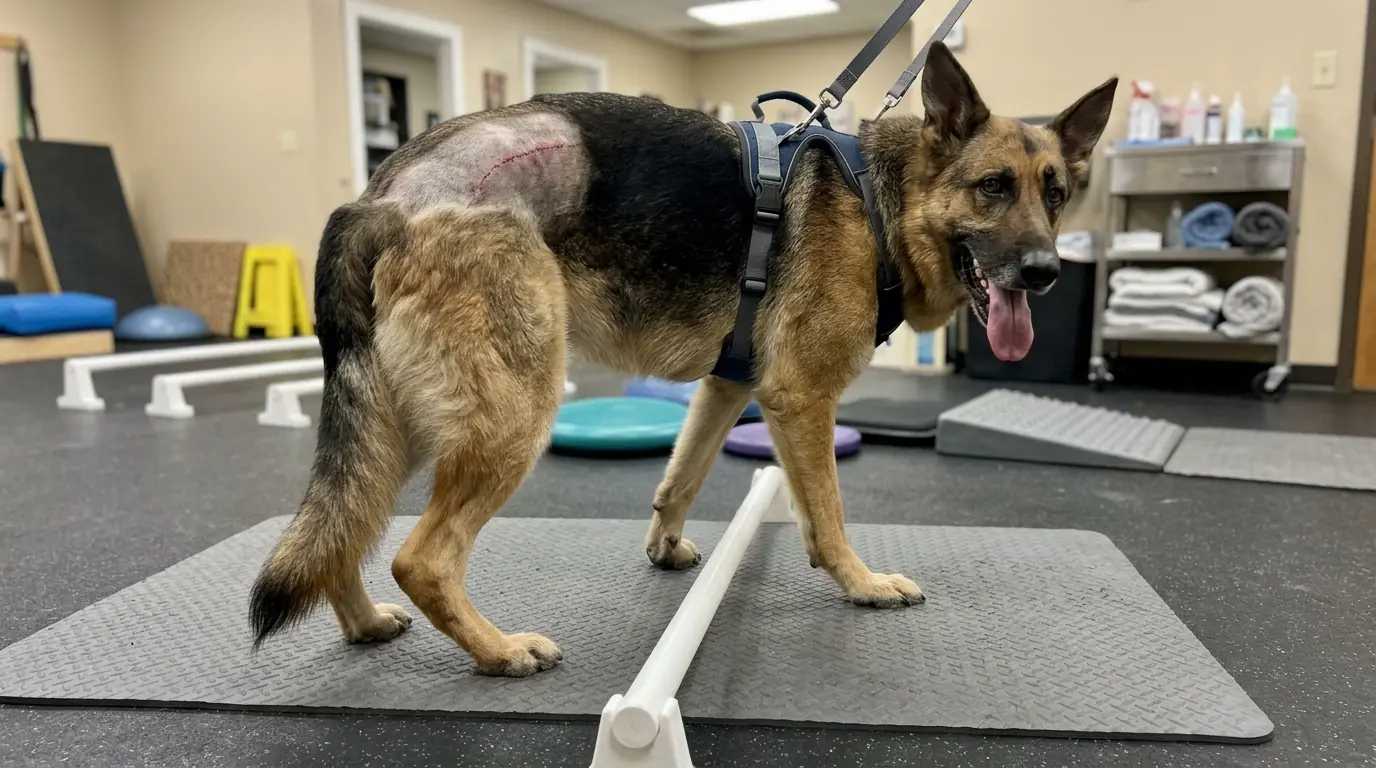
Sadie reaches the first low pole and steps over it carefully.
One front paw.
Then the other.
Her left hind leg clears it.
Her right hind leg follows—but the paw does not land normally.
Instead of placing the pads flat against the rehabilitation mat, the paw folds underneath itself. For a moment, the nine-year-old German Shepherd is standing with the top of that foot against the surface.
Sadie stops.
She shifts.
The weak paw comes up again, and this time she puts it back down in a better position.
Then she faces the pole once more.
She can lift that leg high enough to clear it.
What she cannot yet do every time is know exactly where that foot needs to land.
The Pole Isn't Really Testing How High Sadie Can Step
Sadie is recovering from nerve damage following spinal surgery.
Her rehabilitation now includes work on something most dogs never have to consciously demonstrate: accurately positioning a paw during movement.
The very low cavaletti pole makes the problem easy to see.
Sadie can move three limbs across it with relatively little trouble.
Then the right hind paw reaches the obstacle.
Sometimes she lifts it.
Sometimes it clears.
But after the leg comes forward, the paw may fold underneath instead of landing on its pads.
This abnormal positioning can be associated with impaired proprioception—the nervous system's ability to detect where parts of the body are positioned without relying entirely on vision.
In Sadie's case, her treating veterinary team already knows she is dealing with nerve injury after spinal surgery. The exercise helps reveal how reliably she can control and position the affected limb during rehabilitation.
The important part is not simply whether Sadie gets over the pole.
It is what the paw does afterward.
Her Leg Has Movement, but Movement Isn't Enough
Watching Sadie lift the right hind leg can initially look reassuring.
The limb moves.
It comes forward.
It can clear a very low obstacle.
But neurological function is more complicated than whether a muscle can produce motion.
To take an ordinary step, Sadie's nervous system has to coordinate multiple events.
The leg must move at the appropriate time.
The paw must clear the ground.
The limb has to travel far enough forward.
Sadie needs to recognize where that foot is in relation to the rest of her body.
Then the paw must orient correctly before accepting weight.
A disruption anywhere in that sequence can produce a step that looks very different from normal walking.
For Sadie, one of the clearest problems appears at the end.
She gets the leg across.
Then the paw folds.
The Folded Paw Matters
When a dog's paw lands with the top surface down rather than the pads, the position is often described as knuckling.
It is more than an awkward-looking step.
If a dog repeatedly walks with a paw folded underneath or drags the top of the foot, the skin can be exposed to abnormal friction and pressure.
It also indicates that simply counting steps would give an incomplete picture of mobility.
Sadie can technically move forward.
But if one paw repeatedly lands incorrectly, moving farther is not automatically better.
Her rehabilitation team has to pay attention to movement quality.
A few controlled steps in which Sadie has time to reposition the foot may be more useful than encouraging her to cross a long room while the paw repeatedly folds or drags.
Once again, distance is not the goal by itself.
Control matters.
Sadie Often Realizes Something Isn't Right
The most noticeable part comes immediately after the poor placement.
Sadie stops.
She does not simply continue marching across the next pole.
She pauses with the right hind foot incorrectly positioned.
Then she adjusts.
The paw lifts.
It comes back down.
Sometimes the second placement is better.
That correction is encouraging to observe, but it should not be overinterpreted.