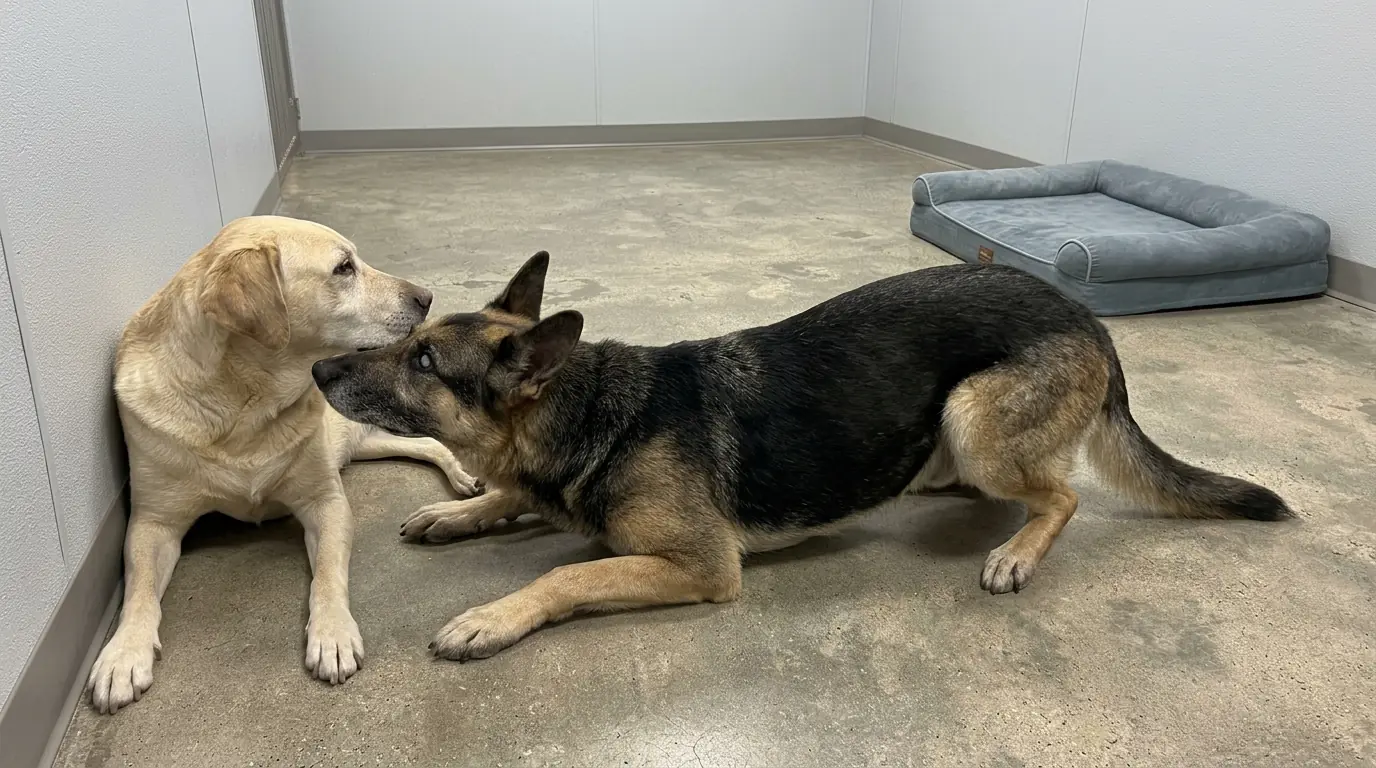
Every night, Scout passes his own bed without lying down.
The nine-year-old German Shepherd moves slowly around the recovery room, nose lowered, tracing the edges of a space he can no longer clearly see.
He touches one corner with his nose.
Then another.
He finds the edge of a bed, investigates it for a moment, and keeps moving.
Across the room, an orthopedic bed is empty and waiting for him.
Scout still does not settle.
The former search-and-rescue dog continues making his careful circuit until eventually his nose reaches something familiar.
Echo.
The eight-year-old Labrador has worked alongside Scout for years. When Scout finally finds her, he presses his muzzle against her shoulder.
And almost immediately, the searching stops.
His legs fold beneath him.
His body lowers to the floor beside her.
Sometimes the orthopedic bed remains completely empty on the other side of the room.
Scout has found the place where he wants to sleep.
Scout Had Spent Years Searching
Before his injury, searching unfamiliar spaces was part of Scout's working life.
As a search-and-rescue dog, he had been trained to move through environments deliberately and use his senses to locate what he was looking for.
Then an injury sustained while working took away most of his vision.
Scout did not lose his ability to smell, hear, move, or investigate.
But his relationship with physical space changed dramatically.
Objects he once could have seen became things he discovered through scent, touch, memory, and careful movement.
A recovery room could be safe and quiet and still require Scout to map it for himself.
During the day, he gradually learned where things were.
At night, however, staff began noticing another routine.
Before Scout would sleep, he seemed determined to locate Echo.
The Bed Wasn't What Ended His Search
Staff had made sure Scout had appropriate bedding.
At nine years old, and with his mobility and vision now changed, a supportive orthopedic bed gave him a comfortable place to rest.
Scout could find it.
That was what made his behavior so noticeable.
His nose sometimes reached the bed during his nightly circuit.
He could investigate its edge.
He could stand beside it.