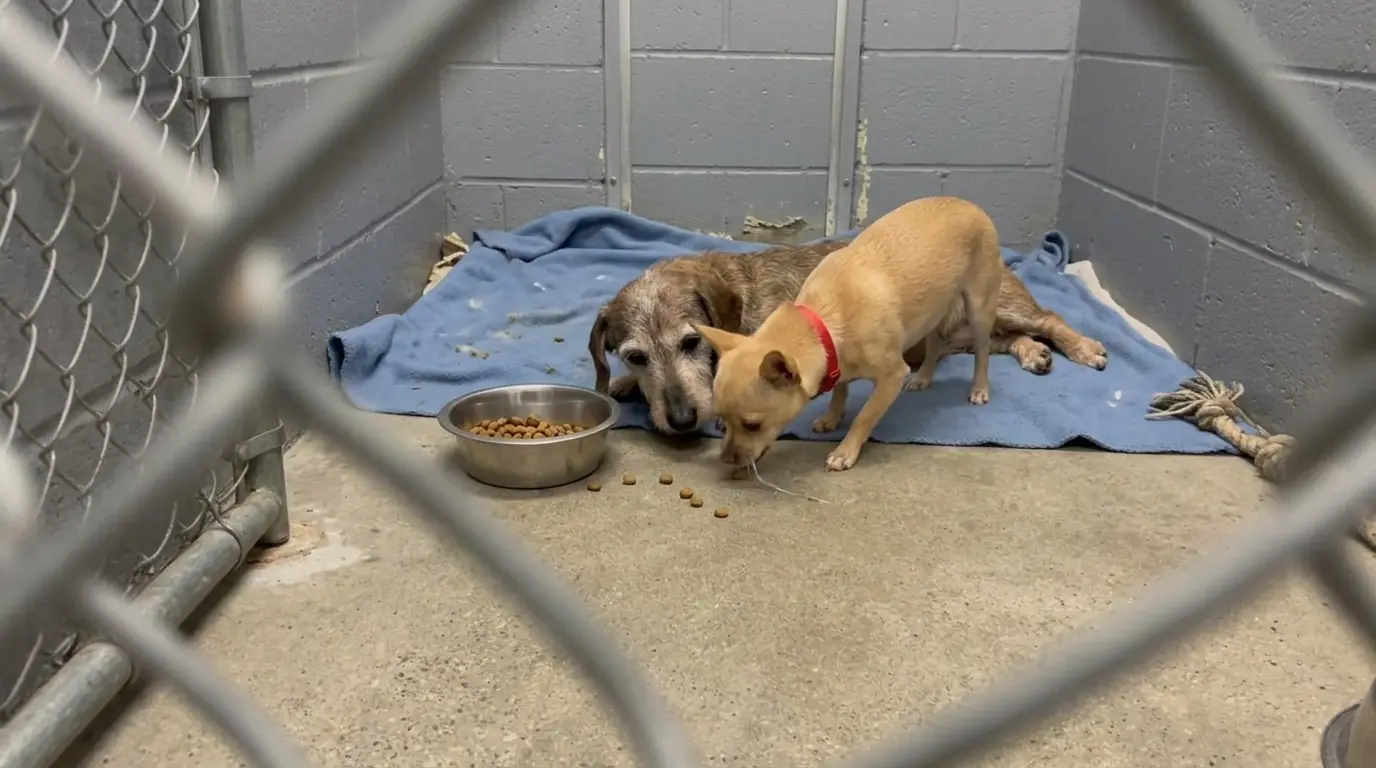
At First, We Thought Millie Had Simply Dropped Her Food
Walter and Millie arrived at the shelter together.
Walter was an elderly Dachshund mix with a long gray muzzle, a narrow chest, and hind legs that had become noticeably weak. Millie was a much younger Chihuahua mix, small enough that she could move around him without much effort.
We did not immediately call them a bonded pair.
They had arrived together, but that alone did not tell us what their relationship was.
We needed to watch them.
It did not take long for one particular behavior to stand out.
At mealtime, Walter ate slowly.
He could still stand at his bowl, but remaining upright required effort. His rear legs sometimes trembled as he shifted his weight. If he became tired enough, he lowered himself onto the floor.
Once Walter was down, getting back up was far harder than lying down had been.
That became important one morning when several pieces of dry kibble bounced out of his bowl.
Two landed only a few inches away.
Another rolled farther across the kennel floor.
Walter looked toward them but stayed where he was.
He stretched his neck toward the closest piece.
It was still beyond his reach.
Then Millie walked over.
She picked up one piece of kibble.
Instead of eating it, she carried it toward Walter.
She opened her mouth and dropped it directly in front of his paws.
Then she turned around and went back to her own bowl.
A few seconds later, she did it again.
We might have dismissed the first piece as an accident.
The second made us pay attention.
Over the following meals, we saw the same behavior often enough that it became difficult to ignore.
When food scattered outside Walter's reach, Millie sometimes collected individual pieces and carried them back toward him.
She did not empty her own bowl into his.
She did not guard his food.
She did not spend the entire meal focused on him.
She would simply interrupt her own eating, retrieve a stray piece, place it near Walter, and return to her meal.
Whatever history these two dogs had shared before entering the shelter was largely unknown.
But this was something we could actually observe.
Walter’s Problem Became Most Obvious After He Lay Down
Walter could walk.
That fact could make his condition look less serious during a brief first impression.
He could come out of the kennel.
He could cross a short stretch of hallway.
He could stand at his food bowl.
But his mobility changed dramatically after he had been lying down.
Rising required several separate movements.
Walter would first lift his head and chest.
His front legs were still comparatively strong, so he could push the front half of his body upward.
Then came the difficult part.
He had to bring his hind feet underneath himself and raise his pelvis.
Sometimes it worked on the first attempt.
Sometimes his rear feet slipped backward.
Other times he pushed his chest fully upright while his hindquarters remained on the floor.
He would pause there.
Then he would try again.
On his weaker days, he needed assistance.
This was not simple laziness or an elderly dog choosing not to move.
Walter's hindquarters had lost strength.
The muscles over his back legs were reduced, and his gait showed the kind of careful compensation that usually develops over time rather than overnight.
His long body also made the weakness more obvious.
As a Dachshund mix, Walter already had a body shape that placed different mechanical demands on his spine and limbs than those of a more squarely built dog.
We could see what his body was doing now.
We could not responsibly claim to know exactly how it had reached that point.
We Could Not Fill In the Parts of Their History We Didn’t Know
Walter and Millie came in together, but their previous life was not fully documented.
We did not know exactly how long they had lived together.
We could not verify when Walter's mobility began declining.
We did not know whether Millie had displayed the food-carrying behavior before coming to us or whether it had developed recently.
There was no reason to invent a dramatic explanation.
The observable facts were enough.
Walter struggled to rise after resting.
Millie repeatedly chose to remain close to him.
When moved into the same larger enclosure, they tended to settle within a short distance of each other.
When Walter changed resting positions, Millie often looked up and followed his movement.
If one dog was temporarily taken out for an examination, the other became more alert to hallway sounds.
And when Walter could not reach scattered food, Millie sometimes carried it back.
Those repeated behaviors told us much more than simply saying they had arrived together.
Over time, they also helped us decide that keeping the two dogs near one another was likely beneficial, provided neither dog's medical or behavioral needs were compromised.
Walter Needed a Neurologic and Orthopedic Evaluation
Senior dogs develop hind-limb weakness for many reasons.
Arthritis can make rising painful.
Spinal disease can affect coordination or strength.
Muscle loss can occur because of chronic pain, reduced activity, neurologic problems, or simply long periods of compensating for another condition.
More than one issue can also be present at the same time.
Walter therefore received a full physical examination rather than being labeled as an old dog with bad legs.
His veterinary team evaluated his spine, hips, knees, feet, and muscle condition.
They watched him walk on a surface where his paws could grip.
His paw placement and neurologic responses were assessed.
His discomfort level was also important.
A dog can be weak without being severely painful, and a painful dog can avoid using a limb even when the underlying nerves and muscles remain functional.
Walter showed chronic hind-end weakness with age-related musculoskeletal changes contributing to his difficulty.
There was not one acute fracture or single new injury that explained everything.
His condition was consistent with a longstanding mobility problem that needed management rather than a dramatic emergency procedure.
That distinction mattered.
The goal was to preserve the function Walter still had and make ordinary movement easier.
The Floor Was Working Against Him
One of Walter's biggest problems was traction.
When a dog with weak hind legs tries to rise, even a small amount of slipping can turn a difficult movement into an unsuccessful one.
Walter would push with his front legs.
His pelvis would start to lift.
Then one rear foot might slide backward.
His body would settle again.
The more attempts he needed, the more fatigued he became.
Nonslip runners were placed in the areas where he most often stood, ate, drank, and got out of bed.
His bedding had to be chosen carefully too.
A thick, fluffy bed might look comfortable, but if Walter sank deeply into it, getting his feet underneath himself became more difficult.
He did better on supportive padding that cushioned his joints without swallowing his small body.
His bowls were placed within an easy route from his resting area.
There was no reason to make him cross the kennel repeatedly for basic necessities.
For Walter, conserving effort was part of maintaining independence.
Millie Had Her Own Needs Too
It would have been easy to tell Walter and Millie's story as though Millie existed only to take care of him.
She did not.
Millie was a young dog with her own temperament, stress responses, appetite, and need for activity.
She was more mobile than Walter and wanted to explore farther.
She investigated smells quickly.
She moved easily between the front and back of the enclosure.
She was more reactive to sudden hallway activity than Walter and needed time to become comfortable with unfamiliar people.
During her initial days, she did not automatically seek physical contact from everyone who entered.
She often watched first.
Treats tossed nearby were more effective than reaching for her.
Once routines became predictable, she began approaching more readily.
She also needed opportunities away from Walter.
Short individual outings allowed her to move at her own pace rather than matching an elderly dog whose walks had to remain brief.
Keeping two dogs together because their relationship appears important does not mean asking the healthier dog to give up everything she needs.
Millie's welfare mattered just as much.
Their Mealtime Behavior Kept Repeating
The food behavior was never perfectly consistent.
That actually made it more believable.
Millie did not retrieve every single piece Walter dropped.
Sometimes she ate her own meal and ignored the kibble beside him entirely.
Sometimes she picked up a stray piece and ate it herself.
But on enough occasions, the same specific pattern returned.
Walter would already be lying down.
A piece of kibble would sit outside the comfortable reach of his neck.
Millie would walk toward it.
She would pick it up gently.
Then she would carry it to Walter and release it close to his front paws.
Afterward, she went back to her own food.
She was not trained to do this by shelter staff.
Nobody pointed toward the kibble.
Nobody handed it to her.
Nobody praised her into repeating the behavior for a camera.
We simply observed it.
That distinction mattered to us because emotional rescue stories do not need to become exaggerated to be meaningful.
A Chihuahua mix moving two pieces of food a few feet across a kennel is a tiny action.
For Walter, whose hindquarters made standing back up disproportionately difficult, those few feet mattered.
Food Was Not Actually Walter’s Biggest Medical Risk
Although the scattered kibble drew attention to his limitation, Walter could eat well when food was positioned appropriately.
His appetite was not the primary problem.
His ability to move safely was.
A senior dog who repeatedly slips while rising is at risk of further discomfort and loss of confidence.
If standing becomes too difficult, activity decreases.
As activity decreases, muscle condition can worsen.
That can make standing even harder.
The cycle can accelerate if it is not addressed.
Walter's care therefore focused on preventing unnecessary decline.
His body condition was monitored carefully.
Excess weight would place additional demand on his weak hindquarters and long back.
At the same time, an older dog with muscle loss should not be put through aggressive calorie restriction.
He needed adequate nutrition to maintain the muscle he still had.
Controlled movement was equally important.
Complete inactivity would not help him maintain function.
Exhausting him would not help either.
Walter’s Rehabilitation Was Deliberately Uneventful
There was nothing dramatic about Walter's rehabilitation.
That was exactly how it needed to be.
His sessions were short.
He walked slowly on nonslip flooring.
He was encouraged to use his hind legs without being pushed until they trembled excessively.
A support harness could be used when he needed additional help rising or maintaining balance.
The harness was not there to drag him forward.
It allowed a caregiver to reduce some of the load while Walter still performed as much of the movement as possible himself.
Simple controlled weight shifts helped him engage the muscles around his hindquarters.
Short standing periods could be useful when he was having a stronger day.
On tired days, rest was more appropriate.
Walter was not expected to transform into an athletic senior dog.
The objective was smaller.
Rise with fewer failed attempts.
Walk without slipping.
Maintain enough strength to toilet comfortably.
Move between his bed, water, and outdoor area.
Continue participating in the parts of life that interested him.
Some Mornings Were Much Harder Than Others
Walter's weakness varied.
After a long rest, his first attempt to stand could be particularly difficult.
He would raise his chest.
His rear legs would push.
Then he might settle back down.
After another attempt, he could sometimes get his feet positioned better and rise.
On other mornings, he stood almost smoothly.
The difference did not necessarily mean his underlying condition had dramatically changed overnight.
Senior mobility can fluctuate.
Fatigue matters.
Activity from the previous day matters.
Joint stiffness can matter.
The number of previous transitions matters.
Walter's caregivers learned not to judge his entire prognosis from one difficult morning or one unusually good afternoon.
Patterns over time mattered more.
Millie Learned to Wait During His Slow Starts
Their relationship showed itself in places other than the food bowl.
During outdoor trips, Millie could reach the end of Walter's comfortable walking distance very quickly.
At first, she would move ahead.
Then the leash would stop as Walter continued behind her.
Over time, she became more accustomed to the slower routine.
She sniffed.
She circled back.