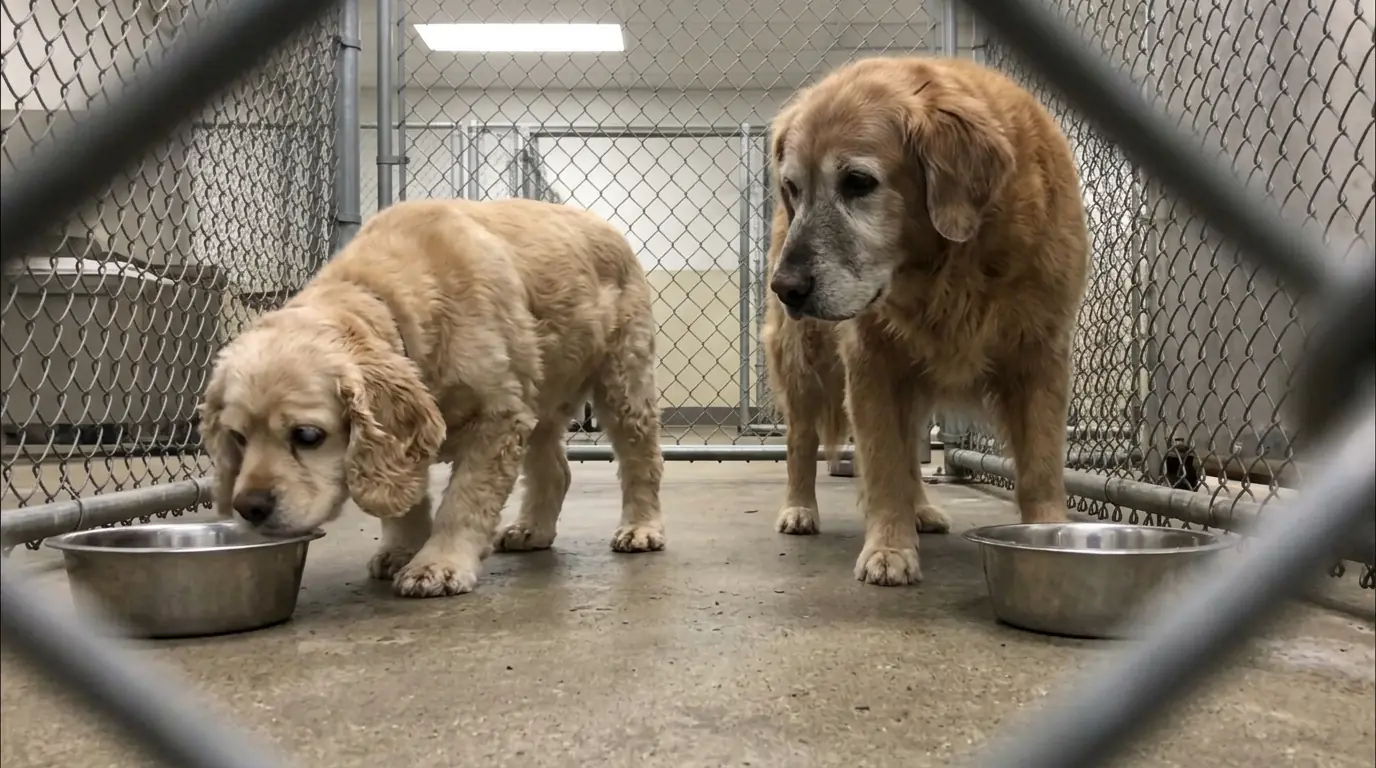
Charlie Stood Beside a Full Bowl and Waited
Charlie and Sophie arrived at the shelter together.
Charlie was an older Golden mix with a graying face, a slow but steady gait, and the calm presence of a dog who had clearly spent years sharing space with another animal.
Sophie was a Cocker Spaniel with profound vision loss.
She could still detect some light and movement at close range, but for practical purposes, she navigated the world almost entirely without reliable sight.
That difference became obvious during their first meal.
Two bowls were placed in the kennel.
Charlie walked directly to his.
Sophie did not.
She moved slowly through the space, nose working, front paws testing the floor ahead of her.
Charlie lowered his head toward his food.
Then he stopped.
He did not eat.
Instead, he lifted his head and turned toward Sophie.
She had passed her bowl by several inches.
Charlie stepped away from his own meal.
He circled around her slowly.
Sophie turned.
Her nose moved toward the floor.
Charlie stayed nearby.
She took several more steps.
Still no bowl.
His food remained untouched.
Then Sophie’s muzzle finally bumped against the rim of her dish.
She stopped.
She sniffed.
She lowered her head.
Only then did Charlie return to his own bowl.
Both dogs began eating.
At first, it seemed like an unusual coincidence.
Then it happened again at the next meal.
And the meal after that.
We Did Not Call Him Her Guide Dog
The behavior was striking, but we were careful about what we said it meant.
Charlie had not been trained as a service animal.
He did not lead Sophie around using a harness.
He did not perform formal guiding tasks.
And we could not say he understood blindness in the way a person would.
What we could document was much more specific.
Charlie consistently delayed eating while Sophie searched for her bowl.
He frequently moved near her during that search.
Once Sophie located the dish and began eating, Charlie usually started his own meal.
That sequence occurred often enough that it became one of the clearest indicators of how closely the two dogs coordinated their routines.
It also told us something important about Sophie.
Finding essential resources in an unfamiliar environment was difficult for her.
Sophie’s Blindness Made the Shelter Feel Much Larger Than It Was
A kennel is not a complicated space for most sighted dogs.
For Sophie, every new object changed the map.
The water bowl.
The bed.
A folded blanket.
A person standing where no one had stood five minutes earlier.
Even Charlie.
She navigated primarily through scent, touch, memory, sound, and information from her whiskers and muzzle.
When she first entered the kennel, her movement was cautious.
She tended to follow the perimeter.
Walls gave her information.
Open floor did not.
She would touch a surface with her nose, pause, then continue.
If something had been moved, Sophie noticed.
Not visually.
Physically.
Her shoulder might brush a bed that had not been in that exact position before.
Her paw might strike the edge of a bowl sooner than expected.
Then she had to update her route.
That meant consistency became part of her care almost immediately.
Charlie Seemed to Understand Their Shared Routine Better Than the Room
Charlie did not appear particularly distressed by the kennel layout.
He found his bed.
He found the water.
He found his food.
But he paid close attention to Sophie.
If she bumped lightly into the side of the kennel, he often looked over.
If she changed direction, he sometimes followed.
When she settled, he usually chose a resting place nearby.
Again, we avoided assigning intent.
Charlie may have been responding to years of familiarity.
He may have learned predictable patterns around Sophie’s movement.
He may simply have preferred proximity to her.
The shelter did not need a human explanation for every behavior.
Repeated observation was enough.
Their Medical Exams Had to Be Done Separately
Even when two dogs arrive together and appear closely attached, each needs an independent medical assessment.
Charlie was a senior dog.
Sophie was a senior dog with major visual impairment.
Their needs overlapped in some places and differed completely in others.
Charlie received a full senior examination including evaluation of joints, teeth, heart, lungs, body condition, muscle mass, skin, and general mobility.
Sophie received the same broad assessment, but her eyes required additional attention.
Blindness itself is not a diagnosis.
Veterinarians needed to determine whether her eyes were comfortable, whether there was active inflammation, and whether any treatable condition was contributing to what remained of her vision.
An eye that cannot see may still be comfortable.
It may also be painful.
That distinction matters enormously.
Sophie’s Vision Loss Was Advanced and Unlikely to Reverse
Her ophthalmic evaluation confirmed severe visual impairment.
The exact underlying changes were chronic rather than something that could simply be corrected and return normal sight.
Her remaining visual function was extremely limited.
More importantly, the examination focused on comfort.
There were no findings suggesting that Sophie required an emergency procedure solely because she was blind.
That shaped her care plan.
The goal became helping her navigate safely and confidently rather than trying to make her behave like a sighted dog.
Blind dogs can adapt extremely well.
But adaptation works best when the environment works with them instead of constantly changing underneath them.
The Food Bowls Became the First Environmental Problem We Solved
At intake, staff placed Charlie and Sophie’s bowls according to ordinary kennel convenience.
That setup made Sophie work harder than necessary.
So we changed it.
Her bowl was placed in the same location at every meal.
A textured mat beneath it created a tactile landmark.
The edge of that mat could be detected with her paws before her muzzle reached the bowl.
Water was positioned along a consistent wall.
The bed stayed in one place.
The kennel was kept as uncluttered as possible.
Those changes were simple.
They reduced how much Sophie had to search.
And they gave us a chance to see whether Charlie’s mealtime behavior would change once she could locate her food more easily.
Charlie Still Waited
The new setup helped immediately.
Sophie found the bowl faster.
Sometimes she followed the wall, stepped onto the textured mat, lowered her head, and located the dish within seconds.
Charlie still stood at his own bowl.
He still waited.
On meals when Sophie became temporarily turned around, Charlie left his food and moved closer to her again.
When she found the dish, he ate.
The environment had reduced her difficulty.
It had not changed his routine.
That consistency suggested the behavior was part of their established relationship rather than something created solely by the shelter.
Sophie Could Eat Independently Once She Found the Bowl
This distinction mattered.
Charlie did not feed her.
He did not push food toward her.
He did not need to stand beside her throughout the meal.
Sophie’s problem was locating the resource.
Once her nose reached the bowl, she ate normally.
Her appetite was good.
She chewed without obvious difficulty.
She did not require hand feeding.
That meant the most respectful support was not doing everything for her.
It was making essential things predictable enough that she could do them herself.
Blindness should not automatically remove independence.
Charlie Had His Own Senior Limitations
Because his behavior around Sophie was so emotionally noticeable, it would have been easy to make Charlie’s role in the story purely supportive.
He had needs too.
His senior examination showed age-related joint stiffness.
After longer rest periods, he rose more slowly.
He still walked independently, but his pace was moderate.
He had some dental changes requiring routine care planning.
His body condition needed to remain appropriate so extra weight did not increase strain on aging joints.
He was not a young, tireless escort.
That mattered when planning their daily routine.
Sophie could benefit from his presence without Charlie being expected to spend every moment guiding her through the world.
We Watched What Happened When Charlie Left the Kennel
Brief separation gave us useful information.
Charlie needed individual examinations.
He needed walks suited to his own mobility.
Sophie also needed to learn the shelter layout without relying entirely on following another dog.
The first time Charlie left for a longer appointment, Sophie became more attentive to sound.
She moved around the kennel.
She checked the area near his bed.
But she did not completely shut down.
She could find water.
She could settle.
At mealtime, staff guided her toward the tactile mat with minimal assistance.
Once she located the bowl, she ate.
Charlie, meanwhile, functioned well away from her.
He accepted treats.
He walked with his handler.
He rested during his exam.
Their relationship appeared meaningful without being so dependent that either dog became unable to function alone.
That was healthy.
Sophie Began Building a Mental Map
Blind dogs often learn spaces through repetition.
Sophie was no exception.
Within days, her movement became more efficient.
Instead of constantly sweeping her nose from side to side, she began traveling familiar routes.
Bed to water.
Water to kennel front.
Kennel front to food mat.
She still moved carefully.
But there were fewer collisions.
When staff cleaned the kennel, everything was returned to the same approximate position.
That consistency helped.
One of the easiest ways to make life harder for a blind dog is to keep rearranging furniture or resources.
For Sophie, predictability created independence.
Charlie’s Circling Behavior Became Less Necessary
As Sophie learned the kennel map, she spent less time searching for her bowl.
That meant Charlie had less opportunity to move around her during meals.
Sometimes he simply stood still and watched.
Sophie stepped onto the mat.
Her nose found the dish.
Charlie began eating.
On more difficult days, the old behavior returned.
If Sophie entered the feeding area from an unusual angle and missed the mat, Charlie might leave his bowl and walk near her.
He never appeared to physically steer her.
He simply moved close.
Sometimes that seemed to coincide with Sophie reorienting.
We documented the pattern without claiming more than we knew.
Noise Could Disrupt Sophie’s Navigation
Blindness was not her only challenge.
The shelter was noisy.
Sophie used sound as part of her orientation, so sudden barking could complicate movement.
If several dogs vocalized at once, she sometimes stopped.
Her ears moved.
Her body became still.
Once the noise subsided, she resumed.
That meant staff avoided hurrying her during loud periods.
A sighted dog can often continue moving while filtering competing sound.
For Sophie, auditory information was more valuable.
Too much of it at once could become confusing.
Charlie sometimes remained near her during those pauses.
Again, proximity seemed to be part of their normal pattern.
Trust-Building Looked Different With Sophie
People often reach toward a dog after making eye contact.
That method did not apply here.
Sophie needed clear auditory and tactile communication.
Caregivers spoke before touching her.
Hands approached slowly from where she could smell them.
Touch began around the shoulder or chest rather than arriving suddenly over the top of her head.
If she was sleeping, she was awakened gently rather than grabbed.
A light floor vibration could help alert her that someone was near.
Routine phrases and consistent handling patterns helped.
Sophie’s confidence grew because people became more predictable, not because she regained vision.
Her First Independent Meal Without Charlie Nearby Was Important
One afternoon, Charlie was out for an individual walk when Sophie’s feeding time arrived.
Her bowl went onto the familiar textured mat.
A caregiver remained nearby but did not physically lead her to it.
Sophie began at the wall.
She followed the perimeter.
Her front paw touched the mat.
She paused.
Then she lowered her head.
Her muzzle hit the rim.
She ate.
Charlie was not there.
That mattered.
His presence clearly helped structure their shared routine, but Sophie was also learning to solve the task independently.
For long-term welfare, she needed both.
Connection and competence.
Charlie Returned and Checked Her Bowl
When Charlie came back, Sophie had already finished.
He sniffed her feeding area.
Then he walked to his own resting place.
Nothing dramatic happened.
That was useful information too.
He did not become distressed because the familiar sequence had been interrupted once.
The behavior was a routine, not an inflexible requirement.
Foster Care Offered a Better Environment for Both Dogs
Once their medical needs were stable, a foster home allowed the pair to leave the sensory intensity of the shelter.
The home was prepared for Sophie before she arrived.
Furniture pathways were kept wide.
Stairs were blocked.
Sharp edges were minimized.
Textured mats marked important locations.
One mat meant water.
Another marked the feeding area.
Beds remained against consistent walls.
No one rearranged the room casually.
Charlie had his own bed nearby.
The setup gave Sophie environmental information that did not depend on sight.
The First Foster Meal Looked Almost Exactly Like the Shelter
Charlie found his bowl immediately.
Sophie did not.
The room was new.
The scents were new.
The floor texture was different.
Her mental map had reset.
She began circling slowly.
Charlie stood beside his food.
He did not eat.
He left the bowl.
He moved around Sophie.
She continued searching.
Eventually, her front paw reached the textured feeding mat.
Her nose followed.
The bowl made a small sound when her muzzle touched it.
Sophie lowered her head.
Charlie turned.
He walked back to his meal.
Both began eating.
Different building.
Same routine.
We Had Enough Evidence to Call Their Attachment Significant
By then, the pattern had repeated across multiple settings.
They chose to rest near each other.
Charlie delayed eating while Sophie located food.
He frequently moved near her during unfamiliar navigation.
Sophie remained comfortable in his presence.
They could both function during brief separation.
Neither dog prevented the other from accessing resources.
The relationship was supportive without appearing coercive.
That was enough to consider them a closely attached pair when planning their future.
Keeping them together, if an appropriate home could do so, appeared beneficial.
But Sophie’s Independence Still Had to Grow
A blind dog should never be made completely dependent on another dog.
Charlie was older.
His mobility could change.
His health could change.
Eventually, there might be things he could no longer do.
Sophie needed environmental skills that would remain useful regardless.
So foster care continued building those skills.
She learned where doors were.
She learned the route to the yard.
She learned which mat led to water.
A small bell on an exterior door gave her an additional sound landmark.
Caregivers used consistent words before transitions.
She was allowed time.
No one pulled her quickly through spaces she had not mapped.
Charlie Learned to Move Around Her More Carefully Indoors
Because Sophie could not visually track him, sudden contact sometimes surprised her.
Charlie naturally moved at a slower senior pace, which helped.
Over time, he also seemed to settle into predictable routes around the home.
He did not frequently body-check her.
He did not crowd her in narrow spaces.
When they passed, Sophie often identified him by scent before contact.
Their calm movement around each other suggested long familiarity.
Feeding Stations Were Kept Separate
Their mealtime ritual was touching.
Their nutrition still needed to be monitored individually.
Separate bowls ensured Charlie received the correct amount for his senior body condition and Sophie received hers.
The bowls were spaced far enough apart that neither dog accidentally ate the other’s food.
Charlie’s waiting behavior was allowed as long as it remained calm.
But no one encouraged Sophie to become dependent on his presence before eating.
If she found her bowl first, she ate.
If Charlie was elsewhere, she ate.
If both were together, the familiar routine often returned.
Sophie’s Vision Did Not Improve
This was important to state clearly.
She did not begin seeing better because her confidence improved.
Her blindness remained.
What changed was her ability to move through a predictable environment.
She stopped colliding as often.
She traveled more directly between familiar locations.
She could find resources faster.
She rested more comfortably.
She started exploring a fenced yard by scent.
Those were behavioral adaptations, not medical recovery of sight.
Charlie’s Arthritis Remained Manageable
His own aging continued alongside Sophie’s adaptation.
Short walks helped maintain mobility.
Good traction mattered indoors.
His weight remained lean.
He was given time to rise after resting.
On stiffer mornings, activity began gently.
He still followed Sophie at times, but caregivers did not allow him to turn every one of her movements into extra work.
If Sophie was safely navigating on her own, Charlie could remain on his bed.
That protected him.
Their Mealtime Sequence Began Getting Shorter
As Sophie learned the foster home, she found her bowl faster.
Charlie’s waiting time shrank from minutes to seconds.
Sophie entered the feeding area.
One paw found the mat.
Her nose found the bowl.
Charlie ate.
Sometimes he barely had time to leave his own dish before she located hers.
That was exactly the kind of change we wanted.
The emotional behavior remained visible.
The practical problem behind it was becoming smaller.
Some Days She Still Got Turned Around
Blindness does not stop being blindness because a dog knows a house.
A chair moved temporarily.
A laundry basket was left in the wrong place.
Someone stood in a familiar pathway.
Those changes could interrupt Sophie’s route.
When that happened, she slowed.
Sometimes Charlie noticed.
He might walk over.
She sniffed him.
Then continued.
Caregivers learned to restore the environment rather than constantly physically redirecting her.
If the obstacle could be removed, it was removed.
Sophie was given the chance to solve the rest.
A New Houseguest Showed How Much She Had Learned
When an unfamiliar person visited, Sophie initially became cautious.
New scent.
New footsteps.
New voice.
But instead of retreating completely, she stayed near a familiar pathway.
The visitor was instructed not to move furniture and not to touch her without warning.
Within a short time, Sophie resumed navigating.
At dinner, she found her feeding mat on the first attempt.
Charlie had barely stepped away from his bowl.
He immediately returned to it.
The change was subtle but significant.
The environment, not Charlie alone, was now helping Sophie succeed.
Their Adoption Plan Needed to Protect Both Dogs
A permanent home for Charlie and Sophie would need to understand that their needs were different.
Sophie required consistency.
Furniture should not be constantly rearranged.
Stairs needed management.
She needed verbal or tactile warning before handling.
Her eyes should continue to be monitored for comfort even if meaningful vision was not expected to return.
Charlie required senior care.
Joint comfort.
Weight management.
Moderate exercise.
Regular veterinary follow-up.
Keeping them together would preserve an important relationship, but it could not mean assuming Charlie would always be physically capable of helping structure Sophie’s routine.
The home itself had to become her reliable guide.
Charlie Slowly Stopped Circling Her at Every Meal
Months into foster care, something changed.
Sophie had become so efficient at finding her bowl that Charlie no longer needed to leave his own dish very often.
He would stand.
Watch.
Sophie crossed the room.
Her paw touched the mat.
Then she found the bowl.
Charlie lowered his head.
Sometimes both dogs began eating almost simultaneously.
The old pattern had not vanished.
It had become unnecessary more often.
Then One Morning, Charlie Started First
It happened quietly.
Breakfast was placed in the usual locations.
Charlie approached his bowl.
Sophie was several feet away.
For a moment, Charlie looked toward her.
Sophie followed the edge of the rug.
Her paw reached the textured mat almost immediately.
Before her nose actually touched the bowl, Charlie took his first bite.
Sophie found her food a second later.
Both ate.
No one corrected Charlie.
No one needed to.
The significance was not that he had stopped caring about where Sophie was.
It was that the routine had become predictable enough that he no longer needed to monitor every step.
Sophie Still Bumps Her Bowl With Her Nose
That sound has become one of the most recognizable parts of their meals.
A soft metallic touch.
Then eating.
Early in their rescue, Charlie seemed to wait for that exact moment before beginning.
Now, Sophie usually finds the bowl so quickly that the pause is barely noticeable.
Sometimes Charlie still waits.
Especially in unfamiliar settings.
Especially if something has been moved.
Especially if Sophie becomes temporarily disoriented.
On those days, he steps away from his own meal again.
He walks near her.
She searches.
Her muzzle finds the bowl.
Then Charlie eats.
Their Relationship Was Never About Making Sophie Helpless
The most meaningful part of Charlie’s behavior was easy to misunderstand.
He was not the reason Sophie could survive blindness.
She learned.
She adapted.
She built a mental map.
She used scent, touch, sound, and memory.
She became increasingly independent.
Charlie was something different.
He was familiar.
He was consistent.
He was part of a routine that seemed to make unfamiliar situations easier.
Good care did not preserve Sophie’s dependence on him.
It reduced the number of things she needed help with while protecting the relationship she clearly valued.
Now Both Bowls Are Easy to Find
The first shelter meal looked almost painfully simple.
Charlie had food directly in front of him.
He could have eaten.
He did not.
Sophie walked past her bowl.
Turned.
Searched.
Charlie left his dish and moved around her until her muzzle finally found the rim.
Then both dogs ate.
That behavior followed them through repeated meals and into a new environment.
It helped us recognize how closely their routines were connected.
But the goal was never to make sure Charlie had to do it forever.
Today, Sophie’s bowl sits on a textured mat she knows.
The furniture remains predictable.
The route is clear.
Her water stays in the same place.
Her blindness has not improved.
She simply knows her world better.
Charlie is still an older dog.
He still watches her.
He still sometimes waits.
But more and more often, breakfast looks ordinary.
Two bowls go down.
Sophie follows the route she knows.
Her nose reaches the dish.
Charlie lowers his head.
And instead of one senior dog standing over a full meal until the other can find hers, both dogs simply eat side by side.