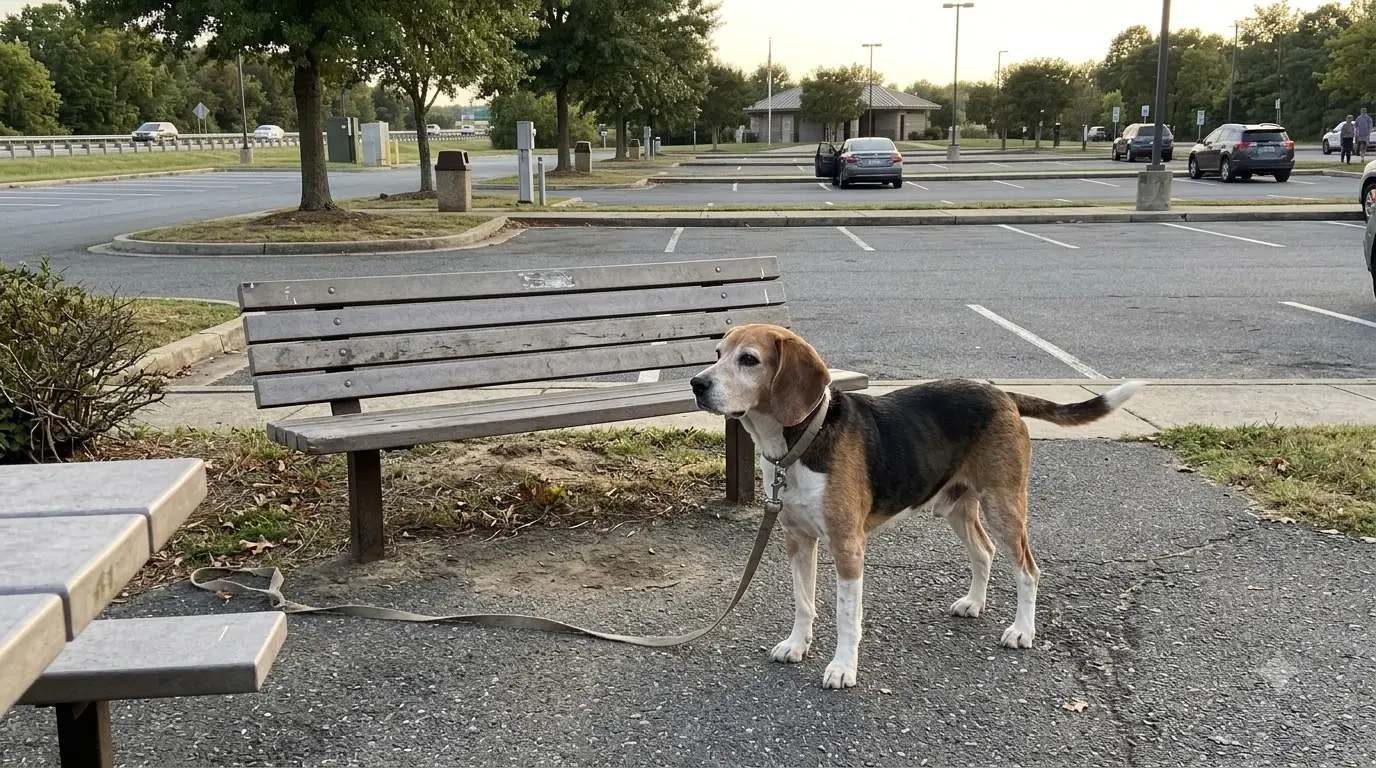
Archie was first noticed early in the morning at a highway rest area.
The parking lot was nearly empty.
A few travelers came and went.
Trucks moved along the highway in the distance.
And between the painted parking spaces, a small older Beagle mix wandered slowly with a faded leash dragging behind him.
The leash was still clipped to his collar.
No one appeared to be holding the other end.
Archie moved from one empty space to another, lowering his gray muzzle toward the pavement and sniffing.
Then he returned to the same bench near the edge of the rest area.
He climbed beneath it briefly.
Then he came back out and lay beside it.
His head lowered between his paws.
Cars arrived throughout the day.
Every time a door slammed, Archie stood.
His ears lifted.
His tail gave a small wag.
He watched.
Sometimes he took several steps toward the sound.
Then another traveler walked away.
Another car pulled out.
Archie returned to the bench.
By late afternoon, the pattern had repeated many times.
By sunset, he was still there.
The leash was still trailing behind him.
What We Could and Could Not Know
The circumstances strongly suggested that Archie had become separated from whoever had previously been responsible for him.
But we could not immediately establish how.
We did not know whether he had slipped out of a vehicle.
We did not know whether someone had intentionally left him.
We did not know whether the leash had been dropped accidentally.
We also did not know how long he had been at the rest area before he was first noticed that morning.
No reliable witness could confirm the event that brought him there.
That uncertainty mattered.
A faded leash and a dog waiting beside a bench create an emotionally powerful image, but rescue work requires us to distinguish observation from assumption.
What we could verify was that Archie was alone in a high-traffic area, attached to a leash that could become caught beneath a vehicle or around an object.
He needed to be moved to safety.
Approaching Archie
A local animal-control officer responded.
Archie noticed the vehicle and stood.
His tail moved immediately.
He took several steps forward.
Then he stopped.
The officer did not walk directly toward him.
Instead, she crouched at an angle and spoke quietly.
Archie sniffed the air.
A small treat was tossed onto the pavement.
He ate it.
Another was placed closer.
Archie approached slowly.
He seemed interested in people but tired.
When the officer reached for the dragging leash, Archie shifted backward slightly.
She stopped.
After another minute, he allowed her to pick it up.
That was enough.
There was no need for additional restraint.
Archie walked beside her toward the transport vehicle.
Before climbing in, he looked back toward the bench.
Then he followed.
His First Hours in Care
At intake, Archie looked every bit like an older dog who had spent too much time outside without enough rest.
His coat was dull and dusty.
His gray muzzle made his age immediately apparent.
His ribs were easier to feel than expected.
He had visible loss of muscle over his hips and hind legs.
His body condition was below ideal, though he was not critically emaciated.
He was mildly dehydrated.
His gums were somewhat tacky.
His paws showed superficial wear consistent with walking on hard surfaces, but there were no deep wounds.
The faded leash was removed and documented.
His collar was checked for identification.
There was no current tag that immediately connected him to a verified caregiver.
Staff also scanned for a microchip.
A chip was not immediately detected.
That meant Archie’s medical care had to move forward without assuming someone would arrive quickly with records.
Archie Was Interested in Food
Food got his attention almost immediately.
He approached the bowl.
He sniffed.
Then he began eating.
After several bites, however, he stopped.
He chewed slowly.
A small piece fell from the side of his mouth.
Archie picked it up and tried again.
The pattern suggested oral discomfort.
His next meal was softened.
He handled that more easily.
The difference was noted for his veterinary examination.
His First Complete Veterinary Exam
Archie received a full senior evaluation.
His temperature was within an acceptable range.
His lungs sounded clear.
He was not in respiratory distress.
His abdomen was soft.
His eyes showed mild age-related changes but no acute emergency.
His ears contained moderate debris and mild inflammation.
His skin was generally intact.
Then the veterinarian examined his mouth.
Archie had advanced periodontal disease.
Heavy tartar covered several teeth.
There was gum recession.
A few teeth were loose.
Dental pain could easily explain his cautious chewing.
But before dental treatment could be planned, another finding changed the order of priorities.
A heart murmur was audible.
The Murmur Needed an Explanation
A heart murmur is an abnormal sound caused by turbulent blood flow.
It does not, by itself, tell us how severe a heart problem may be.
Some older dogs have mild valve disease for years without developing congestive heart failure.
Others progress.
Because Archie was 10 and had no reliable medical history, the murmur needed additional evaluation before anesthesia.
Baseline bloodwork was ordered.
Senior Bloodwork
A complete blood count showed mild anemia.
The anemia was not severe enough to require transfusion or emergency intervention.
His white blood cell count was within a range that did not suggest a major acute systemic infection.
His chemistry panel showed mild changes consistent with dehydration.
Kidney values were slightly above what we might expect in a younger dog, but not high enough to diagnose advanced kidney failure from one test.
His liver values did not indicate an acute crisis.
His blood proteins were modestly low.
That finding could have been influenced by reduced nutrition, age, inflammation, or other chronic factors.
Urinalysis was added to better assess kidney function.
His urine remained reasonably concentrated.
There was no major protein loss.
This supported a cautious interpretation of early age-related renal changes rather than severe kidney disease.
Parasite Screening
Because Archie’s preventive history was unknown, fecal testing was performed.
He tested positive for whipworms.
Whipworms can cause intermittent diarrhea, weight loss, gastrointestinal irritation, and weakness.
Archie’s stool had been somewhat soft after intake.
The infection likely contributed to his body condition, though it would have been inappropriate to blame every problem on parasites.
He began an appropriate deworming protocol.
Follow-up treatment and fecal testing were scheduled.
Cardiac Evaluation
Chest radiographs were obtained.
They showed mild enlargement of the cardiac silhouette but no evidence of fluid accumulation in the lungs.
Archie was not in congestive heart failure.
An echocardiogram was then performed.
The findings were consistent with degenerative mitral valve disease.
This is a common cardiac condition in older dogs, especially smaller and medium-sized breeds.
The mitral valve had become thickened and was allowing some blood to leak backward during each heartbeat.
The important question was whether the disease had progressed enough to require treatment.
Archie’s cardiac measurements showed enlargement that warranted ongoing monitoring, but he remained clinically stable.
His veterinary cardiology plan was based on the exact stage of disease.
He did not need emergency oxygen.
He was not experiencing pulmonary edema.
And he was not considered too fragile to receive future care.
What the Diagnosis Meant for Archie
Archie’s heart condition was chronic.
It would not be “fixed” by one medication or procedure.
The goal was monitoring and managing progression responsibly.
His future caregivers would need to watch for persistent coughing, increased sleeping respiratory rate, fainting, exercise intolerance, rapid breathing, or difficulty breathing.
Periodic cardiac rechecks would be recommended.
His heart disease also meant that anesthesia for dental treatment needed extra planning.
That did not mean dental care should be avoided.
Untreated dental disease can cause substantial chronic pain.
The question was how to make treatment as safe as reasonably possible.
His Hind-Leg Stiffness
Archie’s movement also required evaluation.
He walked independently.
He did not drag his feet.
There was no obvious acute injury.
But he stood slowly after resting.
His first few steps were short.
When the veterinarian manipulated his hips, Archie became mildly tense.
There was also reduced muscle over the hindquarters.
Radiographs showed degenerative changes consistent with osteoarthritis.
No fracture was present.
No major destructive bone lesion was seen.
At 10 years old, the diagnosis was not unusual.
It still mattered.
Managing Arthritis in a Dog With Other Medical Needs
Pain management had to consider Archie’s kidney values and cardiac status.
The veterinary team selected an appropriate strategy and planned follow-up laboratory monitoring.
His bedding was upgraded.
He received low-impact walks rather than long strenuous outings.
Good traction was important.
He did not need to be pushed into exercise.
He needed enough movement to preserve muscle without worsening discomfort.
Over the following weeks, Archie began rising more comfortably.
The stiffness did not disappear.
That was never a realistic expectation.
But his functional mobility improved.
His Leash Became a Familiar Object
The faded leash that had been dragging behind Archie at the rest area was not used for daily walking.
It was too worn.
A safer leash and harness were provided.
The original leash was cleaned and stored temporarily with his belongings.
Archie showed no obvious distress when it was removed.
He did not search for it.
That was useful information.
The leash had been part of the circumstances in which he was found, but we could not assume it carried special emotional meaning for him.
The Bench Behavior Followed Him in Another Way
Archie no longer had a highway rest-area bench.
But he had doors.
Whenever a car door slammed outside the shelter, his head often lifted.
When the sound occurred close to the building, Archie sometimes stood.
His tail moved.
He looked toward the hallway.
If no one appeared, he eventually settled again.
This behavior gradually became less frequent as his routine became more predictable.
The connection to the rest area was impossible to prove.
It may simply have been a learned response to common environmental sounds.
Still, it was something staff noticed.
Dental Treatment Was Planned
Once Archie’s cardiac status, hydration, and laboratory values were understood, dental treatment moved forward.
His anesthetic protocol was tailored carefully.
Dental radiographs revealed severe periodontal disease beneath several teeth.
Multiple teeth required extraction.
The rest were cleaned.
Archie was monitored closely throughout anesthesia.
Heart rhythm.
Blood pressure.
Oxygen saturation.
Ventilation.
Temperature.
All were followed carefully.
He recovered without a major anesthetic complication.
Eating Became Easier
After the extraction sites healed, Archie’s eating changed noticeably.
He remained a slow eater.
That seemed to be partly his normal style.
But he stopped dropping food.
He no longer paused repeatedly to chew on one side.
His appetite remained good.
His meals were measured carefully because he needed modest weight gain without becoming heavy enough to worsen his joints or heart.
Weight Recovery
Archie gained weight gradually.
His ribs became less prominent.
The muscles around his shoulders and thighs improved slowly.
His coat became cleaner and fuller.
His body condition moved closer to a healthy range.
The veterinary team adjusted calories once he reached the target.