The First Thing We Noticed Was How Hard He Tried to Stay Standing
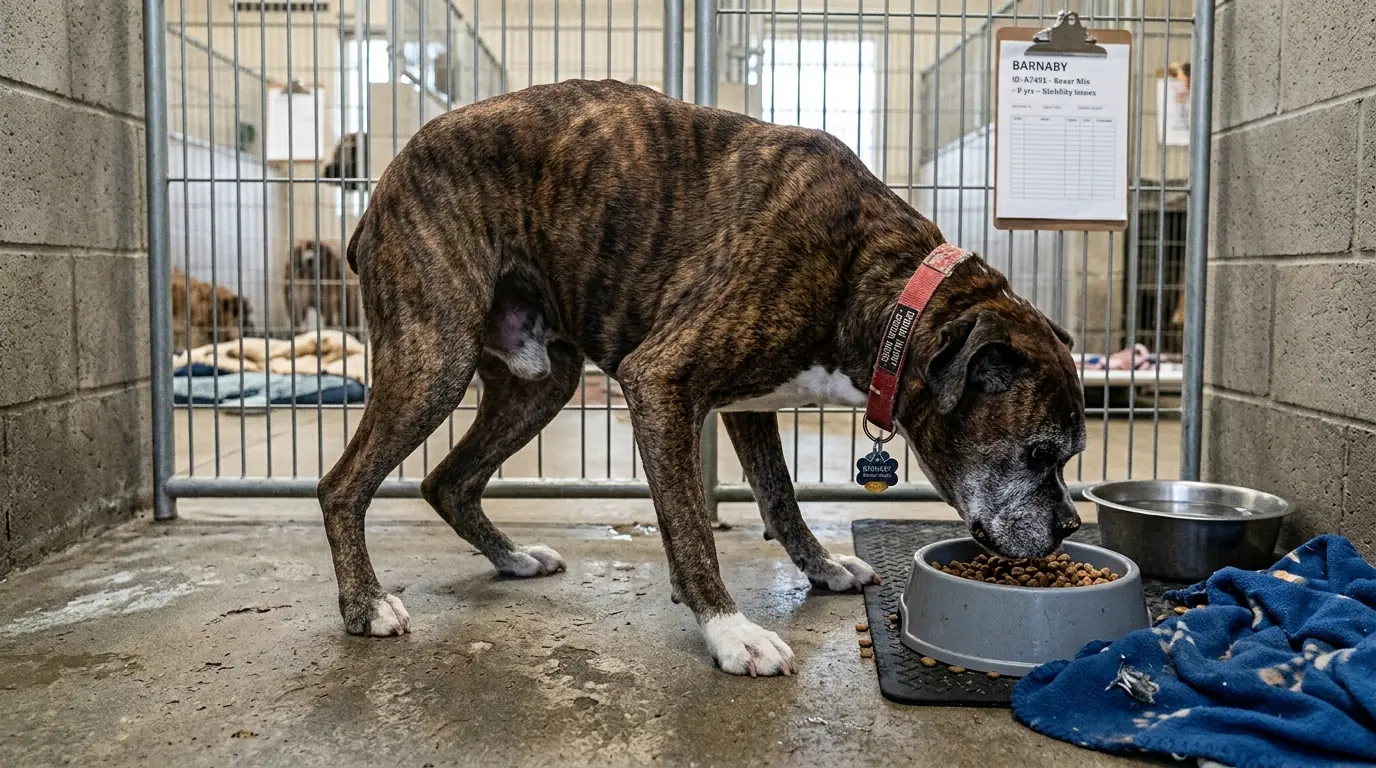
Murphy was nine years old when he came into the shelter, a broad-chested Boxer mix with a graying muzzle, a slightly sunken topline, and two hind legs that no longer seemed able to support him for very long.
At first, he could look surprisingly steady.
He could stand.
He could walk a short distance.
He could turn toward a familiar voice and make his way across the kennel on his own.
But if Murphy remained on his feet for more than a few minutes, the weakness became impossible to miss.
His hind feet would begin to shift beneath him. His stance would widen as he tried to create a more stable base. The muscles in his thighs would tremble. Sometimes one rear paw would drag slightly as he repositioned it.
Meals showed the problem more clearly than almost anything else.
Murphy was interested in food from the beginning. When his bowl was placed in front of him, he would walk over and lower his head to eat.
For the first several bites, he usually remained standing.
Then the trembling started.
His back end would gradually sink lower. He might reposition one foot, then the other, trying to remain upright without interrupting his meal. Eventually, his legs simply could not maintain the position.
Murphy would lower himself slowly onto the floor.
Once he was down, he would stretch his neck toward the bowl and continue eating.
It happened at breakfast.
It happened again at dinner.
The issue was not that Murphy had lost his appetite.
He simply could not stay standing long enough to finish.
There Was Clearly More Going On Than Normal Aging
Older dogs often become slower. Arthritis is common. Muscle mass decreases with age, and many senior dogs need more time getting up after resting.
But Murphy's movement suggested that this was more than ordinary stiffness.
His front end remained comparatively strong. Most of the difficulty was concentrated in his hindquarters.
When he walked, his rear steps were shorter than his front steps. He occasionally scuffed the tops of his hind toes against the floor. Turning required more concentration than moving straight ahead, and slick surfaces made everything noticeably harder.
If he stood still for too long, his rear legs began trembling before the rest of his body appeared tired.
There were also signs that this was not a brand-new problem.
The muscle over Murphy's hindquarters was reduced compared with his shoulders and chest, suggesting that he had been using those muscles differently for some time. His movement had the practiced quality of a dog who had already learned ways to compensate.
But there were limits to what we could know.
We did not have a complete medical history explaining when Murphy's spinal problem began, what originally caused it, or what treatment he may have received before entering the shelter.
There was no responsible way to fill those gaps with assumptions.
What we could document was the dog in front of us: a senior Boxer mix with progressive hind-limb weakness and physical findings consistent with an older spinal injury.
And at nine years old, Murphy needed an environment designed around what his body could do now, rather than what anyone thought a dog his size should still be able to do.
His Veterinary Examination Focused on More Than His Legs
Murphy received a full physical and neurologic assessment rather than simply being labeled a senior dog with weak hips.
His veterinary team watched him walk on a nonslip surface and evaluated how he placed each foot. They checked the movement and comfort of his hips, knees, and other joints. They examined his spine for areas of pain and evaluated muscle tone in his hindquarters.
His neurologic responses were particularly important.
The pattern supported a neurologic component to his mobility problem rather than weakness caused solely by painful joints.
Imaging also showed changes associated with an older spinal injury.
There was no single emergency finding that could simply be repaired and return Murphy to normal movement.
That distinction shaped his care.
This was not a case where rushing him into dramatic surgery was automatically the best answer. His condition appeared chronic, and the priority became preserving the mobility he still had while keeping him comfortable and reducing unnecessary strain.
Murphy could still move his hind legs.
He could still bear weight.
He could still walk independently for short distances.
He could still urinate and defecate without assistance.
Those abilities were important.
So was recognizing that they might change over time.
Eating Became One of the Best Ways to Understand His Limits
In a shelter, meals can reveal things that a brief examination does not.
A dog may manage a short walk down a hallway but struggle with standing still.
That was Murphy.
Walking allowed him to keep shifting his weight. Standing over a food bowl required sustained support from muscles that fatigued quickly.
His appetite remained good, but we did not want every meal to become an endurance exercise.
His feeding area was changed first.
Instead of placing his bowl on bare kennel flooring, we created a nonslip eating space so his hind feet would not slowly slide apart while he stood. The bowl was positioned where he could reach it comfortably whether he was standing or lying down.
We also stopped treating lying down during a meal as something that needed to be corrected.
Murphy was not refusing to stand.
He was conserving what strength he had.
If he needed to eat part of breakfast from the floor, then the goal was to make that position safe and comfortable.
Sometimes he stood through much of the meal.
Sometimes the shaking started early.
On more fatigued mornings, he lowered himself after only a short period.
His care plan had to accommodate all three possibilities.
Getting Down Was Easier Than Getting Back Up
Once Murphy was lying comfortably, he often seemed content to remain there.
The more difficult transition came afterward.
A young healthy dog can spring up from the floor almost without thinking. Murphy had to organize the movement.
First, he would bring his front feet underneath himself.
Then he would push his chest upward.
His front legs did much of the initial work.
His hindquarters followed more slowly.
On good days, Murphy could get all four feet underneath himself on the first attempt.
When he was tired, his rear paws sometimes slipped outward or failed to land where he expected them to. He might pause halfway through the motion, settle again, and try once more.
That was why traction mattered throughout his living space, not only at his food bowl.
Rubber-backed runners and nonslip mats gave his feet something to grip. Bedding needed to be supportive without being so thick that he sank into it and struggled to rise.
His water also had to remain accessible without requiring unnecessary trips across slick flooring.
These changes were simple.
For Murphy, they made everyday tasks less exhausting.
Rehabilitation Started With Very Small Goals
Nobody expected Murphy to suddenly regain the hind-limb strength of a younger dog.
His rehabilitation plan was intentionally conservative.
The goal was not to push him until his legs shook.
The goal was to help him use the strength he still had without repeatedly exhausting it.
Short, controlled walks replaced longer outings.
He moved over surfaces with reliable traction. His handlers allowed him time to place his feet rather than pulling him forward when he slowed.
Exercises were selected according to what he could tolerate.
Weight shifting could encourage controlled engagement of his hindquarters without requiring a long walk. Carefully managed standing exercises helped work the muscles needed for basic postural support. Slow transitions, when he could perform them comfortably, provided functional strengthening.
A support harness was available when he needed additional stability.
It was not used to drag Murphy along or force his hindquarters into a normal gait.
It was there to provide a little assistance when his legs could not quite manage what he was asking of them.
Some sessions lasted only a few minutes.
That was enough.
With chronic neurologic weakness, fatigue itself can increase instability. More exercise is not always better exercise.
Murphy's body set the pace.
Progress Did Not Move in a Straight Line
One of the easiest mistakes to make with a dog like Murphy is judging his condition from a single good day.
He had days when he seemed almost unexpectedly capable.
He would rise cleanly from his bed, walk outside, sniff along the edge of the yard, and return without needing much assistance.
Then the next morning, his hind legs might begin trembling while he was still eating breakfast.
That did not mean he had suddenly lost all his progress.
It meant his endurance varied.
Activity the previous day mattered. Rest mattered. Flooring mattered. Even the number of times he had needed to stand up and reposition himself could influence how tired his hindquarters became.
His rehabilitation was adjusted accordingly.
If he had a stronger morning, he might walk a little farther.
If his feet were scuffing more or his legs were trembling sooner, the session became shorter.
Rest was part of his treatment, not evidence that treatment had failed.
That approach also helped us avoid turning every small improvement into an unrealistic promise.
Murphy had an old spinal injury.
His neurologic deficits were real.
The possibility of future decline could not be ignored simply because he had a good afternoon.
His Kennel Behavior Began to Tell Us Something Else
Murphy's physical condition was the most obvious concern, but entering a shelter at nine years old brought another challenge.
Everything had changed.
The floor was different.
The smells were different.
Dogs barked from neighboring kennels. Doors opened and closed throughout the day. Cleaning equipment moved through the hallway. People he did not know approached his space.
Murphy did not immediately behave like a dog who considered the shelter comfortable.
He tended to remain on his bed when unfamiliar activity passed his kennel.
When someone entered, he watched carefully before deciding whether to stand.
That hesitation could easily have been interpreted as emotional withdrawal, but with Murphy, standing carried a physical cost. We had to be careful not to confuse limited mobility with fear or disinterest.
So interaction was offered without constantly asking him to get up.
People could spend time near Murphy while he remained lying down.
Treats could come to him.
Gentle handling could happen at his level when he was comfortable with it.
Over time, his behavior changed in small, observable ways.
He began eating while familiar caregivers remained nearby.
He rested on his side more often instead of keeping himself positioned for immediate movement.
When his kennel door opened, he no longer always waited for someone to approach him. On stronger days, he would push himself up and move toward the opening.
None of those changes required pretending that Murphy understood why he was there.
They simply showed that his daily environment was becoming more predictable.
The Food Bowl Remained the Clearest Measure
Even as Murphy became more settled, his meals continued to reveal the reality of his condition.
Some mornings he could stand almost until the bowl was empty.
Those meals were easy to celebrate.
But then there were evenings when his rear legs started shaking before he had eaten half of his food.
He would spread his feet.
His knees would flex.
His hindquarters would drop slightly.
Eventually, he would lower himself all the way down.
The difference was that we had stopped waiting for that moment as though it were a failure.
His feeding setup was already prepared for it.
The bowl remained within reach.
The surface underneath him provided traction.
Nobody urged him back onto his feet simply because dogs are usually pictured eating while standing.
Murphy finished his meal in the position his body could manage.
That became an important principle in nearly every part of his care.
Independence did not mean requiring him to perform a task in the conventional way.
It meant giving him the opportunity to do as much as he safely could.
His Weight Had to Be Managed Carefully
For a dog with hind-limb weakness, body weight has an enormous practical effect.
Murphy did not need to become thin, but carrying unnecessary weight would place additional demand on muscles already struggling to support him.
His meals were therefore measured.
The goal was appropriate body condition and adequate nutrition to maintain muscle, not aggressive restriction.
His weight was monitored along with appetite, stool quality, hydration, and general condition.
Because he enjoyed food, meals also became useful for positive handling.
A few pieces of his regular food could be used during calm rehabilitation exercises or when introducing a new surface.
But his main meal remained a meal.
We did not want him to spend breakfast repeatedly standing up for rewards until his hindquarters were exhausted.
For Murphy, energy had to be budgeted.
There was only so much standing and walking available on a given day.
We wanted him to spend it on things that improved his quality of life.
A Quieter Foster Environment Offered a Different Kind of Test
Once Murphy was medically stable and his daily needs were understood, a foster home offered something the shelter could not: a quieter environment where his mobility could be observed across an ordinary day.
The home was prepared before he arrived.
Rugs covered the slickest walking paths.
His bed was placed where he would not need to cross unnecessary stretches of hard flooring to reach water or the door.
Access to stairs was restricted.
His outdoor trips were short and supervised.
The first challenge was not distance.
It was learning the layout.
Murphy needed to discover where he could turn comfortably, which surfaces provided traction, and how far he could travel before fatigue changed his gait.
He was not carried everywhere simply because walking was difficult.
As long as he was comfortable and stable enough, he was allowed to use his own legs.
Assistance remained available when he needed it.
That balance was important.
Too little support could lead to slipping and unnecessary fatigue.
Too much support could remove opportunities to maintain the strength he still possessed.
Household Life Exposed Different Difficulties
Shelter kennels are compact.
Homes are complicated.
There are furniture corners, transitions between rugs and flooring, narrow doorways, thresholds, and tempting reasons to follow people from one room to another.
Murphy initially tried to participate in more movement than his body could comfortably sustain.
If someone walked toward the kitchen, he might get up.
If the person returned a few minutes later, Murphy might rise again.
Those repeated transitions added up.
His foster routine gradually became more deliberate.
He did not need to stand every time a person moved.
Comfortable resting areas were positioned where he could remain included without following every trip through the house.
His outings were predictable.
His exercise was planned.
Rest periods were protected.
This did not make his world smaller.
In many ways, it made more of his world accessible because he was no longer spending all of his available strength on unnecessary movement.
Meals Changed in Foster Care, but the Pattern Did Not Disappear
The first few meals in the foster home looked remarkably similar to the shelter.
Murphy approached his bowl standing.
He ate with enthusiasm.
Then the rear-leg tremor appeared.
He tried to reposition.
Finally, he lowered himself.
The spinal injury had not vanished because the environment had changed.
But the home allowed us to learn more about the pattern.
If Murphy had recently returned from a bathroom break, he tended to lie down sooner during a meal.
After a longer rest period, he often stood longer.
On particularly tired days, his bowl could be placed so that he did not need to remain upright at all.
There was no benefit in asking him to prove that he could stand.
His comfort was more important than appearances.
Over the following weeks, consistent rehabilitation and carefully managed activity helped him become somewhat more efficient in his movement.
He sometimes stood longer.
His transitions could look smoother.
But his underlying neurologic weakness remained.
That was expected.
The Goal Became Sustainability, Not Normality
Murphy's case required a shift in what successful recovery meant.
Success was not making him move exactly like a neurologically normal nine-year-old Boxer mix.
Success was keeping him comfortable.
It was maintaining useful mobility for as long as possible.
It was preventing avoidable falls.
It was making sure he could reach food, water, bedding, and outdoor areas without exhausting himself.
It was recognizing changes early if his neurologic function declined.
His veterinary follow-ups therefore remained important.
Changes in his ability to rise, increasing paw dragging, new pain, worsening coordination, loss of bladder or bowel control, or a sudden inability to bear weight would all warrant prompt reassessment.
His caregivers also watched subtler things.
Was he taking longer to stand?
Was he wearing the nails of his hind feet differently from dragging them?
Was he choosing not to move because he was tired, or because movement had become painful?
Was he slipping more frequently?
Was he still interested in his normal activities?
Those observations helped create a more accurate picture than any single dramatic milestone could.
Murphy Still Had Preferences
It would have been easy for his medical condition to become his entire identity.
Murphy made that difficult.
He had clear opinions about where he wanted to rest.
He preferred being near household activity without necessarily being in the middle of it.
He enjoyed sniffing outside and would sometimes spend more of his limited standing time investigating one patch of grass than actually walking.
He was interested in food enough that the sound of meal preparation often brought his head up immediately.
And as he became familiar with his foster routine, he began choosing when an activity was worth getting up for.
That choice was significant.
Early in care, much of Murphy's movement happened because something required it: an examination, a bathroom trip, relocation during kennel cleaning.
In foster care, more of his movement became voluntary.
Sometimes he heard his food being prepared and began the careful process of getting himself upright before the bowl arrived.
Other times, especially after an active morning, he remained down and waited.
Both were acceptable.
Preparing for a Permanent Home Required Honesty
Murphy could be a deeply rewarding companion, but he was not a dog whose medical needs could be minimized in order to make adoption easier.
A future home would need to understand his condition.
He needed good traction.
He needed controlled exercise rather than strenuous activity.
He needed protection from repeated stair use.
He needed a healthy body weight.
He needed veterinary follow-up.
He might eventually require more assistance than he needed now.
His mobility could remain relatively stable for a period, or his neurologic weakness could progress.
A support harness might become a more regular part of his life.
Changes in toileting ability or mobility would need to be taken seriously.
Most importantly, his future family would need to understand that adapting a task was not the same as giving up on him.
If Murphy needed to lie down to eat, he should lie down.
If he needed a rug to cross a room, the rug should be there.
If a five-minute outing gave him everything he needed from a walk, there was no reason to make it twenty.
His quality of life would be protected by respecting his limits, not constantly testing them.
He Still Lies Down Before Every Bowl Is Empty
Murphy has made meaningful gains since the first days when his hindquarters seemed to fatigue almost as soon as he began using them.
He is more practiced at moving through an environment designed for him.
He wastes less effort slipping on surfaces that his feet cannot grip.
His activity is paced more carefully.
His caregivers know when to offer support and when to let him work through a movement independently.
There are days when he stands through nearly an entire meal.
There are also days when he does not.
The familiar sequence still happens.
Murphy walks to his bowl.
He lowers his head and starts eating.
After a while, the muscles in his hind legs begin to tremble.
His stance changes.
Then, instead of fighting to remain upright until his legs give way, he lowers himself carefully onto the nonslip mat.
The bowl is already positioned where he can reach it.
He finishes eating from the floor.
His spinal injury is still there. His hind legs are still weak, and his future will require thoughtful management rather than promises of a cure.
But Murphy no longer has to spend every meal struggling against a body that cannot stay standing as long as he wants it to.
For a nine-year-old dog living with a chronic spinal injury, sometimes progress looks exactly like that: the same weak legs, the same need to lie down before dinner is finished, but a life arranged so that he can do it safely, comfortably, and without being asked to pretend that he is stronger than he is