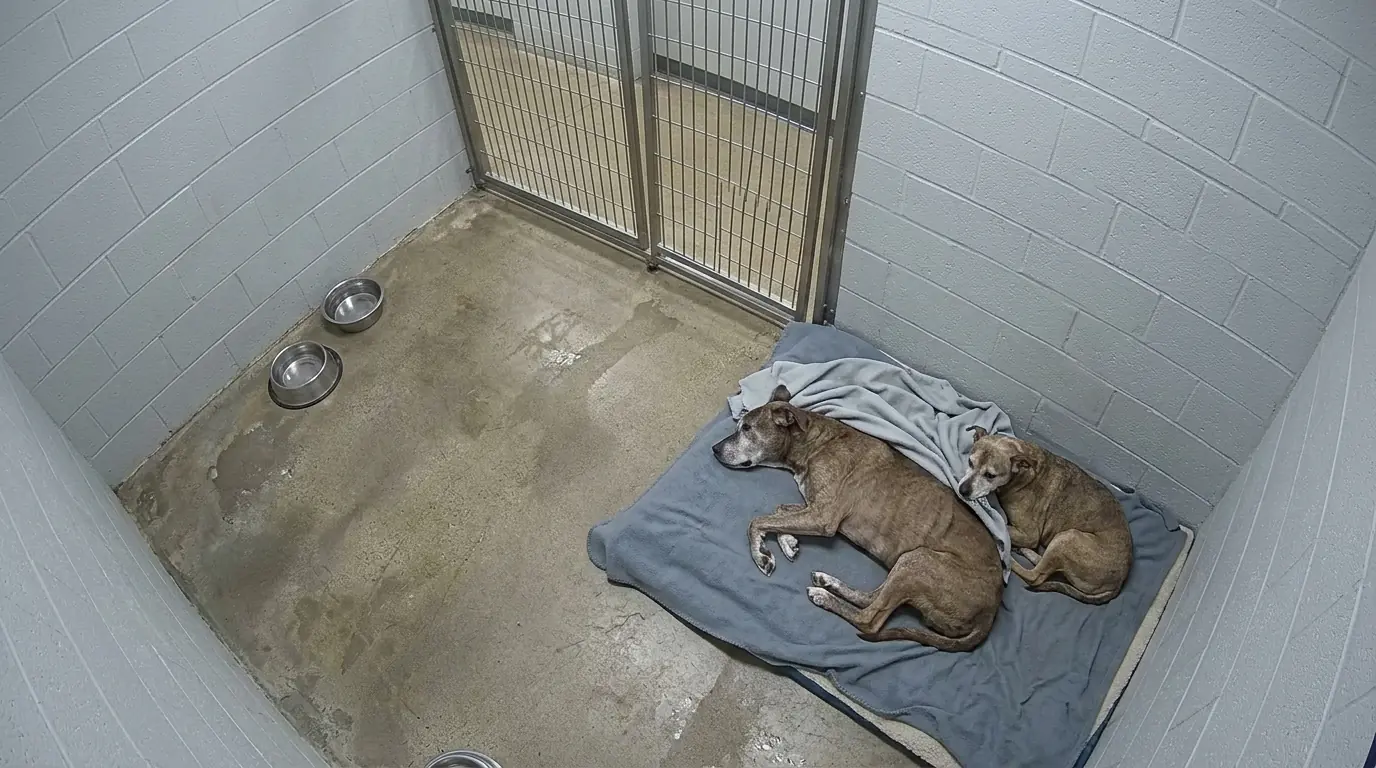
The Blanket Kept Falling Off, and Rosie Kept Bringing It Back
By the time Max and Rosie arrived at the shelter, both dogs were clearly seniors.
Max was the larger of the two, a mixed-breed dog with a broad frame that looked too big for the amount of weight he was carrying. His ribs were easy to feel. The muscles over his hips and shoulders had thinned noticeably. When he rested, especially after the kennel became quiet, a fine tremor often moved through his body.
Rosie was smaller.
She had her own gray around the muzzle and moved with the slower, more deliberate pace of an older dog, but she was in better body condition and seemed physically steadier than Max.
They were housed together because they had arrived together and their initial behavior around one another was calm. That did not automatically mean they were bonded.
Staff still needed to watch them.
The first behavior that drew attention happened at night.
Max had been given a padded bed and a fleece blanket.
He settled on his side.
The blanket covered most of his body.
Then he shifted.
The fabric slid from his ribs and gathered beside him.
Within a few minutes, the trembling returned.
Rosie was curled nearby.
She lifted her head.
Then she stood, walked to the loose edge of the blanket, and picked it up gently between her teeth.
She pulled backward.
The fleece dragged across the bed and back over part of Max’s side.
Rosie released it.
Then she turned, lowered herself beside the section of his body that was still uncovered, and curled against him.
The first time, it was easy to wonder whether she had simply been moving bedding.
Then Max shifted again later that night.
The blanket slipped.
Rosie did it again.
We Were Careful About What We Said It Meant
It would have been easy to say Rosie knew Max was cold and was deliberately tucking him in.
That might make a beautiful sentence.
It would also go beyond what we could prove.
Dogs manipulate bedding for many reasons.
They nest.
They pull blankets into preferred positions.
They move fabric to create softer resting spaces.
Dogs that live closely together may also develop routines around shared beds and blankets.
What mattered was the consistency of what staff actually observed.
When the blanket slipped from Max’s body, Rosie often took the edge in her mouth and pulled it toward him.
Afterward, she frequently chose to lie against whichever portion of his body remained exposed.
She did not drag the blanket into her own bed.
She did not repeatedly pull it away from Max.
The pattern occurred enough times that it became part of their nightly routine.
We did not need to assign human reasoning to make it meaningful.
Max’s Shivering Could Not Simply Be Blamed on Age
Senior dogs can tremble for many reasons.
Cold is one possibility.
Pain is another.
Weakness, anxiety, metabolic disease, neurologic changes, medication effects, or generalized illness can also contribute.
Max was severely underweight enough that poor insulation was an obvious concern.
A dog with reduced body fat and muscle has less protection against changes in temperature.
But that could not be the end of the medical assessment.
He needed to be examined.
His weight loss needed an explanation.
And the tremor needed to be evaluated in context.
Max received a complete physical examination.
His body condition was documented carefully.
His hydration was assessed.
The loss of muscle over his back and hindquarters was significant.
His mouth and teeth were checked for pain that might make eating difficult.
His abdomen was palpated.
His heart and lungs were evaluated.
His joints and spine were examined for discomfort.
Baseline bloodwork and urinalysis were appropriate because severe weight loss in a senior dog can have many underlying causes.
A fecal screen was also considered based on his history and intake circumstances.
The important thing was not to assume that every thin dog simply needed more food.
There Was No Single Dramatic Diagnosis
Max’s initial testing did not reveal one spectacular emergency that explained his entire condition.
There was no large abdominal mass found on examination.
No acute fracture.
No sudden organ failure.
Instead, his condition appeared to be the result of chronic undernutrition and age-related muscle loss, with senior medical issues that required management but did not account for every pound he had lost.
That was useful information.
It meant Max could begin a controlled nutritional rehabilitation plan without a major surgical crisis taking priority.
It also meant his recovery would be slow.
A severely underweight senior dog should not be expected to look normal after a few large meals.
His body needed time.
Feeding Max More Had to Be Done Carefully
The instinct when seeing a thin dog is to feed generously.
For Max, the plan needed more structure.
His meals were measured.
Calories were increased in a controlled way.
Food was divided into manageable portions rather than offered as one enormous meal.
His appetite was watched.
So were stool quality, hydration, abdominal comfort, and weight trends.
If he ate poorly, that mattered.
If he ate well but failed to gain, that mattered too.
His weight was checked regularly rather than judged only by appearance.
The goal was gradual restoration of body condition while maintaining digestive tolerance.
Protein intake and overall nutritional adequacy mattered because Max needed to rebuild muscle, not simply add body fat.
That process would take weeks.
Possibly longer.
Keeping Him Warm Became Part of Medical Care
Max’s low body condition made environmental temperature especially important.
The shelter kennel itself was climate controlled, but a dog as thin as Max could still become uncomfortable on surfaces or in conditions another dog tolerated easily.
His bedding was increased.
A supportive mattress reduced pressure over his hips and elbows.
Blankets were changed when damp.
Drafts around the kennel area were minimized.
The team also made sure the trembling was not being ignored when it occurred despite warmth.
If Max continued shivering while appropriately covered and in a comfortable environment, pain and other medical causes needed reassessment.
The blanket was support.
It was not a substitute for veterinary care.
Rosie Had Her Own Senior Examination
Because Max’s appearance was more dramatic, Rosie could easily have become an afterthought.
She was not.
Rosie received her own full senior assessment.
Her body condition was better, but age-related changes were present.
She had some mild stiffness after rest.
Her dental health required routine attention.
Her bloodwork was evaluated independently.
She ate well and moved more comfortably than Max.
She did not need the same nutritional plan.
That meant feeding the two dogs had to be managed separately even though they shared a kennel.
Max needed increased nutritional support.
Rosie did not need to gain unnecessary weight just because the dog beside her did.
Their Relationship Showed Up in More Than the Blanket
The blanket behavior was the most visually striking thing staff noticed.
But it was not the only pattern.
Rosie often chose the bed closest to Max.
If he changed position, she frequently lifted her head.
When he returned from a veterinary exam, she usually stood and sniffed him before settling again.
Max also appeared more relaxed when Rosie was nearby.
That did not mean he could not function without her.
During short separations, he still ate.
He could rest.
He accepted handling.
Rosie also managed individual walks and examinations without becoming unable to cope.
That was important.
A meaningful attachment does not have to mean complete dependence.
Max Slept More Than Rosie
His poor condition affected endurance.
Max tired easily.
Even short walks to eliminate could leave him ready to rest.
Rosie had more stamina.
She spent more time standing at the kennel door or investigating hallway activity.
This difference mattered when staff interpreted their shared behavior.
Rosie was not simply lying beside Max because she was equally exhausted.
She often made a choice to return to him after moving around the kennel.
At night, when activity decreased, she tended to settle closest.
The Blanket Became Part of a Repeated Sequence
There was a pattern.
Max would lie down.
A caregiver covered him loosely enough that he could move freely.
He would sleep.
Eventually, he shifted.
The blanket slid toward the edge of the bed.
Sometimes the exposed section was his back.
Sometimes his flank.
Occasionally most of the blanket ended up beneath him.
Rosie would notice.
She often stood.
She approached the loose fleece.
She took the edge between her front teeth.
Then she pulled.
Her movements were not perfect.
Sometimes the blanket bunched.
Sometimes she managed to cover only Max’s hindquarters.
Sometimes she dragged it too far and had to reposition herself.
There was no neat human-style tuck.
But the result was often the same.
More blanket over Max.
Rosie beside what remained uncovered.
We Made Sure Rosie Was Not Being Asked to Do a Job
As touching as the behavior was, Max could not depend on Rosie for warmth.
Staff checked him regularly.
Blankets were repositioned when necessary.
His bedding was adjusted.
If he was cold, people addressed it.
No one deliberately left the blanket fallen just to see whether Rosie would retrieve it.
That would have prioritized an emotional scene over Max’s welfare.
The behavior was allowed to happen naturally.
It was never required.
Max’s Body Condition Began Improving Slowly
After the first several weeks, the scale began showing gradual progress.
His ribs were still visible.
His hips were still prominent.
But the change was moving in the right direction.
His appetite remained consistent.
His stool stabilized.
His energy improved.
He began standing for slightly longer periods.
The muscles over his hindquarters were still reduced, but his gait looked less fragile.
These were small changes.
They mattered more than a dramatic before-and-after picture.
Severe weight restoration is slow.
Older dogs rebuild muscle even more gradually than younger ones.
The Trembling Did Not Vanish Immediately
As Max gained weight, he still had episodes of trembling.
Some were clearly associated with rest and being uncovered.
Others appeared after exertion.
That meant the team continued monitoring rather than assuming food had solved everything.
His comfort plan was adjusted as needed.
Senior joint stiffness was managed appropriately.
Rest remained important.
The kennel temperature remained comfortable.
As his body condition improved, the tremors became less frequent, but they did not disappear in one clean moment.
That was realistic.
Rosie Began Pulling the Blanket Less Often
This change happened for a practical reason.
Max started keeping more of his own body heat.
He also changed positions more comfortably and spent longer periods settled on the supportive bed.
Staff became better at arranging the fleece so it did not slide immediately.
There were simply fewer opportunities for Rosie to move it.
That was good.
The goal had never been to preserve the behavior.
The goal was Max’s comfort.
A Quieter Foster Home Became the Next Step
Once both dogs were medically stable enough, a foster home offered more consistent rest than a shelter kennel.
The home was prepared with their different needs in mind.
Max had a thick, supportive bed in a draft-free area.
A second bed was available for Rosie.
Nonslip rugs made movement easier for both seniors.
Meals were given separately so intake could be monitored accurately.
Max’s food continued to support gradual weight restoration.
Rosie maintained a senior-appropriate diet without excess calories.
Blankets were placed on both beds.
They Chose One Bed Anyway
On the first night, Max went to the larger bed.
Rosie explored the room for several minutes.
Then she walked back to him.
There was an entire second bed available.
She ignored it.
She curled along the edge of Max’s mattress.
The foster family left the second bed in place.
Choice mattered.
Over the following nights, Rosie did sometimes use it.
But more often, she returned to Max.
The Blanket Behavior Followed Them Home
During their first week in foster care, Max rolled onto his side and pushed most of his blanket behind him.
Rosie had been asleep a few feet away.
She woke.
She walked over.
She picked up the loose corner.
She pulled it toward Max.
The fleece landed across his ribs.
Then Rosie stepped around and lay against his exposed abdomen.
Different building.
Different bed.
Same behavior.
That told us the pattern was not simply a response to one shelter kennel.
It was something Rosie continued to do in a quieter environment where she had other comfortable choices.
Foster Care Revealed How Much Max Had Been Conserving Energy
In the shelter, Max had looked tired.
At home, it became easier to see just how carefully he rationed movement.
He did not get up every time someone entered the room.
He watched.
If food was involved, he stood.
If it was time to go outside, he stood.
If Rosie moved to another bed, he often stayed where he was.
That was actually useful.
Unnecessary movement could consume energy he needed for recovery.
The foster family learned to bring some things to him rather than asking him to follow them constantly.
He Began Showing More Interest in the Yard
As weight returned, Max’s world expanded.
At first, outdoor trips were functional.
Walk out.
Eliminate.
Return.
Later, he began sniffing.
He paused at grass.
He investigated the fence.
He remained outside a little longer.
Rosie usually moved faster, so the dogs also received outings adapted to their individual endurance.
Rosie could walk farther.
Max did not need to match her.
Again, staying together did not mean receiving identical care.
Rosie’s Attachment Did Not Prevent Independence
Rosie could spend time away from Max.
She took individual walks.
She rested in another room occasionally.
She interacted with familiar people without needing him beside her.
That was healthy.
The foster family encouraged this naturally.
They did not constantly place the two dogs together for emotional effect.
If Rosie wanted another bed, she used it.
If Max wanted to sleep alone, he was allowed to.
Their repeated choices carried more meaning because they were actually choices.
Max Started Sleeping More Deeply
One of the best changes was sleep.
At intake, Max often rested lightly.
His thin body curled tightly.
His tremors interrupted periods of rest.
As his nutritional status improved and the foster environment became familiar, his posture changed.
He began sleeping on his side more often.
His legs stretched farther away from his body.
His head stayed down through ordinary household sounds.
Deep sleep became more common.
That was an important quality-of-life improvement.
A dog recovering from severe depletion needs rest as much as calories.
The Blanket Still Slipped
Max was a restless repositioner on some nights.
He might start fully covered and wake an hour later with the fleece underneath him.
Rosie still occasionally intervened.
But something else began happening.
Sometimes the blanket fell and Max did not start trembling.
Rosie looked at it.
Then she stayed where she was.
Those nights showed us how much his physical condition was changing.
He no longer needed the same level of external warmth every time the blanket shifted.
His Weight Gain Had to Slow as He Approached a Healthier Condition
Nutritional rehabilitation is not an endless process.
Once Max approached a healthier body condition, calories had to be reassessed.
Continued aggressive gain could eventually place unnecessary stress on senior joints.
The goal shifted from restoration toward maintenance.
His muscle condition continued to be monitored.
So did his mobility.
He was still an elderly dog.
A fuller body did not make age-related issues disappear.
Rosie’s Own Stiffness Became More Noticeable Over Time
Once Max was more stable, attention naturally shifted toward some of Rosie’s subtler needs.
She was slower after long naps.
She hesitated slightly before jumping down from a low surface.
That led to additional senior mobility management.
Steps and ramps were considered where useful.
Her exercise stayed moderate.
Pain or worsening stiffness would warrant reassessment.
This was another reason not to cast Rosie as the permanently healthy caretaker.
She was aging too.
She deserved the same attention.
The Pair Became Easier to Describe Honestly
By this stage, their relationship had been observed across multiple settings.
They chose proximity.
Rosie repeatedly manipulated bedding around Max.
She often slept beside him.
Max remained comfortable with her physical closeness.
They could both function separately.
They did not guard food or beds from each other.
Keeping them together appeared beneficial.
It was reasonable to describe them as a closely attached senior pair.
Their Adoption Plan Needed to Account for Two Aging Bodies
A future home could not think only about the emotional appeal of adopting them together.
Max would continue requiring senior care and monitoring of body condition.
His history of severe weight loss meant any future decrease in appetite or weight would need attention.
Rosie had emerging age-related mobility needs of her own.
Both dogs needed easy access to comfortable bedding.
Slippery flooring should be minimized.
Long staircases could become increasingly difficult as they aged.
Veterinary follow-up would be important for both.
The right home needed to be prepared for the reality of caring for two seniors whose needs might increase over time.
Max Eventually Stopped Shivering Most Nights
The change was gradual enough that no one could point to one evening when it happened.
There were simply fewer tremors.
Then fewer again.
His body condition improved.
His environment remained warm.
His discomfort was managed.
His rest became deeper.
One evening, Max rolled and lost the entire blanket.
Rosie lifted her head.
She watched him.
Max remained asleep.
No trembling.
Rosie lowered her head again.
She did not get up.
That was one of the quietest signs that the care plan was working.
The Next Cold Night Brought the Old Routine Back
Recovery does not erase vulnerability.
During a colder evening, Max curled tightly again.
The blanket slipped from one side.
A light tremor started along his hindquarters.
Rosie stood.
She took the blanket in her mouth.
She pulled it over him.
Then she lay against his exposed flank.
The behavior had not disappeared.
It had simply become less necessary.
Max No Longer Looks Like the Same Fragile Dog
His ribs are no longer as stark.
There is more muscle over his hips.
His coat sits differently over a body that has regained healthy tissue.
He has more endurance.
He spends more time investigating his surroundings.
None of this happened quickly.
It came from weeks of controlled nutrition, senior medical management, rest, and careful observation.
His age remains.
His health still needs monitoring.
But his body is no longer operating with the same limited reserves it had at intake.
Rosie Still Checks the Blanket
Even now, Rosie notices when it moves.
Sometimes she noses at it.
Sometimes she pulls a corner.
Sometimes she simply curls beside Max without touching it.
There is no perfectly consistent ritual anymore.
There does not need to be.
The important part is that Max no longer depends on it in the same way.
Their Story Was Never Really About a Blanket
The blanket was what made people stop.
A small senior dog tugging fleece back over a much larger, frailer dog is difficult not to notice.
But the behavior pointed toward something bigger.
Max arrived with too little body weight to comfortably regulate himself.
He needed medical assessment.
Nutrition.
Warmth.
Rest.
Time.
Rosie happened to have a repeated way of responding when the blanket slipped.
That behavior gave us another reason to watch closely.
It did not replace care.
It helped reveal where care was needed.
These Days, Rosie Often Falls Asleep Before the Blanket Moves
Their evenings are quieter now.
Max settles onto his bed.
Rosie usually chooses a place close by.
Sometimes they touch.
Sometimes there is a small gap between them.
The blanket is placed loosely across Max if the room is cool.
He shifts.
He sighs.
He sleeps.
Most nights, the fleece stays where it is.
Sometimes it does not.
If it slides away and Max remains comfortable, Rosie may never move.
She simply sleeps beside him.
But every so often, especially on a colder night, the old sequence returns.
Max turns.
The blanket falls from his ribs.
Rosie lifts her gray muzzle.
She stands.
She takes the edge carefully between her teeth and pulls until part of it lies across him again.
Then she curls against the section the blanket did not cover.
We still cannot say exactly what Rosie understands about Max’s body.
We do not need to.
We know what she does.
And we know how much less often she has to do it now.
Max is still a senior dog.
Rosie is too.
Neither one has been made young again.
But the dog who once trembled beneath a body far too thin for his frame can now sleep through most nights without needing his blanket pulled back into place.
And when he does need it, the smaller dog beside him still sometimes gets there before anyone else does.