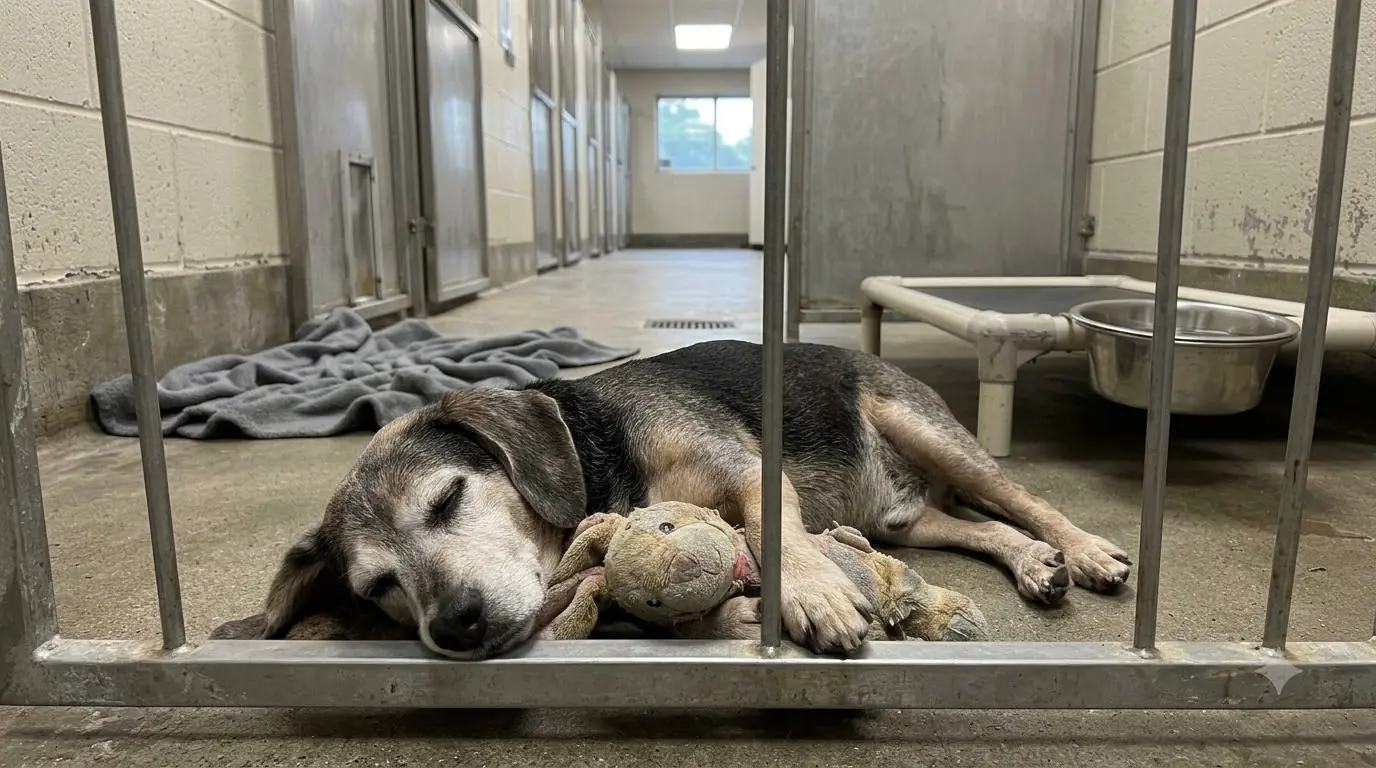
Walter has developed a routine around footsteps.
Most of the day, his faded stuffed rabbit stays on or near his blanket. Sometimes Walter rests his chin across it. Sometimes he leaves it beside his bed while he eats or drinks.
But when voices begin carrying down the senior-dog row and shoes start moving along the hallway, Walter notices.
He raises his head.
Then, if the footsteps keep coming, he stands.
Walter is 11 years old, so standing is not something he does with the quick spring of a young dog. He stretches first. His back legs take an extra moment to straighten. Then he finds his rabbit, picks it up gently, and walks toward the front of his kennel.
He places the toy between his paws.
And he waits.
How Walter Came Into Our Care
Walter came to us through an owner surrender after changes in his previous household made it impossible for his family to continue caring for him.
We know some basic information about his life before the shelter, but not every detail. There is no reason to turn the missing pieces into a more dramatic story than the one we actually know.
Walter had lived in a home.
He knew what a leash was. He understood household routines. He was comfortable resting near people, and he seemed familiar with ordinary sounds like doors opening, food being prepared, and someone moving around nearby.
His faded stuffed rabbit arrived with him.
It was already worn by then.
The fabric had softened from use, and the rabbit no longer looked much like something recently purchased from a pet-store shelf. Walter, however, treated it as if nothing about it needed replacing.
During his first days with us, the rabbit stayed close.
Walter's transition into shelter life was relatively quiet.
He ate, though initially more slowly than he does now. He accepted walks. He allowed routine handling from staff and gradually became familiar with the people responsible for his daily care.
But the shelter itself was a major change.
There were dogs barking on both sides of him. Doors opened and closed throughout the day. Cleaning carts rolled past. Leashes jingled. New animals arrived. Others left.
Walter mostly observed.
His First Days in the Senior-Dog Row
Walter never became one of the dogs who tried to compete with the noise.
When someone entered the hallway, some dogs immediately came forward. Others barked. Some bounced against their kennel doors or pushed their noses through the openings.
Walter usually needed a little longer.
He might lift his head when the first footsteps appeared and remain on his blanket for several seconds.
Then he would stand.
That delay seems small when described on paper.
On an adoption floor, it matters.
Visitors are taking in many animals at once. A dog who is already standing at the front of a kennel can attract attention before Walter has finished getting to his feet.
And Walter is a senior dog in a row where age is impossible to ignore.
His face has grayed. His pace is slower. When he wakes from a deep sleep, he sometimes needs a few steps before his body loosens up.
None of those things prevent him from enjoying his day.
But they make his first impression very different from that of a younger dog.
Walter does not leap at the door.
He does not perform for everyone who passes.
He simply comes forward when he realizes someone may be approaching.
More and more often, he brings the rabbit with him.
Why Walter Keeps Being Overlooked
There is no single explanation for every visitor who has walked past Walter.
Some families arrive specifically hoping for a younger dog. Some need a pet whose age and physical needs fit a particular lifestyle. Others may simply connect with another animal first.
Those are normal parts of adoption matching.
But Walter does face a challenge shared by many senior shelter dogs: younger animals often make a faster first impression.
A younger Beagle mix several kennels away might be standing against the door before a family even enters the row.
Walter may still be stretching.
A younger dog may be ready for a long hike or an afternoon of running around a yard.
Walter's favorite version of an outing is different.
He wants time to sniff.
He wants to investigate the bottom of a fence, a patch of grass, a leaf somebody stepped on five minutes earlier, and whatever interesting information another dog apparently left beside a tree.
His walks are not about distance.
They're about Walter.
For the right person, that's part of his appeal.
But prospective adopters looking for a highly active companion may reasonably decide that another dog is a better match.
His age also means potential adopters need to think realistically about senior veterinary care.
Walter is not a difficult dog to care for, but adopting an 11-year-old is different from adopting an 11-month-old.
Those considerations can narrow the number of homes that fit him.
Meanwhile, Walter continues doing the same thing when people arrive.
He gets up.
He carries the rabbit forward.
He waits.
What People Don't See From the Hallway
The biggest difference in Walter becomes obvious when he leaves the adoption floor.
Outside, there is no row of barking dogs competing for attention.
There is no family trying to look at six kennels in ten minutes.
There is simply Walter, a leash, and a world containing far more smells than any reasonable Beagle could investigate in one afternoon.
He walks slowly.
Not reluctantly.
Slowly.
Walter likes to stop.
A lot.
He can spend an impressive amount of time examining one patch of grass. If his handler starts walking again before he has completed his investigation, Walter may take another sniff before eventually following.
There is something almost methodical about him outside.
He explores at his own pace, his nose often leading the rest of his body.
Then eventually, Walter gets tired.
That is when another part of his personality appears.
If a familiar person is standing nearby, Walter often moves toward them and leans.
There is no dramatic request for attention.
He simply presses the side of his body against the nearest leg and remains there.
Sometimes that is all he wants.
A place to rest for a minute.
A person beside him.
Then, when he is ready, Walter continues.
Inside a quiet room, he behaves similarly.
Walter does not need constant entertainment. Once he has investigated his surroundings and decided everything is acceptable, he settles.
Give him a blanket and a familiar person nearby, and he can become remarkably content doing very little.
That side of Walter is difficult to demonstrate through a kennel door.
The Rabbit
Walter's stuffed rabbit has become part of his shelter routine.
We do not pretend to know exactly what Walter thinks about the toy.
Dogs can form strong preferences for familiar objects, but assigning complicated human meanings to every behavior would be guesswork.
What we can say is what we observe.
Walter chooses the rabbit frequently.
He carries it carefully.
He sleeps near it.
And when activity starts in the hallway, he often brings it with him.
The pattern has become familiar.
Footsteps.
Walter's head rises.
He stands.
He picks up the rabbit.
Then he walks to the door.
Sometimes visitors stop.
Sometimes they don't.
When the hallway becomes quiet again, Walter often picks the rabbit back up and returns to his blanket.
That small routine says more about Walter's days here than any description of him as "sad" ever could.
Because Walter is not spending every hour miserable.
He eats.
He walks.
He sniffs.
He rests.
He enjoys attention.
He has people he recognizes.
He has good parts of his day.
He simply keeps experiencing one particular moment without the ending we would like for him.
The kennel door remains closed.
Walter's Health at 11
Walter received the same intake veterinary assessment we use to establish an appropriate care plan for senior animals.
His age is visible, and we approach his care accordingly.
Like many older dogs, Walter has some age-related stiffness, particularly after resting for a long period. Staff monitor his mobility and make sure his exercise remains appropriate for his comfort level.
His walks are deliberately unhurried.
Nobody needs Walter to cover a certain distance.
The goal is movement, enrichment, sniffing, and time away from the kennel.
His body condition, appetite, hydration, skin, coat, teeth, eyes, ears, heart, lungs, and mobility are all areas that receive attention during routine senior care. Preventive care and follow-up veterinary monitoring are especially important at his age.
Walter's future adopter will need to understand that senior dogs can require more frequent veterinary attention as they continue aging.
That does not mean Walter spends his days requiring complicated medical management.
He doesn't.
Most of Walter's routine is wonderfully ordinary.
Breakfast.
Bathroom break.
A slow walk.
Rest.
Another outing.
Dinner.
Sleep.
But anyone considering him should be prepared for the realities that come with loving an older dog rather than assuming age is merely a number on his adoption profile.
We want Walter's eventual placement to last.
That means being honest about both the easy parts and the responsibilities.
What a Normal Day Looks Like for Walter
Mornings begin before visitors arrive.
Walter gets up for his first bathroom break, takes his time outside, and returns for breakfast.
Afterward, he usually settles again.
Senior dogs often sleep more than younger dogs, and Walter takes that privilege seriously.
His rabbit is usually somewhere close.
Later comes another walk or enrichment activity.
Walter is particularly well suited to sniff-focused outings because he does not need a complicated game to stay interested.
The environment itself is enrichment.
A different walking route can occupy him for quite a while.
So can a patch of grass that apparently contains information available only to Beagles.
Then the public part of the day begins.
The energy changes when visitors arrive.
Walter notices voices.
He notices doors.
He notices the repeated sound of people stopping and starting along the hallway.
And he notices when leashes appear.
A leash can mean many things in a shelter.
A walk.
A meet-and-greet.
A dog going into foster care.
Or, occasionally, a dog leaving for home.
Walter does not know the paperwork behind any of those events.
He only knows that activity is happening around him.
Yesterday, Two Doors Opened
Yesterday was busier than usual near Walter's kennel.
Two younger dogs were preparing to leave with their new families.
There were conversations in the hallway, adoption materials being gathered, and the familiar movement that happens when an animal is going home.
Walter watched.
The first kennel opened.
A younger dog came out wearing a leash and left with a family.
Later, another door opened.
Another dog left.
Walter remained in his kennel.
We cannot tell readers what Walter understood about those departures. Saying he knew exactly why the other dogs were leaving would give him thoughts we cannot verify.
What we can describe is what happened afterward.
Walter stayed attentive to the hallway.
And as the day wound down, the number of footsteps decreased.