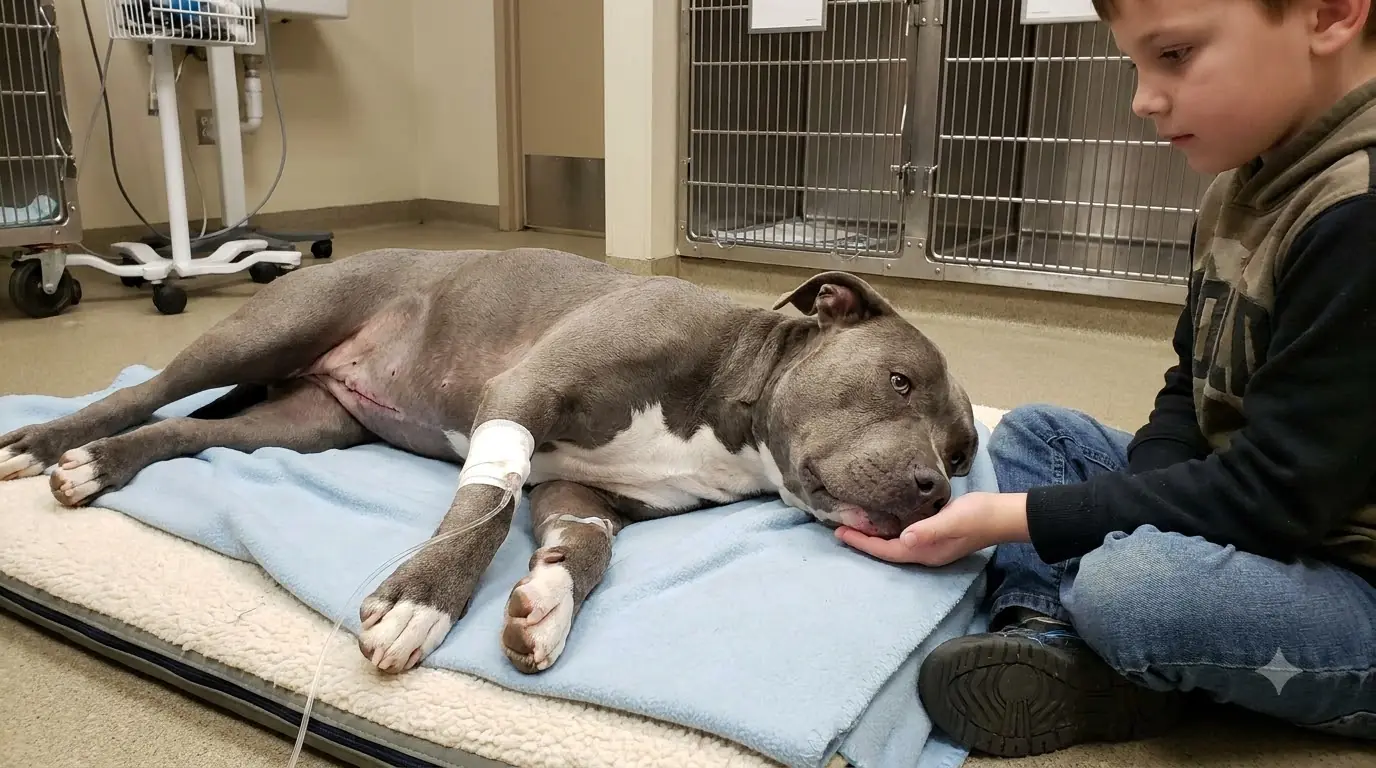
The little boy was told not to ask her to move.
That was the first rule.
The American Pit Bull Terrier had just come through major surgery and was still in the recovery ward of a veterinary hospital. Her abdomen had been shaved. One front leg was wrapped around an IV catheter. Her body was weak enough that standing was not yet an option.
Even lifting her head took effort.
So when the boy came in, staff placed a chair beside the recovery bed and asked him to stay quiet.
No hugging.
No climbing onto the bed.
No trying to make her sit up.
No calling her name over and over.
Just sit close enough for her to know he was there.
He did.
For the first few minutes, the Pit Bull barely moved.
Her breathing was slow and regular. Her eyes opened, then closed. One ear shifted when the boy spoke softly.
He rested his hand on the edge of the blanket.
Not touching her.
Just near enough that she could smell him.
The dog's eyes opened again.
Then her head began to rise.
It was not a smooth movement.
Her chin lifted less than an inch.
Stopped.
Lifted again.
The muscles along her neck tightened as she tried to hold the weight of her own head away from the bedding.
The boy remained completely still.
Staff watched closely.
No one wanted her straining after major surgery.
The Pit Bull moved her muzzle forward.
Barely.
A small shift through the shoulders.
Then another.
Her abdomen stayed supported.
Her IV leg remained where it was.
She was not trying to stand.
She was simply trying to close the few inches between her face and the boy's hand.
He moved his palm a little closer.
That helped.
The dog's nose touched his skin.
Then her muzzle settled fully into his palm.
For several seconds, she stayed there.
The boy did not stroke her.
He did not lift her head.
He simply let his hand become the place where it rested.
The Pit Bull's eyes closed.
Whatever strength had carried her those final inches was gone.
Her head became heavy in his hand and slowly slid back onto the blanket.
But this time, her nose stayed against his fingers.
She Had Been Much Stronger Before Surgery
The weakness staff were seeing now was not her normal state.
Before the procedure, she could walk.
She could stand.
She could follow familiar people.
She could reposition herself without help.
The surgery had been medically necessary and substantial enough that the veterinary team expected the first recovery period to be difficult.
Major abdominal procedures can leave a dog sore, fatigued, nauseated, and reluctant to move.
Anesthesia itself takes time to clear.
Pain medication can contribute to drowsiness.
The body is also directing enormous resources toward stabilization and healing.
For this dog, the result was profound temporary weakness.
The Shaved Abdomen Showed Where the Work Had Been Done
The fur had been clipped widely enough for sterile preparation and surgical access.
That made the procedure look even more dramatic.
A large section of bare skin.
An incision.
Medical adhesive or sutures depending on the closure method.
The veterinary team monitored the area closely.
Swelling.
Redness.
Discharge.
Heat.
Pain.
Any change could matter.
The incision was not something the family or visitors were encouraged to touch.
The same was true of the IV leg.
The IV Was There Because Recovery Needed Support
Fluids.
Medication.
Access in case her condition changed.
The catheter gave the medical team a reliable route without repeatedly placing new needles into an already exhausted dog.
The bandage around the leg had to remain clean and correctly positioned.
Staff monitored the paw below it for swelling.
They checked the catheter site for irritation.
Nothing about the little boy's visit changed those priorities.
The dog was still a patient first.
Her Pain Was Treated Before Anyone Expected Interaction
A recovering dog should not have to tolerate avoidable pain just because she is calm.
The veterinary team used appropriate postoperative pain management.
Her comfort was assessed repeatedly.
Body tension.
Heart rate.
Breathing.
Facial expression.
Response to touch.
Restlessness.
Reluctance to reposition.
All could provide information.
A quiet dog is not automatically a comfortable dog.
That mattered especially with a Pit Bull who was too weak to move much even if something hurt.
Staff Limited the Visit on Purpose
The boy wanted to stay.
That was understandable.
The dog had been part of his daily life before hospitalization.
Seeing her unable to stand was difficult.
But recovery requires sleep.
Too much stimulation can keep a patient awake when the body needs rest.
So the visit was brief.
Calm.
Controlled.
The goal was not to prove that the dog recognized him.
The goal was to let them spend a little time together without taking energy away from healing.
She Recognized Something Familiar Enough to Respond
Exactly what she recognized could not be known in a human sense.
The boy's scent.
Voice.
Movement.
Appearance.
Likely a combination.
Dogs use multiple cues when identifying familiar people.
What staff observed was straightforward.
Before he arrived, she was resting.
When he sat near the bed, her attention increased.
When his hand came close, she made a voluntary effort to reach it.
That was enough.
No one needed to say she was “fighting for him.”
The First Attempt Cost Her More Than Anyone Expected
The head lift lasted only seconds.
Afterward, she slept deeply.
Her neck remained relaxed.
The boy's hand had been moved away so she could rest naturally.
Staff continued monitoring.
The interaction had looked tiny.
Medically, it showed just how little reserve she had.
A dog who becomes exhausted from moving her head several inches is not ready for unnecessary standing, walking, or repeated visits.
That changed how everyone approached the rest of the day.
Her Recovery Bed Became the Center of Her World
For the first phase, everything came to her.
Water when medically appropriate.
Food when the team was ready to offer it.
Medication.
Temperature checks.
Incision assessments.
Comfort care.
She did not have to cross a room.
She did not have to sit up for attention.
The hospital environment was arranged around the body she had at that moment.
Eating Did Not Return Immediately
That was not unexpected.
Anesthesia.
Pain.
Nausea.
The underlying reason for surgery.
All can reduce appetite.
The veterinary team did not panic at a single missed meal.
They monitored the trend.
Did she show interest in food?
Could she keep water down?
Was she nauseated?
Was abdominal discomfort limiting intake?
Did medications need adjustment?
Nutrition mattered.
So did timing.
Forcing food into a nauseated postoperative dog can make things worse.
The Boy Was Not Allowed to Tempt Her With Random Food
Even though he wanted to help.
Human families often want to bring a favorite snack.
After major abdominal surgery, that may not be medically appropriate.
The team controlled what she received.
Food had to fit the postoperative plan.
If she was ready to eat, small amounts could be introduced.
If not, the answer was not necessarily a cheeseburger or handful of treats.
The boy could help in another way.
By staying calm.
The Next Visit Looked Different
The following day, the Pit Bull was still weak.
But she was more alert.
The boy sat beside the bed again.
This time, staff placed his chair closer before he settled.
They had learned from the first visit.
There was no reason for the dog to spend energy crossing those last few inches.
He placed his hand on the blanket.
The Pit Bull opened her eyes.
Lifted her head.
Less distance this time.
Her muzzle found his palm almost immediately.
Then she rested.
That was better care.
Same connection.
Less physical cost.
Good Recovery Meant Making the Struggle Unnecessary
The first moment was emotionally powerful because she had used visible effort to reach him.
Medically, no one wanted that to become a routine.
If she wanted his hand, bring the hand closer.
If she wanted his face in view, lower the chair.
If she wanted company, let her have company without requiring movement.
The most compassionate response to a heartbreaking behavior is often to remove the reason it has to happen.
She Began Moving Her Front Legs More
That became one of the first small signs of increasing strength.
A paw repositioned.
Then the other.
Her IV leg remained protected, but she could shift the shoulder slightly.
Later, she could brace one front leg under her chest for a few seconds.
Staff watched carefully.
The abdominal incision meant every movement through the core had to be respected.
No sudden pulling.
No asking her to sit because she looked more awake.
The First Supported Chest-Up Position Was Brief
A trained caregiver helped.
The Pit Bull brought her front legs underneath.
Her chest rose.
The abdomen remained supported.
She held herself in a sternal position for only a short period.
Then staff helped her lower again.
That was enough.
The goal was not to create a dramatic milestone.
It was to assess how the body tolerated a little more upright posture.
She Was Tired for Hours Afterward
That was useful information.
Even a medically appropriate small effort could fatigue her.
The team adjusted activity accordingly.
Recovery cannot be rushed simply because a patient completes one new movement.
The body still needs time to rebuild.
The Little Boy Was Told Not to Ask Her to Sit Up
He understood.
When he visited, he remained low.
Sometimes on a chair.
Sometimes sitting on the floor beside the bed, depending on hospital rules and safety.
The Pit Bull did not need to perform progress for him.
If she remained flat, he stayed.
If she slept, he waited quietly or left so she could rest.
That pattern helped protect her.
One Day She Slept Through Most of His Visit
The boy looked disappointed at first.
Staff explained that deep sleep was useful.
The dog had spent much of the previous day more alert.
Her body was tired.
The boy sat for several minutes anyway.
He did not wake her.
When it was time to leave, she had not opened her eyes.
That visit still counted.
Recovery does not need visible emotional moments every time.
The Next Morning, She Ate
Only a small amount.
But voluntarily.
The food was appropriate for her postoperative plan.
She sniffed.
Took a bite.
Paused.
Then another.
Staff documented it.
No cheering around the bed.
The Pit Bull did not need excitement.
The meal itself was enough.
Her Gut Function Was Monitored Closely
After abdominal surgery, the digestive system matters.
Vomiting.
Diarrhea.
Abdominal distention.
Pain.
Failure to pass stool depending on the procedure and timing.
All could require reassessment.
The medical team watched for what was appropriate to the specific surgery.
They did not interpret eating as proof that every risk had passed.
The Incision Remained Clean
That was a good sign.
No concerning drainage.
No obvious separation.
Swelling stayed within what the veterinary team considered acceptable.
The dog wore whatever protective equipment was needed to prevent licking.
Every day without a complication allowed the next stage of recovery to become more realistic.
She Tried to Follow a Technician One Afternoon
That showed her energy was returning faster than her medical clearance.
A staff member finished care and moved away.
The Pit Bull lifted her head.
Then shifted a front leg under herself.
Her body started to gather as though she might try to rise.
The technician immediately returned.
Sat beside her.
The dog relaxed.
No stand.
That became another reminder.
Feeling more interested in movement does not mean the abdomen is ready for unrestricted activity.
The Boy Triggered the Same Impulse Once
He stood to leave.
The Pit Bull's head came up.
Her front paw shifted.
Staff saw the beginning of an attempt.
The boy stopped.
Sat back down.
The dog settled.
After that, departures were managed differently.
The boy would stay seated while another adult redirected the dog's attention or while staff made sure she was fully resting before he left.
No reason to make her chase someone emotionally or physically.
Her First Assisted Stand Came Later
Only when the veterinary team believed it was appropriate.
A support sling or careful hands helped stabilize her.
The Pit Bull brought her feet underneath herself.
Her body rose.
The abdomen stayed protected.
For a few seconds, she stood.
Her legs trembled.
Not because of a specific orthopedic problem.
Because she was weak.
Staff lowered her before fatigue became a fall.
The Boy Did Not Witness the First Stand
That was intentional.
Medical rehabilitation did not need an audience.
The movement happened when the dog was ready, not when a family member happened to be visiting.
Later, he was told she had stood with help.
That was enough.
Her First Steps Were Even Smaller
Stand.
One front paw forward.
One hind foot.
Pause.
Another step.
Then rest.
No hallway walk.
No dramatic reunion.
The entire session covered only a short distance.
That was appropriate.
Major surgery recovery progresses through small controlled milestones.
She Still Preferred Her Head in the Boy’s Hand
Whenever he visited, that remained consistent.
The dog did not need to be standing.
She did not need to walk.
His palm came near.
Her muzzle moved toward it.
Sometimes she managed the distance herself.
Other times he brought his hand all the way to her.
Her head settled there.
That became their version of a greeting.
Staff Watched Whether She Initiated
That mattered.
The boy was told not to press his hand beneath her face if she turned away.
No forcing closeness.
If the Pit Bull chose the contact, good.
If she preferred sleep, let her sleep.
Most visits, she oriented toward him.
Not every visit.
That variability was normal.
Recovery Began Returning Her Choices
At first, nearly everything happened to her.
IV fluids.
Medication.
Position changes.
Monitoring.
Then she started participating.
Lift head.
Shift paw.
Choose food.
Choose contact.
Stand with support.
Take a few steps.
Those small choices marked a meaningful transition from immediate postoperative care toward rehabilitation.
The IV Eventually Came Out
Only when the medical team no longer needed continuous access.
The bandage was removed.
The skin underneath was checked.
The shaved patch on the leg remained.
That made the dog look medical even as she improved.
The absence of the IV did not mean she was ready for normal activity.
It simply meant one phase of support had ended.
She Could Finally Reposition Herself
This was a much bigger milestone than it sounds.
Early on, staff had to help her move off pressure points.
Later, she could shift one hip.
Then roll slightly.
Then choose a more comfortable position without full assistance.
That reduced the risk of pressure-related skin problems and gave her more independence.
She Began Sitting Upright Briefly
Again, only when medically appropriate.
The abdominal muscles still needed protection.
She could hold a seated posture for a short period.
Then lie down.
Her endurance remained limited.
The boy saw this stage once.
He stayed seated too.
No attempt to make her walk toward him.
Her First Walk to Him Was Not Allowed to Be Long
The Pit Bull was already cleared for several controlled steps.
The boy sat only a short distance away.
A handler supported her.
She stood.
Walked.
Slowly.
Reached him.
Then staff had her lie down on a prepared mat.
The boy placed his hand near her muzzle.
Her head went into his palm.
The same final position.
A very different journey.
Weeks Earlier, She Could Not Even Hold Her Head There
That contrast stayed with the hospital team.
The first visit ended with her muzzle touching the boy's palm and then collapsing from exhaustion.
Now she could reach him with several supported steps.
The progress had taken time.
Surgery.
Pain control.
Sleep.
Nutrition.
Monitoring.
Rehabilitation.
No single emotional moment had caused it.
She Had Better Days and Harder Days
Some mornings she moved more comfortably.
Other days, her body looked tired.
That was expected.
Postoperative recovery is not perfectly linear.
A more active day can produce fatigue.
Appetite can fluctuate.
The incision can feel tighter as healing progresses.
The dog did not need to improve every twenty-four hours to be moving in the right direction overall.
The Boy Learned to Notice Those Differences
On stronger days, he could see more alertness.
On harder days, he sat closer and expected less.
That was a valuable skill.
Love for an animal is not only excitement when they improve.
It is also adjusting behavior when they are tired.
She Eventually Left the Hospital
Not because she was fully recovered.
Because she had become medically stable enough for the next phase of care outside continuous hospitalization.
Discharge instructions were detailed.
Medication.
Incision care.
Activity restriction.
Diet.
Warning signs.
Follow-up appointments.
No jumping.
No rough play.
No running through the house to greet people.
The family needed to protect healing after the hospital stopped doing it for them.
The Boy Was Given Rules at Home Too
No calling her from another room.
No encouraging stairs.
No inviting her onto furniture.
No tug games near the abdomen.
No squeezing around the body.
Sit near her.
Let her come when she is medically ready.
Adults handle medication and major care.
Those rules prevented one affectionate child from accidentally becoming a rehabilitation problem.
Her Bed Was Put Where the Family Spent Time
That was one of the most useful environmental changes.
If she wanted the boy, he could sit beside the bed.
She did not need to follow him through the house.
A low recovery area near ordinary family life reduced unnecessary movement.
Water stayed close.
Nonslip rugs covered the route outside.
The same principle from the hospital continued.
Bring the world closer to the patient.
She Still Tried to Follow Him Once
The boy stood and walked toward another room.
The Pit Bull began rising.
An adult stopped the sequence gently.
The boy came back.
Sat.
The dog relaxed.
Everyone learned.
Her social motivation was returning faster than the surgical tissues.
That was good emotionally.
It had to be managed medically.
She Eventually Needed Less Management
Weeks passed.
The incision healed.
The shaved abdominal fur began growing back.
Her strength returned gradually.
Follow-up examinations showed whether the surgery was healing as expected.
Activity increased step by step.
Longer leash walks.
More independent standing.
Normal household movement.
Still no abrupt jump from recovery to unrestricted life.
The First Time She Walked Across the Room to the Boy
Nobody had arranged it.
He was sitting on the floor.
The Pit Bull stood from her bed.
Walked slowly across.
No support sling.
No IV.
No hospital blanket.
She reached him.
The boy placed his hand down.
The dog lowered her head into it.
Then stayed standing for a few seconds before choosing to lie beside him.
It was the same action that had cost nearly all her strength after surgery.
Now it was ordinary.
Ordinary Was the Goal
Not dramatic recovery footage.
Not a dog suddenly running.
Not a heroic leap.
The goal was for ordinary movements to stop being major medical events.
Lift head.
Stand.
Walk.
Choose a person.
Lie down.
Sleep.
Those are the things people rarely notice until an animal loses them.
Her Abdomen Still Looked Different for a While
Short regrowing fur.
A healing surgical line.
Possibly some residual sensitivity depending on the procedure.
The family was reminded not to judge recovery only by appearance.
Deep tissues can take longer than skin.
Activity restrictions remained tied to veterinary guidance, not how closed the incision looked from the outside.
The Boy No Longer Needed to Sit Beside a Hospital Bed
But he often sat beside her bed at home.
Old habit.
The Pit Bull would walk over or already be there.
Sometimes she rested her muzzle in his hand.
Sometimes on his leg.
Sometimes nowhere near him because she wanted to sleep by herself.
Choice had returned.
That was healthy.
The Hospital Team Remembered the First Visit
Not the surgery itself.
Not the equipment.
The tiny movement afterward.
A weak dog.
Bare abdomen.
IV in one front leg.
Boy sitting beside the recovery bed.
Hand waiting.
Dog lifting her head.
Trying to move forward.
Using nearly everything she had to make her nose touch his palm.
Then collapsing back down.
That image explained her weakness better than any number on a chart.
It Also Taught Everyone What Not to Ask of Her
If lifting the head took that much effort, then standing could wait.
Walking could wait.
Long visits could wait.
The emotional behavior became a medical boundary.
Her body needed less.
So people gave her less to do.
She Never Needed to Prove How Much the Boy Mattered
She showed interest.
That was enough.
No repeat performances.
No asking her to drag herself closer for cameras.
No recreating the first moment after she became stronger.
The goal was always to make that level of struggle unnecessary.
Recently, the Boy Held Out His Hand From Several Feet Away
The Pit Bull was lying on a rug.
She saw him.
Lifted her head easily.
Then stood.
Walked over.
Placed her muzzle in his palm.
No pause.
No trembling neck.
No immediate collapse.
She remained there for a moment.
Then moved away toward her bed.
The boy let her.
That Small Walk Contained the Entire Difference
At the hospital, a few inches had been almost too much.
At home, several feet no longer defined her day.
That is what recovery looks like when it is real.
Not magic.
Function returning one ordinary movement at a time.
She Is Still the Same Dog Who Reached for Him
That part never needed to change.
What changed was the cost.
Then:
Lift.
Strain.
Inch forward.
Touch hand.
Collapse.
Now:
Notice.
Stand.
Walk.
Choose contact.
Move on.
The relationship can exist without exhausting the body.
Staff Never Forgot Where Her Head Landed
In the boy's palm.
That was the final point of the first effort.
She had reached him.
Then had nothing left.
Her head simply became too heavy.
He did not try to hold it up.
He lowered his hand with her until her cheek was supported by the blanket again.
That detail mattered.
He did not ask her to stay awake for him.
He Learned the Right Kind of Closeness
Sometimes closeness means interaction.
Sometimes it means allowing rest.
That lesson shaped the entire recovery.
The boy could sit beside her without touching.
Touch without moving her.
Leave without making her follow.
Return without demanding a greeting.
Those behaviors made him easier for a recovering dog to be around.
The Major Surgery Is Still Part of Her History
It always will be.
There may be follow-up needs related to the original condition.
The rescue and family remain responsible for whatever monitoring the veterinary team recommends.
A successful recovery does not erase the reason surgery happened.
It means the dog regained enough health and function to return to ordinary life.
The Scar Is Easier to Miss Now
The fur covers more of it.
The IV patch has grown back.
Her body no longer looks like a hospital patient.
People meeting her now would not necessarily know how weak she had once been.
The boy does.
The veterinary staff do.
They remember the inches.
And That Is What Makes the Ending Matter
Not that she can run.
Not that she looks perfect.
Not that a child “gave her the will to live.”
Those would all distort what happened.
The meaningful change is simpler.
She once had so little strength that lifting her own head toward a familiar hand exhausted her.
People learned to bring comfort closer.
Medicine did the work it needed to do.
Her body healed at its own pace.
Strength returned.
She Still Reaches for His Hand
Sometimes from the floor.
Sometimes from her bed.
Sometimes after walking across an entire room.
Her nose finds the palm.
Her head rests there.
The gesture looks almost identical.
But now, when she puts her muzzle into the little boy's hand, she is not doing it because those last few inches have taken everything she has.
She can lift her head again when she wants.
Stand when she needs.
Walk away when she is finished.
And the hand that once waited beside a veterinary recovery bed is now simply one safe place she can choose to rest.