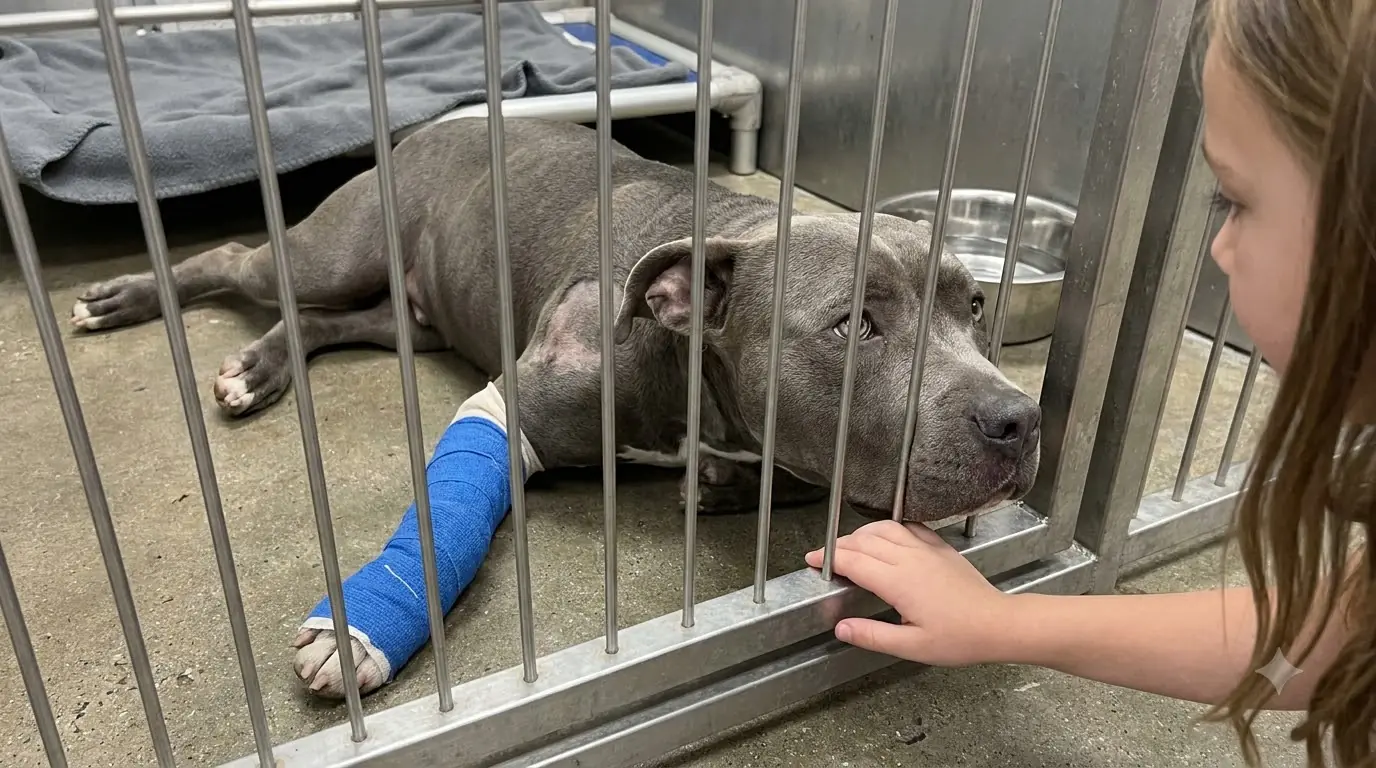
The little girl did not call her.
That was important.
She simply sat down outside the kennel and placed one hand flat on the hallway floor near the bars.
Inside, the American Pit Bull Terrier was lying on a low recovery mat.
One shoulder had been shaved for surgery.
The front leg beneath it was wrapped in a thick bandage, held carefully away from the rest of her body. She could not comfortably put normal weight through it yet.
That left three working legs.
For most of the morning, she had stayed down.
Standing was difficult.
Walking was harder.
Every time she rose, her body had to shift weight toward the opposite front limb while the hind legs moved forward to keep her balanced.
Staff had been limiting unnecessary movement for exactly that reason.
Then the girl sat outside.
The dog lifted her head.
She watched for several seconds.
The child stayed still.
The Pit Bull moved one hind foot underneath herself.
Then the other.
Her healthy front paw planted firmly on the mat.
She pushed.
Her chest came up unevenly.
The bandaged leg remained lifted.
For a moment, she stood on three legs and simply tried to balance.
Staff moved closer.
They expected her to lie back down.
Instead, she took a step.
Then another.
Each movement produced the same visible pattern.
Healthy front paw forward.
Hind legs catch up.
Bandaged leg held out of the way.
Pause.
She crossed the kennel slowly.
When she finally reached the gate, she did not remain standing.
She lowered herself carefully.
Chest first.
Then one hip.
The injured front leg stayed extended.
The little girl's hand was still on the floor outside.
The Pit Bull moved her head toward it.
She pushed her muzzle close to the lower bars.
Then turned slightly and pressed one cheek against the narrow space beside the gate.
Her face came to rest only inches from the child's fingers.
The girl did not reach inside.
She simply moved her hand a little closer.
The dog closed her eyes.
The trip across the kennel was over.
The Front Leg Was Still in the Earliest Stage of Recovery
The surgery had already happened.
Recovery had not.
That distinction mattered.
A dog leaving an operating room with a repaired or treated limb is not suddenly functional again.
The tissues need time.
Pain has to be controlled.
Swelling has to be monitored.
The incision has to remain protected.
Bandages need regular inspection.
Movement needs limits.
The American Pit Bull Terrier had been admitted with a visibly injured front limb serious enough to require surgical treatment.
Her shoulder had been clipped extensively so the veterinary team could prepare and access the area safely.
Afterward, the limb was wrapped.
The exact support and dressing plan depended on what had been repaired and what the surgeon needed protected.
What staff saw every day was simpler.
She could not use that leg normally yet.
A Front-Leg Injury Changes the Entire Body
Dogs naturally carry more weight through the front end than the rear.
That makes loss of one front limb especially demanding in the short term.
The remaining front leg has to work harder.
The shoulders compensate.
The spine shifts.
The hindquarters help more with balance.
Turns become awkward.
Lying down becomes a controlled collapse if the dog is not supported properly.
Standing can require multiple adjustments.
That was why the shelter did not encourage her to walk simply because she was willing.
Willingness and medical readiness are not the same thing.
Her Kennel Had Been Rearranged Around Three-Legged Movement
The floor had traction.
Her bed was low.
No high cot.
No loose blankets that could tangle around the bandaged limb.
Food and water were positioned so she could reach them without crossing the kennel repeatedly.
Bathroom trips were controlled.
A sling or harness could be used if the veterinary team wanted additional stability.
Everything was designed around conserving movement.
Then social interest complicated the plan.
She Was Still Very Interested in People
That became obvious soon after surgery.
She did not necessarily stand for everyone.
Pain medication and fatigue kept her resting much of the time.
But when someone sat quietly near the kennel, her attention changed.
Eyes up.
Head lifted.
Ears shifting toward the person.
Sometimes a small tail movement against the bedding.
When people came close enough, she could settle without moving.
If they stayed farther away, she sometimes tried to close the distance herself.
That was the behavior staff needed to manage.
The Little Girl Made Herself Easier to Reach
She was visiting with an adult and had been told the dog was recovering from surgery.
No touching through the gate.
No calling her over.
No banging on the bars.
No asking her to stand.
The child followed those instructions.
She sat down.
That should have reduced pressure on the dog.
It did.
Just not enough to stop her from coming.
Staff Almost Interrupted the First Attempt
The Pit Bull had already lifted her chest.
The injured front leg was held off the floor.
A caregiver moved toward the kennel.
They were prepared to redirect her.
Then they noticed the dog was calm.
Not frantic.
No lunging.
No rapid movement.
She was choosing a slow, deliberate approach.
The distance was short.
Staff allowed several controlled steps while remaining ready to assist.
Once she reached the gate, they did not let her stay standing.
The dog lowered herself.
That was the safer outcome.
The Child Did Not Touch the Bandage
This sounds obvious.
It is still worth stating.
Children are naturally drawn to visible injuries.
A large white bandage can look like the most important part of the dog.
The girl was told not to reach toward it.
The bandaged limb needed protection.
The shoulder incision needed protection.
Even gentle contact could be uncomfortable.
So the interaction stayed at the dog's face.
That was where she chose to bring herself anyway.
Her Cheek Stayed Against the Gate
Not continuously.
She would lift her head.
Sniff.
Settle again.
The lower bars created a narrow opening where the side of her muzzle could rest close to the hallway.
The girl's hand stayed outside.
Sometimes there was no contact at all.
Just inches of space.
That was enough.
The dog did not need a hug.
The child did not need to prove affection through touch.
Proximity was the interaction.
Staff Did Not Call It Love at First Sight
That would have been too much.
The Pit Bull had known the child for minutes.
What staff could say responsibly was that she showed social interest.
She voluntarily moved toward the child despite physical difficulty.
Once there, she relaxed enough to lie down and remain close.
That was meaningful.
It did not require a larger emotional claim.
The Surgery Was Only One Part of Her Medical Story
Postoperative care involved more than the visible bandage.
Pain control was reviewed.
Temperature monitored as appropriate.
Appetite mattered.
Hydration mattered.
The incision needed regular assessment.
Swelling, drainage, odor, heat, and changes in the bandage all required attention.
If the limb was splinted or otherwise stabilized, toes needed monitoring for swelling or circulation changes.
If the bandage became wet or shifted, staff could not simply wait until the next scheduled change.
Those details were less emotionally visible than the girl's hand.
They were what protected the leg.
She Was Not Allowed to Lick the Surgical Area
That required management.
Depending on the location and type of surgery, an Elizabethan collar or another protective device could be used.
Any protective equipment had to fit without rubbing the injured shoulder.
The goal was to prevent chewing and licking while minimizing additional stress.
The dog did not understand why the wound needed protection.
The humans did.
That meant humans had to create the boundary.
Her Appetite Returned Before Her Mobility Did
This was encouraging medically.
She showed interest in meals.
Staff brought food close.
She did not need to stand over the bowl.
She could eat in a comfortable supported position.
That helped maintain energy without requiring unnecessary movement.
A dog who feels somewhat better after surgery can become more active before the repair is ready for more activity.
That was the next challenge.
She Started Wanting to Follow People
The little girl was not the only one.
A familiar caregiver entered.
The Pit Bull's head came up.
The person moved toward the door.
The dog started gathering herself to stand.
Staff stopped the movement.
The caregiver came back instead.
Sat beside the kennel.
The dog relaxed.
That became a new rule.
If she wants to follow, reduce the distance.
Do not make the patient chase the interaction.
The Girl Returned the Next Day
Again, she sat.
This time staff moved the recovery mat closer to the kennel front before the visit.
That small change mattered.
The Pit Bull did not need to cross the entire space.
She lifted her head.
Looked.
Then shifted forward only slightly.
Her cheek reached the bars without a full stand.
Much better.
The same emotional connection.
Far less physical cost.
Good Recovery Sometimes Means Making the Heartbreaking Behavior Unnecessary
The first image was powerful.
A dog on three legs struggling across a kennel to reach a child.
But medically, staff did not want to see it repeated.
A successful care plan would reduce the need.
Bring the bed forward.
Bring people closer.
Let interaction happen while she remains down.
The goal was not to preserve the scene because it was moving.
The goal was to protect the repair.
The Dog Did Not Object to the New Setup
She used the mat at the front.
That was useful.
Now when people stopped, she could remain lying down and still be part of the interaction.
The injured leg stayed supported.
The healthy front limb got a break.
The child could sit nearby.
No three-legged crossing required.
Her First Bandage Change Was Uncomfortable
Postoperative care is not always gentle-looking even when it is done carefully.
The wrap had to come off.
The skin beneath needed inspection.
The surgical site needed assessment.
Any swelling had to be compared with previous findings.
The dog was given appropriate pain control.
Sedation could be used if needed to keep the procedure safe and humane.
No one expected her to tolerate discomfort because she had been calm with visitors.
Being socially tolerant does not erase pain.
She Returned Tired
After treatment, the Pit Bull went back to the kennel.
Her body was more subdued.
The girl was not there.
A caregiver sat nearby instead.
The dog remained on the mat.
No attempt to stand.
That was exactly what recovery required on a harder day.
Improvement Came in Small Movements
The first milestone was not running.
It was weight placement.
Depending on the surgical plan, the veterinary team watched for whether she could begin toe-touching or gradually loading the limb when medically appropriate.
The paw might touch briefly.
Then lift.
Later, a fraction more weight.
Those changes mattered.
They were not rushed.
Orthopedic tissue heals on biological timelines.
Motivation cannot accelerate bone or tendon repair safely.
The Healthy Front Leg Needed Monitoring Too
Compensation can create problems.
The opposite front limb was carrying more load.
Staff watched for soreness.
Muscle fatigue.
Changes in posture.
That was another reason to keep movement controlled.
The injured limb was obvious.
The compensating limbs were quietly doing extra work.
She Began Lowering Herself More Smoothly
Early on, lying down was awkward.
Healthy front leg bends.
Chest shifts.
Bandaged leg held out.
Hips rotate.
The sequence sometimes looked unstable.
Later, she controlled it better.
That showed increased comfort and coordination even before normal walking returned.
Small functional changes were more useful than dramatic ones.
The Girl Learned to Wait for Her
During later visits, the child never called the dog over.
If the Pit Bull wanted to move closer, staff decided whether the movement was medically appropriate.
Often the answer was simply to bring the child closer.
Sit beside the mat.
Hand on the floor.
Dog sniffs.
No need for anything more.
The girl adapted easily.
That Made the Interaction Better for Both
The dog could rest.
The child could remain longer.
Nobody had to worry about a sudden slip or painful misstep.
The emotional part remained.
A large dog choosing to keep her face near one small hand.
The physical strain reduced.
That was exactly what staff wanted.
She Had No Reason to Perform Recovery for Visitors
The shelter was careful about that.
People naturally wanted to see her “try to walk.”
Staff said no.
Her rehabilitation belonged to the medical plan.
Not the audience.
If a session was scheduled, trained staff handled it.
If she was resting, she rested.
No standing because someone wanted a hopeful video.
Her Rehabilitation Started Conservatively
When the surgeon or veterinary team cleared the next phase, controlled exercises could begin.
Short supported stands.
Careful weight shifts.
A few slow steps on nonslip flooring.
No sharp turns.
No jumping.
No rough play.
No chasing toys.
The Pit Bull's enthusiasm had to be managed because her body could feel better before it was structurally ready.
She Was Sometimes Frustrated by the Limits
This was visible.
A person moved away.
She tried to stand.
A toy rolled beyond reach.
Her ears came forward.
Her body prepared.
Staff redirected.
Food enrichment within reach helped.
Calm scent activities helped.
People sitting with her helped.
Restriction does not mean boredom has to be ignored.
It means enrichment has to match medical reality.
The Girl Became One of the Easiest Visitors
Not because the dog had a magical connection with children.
Because this particular child had learned how to interact with an injured dog.
Low.
Quiet.
No grabbing.
No demanding movement.
Those behaviors made her predictable.
Predictability is valuable to animals recovering from pain.
One Afternoon, the Pit Bull Did Not Come to Her
That was good.
The girl sat outside.
The dog lifted her head.
Looked.
Then stayed where she was.
The child remained.
After a few minutes, staff moved her chair or mat closer.
The Pit Bull sniffed through the bars.
Interaction achieved.
No steps.
No extra load on the repair.
Progress Meant Less Effort, Not More
That can seem backward.
People often expect recovery to look like doing more every day.
Sometimes the best sign is that the environment has stopped asking for unnecessary effort.
The dog no longer has to cross the kennel to be socially included.
The child no longer has to wait at a distance.
The patient's energy can go toward healing.
Her Bandage Eventually Became Less Bulky
Only when medically appropriate.
As healing progressed, the type of support and wound coverage changed according to veterinary judgment.
A smaller bandage did not mean the leg was fully healed.
It meant the protection requirements had changed.
Staff still restricted activity.
The Pit Bull still had to be prevented from overusing the limb.
She Began Touching the Paw Down
At first, only briefly.
A few seconds while standing.
Then lift.
The healthy front leg remained dominant.
Over time, depending on the surgical repair and follow-up findings, controlled weight-bearing increased.
The team watched the gait carefully.
Was she loading evenly?
Was pain increasing?
Was the shoulder stable?
Any setback could mean reducing activity and reassessing.
The First Four-Legged Stand Was Quiet
No applause.
No crowd.
She rose during a controlled session.
For a moment, all four paws contacted the surface.
The formerly injured front leg carried only partial weight.
Still.
It was there.
The dog held the position briefly.
Then staff helped her rest.
That was enough for one session.
The Girl Did Not See That Milestone Live
That was probably better.
Recovery did not need to become a performance tied to one visitor.
When she returned later, staff explained that the dog was beginning to use the limb a little more.
The child sat beside the gate.
The Pit Bull was already lying down.
She pressed her cheek near the bars again.
Same relationship.
Different stage of healing.
The Dog Started Wanting to Play
That created the next medical challenge.
A recovering Pit Bull can feel dramatically better before full clearance.
The tennis ball came out of a storage bin.
Her whole posture changed.
Staff put it away.
Not forever.
Not yet.
A safer low-motion food puzzle replaced it.
The dog looked disappointed.
That was preferable to reinjury.
Her Shoulder Fur Started Growing Back
The shaved area remained obvious for weeks.
First bare skin.
Then short fuzz.
Then uneven coat.
Visitors sometimes assumed the lack of fur meant the wound was still fresh.
Staff explained the difference.
Skin and deeper tissue healing follow one timeline.
Hair regrowth follows another.
The dog could look visibly “medical” long after the surgical incision had closed.
The Child's Hand Became Less Necessary as a Landmark
Early on, the Pit Bull seemed strongly drawn toward the girl's position.
Later, she could settle with the child nearby without pressing directly to the bars.
Sometimes she stayed on the mat.
Sometimes the girl sat outside reading quietly.
The dog slept.
That was another healthy change.
The interaction could exist without constant physical closeness.
Staff Began Learning More About Her Beyond the Injury
She liked food.
She enjoyed people.
She could settle after initial excitement.
She was curious about toys.
She responded well to reward-based handling.
She sometimes leaned heavily into familiar adults when standing, partly social and partly because balance was still developing.
These details mattered for placement.
She was not simply “the dog who crawled to a little girl.”
She needed a home that could handle her full adult personality.
Adoption Planning Could Not Ignore the Surgery
Any future adopter needed a clear medical handoff.
What procedure had been performed.
Activity restrictions.
Medication schedule.
Follow-up imaging or examination dates.
Rehabilitation instructions.
Warning signs.
When normal exercise might resume.
What long-term limitations, if any, were expected.
A compelling shelter interaction could bring attention.
The medical record had to guide the placement.
A Home With Children Needed Rules
The girl's good interaction did not make the dog automatically appropriate for every child.
Adults remained responsible.
No sitting on the dog.
No grabbing the injured leg.
No hugging around the neck.
No rough play during recovery.
No unsupervised interactions.
Toys managed appropriately.
The Pit Bull's calm response to one respectful child was encouraging.
It was not a universal guarantee.
Her Walking Slowly Became More Balanced
Three-legged hopping became partial four-legged use.
Then a more consistent but still uneven gait.
The shoulder remained weaker.
Muscle had to rebuild.
The veterinary team increased activity gradually.
No instant normality.
The dog might have one strong day followed by soreness the next.
That did not automatically mean something had failed.
Recovery fluctuates.
She Still Came to the Girl Sometimes
Once the medical team allowed more movement, the dog regained some choice.
The girl sat several feet from the kennel.
The Pit Bull stood.
All four paws touched.
She walked forward slowly.
Still limping.
Reached the gate.
Then lay down beside the child.
The movement looked superficially similar to the first day.
The difference was enormous.
She was no longer balancing entirely on three legs.
The Girl Still Put Her Hand on the Floor
That part stayed.
No grabbing.
No reaching through.
The Pit Bull turned her face.
Cheek near the bars.
Several quiet minutes.
Then the dog rested.
A repeated interaction became less about urgency and more about familiarity.
The First Day Had Been About Cost
Every step cost her.
Every second standing required compensation.
She had chosen to make the trip anyway.
That was what made it emotionally strong.
Good care could not leave the story there.
The goal was to reach a point where social connection no longer required that much physical cost.
Foster Care Became Possible After Her Restrictions Eased
A foster home offered quieter recovery.
Nonslip floors.
No required stairs.
A low bed.
Ability to maintain activity restrictions.
Experience with post-operative dogs.
That was more valuable than a busy shelter kennel once her condition was stable enough for transfer.
The Foster Was Told About the Girl Interaction
Not as proof of special destiny.
As a handling clue.
She responds well to people who sit low and wait.
She likes face-level proximity.
She may try to follow people even when she should rest.
Do not use social motivation to make her exceed restrictions.
That information translated directly into safer home care.
The First Foster Week Was Mostly Boring
Exactly as it should have been.
Leashed bathroom trips.
Medication.
Rest.
Controlled rehabilitation.
Food enrichment.
Sleep.
No visitors for the first few days.
No running.
No furniture jumping.
No stairs.
The dog was not thrilled with every restriction.
Healing tissue did not care.
She Followed the Foster Around With Her Eyes
That was enough.
If the person moved rooms, she sometimes prepared to stand.
The foster returned.
Sat nearby.
The same principle from the shelter followed her home.
Do not make her body chase the relationship.
Eventually, She Could Follow Safely
Short distances.
Slowly.
Four legs.
Still a mild limp.
Then increasingly smoother movement.
The first time she walked from her bed to the kitchen without hopping, the foster noticed every step.
The dog only noticed that something smelled good.
That was probably healthier.
The Surgical Leg Remained Part of Her History
Even after major healing.
The shoulder might retain a scar.
The fur could grow differently over the clipped region.
Muscle could remain asymmetric for a while.
Future joint health might require monitoring depending on the original injury.
Recovery does not erase trauma.
It restores as much comfortable function as medicine reasonably can.
She Eventually Returned for a Shelter Recheck
The environment was familiar enough to increase her excitement.
People.
Doors.
Smells.
The foster kept her controlled.
No sprinting down the hallway.
The Pit Bull walked on all four legs.
A slight asymmetry remained.
That was expected.
The Little Girl Happened to Visit Again
There was no planned reunion event.
No staging.
The child saw the dog.
Sat down.
The Pit Bull noticed.
For a moment, staff remembered the first day.
The shaved shoulder.
The thick bandage.
The three-legged stand.
The slow crossing.
The cheek against the bars.
This time, the dog took several balanced steps.
Reached the child.
Then sat.
She Did Not Need to Collapse Onto the Floor
That was the difference.
She could choose her position.
The girl placed her hand down.
The Pit Bull sniffed.
Then leaned the side of her face toward it.
The gesture was familiar.
The body supporting it was stronger.
The Rescue Did Not Call It a Miracle
There had been surgery.
Pain management.
Bandage care.
Weeks of restrictions.
Follow-up exams.
Rehabilitation.
Foster management.
Many small decisions.
That is how orthopedic recovery happens.
Not through emotion.
Through time and controlled care.
She Still Has to Be Protected From Herself Sometimes
This is true of many recovering dogs.
She feels good.
She wants more.
The body may not be ready for everything she wants.
Humans remain responsible for saying no to unsafe activity until veterinary clearance is complete.
That is care too.
The First Interaction Remains the One Staff Remember
Not because the child saved her.
Not because the dog somehow understood kindness in a dramatic human way.
Because the physical contradiction was impossible to miss.
One front leg unusable.
Shoulder shaved.
Bandage wrapped thickly.
Dog should be resting.
Child sits.
Dog gets up anyway.
Three legs across the kennel.
Then down.
Cheek to the bars.
Staff Would Never Ask Her to Do It Again in That Condition
That may be the clearest sign they cared about the moment for the right reason.
They documented it.
Then changed the setup so repetition was unnecessary.
The mat moved forward.
People came closer.
The injury got time.
The dog did not need to prove social interest over and over by risking another painful trip.
The Girl Learned That Too
Later visits became quieter.
She did not measure the dog's progress by whether the dog came to her.
Sometimes the Pit Bull slept.
The child sat.
That counted.
Sometimes the dog lifted her head.
That counted.
Sometimes she walked over.
Only when medically appropriate.
That counted too.
Recovery Gave the Dog Back Choice
That is the larger outcome.
During the first days after surgery, her world was restricted by pain and medical necessity.
Later, she could decide.
Approach.
Stay.
Stand.
Lie down.
Walk away.
Those choices are easy to overlook until an injury removes them.
Recently, Someone Sat Across the Room From Her
The Pit Bull noticed.
Months earlier, she might have tried to cross even when she should not.
Now she stood normally.
Walked over.
No three-legged hop.
No bandage held off the ground.
No hesitation from the shoulder.
She reached the person.
Sniffed.
Then lay down nearby.
Ordinary.
That is the best outcome.
She Still Likes to Put Her Face Close to Hands
That trait remains.
A person sits.
She approaches.
Sniffs.
Sometimes presses the side of her muzzle against a knee or a hand.
The rescue does not overinterpret it.
It is simply part of the social dog she appears to be.
The Little Girl Never Had to Touch the Injured Leg
She did something more useful.
She stayed still enough that the dog could choose contact elsewhere.
That became a small model for every caregiver who came after her.
Respect pain.
Let the dog initiate.
Reduce distance.
Protect the repair.
The Shoulder Fur Is Growing Back
The bandage is gone.
The leg works again within the limits established by her veterinary team.
The original surgical site is far less visually obvious.
What remains most memorable is not the scar.
It is how difficult the first trip across the kennel looked.
She Could Barely Use Three Legs, and She Came Anyway
That remains true.
But the better part of the story is what staff did afterward.
They stopped making coming necessary.
They moved comfort closer.
They taught visitors to meet her where she was.
They gave the surgical leg the time it needed.
And Now, When the Girl Sits Down
The Pit Bull does not have to balance on three legs to reach her.
She can walk normally enough to choose the interaction.
Sometimes she does.
Sometimes she stays on her bed.
Sometimes the girl comes closer instead.
The relationship no longer depends on an injured dog crossing a kennel.
That Is the Callback Staff Care About
The first day:
Healthy front paw planted.
Three other legs trying to organize around one unusable limb.
Slow hop.
Bars.
Careful descent.
Cheek beside a child's hand.
Now:
Four paws.
Controlled walk.
No thick bandage.
No shaved surgical shoulder dominating the view.
And the same quiet preference for putting her face close to someone who sits down and gives her time.
The little girl never needed the dog to come to her.
The rescue eventually taught everyone else the same thing.
And once the Pit Bull's body was finally ready, she got the choice to come anyway.