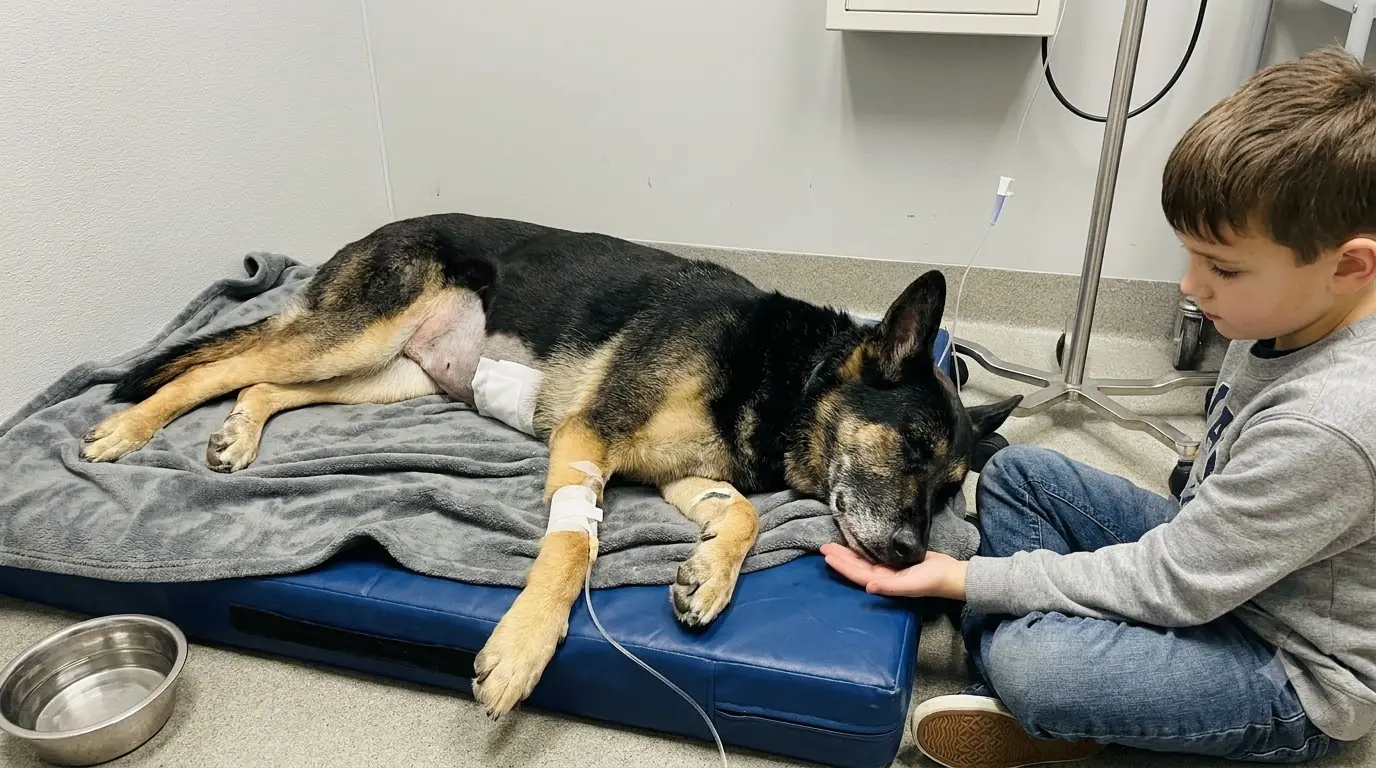
The German Shepherd was lying almost completely still when the little boy entered the recovery room.
A wide section of fur had been shaved from her abdomen for emergency surgery.
One front leg was wrapped around an IV catheter.
Several monitors and lines surrounded the bed.
Her body looked heavy against the padding, as if even changing the position of one paw required more energy than she had available.
The veterinary team had warned the family before they came in.
She was awake, but weak.
She might not lift her head.
She might not react much.
She needed rest more than anything.
The boy understood.
He entered quietly.
No running.
No calling her name loudly.
No reaching over the bed before staff told him it was safe.
He sat down beside the recovery mattress and placed one hand near the edge.
For several seconds, the Shepherd did nothing.
Then her eyes opened.
Her gaze moved slowly.
Not sharply.
Not with the alertness she would have had at home.
She seemed to search the room in pieces.
The doorway.
The veterinary technician.
The side of the bed.
Then the little boy.
Her ears barely moved.
Her head remained down.
But something in her posture changed.
One front paw shifted.
Her neck tightened.
And with an effort that looked almost too large for such a small movement, she began trying to lift her head.
The muzzle rose perhaps an inch.
Then stopped.
Her muscles trembled.
The head came back down.
The boy did not move.
The Shepherd rested.
Then tried again.
This time she lifted just enough to turn her face toward his hand.
Her body stayed completely flat.
Her abdomen did not leave the mattress.
The IV line remained protected.
Only the head moved.
Slowly.
A few inches at a time.
Until her nose reached his fingers.
The boy opened his palm.
The Shepherd pushed her muzzle forward once more.
Then her strength ran out.
Her face settled into the child's hand.
And within less than a minute, she was asleep again.
The boy kept his hand exactly where it was.
She Had Been Through a Major Emergency
The Shepherd had not arrived at the hospital for a routine procedure.
Her surgery had been urgent.
Whatever problem had brought her in required immediate intervention rather than a wait-and-see approach.
The veterinary team stabilized her first.
Pain control.
IV access.
Appropriate diagnostics.
Then surgery.
By the time she reached the recovery area, her body had already experienced far more than the incision alone.
Stress.
Anesthesia.
Medication.
Fluid shifts.
Pain.
Fatigue.
That matters when looking at a dog after an emergency operation.
A patient may appear profoundly weak even when the procedure itself has gone as planned.
Recovery takes time.
The Shaved Abdomen Told Only Part of the Story
The clipped fur made the surgery visible.
But the deeper recovery was happening where no one could see it.
Tissues needed time.
Inflammation needed to settle.
Pain needed to remain controlled.
The gastrointestinal system needed to wake back up.
Hydration needed to stabilize.
The dog had to maintain comfortable breathing and circulation.
Eventually she would need to eat.
Urinate.
Reposition.
Stand.
Walk.
But none of those steps could be rushed.
The little boy saw only that his dog could barely raise her head.
The medical team saw a patient still in the earliest phase of recovery.
The IV Was Essential
The catheter in her front leg allowed the team to give fluids and medication without repeatedly sticking her.
That line had to remain secure.
The bandage needed to stay clean and dry.
The paw below it had to be checked for swelling.
Any sudden attempt to stand or crawl could pull on the tubing.
That meant even emotional moments had to stay medically controlled.
No letting her drag herself toward the child.
No encouraging her to get up because she clearly wanted to be close.
Humans could move.
She could stay.
That Became the First Rule of the Visit
If she wanted contact, bring the contact to her.
The little boy could sit beside the bed.
He could place a hand where she could reach it.
He did not need to call her across the room.
He did not need to ask for a greeting.
The dog had already spent enough physical effort surviving the emergency.
She did not need to spend more proving that she recognized him.
Staff Were Careful About Interpreting the Moment
It would have been easy to say she was searching for him because she knew he would make her safe.
That would have gone beyond what anyone could know.
The observable behavior was enough.
The boy entered.
The Shepherd opened her eyes.
She oriented toward him.
She attempted to lift her head more than once.
She moved her muzzle toward his hand.
Then she settled with her face resting there.
That was real.
No extra story needed.
Her First Visit Ended Quickly
Not because anything went wrong.
Because she became tired.
The Shepherd's eyes closed.
Her breathing remained steady.
Her head stayed in the boy's palm.
After several minutes, staff helped the child slowly move his hand away so the dog's neck could rest in a more neutral position.
The Shepherd did not wake fully.
The boy stood.
Left quietly.
No dramatic goodbye.
The patient needed sleep.
Sleep Was Part of Treatment
After emergency surgery, rest is not empty time.
The body is repairing.
The brain is clearing anesthetic effects.
Pain medication is working.
Energy is being conserved.
A dog that sleeps comfortably is often doing exactly what the medical team wants.
The family learned very quickly that a calm visit could be successful even if the Shepherd slept through most of it.
The Next Time the Boy Came In, He Sat Closer From the Beginning
There was no reason to make the dog search farther than necessary.
The chair was positioned beside the bed.
His hand was placed near her muzzle.
The Shepherd opened her eyes.
This time, she did not need two attempts.
Her head moved only slightly.
The boy moved the rest of the distance.
Her nose touched his fingers.
Then she rested.
That was a better visit.
Less effort.
Same familiarity.
Good Care Made the Emotional Moment Smaller
That may sound strange.
But it was exactly what the team wanted.
The first visit had looked dramatic because the dog had to work to reach him.
The better visit required almost nothing from her.
The child was already there.
The hand was already within range.
The Shepherd could simply notice.
Touch.
Rest.
When a patient is weak, reducing the struggle is progress.
Her Pain Was Monitored Separately From Her Social Response
The fact that she looked for the boy did not mean she was comfortable.
Dogs can remain socially responsive while still experiencing pain.
The veterinary team assessed her expression.
Body tension.
Response to handling.
Breathing.
Movement.
Incision area.
Ability to settle.
Medication was adjusted based on the whole picture.
No one used recognition of family as proof that the postoperative pain plan was adequate.
The Incision Needed Close Observation
Redness.
Swelling.
Heat.
Discharge.
Separation of the surgical line.
Any of those changes could matter.
The dog could not be allowed to twist or strain the abdomen unnecessarily.
That was another reason the family was told not to invite movement.
The dog could heal beside them.
She did not need to come to them.
She Was Not Ready to Stand
That became obvious during the first day.
She could reposition a front leg.
Shift her head.
Maybe move one shoulder.
But a normal stand would require the entire body.
Front limbs.
Core.
Hindquarters.
Balance.
The Shepherd did not have that reserve yet.
The veterinary team did not ask for it.
The Boy Wanted to Help
That was natural.
He asked if he could hold her up.
If he could help her walk.
If he could move her leg.
The adults explained that helping sometimes meant not doing those things.
The veterinary staff would handle movement.
He could provide something else.
Quiet.
Familiar scent.
A hand to rest against.
That gave him a role that did not interfere with medicine.
She Began Eating Small Amounts
When medically appropriate, food was introduced gradually.
She sniffed at first.
Then took a few bites.
Stopped.
Later, more.
The return of appetite was useful.
Not because a single meal meant recovery was complete.
Because it showed one more body system beginning to function normally again.
The Boy Was Not Used to Coax Her Into Eating
That was deliberate.
It might have been tempting to place food in his hand and make the interaction more emotional.
But the veterinary team wanted to know whether the dog could eat without social pressure.
Food tolerance was a medical observation.
The family could comfort her separately.
She Started Repositioning Herself
First the head.
Then a shoulder.
Then a more complete shift.
These were small but important milestones.
A dog lying still for too long can develop discomfort and pressure problems.
The ability to move herself meant more control.
Less hands-on repositioning.
Better comfort.
The Boy Noticed Her Eyes Following Him More Clearly
That was one of the first things the family saw before the dog became physically stronger.
He would enter.
She would open her eyes.
The gaze tracked him.
Not perfectly.
Not for long.
But more reliably.
That gave the child reassurance without needing the dog to move.
The Shepherd Still Slept With Her Muzzle in His Hand Sometimes
It became a pattern.
The boy sat.
Hand down.
The dog shifted.
Face into palm.
Then sleep.
Not every visit.
Sometimes she was too tired to move at all.
Sometimes she chose another position.
That variability was healthy.
Staff did not treat the behavior as something that had to happen each time.
The Child Learned Not to Expect It
That was important too.