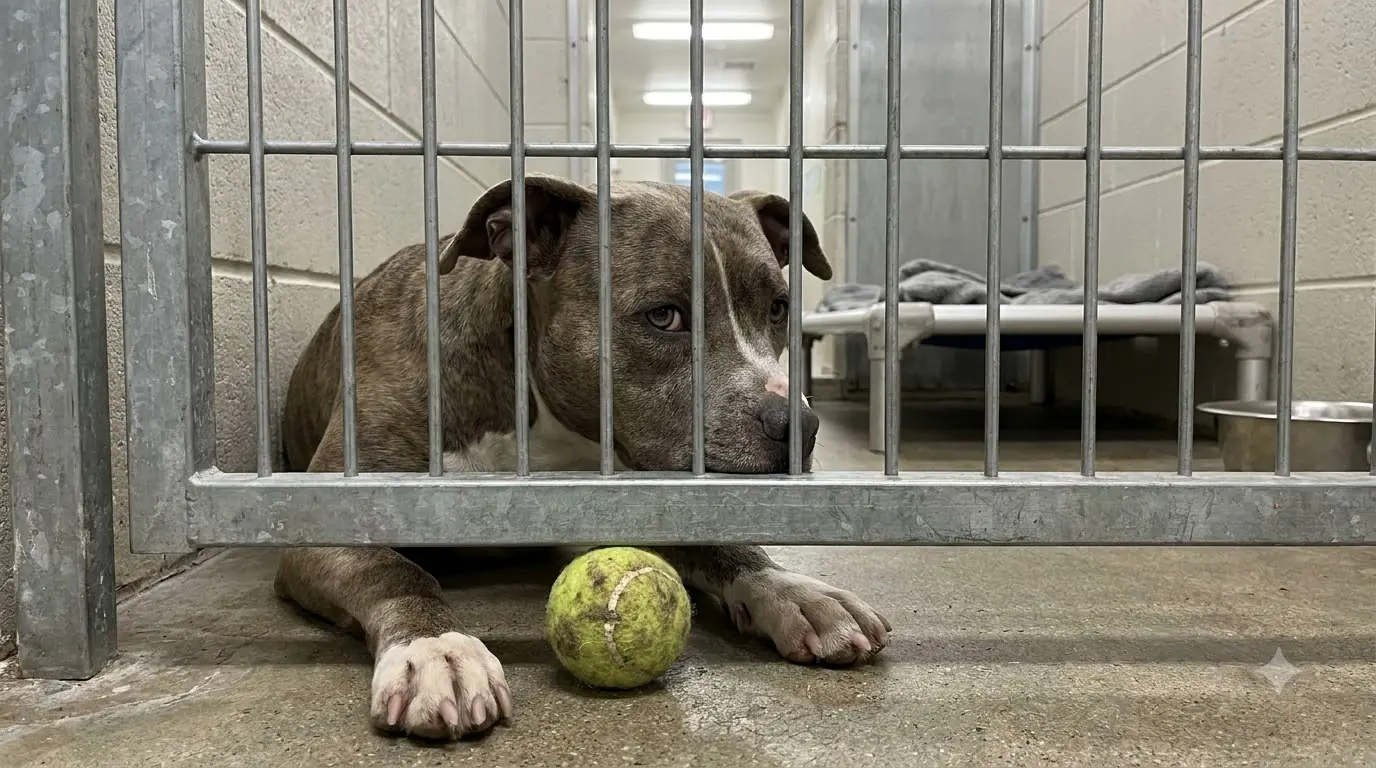
The tennis ball is so worn that most dogs would probably ignore it.
Its bright color has faded. One side is rough from years of teeth. The felt has been rubbed nearly smooth in places, and there is a shallow split beginning along one seam.
To the six-year-old Pit Bull mix in the shelter kennel, none of that seems to matter.
It is the first thing she reaches for whenever footsteps stop outside her door.
This afternoon, she was lying near the front of the kennel when someone entered the row.
Her head lifted.
Her ears came forward.
Then she looked down between her paws.
The old tennis ball was there.
She picked it up.
By the time the visitor reached her kennel, the Pit Bull was already standing behind the bars with the ball held carefully in her mouth.
She did not bark.
She did not jump repeatedly against the gate.
She simply stood there.
Tail moving low behind her.
Eyes fixed on the person outside.
The visitor crouched for several seconds.
The dog pushed her nose closer to the bars, the tennis ball still between her teeth.
Then the visitor stood.
There were more kennels farther down the hallway.
More dogs to meet.
The person walked away.
The Pit Bull watched.
She remained standing until the footsteps were several kennels away.
Then her tail stopped.
She lowered her head.
The ball dropped gently onto the concrete between her front paws.
She circled once.
Lay down directly behind the gate.
And rested her chin beside it.
In approximately four hours, if no adopter or rescue organization has committed to taking her, she is scheduled to reach the end of the time available to her at this overcrowded shelter.
She does not know that.
She only knows that someone has entered the hallway.
So the next time footsteps approach, she will probably pick up the ball again.
She Had Lived Inside a Home for Years
This dog did not arrive as a feral stray who had never learned what a household was.
For years, she had lived inside with people.
She knew familiar domestic routines.
Doors opening.
Meals arriving.
People sitting in rooms.
Someone reaching for a leash.
Someone throwing a toy.
The tennis ball had been among the belongings that stayed with her when she was surrendered.
The rescue could confirm that she had lived in a home before shelter intake.
Beyond the documented surrender information, staff were careful not to invent motives or private details that were not theirs to share.
There had been a change in circumstances.
The dog entered the shelter.
That was the factual part.
What she understood about the separation could not be known.
What happened afterward could be observed.
She kept the tennis ball close.
At First, Staff Thought It Was Just Her Favorite Toy
There was nothing unusual about that.
Some dogs arrive with a blanket.
Others have a stuffed animal.
A few carry the same rubber toy from one side of the kennel to another.
Familiar objects can be useful in an unfamiliar environment.
The Pit Bull mix liked the tennis ball enough that staff made sure it remained with her whenever it was safe to do so.
She carried it.
Chewed it occasionally.
Slept near it.
But over time, the team noticed that the ball seemed especially important when people approached.
A hallway could be quiet for half an hour.
She might sleep.
Then footsteps arrived.
The dog woke.
Found the ball.
And brought it to the gate.
She Did Not Always Bring Other Toys
Staff tested that unintentionally simply by providing enrichment.
A newer tennis ball went into the kennel.
She played with it briefly.
A durable rubber toy was offered.
She investigated it.
A stuffed toy received some attention.
But when visitors came, she frequently returned to the old ball.
Sometimes it was already beside her.
Sometimes she had left it on the bed and had to turn around to retrieve it.
The routine became remarkably consistent.
Person approaches.
Ball up.
Gate.
Wait.
Nobody Knows Exactly What the Ball Means to Her
It would be easy to say she remembers playing with her former family.
Perhaps she does.
It would be easy to claim she is bringing visitors the one thing she has left from home.
That interpretation is emotionally compelling.
It is also impossible to prove.
Dogs form associations with objects, scents, routines, and reinforcement histories.
She may have learned that carrying a ball gets human attention.
She may simply enjoy having something in her mouth when excited.
The toy may be familiar enough to help her regulate herself in a stressful environment.
All are plausible.
The shelter does not need to choose one and present it as her thoughts.
The behavior itself is enough.
When someone comes near her kennel, she often wants that ball with her.
The Shelter Has Been Full for Too Long
Her situation cannot be understood without the capacity problem.
Animal shelters have finite kennel space.
Dogs continue arriving even when the building is already full.
Strays require housing.
Animals involved in emergencies need somewhere to go.
Owner surrenders arrive.
Medical cases need isolation.
Dogs completing legal hold periods remain until an outcome becomes available.
When adoption and rescue placement do not keep pace with intake, kennels do not multiply.
Time becomes part of the equation.
This Pit Bull mix had already remained beyond the period the shelter had been able to reasonably hold her while continuing to manage incoming animals.
The deadline was not invented to make a social-media post more dramatic.
It reflected an overcrowded system with more dogs needing placement than available space.
That reality is difficult.
It is also the one staff were working inside.
She Is Only Six
That makes her especially easy to misread as older when she lies quietly at the gate.
Six is not puppyhood.
But it is not extreme old age either.
She is a mature adult dog.
Her veterinary intake did not reveal the kind of major mobility limitation that would prevent an ordinary home life.
She could walk normally.
She could engage with people.
She could play in short bursts.
Her body showed the ordinary signs of a dog who had lived some life already, but she was not being presented as a hospice case.
Her biggest obstacle was not catastrophic medical disease.
It was time.
Shelter Stress Changed Her Activity
During her first weeks, she was more active.
Staff remember her standing quickly when someone approached.
She would move back and forth near the gate.
She sometimes tossed the ball for herself inside the kennel.
As weeks accumulated, she spent more time lying down.
That did not automatically mean depression.
Behavior in kennels changes for many reasons.
Dogs habituate to routine.
They conserve energy.
Some become less reactive.
Some become more stressed.
Staff looked at the whole pattern.
She continued eating.
She accepted outings.
She engaged with familiar caregivers.
She still picked up the tennis ball when visitors came.
That last behavior remained one of her clearest signs of social interest.
She Does Not Throw the Ball at People
That detail matters.
When the Pit Bull reaches the gate, she usually keeps it in her mouth.
Sometimes a person crouches and speaks softly.
She presses the front of the ball against the bars.
Occasionally she releases it.
More often she holds on.
Nobody reaches through and tries to take it.
The shelter avoids creating conflict around valued objects.
If she wants to carry the toy, she can carry it.
The point is not to test whether she will surrender it.
The point is to observe what she does when a person is present.
In a Meet-and-Greet Room, the Ball Changes
Outside the kennel, her behavior becomes easier to understand.
She enters a quieter room.
Sniffs.
Checks the corners.
Looks at the people.
If the tennis ball is present, she may carry it around.
Then she sometimes drops it.
A person can roll it gently.
She follows.
Not with the frantic energy of a young retriever.
More like a dog who already understands the game.
Pick up.
Carry back partway.
Stop near the person.
Wait.
That history with play is useful behavioral information.
She has participated in ordinary human-dog interaction before.
She Can Also Settle Without the Toy
That is equally important.
The ball is meaningful.
It is not the only way she functions.
After several minutes in a quiet room, the Pit Bull can lie near a person.
She may rest her chin on the floor.
Accept gentle scratching.
Watch the door.
Sometimes she leaves the ball several feet away.
That tells staff she is not compulsively attached to it in every context.
The strongest connection appears inside the kennel when people are passing.
The Kennel Gives Her Very Little Time With Each Person
That may be part of the pattern.
A visitor can walk from one end of the row to another quickly.
There may be only seconds to attract attention.
Dogs use different strategies.
Some bark.
Some jump.
Some spin.
Some paw at the bars.
She carries a tennis ball.
It is quiet.
That means people can miss her.
Someone hears a louder dog next door.
Turns.
The Pit Bull is left standing with the ball still in her mouth.
Then the visitor moves on.
Staff Started Pointing Out the Ball
“She grabbed that because you stopped.”
It was a small explanation, but it changed how some people saw her.
They looked again.
Sometimes they crouched.
Sometimes they stayed an extra minute.
The Pit Bull remained at the gate.
The ball stayed in her mouth.
Those moments did not always lead to an application.
But they let people meet a little more of the dog than they would have seen walking past.
Her Deadline Became Shorter as Her Behavior Stayed the Same
Days became hours.
Staff continued posting.
Calling rescue partners.
Reviewing inquiries.
Trying to find a viable option.
The Pit Bull did not become visibly different because the number changed.
She did not know she had twelve hours.
Then eight.
Then four.
The countdown belonged entirely to humans.
Her routine remained canine and immediate.
Footsteps.
Ball.
Gate.
Person leaves.
Ball down.
Rest.
Staff Refused to Make Her Repeat It for Cameras
Once the behavior began receiving attention, it would have been easy to manufacture more footage.
Move the ball away.
Walk out.
Come back.
Film her retrieving it.
Repeat.
That was not necessary.
The shelter already had enough naturally occurring examples.
A dog facing a difficult deadline should not spend the final hours being repeatedly stimulated because a behavior is emotionally effective online.
If she was asleep, staff let her sleep.
If she happened to bring the ball when someone approached, they documented it.
Her welfare still came before the post.
She Had Already Been Evaluated for Placement
Because time was so short, people naturally asked whether there was some hidden reason she had not been adopted.
Was she aggressive?
Was she dangerously ill?
Was there something wrong with her?
The shelter's behavioral observations did not support turning her into a perfect dog.
No animal should be marketed that way.
She had real needs.
She could become excited around play.
Like many strong adult dogs, she benefited from handlers who understood leash management and reward-based training.
Introductions to other household animals would need to be handled based on actual assessment rather than assumptions.
Children, if present in a potential home, would need an appropriate supervised meet depending on the household.
But she had not spent months in the shelter because staff had discovered some secret that made her unplaceable.
She had spent months in an overcrowded system.
The Tennis Ball Helps Staff Explain Her
Not as a gimmick.
As a behavioral detail.
She is still interested in interaction.
Still responsive to people.
Still carrying something familiar into social moments.
A dog completely disengaged from the environment might not behave that way.
Again, the ball does not prove happiness.
It does not erase stress.
But it shows participation.
She Has a Specific Way of Waiting After Someone Leaves
The dog rarely throws herself at the gate once a visitor continues down the row.
She watches.
Still holding the ball.
Then, when the person is clearly gone, her head lowers.
Her jaw relaxes.
The ball lands between her paws.
Sometimes it makes a quiet rubber thump on the kennel floor.
Then she folds herself down directly behind it.
That sequence has happened often enough that caregivers can almost predict it.
She Usually Does Not Take the Ball Back to Bed
That is another detail staff noticed.
Her bed is farther inside.
Yet after a visitor leaves, she often remains at the gate.
Ball between her paws.
Body down.
She may stay there until the next person appears.
It seems to give her the shortest possible distance to the next interaction.
No one can know whether that is consciously strategic.
It is simply where she chooses to be.
They Moved a Mat Toward the Front
Repeatedly lying on hard flooring is not ideal.
So staff adjusted her environment.
A thin supportive mat was placed close to the bars.
It allowed her to keep the same location without placing her elbows and hips directly on concrete for long periods.
She began using it.
The ball often ends up there too.
That small accommodation became important as her kennel stay lengthened.
Her Appetite Remained Reliable
This was medically useful.
Even as shelter stress accumulated, she generally ate.
She drank normally.
Her weight was monitored.
Routine medical care remained current according to the shelter's program.
Staff watched for gastrointestinal changes, skin issues, coughing, lameness, or other signs that prolonged kennel housing was affecting her physically.
No major new condition appeared to explain the urgency.
Again, the central problem was placement.
The Ball Was Removed Only When Safety Required It
Tennis balls can wear down.
They can split.
Pieces can become ingestion hazards.
Because hers was old, staff inspected it frequently.
When the seam began loosening more, there was a real question about whether it could remain safely available.
The sentimental value of an object cannot override choking or obstruction risk.
So the shelter managed it carefully.
Supervised use when necessary.
Replacement options offered.
Her old ball preserved only as long as its condition remained safe enough.
She Preferred the Old One
That made the choice difficult.
New tennis ball beside old ball.
She sniffed both.
Sometimes played with the new one.
When footsteps came, the old ball was still frequently the one she selected.
Again, nobody could explain exactly why.
Familiar smell.
Texture.
History of reinforcement.
Simple preference.
Whatever the reason, the pattern remained.
One Staff Member Sat With Her Instead of Taking the Ball
This became a useful interaction.
The Pit Bull came forward with the toy.
The caregiver opened the kennel when safe to do so and entered calmly.
The dog expected activity at first.
Instead, the person sat.
The Pit Bull stood with the ball.
Then lay down.
Still holding it.
After several minutes, she released it near the caregiver's shoe.
No one threw it.
The dog rested.
That reminded staff that not every ball presentation had to become play.
Sometimes the toy could simply exist between them.
The Four-Hour Mark Made Every Visitor Feel Different to Staff
The Pit Bull did not know.
The humans did.
A couple walked in.
She picked up the ball.
They stopped.
Staff watched more closely than usual.
Would they ask about her?
Would they want to meet her?
The couple spoke briefly to reception.
Then continued toward another dog.
The Pit Bull stood at the gate.
Ball in mouth.
She watched them disappear.
Then dropped it.
Lay down.
That same behavior had happened countless times.
Now the clock made it feel heavier.
Staff Had to Resist Seeing Every Person as “The One”
That mindset can create poor matching decisions.
A serious adopter still had to be appropriate.
The shelter could not hand over a strong adult dog to anyone simply because there were hours left.
Identity verification.
Household information.
Other animals.
Housing rules.
Ability to provide veterinary care.
Basic compatibility.
Those things still mattered.
Emergency placement does not mean careless placement.
Rescue Placement Had Requirements Too
A rescue organization saying “interested” was not enough.
Who would physically take the dog?
Was there a foster home?
Could transport happen before the deadline?
Would the rescue accept medical and behavioral responsibility?
Was the commitment confirmed?
Staff had learned through experience that verbal enthusiasm can collapse when logistics appear.
Until there was a real destination, the Pit Bull remained at risk.
Meanwhile, She Kept Carrying the Ball
Another person.
Up she went.
The old greenish-yellow sphere in her mouth.
Gate.
Wait.
The person placed a hand against the bars.
The Pit Bull sniffed around the ball.
Her tail moved.
The person spoke softly.
For a moment, the dog's body looked more animated than it had all morning.
Then the visitor was called away.
The ball stayed in her mouth until they were gone.
She Did Not Know How Close the Deadline Was
That fact kept staff grounded.
It prevented them from turning her behavior into a conscious farewell.
She was not giving away her toy because she knew she was dying.
She was not making “one last attempt” in the human sense.
She was doing what she had already been doing.
That makes the scene more responsible and, in some ways, more difficult.
Her world had not suddenly become dramatic.
Only ours had.
She Still Needed Normal Bathroom Breaks
Even with four hours left.
She still had to go outside.
Still needed water.
Still needed opportunities to move away from the kennel.
Staff did not keep her locked at the gate because exposure to visitors might save her.
During a short outdoor break, the Pit Bull carried a different ball for part of the walk.
She sniffed grass.
Stopped at a fence.
Looked toward a passing person.
Then returned inside.
The shelter tried to keep the day as ordinary as possible.
Outside the Kennel, She Was Easier to See as a Dog
Not a deadline.
Not a number.
A six-year-old Pit Bull mix.
Strong shoulders.
Bright attention when something interested her.
A tendency to carry toys.
A dog who could walk beside a familiar handler.
A dog who liked sniffing.
A dog who sometimes lay down after only a few minutes because kennel life had made rest attractive.
That fuller picture was what any adopter needed to consider.
A Child Visitor Rolled the Ball Once
The interaction was controlled.
The child was old enough to follow instructions.
The Pit Bull was given space.
The old ball was not used because of its deteriorating condition; a safer replacement was offered.
The child rolled it gently.
The dog followed.
Picked it up.
Returned partway.
Stopped.
The child did not grab for it.
The Pit Bull held it.
Then dropped it.
That small moment helped show staff that her toy behavior could remain calm around appropriate people.
It did not establish universal child compatibility.
One interaction never does.
But it was another piece of information.
The Shelter Kept Calling
Rescue partners.
Previous inquiries.
People who had shared her post.
Anyone with a realistic chance of helping.
Calls went unanswered.
Some people could not take a dog that day.
Others had no foster.
A few had breed restrictions.
One landlord would not allow Pit Bull-type dogs.
Those practical barriers are common.
They become brutal when time is measured in hours.
The Dog Did Not Become Harder to Handle as the Day Went On
If anything, she became more tired.
More time lying near the gate.
The tennis ball remained between her paws.
When a person came, she still rose quickly enough.
Ball in mouth.
Stand.
Wait.
Then down again.
The routine began costing her less physically than it had emotionally in the eyes of the people watching.
She Fell Asleep With the Ball Touching Her Wrist
At one point, the hallway remained quiet long enough for her to sleep.
Her front legs were stretched forward.
The tennis ball rested against the inside of one paw.
Her muzzle lay only an inch away.
A volunteer walked past slowly.
The dog did not wake.
They let her sleep.
The shelter did not need another video.
She needed rest.
The Clock Dropped Below Three Hours
An inquiry came in.
Then stalled.
The potential adopter needed to speak with a family member.
Staff waited for confirmation.
The Pit Bull did not.
She woke when footsteps approached.
Picked up the ball.
The person was a shelter employee carrying paperwork.
The dog still went to the gate.
Same behavior.
She did not distinguish between someone who might adopt her and someone simply doing their job.
That was another reason not to anthropomorphize it.
She responded to people.
Not rescue negotiations.
The Inquiry Fell Through
Housing restrictions.
No fault assigned.
Just another closed path.
Staff returned to outreach.
The dog dropped the ball again.
One Rescue Asked for More Information
Medical records were sent.
Behavior notes.
Photos.
Video of her interacting outside the kennel.
The shelter explained the tennis-ball behavior but did not use it as proof that she would be easy in every environment.
Rescues need accurate information.
Does she show resource guarding?
What has been observed around other dogs?
How does she handle restraint?
Is she spayed?
Vaccination status?
Any medications?
Transport needs?
The emotional story gets attention.
The factual record gets a dog safely placed.
The Ball Nearly Had to Be Thrown Away That Afternoon
A caregiver noticed the seam had opened farther.
That created a safety issue.
The Pit Bull had begun worrying at the loose felt.
The shelter could not leave it with her unsupervised.
For the first time, the old ball was removed.
The dog watched it leave.
She stood near the gate.
Then looked down where it had been.
A new tennis ball was placed in the kennel.
She sniffed it.
Picked it up.
Dropped it.
For several minutes, she seemed less interested.
Staff Did Not Give the Unsafe Ball Back Just Because Time Was Short
That mattered.
Compassion does not mean ignoring preventable danger.
If she had hours left in the shelter, those hours still deserved safe care.
The old ball was kept nearby for supervised interaction while the new one stayed in the kennel.
If a placement came through, the worn ball could travel with her only if it could be stored as a familiar object rather than left available for chewing.
The dog mattered more than the symbolism.
The Next Visitor Got the New Ball
Footsteps.
Head up.
She looked toward the spot where the old ball usually rested.
Then toward the new one.
She picked it up.
Went to the gate.
Staff noticed immediately.
The ritual had survived the object change.
That was useful behavioral information.
Perhaps the action itself mattered as much as the specific ball.
She Waited the Same Way
New ball in mouth.
Eyes up.
Visitor stops.
Visitor leaves.
Ball down.
Lie at gate.
The rescue had learned something.
The old tennis ball was familiar.
But bringing a toy to people seemed to be part of her broader social behavior.
That could be something a future home continued in a much healthier environment.
Below Two Hours, a Rescue Called Back
This time, there was a possible foster.
Not guaranteed.
Possible.
The rescue needed to confirm household details.
Transport was being arranged.
The shelter did not announce that she was safe.
Too many things could still fail.
The Pit Bull remained available.
The deadline remained active.
Staff kept working.
She Was Taken Into a Quiet Room During the Calls
The kennel row had become overstimulating.
People were stopping more frequently because of the urgent post.
The dog was bringing the ball to everyone.
Standing repeatedly.
Getting more aroused.
That was not good for her.
So staff moved her into a quieter meet-and-greet room with water and bedding.
The new tennis ball came too.
She sniffed.
Lay down.
For the first time in hours, there were no bars directly in front of her.
Without Passing Visitors, She Stopped Carrying the Ball
She simply rested beside it.
That reinforced what staff had already suspected.
The presentation behavior was connected strongly to people approaching her kennel.
In a room where someone stayed, she did not need to keep making the same introduction.
A caregiver sat near her.
The Pit Bull remained down.
After several minutes, she rolled slightly onto one hip.
Her breathing slowed.
The ball sat untouched.
This Was the Dog a Foster Would Actually Need to Meet
Not a permanently frantic dog running around with a ball.
A mature adult who could settle once the environment settled.
That distinction mattered enormously.
Kennel behavior is not home behavior.
Some dogs become more active outside.
Some become less.
Foster care would give the rescue the chance to understand her beyond the gate.
If they could get her there.
The Foster Was Confirmed
But confirmation was only one piece.
Transportation still had to happen.
Paperwork still had to be completed.
The shelter still treated the situation as active until the transfer was real.
The deadline was now less than two hours away.
The Pit Bull was asleep.
Her new tennis ball rested near her front foot.
Staff Prepared Her Records
Vaccinations.
Medical notes.
Behavior observations.
Feeding information.
Any medications.
Microchip information.
Surrender documentation appropriate for transfer.
Everything had to leave with her.
A dog does not become safe simply because someone says yes.
Safe means continuity of care.
The Old Ball Was Packed Too
Not inside her mouth.
Inside a bag.
It was no longer reliable as an unsupervised toy.
But staff knew it had accompanied her through months in the shelter.
There was no reason to throw it away immediately if it could be preserved safely.
A future foster could decide whether to keep it out of reach as a familiar scent object.
The safer ball would be the one she actually played with.
When the Transporter Entered, She Did the Same Thing Again
Footsteps reached the quiet-room doorway.
The Pit Bull woke.
She looked toward the person.
Then toward the new tennis ball.
Picked it up.
Stood.
And walked to the door.
No kennel bars this time.
The transporter entered.
Crouched.
The dog approached with the ball still in her mouth.
She sniffed.
Stayed close.
The transporter did not grab the toy.
They simply let her hold it.
The Deadline Had Less Than an Hour Left
Again, the dog did not know.
To her, this was another person.
Another doorway.
Another possibility for interaction.
Staff fitted her with safe transport equipment.
Checked identification.
Took her outside.
The dog carried the tennis ball part of the way.
Then dropped it.
A caregiver picked it up.
She Hesitated at the Vehicle
That was understandable.
After months in a shelter, another transition can be stressful even when humans know it is positive.
She sniffed the opening.
Looked back.
The transporter gave her time.
A low step helped.
She entered.
No forcing.
Once inside, she turned.
The ball was placed beside her.
She sniffed it.
Lay down.
Only Then Did Staff Mark the Transfer Complete
Not when the rescue commented.
Not when the foster volunteered.
Not when transport was promised.
When the dog was physically transferred into confirmed rescue care with records and a safe destination.
That distinction matters in urgent shelter work.
Interest is hopeful.
Commitment is useful.
Transfer is real.
Her Story Did Not End in the Parking Lot
Rescue placement was not a magical solution.
She still had to decompress.
Adjust to another environment.
Learn new people.
Potentially learn household routines again after months in a kennel.
The foster needed to observe her honestly.
Sleep.
Appetite.
Bathroom habits.
Toy behavior.
Reactivity to sounds.
Ability to settle alone.
How she handled visitors.
What happened when the tennis ball was present.
The real work was only changing shape.
Her First Foster Evening Was Quiet
No adoption party.
No room full of people.
The Pit Bull entered slowly.
She sniffed the floor.
Walked through the main room.
Checked a water bowl.
A low bed had been prepared.
She noticed it.
Then noticed the person sitting nearby.
The new tennis ball was on the floor.
She picked it up.
Walked toward the foster.
Stopped.
The foster did not reach.
The dog stood for several seconds.
Then dropped the ball.
This Time, the Person Did Not Walk Away
That was the first major difference.
At the shelter, the pattern almost always ended with departure.
Visitor appears.
Ball.
Gate.
Visitor leaves.
Ball down.
Dog lies alone.
Here, the ball dropped.
The person remained seated.
The Pit Bull sniffed their knee.
Then lay down several feet away.
The foster stayed.
The dog did not need to pick the ball up again.
She Watched the Front Door That Night
A new home is still new.
Sounds outside drew her attention.
When someone moved in the hallway, her head lifted.
She sometimes grabbed the ball.
But because people did not repeatedly appear and vanish within seconds, the behavior looked different.
She carried it into the room.
Then settled.
No bars.
No deadline.
No line of strangers deciding in a few seconds whether to keep walking.
The Old Ball Stayed on a Shelf
The foster let her sniff it under supervision.
She recognized it enough to show interest.
But the split seam made continued chewing unsafe.
So the rescue kept it as part of her belongings rather than an active toy.
The Pit Bull had several safe replacement balls.
She accepted them.
That itself became part of the transition.
Familiar habits could continue without preserving unsafe objects.
She Began Bringing the Ball to the Foster
Not every time.
Often enough.
A person sat on the couch.
The Pit Bull picked up a ball.
Approached.
Sometimes she dropped it nearby.
Sometimes she kept it in her mouth while leaning against a leg.
The behavior that had looked devastating behind shelter bars became something ordinary in a living room.
A dog asking for interaction.
People Could Finally Respond Without Disappearing
Roll the ball.
Wait.
She retrieves.
Returns.
Maybe drops it.
Maybe does not.
Then both settle.
That was what the shelter environment could rarely offer.
Continuity.
The same person still there after the interaction.
She Did Not Need to Run to Every Footstep
That changed gradually.
In the first days, movement near the front of the house got her attention immediately.
Later, she sometimes stayed on the bed.
A familiar person could enter the room and walk toward her.
She began learning the same lesson many long-term shelter dogs need after placement.
Human contact does not have to be captured in the few seconds before someone moves to the next kennel.
Her Body Relaxed Differently
At the shelter gate, she often rested in a compact position.
Front paws forward.
Ball between them.
Head up easily at footsteps.
In foster care, she began sleeping on her side.
Legs extended.
Sometimes the ball several feet away.
She could sleep through movement.
Those changes told caregivers that her arousal level was decreasing.
She Still Loved the Ball
Recovery did not require losing the behavior that had made people notice her.
She still carried toys.
Still brought them toward people.
Still seemed to enjoy the interaction.
The difference was what happened after.
Nobody vanished automatically.
The Shelter Staff Received an Update
A photograph showed the Pit Bull mix lying on a rug.
One safe tennis ball near her shoulder.
Another under a table.
Her eyes were closed.
No gate.
No concrete kennel floor.
The image was simple.
That was why it mattered.
Four Hours Had Almost Defined Her Entire Story
It was the number people remembered.
Four hours.
Then less.
A dog at risk in an overcrowded shelter.
An old tennis ball.
Every visitor receiving the same quiet greeting.
But the deadline was not who she was.
It was a circumstance around her.
The foster home finally gave staff the chance to see what remained once the clock disappeared.
She Was Still a Six-Year-Old Dog Who Wanted People to Play
That was the uncomplicated part.
She liked carrying balls.
She liked being noticed.
She could settle.
She had years of household experience behind her and, with proper transition support, the ability to learn a household again.
The shelter had seen fragments.
The foster could see the whole pattern.
There Were Still Adoption Questions Ahead
Rescue transfer did not automatically mean permanent placement.
Her behavior around other animals needed thoughtful assessment.
Household fit mattered.
Medical care remained necessary.
Future adopters needed to understand her exercise, training, and enrichment needs.
She would not be placed solely because people had been moved by the deadline.
The right home still mattered.
But She Finally Had Time to Find It
That was the thing the shelter could not give her anymore.
Time.
Time to decompress.
Time for a foster to understand her.
Time for adopters to meet her without a countdown attached.
Time for the dog to show behaviors other than the ones shaped by kennel life.
Time for a tennis ball to become a toy again instead of the thing she carried to every passing stranger.
She Still Does the Same Thing When Someone New Comes Over
The door opens.
The Pit Bull notices.
She looks around.
Often finds a tennis ball.
Picks it up.
Walks toward the visitor.
That part has not changed.
She may stand several feet away at first.
The person is asked not to reach immediately.
Let her investigate.
Let her choose.
Sooner or later, the ball comes closer.
But the Ending of the Interaction Is Different
At the shelter, the person usually walked away.
Now the visitor may sit.
The foster remains.
The dog has somewhere familiar to return to.
If she drops the ball, it does not necessarily mark the end of contact.
Sometimes someone rolls it.
Sometimes nobody does.
She can pick it back up later.
There is no next kennel.
One Evening, She Left the Ball in the Middle of the Room
The foster noticed because the old shelter behavior had been so consistent.
A visitor arrived.
The Pit Bull carried a ball over.
The person sat.
The dog sniffed them.
Then she dropped the ball.
Walked to her bed.
Lay down.
The tennis ball remained several feet away.
She did not keep it between her paws.
She did not need to lie beside the front door.
She simply rested.
That Was the Quietest Evidence of How Much Had Changed
Not a dramatic adoption photo.
Not a giant celebration.
An unattended tennis ball.
Months earlier, the ball stayed with her because every interaction was brief.
Four hours from the end of her shelter time, she was still presenting it to anyone who stopped.
Then watching them go.
Now the ball can sit in the middle of a room.
The person can move.
Come back.
Stay.
Staff Still Remember the Last Day
The Pit Bull behind the bars.
Old tennis ball in her mouth.
Someone walking away.
The careful lowering of her head.
The soft thump as the ball landed between her paws.
Then her body folding onto the floor right there at the gate.
Less than four hours left.
And still, the next set of footsteps made her pick it up again.
She Never Knew What the Countdown Meant
She never needed to.
The responsibility belonged to the people around her.
She just kept doing the behavior that had worked for her in one form or another.
Bring the toy.
Go toward the person.
Wait.
That was the question her body kept asking.
Will you stay?
No one can know whether she understood it that way.
But the foster home finally gives the behavior a different outcome.
Now Someone Usually Does
She picks up the ball.
Walks across the room.
Drops it near a person.
Maybe they play.
Maybe they do not.
The Pit Bull eventually lies down.
And when she wakes, the person is often still there.
No bars.
No line of kennels.
No stranger disappearing before she has even put the toy down.
No four-hour clock.
The old tennis ball that once accompanied her to the shelter gate has been retired because it became too damaged to use safely.
But the habit it carried has survived.
She still brings people a ball.
The difference is that now, when she drops it between her paws and lies down, she does not have to watch them walk away.