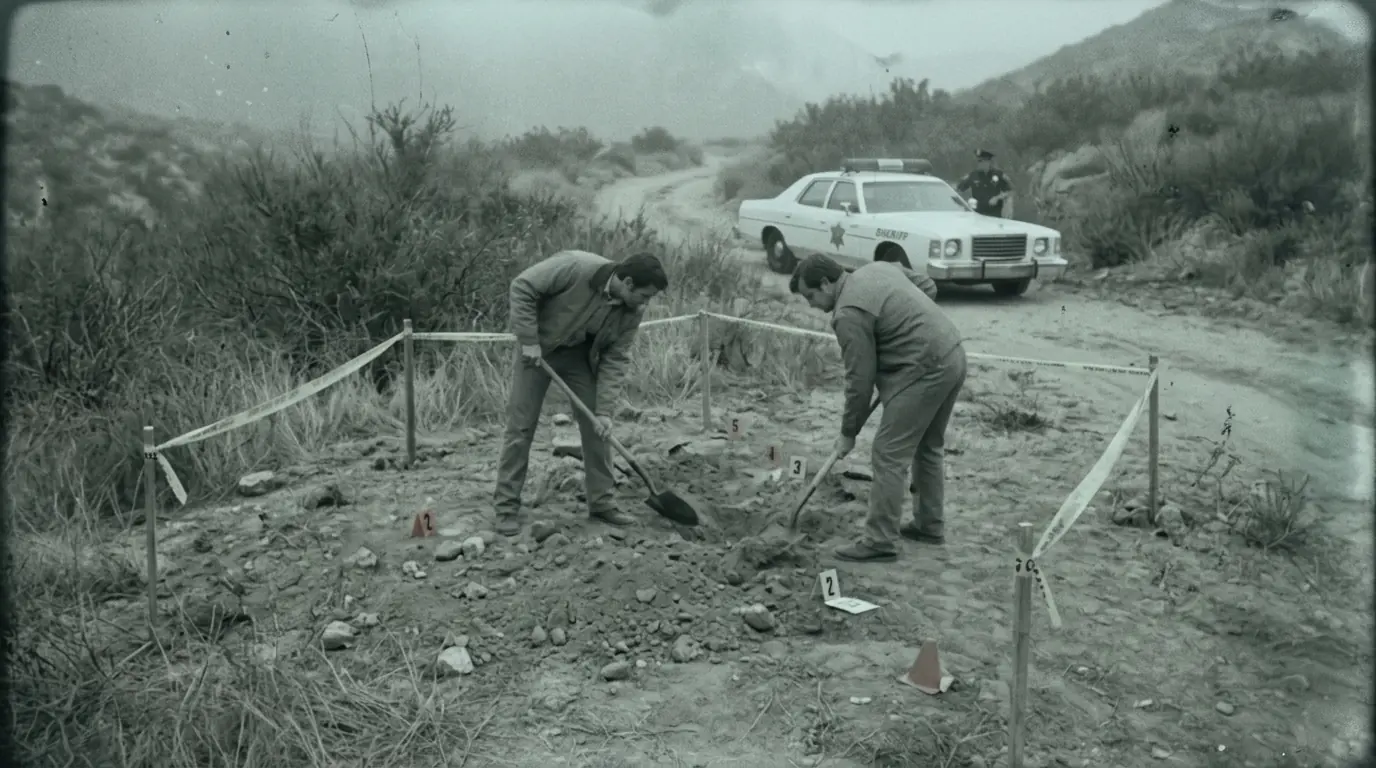
Los Angeles, California.
December 17, 1980.
A mother drove slowly through an isolated canyon north of Los Angeles with two of her children and a young niece inside the vehicle.
She was looking for a woman she had never met.
She did not know exactly where the woman was.
She had no address.
No witness had given her directions.
No police officer had told her where to search.
She later said she was following an image that had appeared suddenly in her mind only hours earlier.
A winding canyon road.
A curve.
A dirt path.
A hill.
Brush.
And something white lying near the ground.
The woman's name was Etta Louise Smith.
She worked for Lockheed in Burbank.
She was a mother of three.
She did not have a career solving crimes.
She did not know the missing woman.
And in 1980, according to her later testimony, she did not consider herself a professional psychic.
Yet now she was driving through Lopez Canyon looking for the body of a nurse named Melanie Uribe.
For about thirty minutes, Etta and her family searched.
Then her eight-year-old daughter saw something.
White.
Near the road.
Etta got out.
She moved closer.
Then she saw the shoes.
White nurse's shoes.
According to her later courtroom testimony, the recognition was immediate.
It was Melanie.
The family rushed back toward the vehicle.
They found help.
Police were brought to the location.
And within hours, a woman who thought she had just helped solve a missing-person case found herself sitting in an interrogation room.
Detectives had one question they could not answer.
How did she know?
They questioned her for roughly ten hours.
She was given a polygraph.
Investigators decided parts of her response appeared deceptive.
By the next morning, Etta Smith was no longer being treated as a helpful citizen.
She was under arrest on suspicion of murder.
She would remain in custody for four days.
Meanwhile, elsewhere in Pacoima, the actual killers were talking.
One of them had begun bragging about what they had done.
Someone finally told police.
That tip would lead detectives to three young men.
And when investigators reconstructed the crime, they discovered something extraordinary.
They already had evidence that Melanie Uribe had been abducted by men.
A witness had seen it happen.
He had watched strangers converge on her truck at a red light.
He had heard a woman scream.
The real killers had no known connection to Etta Smith.
And Etta had apparently driven almost directly to the place where they left Melanie.
More than six years later, a California judge would rule that police never had sufficient probable cause to arrest Etta at all.
But that ruling still could not answer the question that made the case famous.
How did she know where to look?
December 15, 1980
Melanie Uribe was thirty-one years old.
She was a registered nurse.
She lived in the Sylmar area of Los Angeles and worked at Pacoima Memorial Hospital.
She was divorced and had an eight-year-old son.
On the night of December 15, Melanie left for work.
She was driving a Chevrolet LUV pickup truck.
She never arrived at the hospital.
At approximately 11 p.m., a man named Paul Wood was outside near the intersection of Foothill Boulevard and Arroyo Street.
He saw something unusual happening near the intersection.
Two men appeared to be waiting near a wall.
One manipulated the pedestrian signal.
The traffic light changed.
Melanie's pickup stopped.
Then the men moved toward it.
Wood saw figures force their way into the vehicle.
He heard sounds of struggle.
Then he heard a woman's screams.
The truck drove away.
This was not a disappearance in which investigators had absolutely no idea whether the missing person left voluntarily.
Someone had seen a violent event.
Melanie had been intercepted on her way to work.
The Truck
By the following morning, authorities found Melanie's pickup.
Someone had deliberately set it on fire.
The vehicle was discovered in Pacoima.
Now the case had changed completely.
Melanie had not simply failed to show up at work.
A witness had heard screams.
Men had forced themselves into her vehicle.
The vehicle had been abandoned and burned.
Police began searching aggressively.
House-to-house inquiries were conducted.
Investigators were trying to determine where Melanie had been taken.
That search would indirectly trigger the strangest event in the entire case.
Because on December 17, Etta Smith heard about it on the radio.
Etta Smith
At the time, Etta worked for Lockheed in Burbank.
Later newspaper accounts described her as an aerospace worker or shipping clerk.
She lived in Pacoima.
She had heard about Melanie's disappearance.
A friend had mentioned the missing nurse.
Then, while Etta was listening to a radio report at work, she heard that police were conducting house-to-house searches.
Something about that phrase caught her attention.
Etta later described her immediate reaction:
Melanie was not in a house.
Then came the image.
She said it appeared with unusual clarity.
Almost like watching a short movie.
A canyon road.
The road curving.
A hillside.
A dirt path.
Brush.
And a white object.
She interpreted the white object as possibly being Melanie.
Perhaps the nurse's white uniform.
Etta did not know the name of the canyon she believed she was seeing.
But she felt she knew how to get there.
The impression would not leave her alone.
"They're Going to Think I'm Crazy"
Etta faced an obvious problem.
What exactly was she supposed to tell police?
"I saw your missing person in my mind"?
She later testified that she hesitated because she feared officers would think she was "off her rocker."
That fear was not unreasonable.
Police investigations depend on information that can be evaluated.
An eyewitness can explain:
I saw this person.
A neighbor can say:
I heard something.
A caller can say: