Fifty-eight-year-old Daniel Mercer has lived in Briarwood Estates, an upscale North Carolina subdivision, for almost eighteen years. He is quiet, meticulous, and far more comfortable repairing machinery than arguing at neighborhood meetings. After retiring from a regional utility company, Daniel legally installs a compact above-ground fuel system beside his detached garage so he can refuel the diesel equipment he uses to maintain his twelve-acre property.
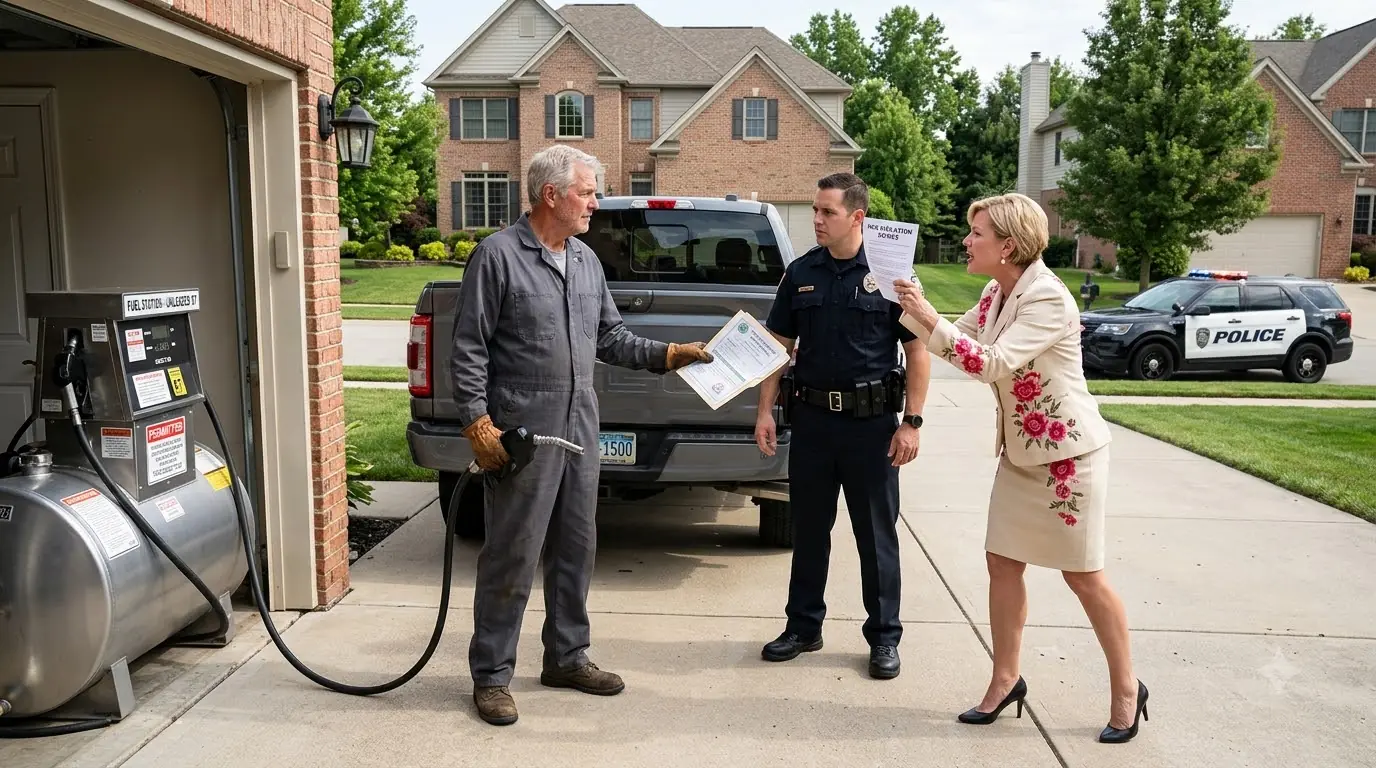
He does everything by the book.
The tank is professionally installed. The county issues a permit. A fire inspector signs the installation certificate. Required setbacks and protective barriers are documented. Daniel keeps every approval inside a weatherproof folder mounted beside the equipment.
That should end the matter.
Instead, it attracts the attention of HOA president Cynthia Bradford.
Cynthia has spent six years gradually transforming the Briarwood HOA from a small administrative board into something residents increasingly fear challenging. She dislikes Daniel because he routinely asks for written authority whenever she orders homeowners to change something.
When Cynthia demands that Daniel remove the fuel system, he asks her to identify the covenant prohibiting it.
She cannot.
So she proposes a new amendment.
The amendment would prohibit visible residential fuel-storage equipment throughout Briarwood. Several residents support the idea, but others worry the language is overly broad and gives the board excessive inspection authority.
At a contentious board meeting, the amendment fails.
Cynthia loses by one vote.
Daniel assumes the issue is finished.
The following morning, while he is quietly refueling his pickup in his own driveway, Cynthia arrives wearing an expensive cream suit decorated with bright floral embroidery. She carries an official-looking HOA violation notice and tells Daniel he has twenty-four hours to disconnect the equipment.
When he refuses, she calls police.
Officer Ryan Cole arrives expecting a routine neighborhood dispute.
Cynthia immediately waves the violation notice in front of him, insisting the HOA adopted the prohibition that morning and demanding that he order Daniel to stop fueling.
Daniel barely argues.
He simply opens his weatherproof document box and hands Officer Cole the county permit and inspection certificate.
Cynthia tries to dismiss them as irrelevant.
Cole checks the HOA paperwork instead.
That is when the confrontation changes.
The notice identifies a newly adopted rule and even lists an amendment number.
But when Cole checks the association’s publicly filed meeting minutes and contacts the property-management office, he discovers that the amendment did not pass.
It was rejected the previous night.
Cynthia is attempting to enforce a rule that does not exist.
What initially appears to be one angry HOA president bluffing her way through a driveway argument becomes something larger when residents begin comparing their own violation letters.
Several notices cite rules that were never formally adopted.
Others contain altered approval dates.
One homeowner paid hundreds of dollars in fines under a landscaping amendment that the board had postponed rather than passed. Another removed an expensive storage shed because Cynthia claimed the HOA had adopted new setback requirements.
Daniel initially wants nothing more than to be left alone.
But when an elderly widow admits she paid a fine she could not afford because she was afraid of losing her home, Daniel agrees to help residents organize their records.
The investigation does not reveal a massive financial theft.
It reveals something subtler.
Cynthia had slowly begun treating proposed rules as existing rules whenever she believed the board “should have” approved them. Management staff rarely challenged her. Homeowners usually complied because fighting a violation cost more time and stress than obeying it.
The false fuel-system notice becomes the mistake that finally makes the pattern visible.
Daniel refuses to turn the conflict into revenge.
He asks for three things: every disputed rule must be compared against actual recorded board action, improperly collected fines must be refunded, and no individual HOA officer may issue enforcement notices without verification from the association’s management system.
Cynthia loses her presidency.
Briarwood rewrites its procedures.
And months later, Daniel is once again standing beside his pickup, calmly refueling on his own driveway.
The equipment is unchanged.
The difference is the piece of paper hanging inside the HOA office.
It reads:
NO RULE BECOMES ENFORCEABLE UNTIL THE VOTE IS RECORDED.
Daniel never wanted to become the neighborhood’s symbol of resistance.
He only wanted the paperwork to mean what it said.
At 9:17 on Saturday morning, Daniel Mercer heard the voice before he saw the woman.
“Turn that off.”
He kept one gloved hand around the fuel nozzle.
The pump hummed quietly beside the detached garage.
His gray Ford pickup sat directly in front of him, parked on the concrete pad he had poured twelve years earlier.
Daniel looked over his shoulder.
Cynthia Bradford was crossing his driveway.
Fast.
That was unusual.
Cynthia rarely hurried.
She preferred entrances.
Today she wore a cream-colored blazer embroidered with large pink and burgundy flowers along the sleeves and lapels, a matching knee-length skirt, black heels, pearl earrings, and the expression of someone arriving to correct a problem the rest of the world had somehow failed to recognize.
A leather folder was tucked beneath one arm.
Three sheets of white paper were held in her right hand.
She pointed them at Daniel.
“I said turn that off.”
Daniel looked at the pump.
Then back at her.
“No.”
Cynthia stopped six feet away.
Her mouth tightened.
“You were notified.”
“I was not.”
“I sent notice this morning.”
Daniel glanced toward the mailbox at the end of the driveway.
“Mail hasn't come.”
“Email.”
“I haven't checked.”
“That is not my problem.”
Daniel returned his attention to the truck.
The nozzle remained securely seated.
The small professionally installed tank stood several feet from the garage wall behind protective steel bollards.
Everything looked exactly as it had looked for seven months.
No leaking fuel.
No improvised hoses.
No rusty barrel.
No dangerous homemade arrangement.
Just equipment.
Permitted.
Inspected.
Documented.
Cynthia stepped closer.
“Mr. Mercer.”
Daniel watched the gauge.
“Daniel is fine.”
“I am addressing you officially.”
“That seems exhausting.”
Her expression sharpened.
“This system is now prohibited.”
Daniel turned his head.
“Now?”
“Yes.”