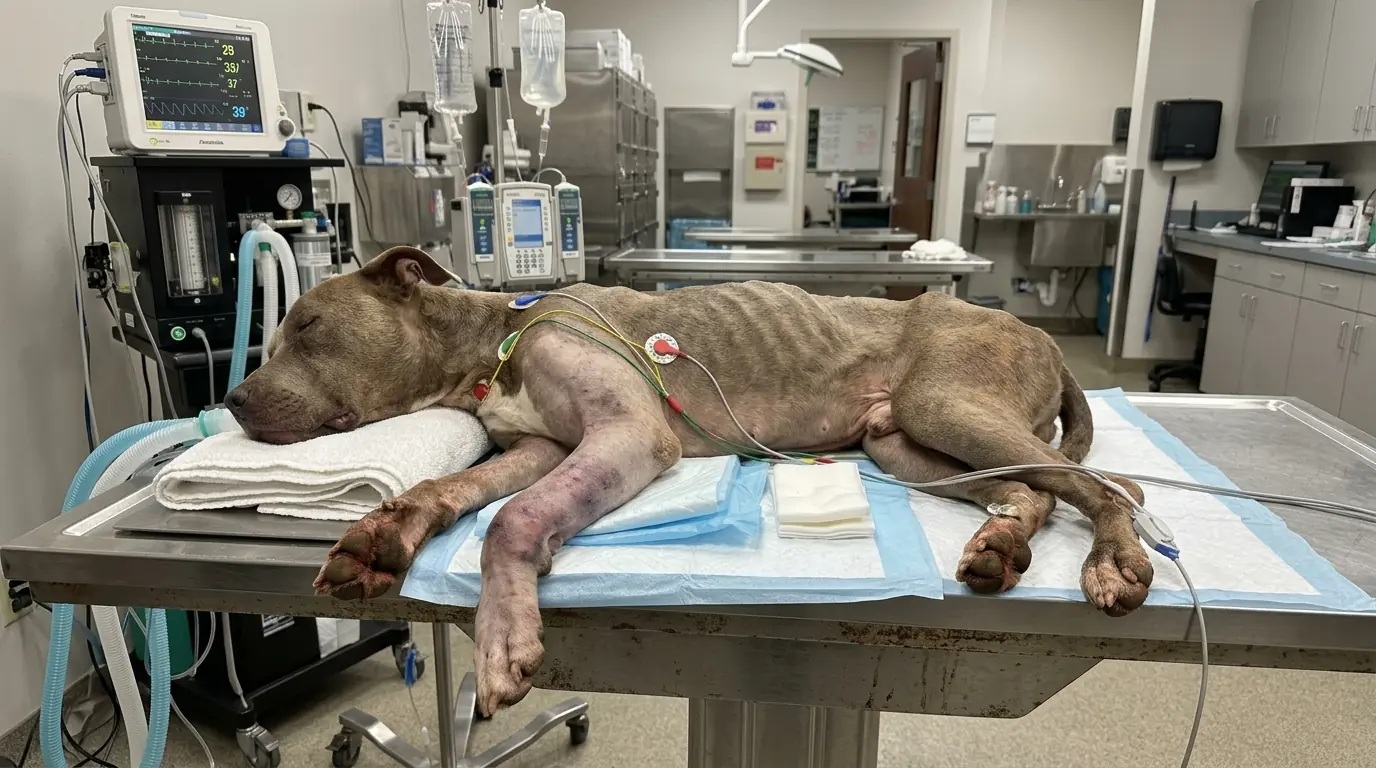
By the time rescuers reached her beneath an overpass outside Atlanta, the Pit Bull had apparently learned how to move without depending on one of her front legs.
Three paws carried most of her weight.
The fourth did little more than follow.
She was painfully thin, with the outlines of her ribs and hips visible beneath her coat.
Her paws were dirty from the streets.
And when she tried to move, one front leg dragged awkwardly rather than supporting her.
This was not a small limp.
Something had happened to that limb before rescuers found her.
And by the time she reached veterinary care, the old fracture had become a much bigger problem.
The Leg Didn't Look Like a Fresh Injury
A newly broken limb can cause sudden swelling, pain, and an immediate refusal to bear weight.
This dog's condition suggested something more complicated.
The fracture was old.
She had apparently been compensating for it while surviving outside.
Exactly how the original injury happened was unknown.
No one had seen the moment the bone was damaged.
No one could say how long she had been living with it.
What mattered now was what time and continued movement had done to the injured limb.
She Had Been Moving on Three Legs for Too Long
Dogs can be remarkably effective at compensating.
When one limb becomes painful or unusable, the others take over.
But compensation is not the same as recovery.
For this Pit Bull, the remaining front leg had to carry far more responsibility.
Both hind legs had to help propel and stabilize a body that could no longer distribute weight normally across four limbs.
Every trip in search of water, food, or somewhere to rest placed additional demand on those three usable legs.
And she had been doing it while severely underweight.
The Dirt on Her Paws Told Its Own Part of the Story
Later, on the surgical table, much of the injured front leg had been shaved and cleaned in preparation for treatment.
The contrast was difficult to miss.
One limb was surrounded by the controlled environment of emergency veterinary care.
The other paws still carried traces of where she had been.
Dust.
Road grime.
The residue of days spent moving through an environment where an injured dog had no safe way to rest and heal.
Staff did not need to invent a dramatic history.
Her body already showed enough.
The Fracture Had Become More Complicated With Time
An old fracture is not necessarily an easier fracture.
If damaged bone heals in a poor position, remains unstable, or is repeatedly stressed, the long-term problem can become much harder to address.
The surrounding joints and soft tissues may also be affected.
Muscles can shrink when a limb is not used normally.
Movement patterns change.
Pain can become persistent.
By the time this dog reached veterinary care, simply putting a splint around the outside and sending her back to normal activity was not going to erase what had happened.
The Surgical Team Had to Work With the Leg They Had Now
Not the leg as it had been immediately after the original injury.
Not the healthy limb she had before it happened.
The limb in front of them had already been through prolonged abnormal use.
That meant treatment had to be based on its current condition.
The damaged area was shaved.
The skin was prepared.
The leg was positioned for the procedure and subsequent stabilization.
Around her, the operating room was clean.
Her remaining paws were not.